by Jonathan Eberle | Jan 3, 2026 | News
By Jonathan Eberle |
Republican leaders in the Arizona Legislature have introduced companion bills aimed at funding a newly created corrections oversight office, a move they say is necessary to restore independent accountability within the state’s prison system.
House Government Committee Chairman Walt Blackman (R-LD7) and Senate Regulatory Affairs & Government Efficiency Chairman Shawnna Bolick (R-LD2) announced the legislation in December, arguing that the oversight office—authorized by lawmakers during the previous session—has remained dormant due to a lack of funding.
Blackman’s proposal, House Bill 2063, and Bolick’s Senate Bill 1032 would appropriate $1.5 million to launch the Department of Corrections Oversight Office. According to the bill sponsors, the funding would allow the office to operate independently of both the Legislature and the Governor’s Office, preserving its role as a third-party watchdog.
Under the legislation, the oversight office would be tasked with reviewing prison conditions and operations, receiving complaints and tips from the public, and identifying systemic issues before they develop into larger crises. Supporters say the goal is to prevent costly litigation, reduce the risk of federal intervention, and improve safety and accountability within Arizona’s corrections system.
“Arizona already spends nearly $2 billion a year on corrections, yet serious problems continue to go unanswered,” Blackman said in a statement. He added that concerns raised by whistleblowers, families, and corrections staff have persisted for years and have ultimately resulted in higher costs for taxpayers. Blackman described the proposed funding as a modest investment that could lead to greater transparency and long-term savings.
Bolick echoed those concerns, emphasizing that the office cannot fulfill its intended purpose without financial support. “We created this office to provide independent oversight, but without funding it exists only on paper,” she said. Bolick pointed to rising legal expenses and ongoing court involvement as evidence that additional accountability mechanisms are needed.
Arizona’s prison system has faced increased scrutiny in recent years following reports of violent incidents, operational shortcomings, and mounting legal costs. The state continues to spend tens of millions of dollars on litigation and court monitoring, including expenses related to the Jensen v. Thornell case, in addition to routine prison operations and health care costs.
Lawmakers backing the bills argue that a fully funded oversight office would help identify problems earlier, improve conditions for inmates and staff, and reduce the likelihood of prolonged legal battles or federal oversight. They contend that the proposed funding represents a preventative approach rather than a reactive one.
Jonathan Eberle is a reporter for AZ Free News. You can send him news tips using this link.
by Jonathan Eberle | Jun 7, 2025 | News
By Jonathan Eberle |
Arizona Senate Public Safety Committee Chairman Kevin Payne (R-LD27) is intensifying his investigation into the state’s Department of Corrections, Rehabilitation, and Reentry (ADCRR), citing a string of violent incidents—including inmate murders, suicides, drug overdoses, and assaults on staff—as signs of a deepening crisis within the prison system.
Chairman Payne, who first launched a probe in April after the murder of three inmates at the Arizona State Prison Complex in Tucson, has now sent a second letter to ADCRR Director Ryan Thornell, requesting a broader set of records and data to evaluate the agency’s operational failures and safety protocols.
The investigation was originally prompted by a high-profile case involving Ricky Wassenaar, a convicted murderer serving 16 life sentences. Wassenaar, who previously orchestrated a two-week-long hostage crisis at the Lewis Prison Complex in 2004, is accused of killing three fellow inmates during what prison officials described as an “altercation.”
In response, Payne initially requested timelines, staffing rosters, incident reports, and documentation on policy changes related to the case. After reviewing the initial information provided by the department, Payne—joined by House Judiciary Committee Chairman Quang Nguyen—is now demanding additional public records be delivered by June 25.
“These details will be used in determining the next course of action to ensure the safety and security of both correctional employees and inmates,” Payne said. The senator did not mince words in describing the situation.
“I have grave concerns that a disaster is unfolding right before our eyes at Arizona’s correctional facilities,” Payne said in a statement. “I fear the lives of correctional officers and staff are in jeopardy each day they report for duty, and I’m concerned dangerous inmates within their custody are not secure. It appears we have a ticking time bomb on our hands.”
Payne added that the requested records will help determine why “current policies and procedures are failing both employees and inmates.” He pledged to keep the public informed as more information is gathered and reviewed.
The ADCRR has faced scrutiny in recent years over staffing shortages, aging infrastructure, and ongoing security issues. The outcome of this investigation could carry significant implications for prison policy and oversight in Arizona.
Jonathan Eberle is a reporter for AZ Free News. You can send him news tips using this link.
by Matthew Holloway | Dec 1, 2024 | News
By Matthew Holloway |
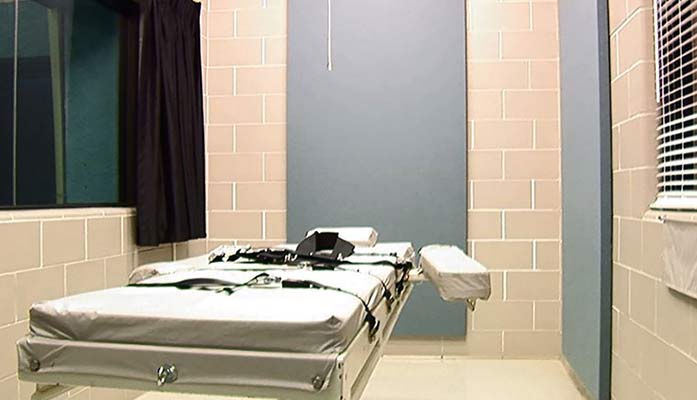
Attorney General Kris Mayes has said that the State of Arizona is prepared to act upon its first execution warrant after fellow Democrat Gov. Katie Hobbs dismissed a retired federal magistrate she appointed to review the state’s execution process in 2023.
Former Magistrate David Duncan reportedly never finished his work before his dismissal according to the Arizona Daily Star. Despite his authorization to charge $175 per hour up to $100,000 to conduct a full review of Arizona’s fraught execution process, Duncan was notified in a letter obtained by Capitol Media Services that Hobbs no longer has confidence in him.
According to the Daily Star, Hobbs said in the letter that Duncan’s review has strayed beyond his mandate, which was explicitly to review the protocols and procedures used by the AZ Department of Corrections, Rehabilitation and Reentry (ADCRR) to judicially mete out death.
Gov. Hobbs observed in one report that Duncan suggested the ADCRR should weigh the implementation of the firing squad, explaining that it “does overcome the impediments to lethal injection from unavailability of material and skilled personnel.” Though firing squad is not currently available under Arizona law, it is far from unprecedented with Idaho, Mississippi, Oklahoma, South Carolina, and Utah still offering the option as of 2024. Duncan’s inquest was terminated and he stands to be paid just $36,000.
Hobbs noted further that Ryan Thornell, whom she tapped for director of the corrections department, also completed his own review of the execution protocols and, per Capitol Media Services, made a series of recommendations including revised training standards and enhanced documentation.
Thornell told reporters that the greatest issues facing the department have been staff who’ve proven unable to place an intravenous line into the condemned to deliver the lethal injection, leading to “executions lasting longer than expected.” He further noted that some executions have depended on a procedure that was “extensive and intrusive.”
He reported that a medical team has been sourced, which includes a trained phlebotomist “providing a level of expertise to the team related to IV placement procedures.’’ He added that decision making in executions has been “inconsistent” and said, “I will not make decisions without the advice of the trained and qualified medical/IV team.”
Hobbs claimed, “With these changes in place, ADCRR is prepared to conduct an execution that complies with the legal requirements if an execution warrant is issued.”
Capitol Media Services reported via X that the first execution warrant should be sought by AG Mayes within two weeks.
That warrant will be sought to execute Aaron Gunches, a man who pleaded guilty to the first-degree murder and kidnapping of his girlfriend’s ex-husband Ted Price in 2002. In 2022, after nearly two decades on death row, Gunches waived his right to post-conviction appeal and motioned for his own execution, a motion he later withdrew in 2023 upon Hobbs taking office. The Arizona Supreme Court has refused to reconsider the motion, however, the warrant expired before it could be acted upon. Mayes must now seek a new death warrant.
“Given the review that has now been completed by the Department of Corrections, I feel confident that the state is prepared to conduct an execution,’’ the Attorney General told Capitol Media Services. “And so I will be issuing a request for an execution warrant to the Supreme Court in the next two weeks.’’ AG Mayes told reporters that there are some 111 inmates currently housed on death row in Arizona, awaiting execution and among them 25 have exhausted all possible appeals.
“There are 25 families out there who have an expectation that the killer of their loved ones will be executed,’’ Mayes told Capitol Media. She also added that the disparity between counties that can afford to implement the expensive procedures of the death penalty as opposed to those that cannot as easily is “something I think the Legislature needs to address.’’
Matthew Holloway is a senior reporter for AZ Free News. Follow him on X for his latest stories, or email tips to Matthew@azfreenews.com.
by Matthew Holloway | Jun 2, 2024 | News
By Matthew Holloway |
In the tumultuous race for the Maricopa County Attorney’s Office, the incumbent Republican Rachel Mitchell is facing attacks from both sides as fellow Republican Gina Godbehere, a former bureau chief for the MCAO and former prosecutor in Goodyear was first to launch a blistering campaign. However, by comparison the findings of investigative reporters against Godbehere are far more serious than those she’s levied against Mitchell.
The victor in the upcoming July primary will face off against Democrat Tamika Wooten, a judge pro tem, former chief prosecutor in Glendale, and a municipal judge in multiple jurisdictions. But before Wooten has even taken the stage, the GOP primary campaign has already been marked by the weapon of choice for any Attorney’s race: ‘sweetheart’ plea deals. Godbehere fired the first shot, blasting Mitchell for a plea deal with former director of the Arizona Department of Corrections, Rehabilitation and Reentry, Charles Ryan in a radio interview with KFNN’s J.D. Hayworth as reported by the Phoenix New Times on April 9th.
Godbehere prefaced the issue telling Hayworth, “The problem with the county attorney is she’s wedged between a Democratic governor and a Democratic attorney general, and she has liberal staff that are running that office.” She later landed the rhetorical blow, “When you allow sweetheart deals, like in the Ryan case or pointing the gun at police, and you’re not holding offenders accountable, this is the problem we’re having.”
As noted by New Times, Wooten also latched onto the plea deal telling the outlet, “As a prosecutor, justice is supposed to be blind, and (Mitchell’s) not making her decisions that way. I think there was definitely some favoritism based on Ryan’s former position.”
It didn’t take long though for the investigative reporters at the Arizona Daily Independent to uncover a troubling unsolicited plea deal issued by Godbehere during her tenure with the MCAO for 52-year-old Laquanza Young, also known as Quan Chaney before changing his name in 2019. As reported by the Independent, Young (then known as Chaney) was arrested in 2009 for attempting to rob his former employer Cricket Wireless, threatening a pregnant former co-worker at gunpoint while doing so. He had been previously terminated by Cricket on suspicion of theft and for weeks ahead of the robbery reportedly sent threatening emails to his ex-employer.
Young was arrested and was looking at 3 counts of aggravated assault, burglary, and armed robbery charges, class three and two felonies respectively, and had a lengthy criminal record. Depending on mitigating facts he should’ve been looking at up to 30 years in prison. Confusingly, Young even expressed in pretrial statement that he had no interest in a plea deal. That was at least until Godbehere took the case.
According to the Independent, “Godbehere promptly gave Young a five-week continuance for his trial date, and then offered him a plea deal. Instead of felony charges for aggravated assault, burglary, and armed robbery, Godbehere offered Young lesser charges of disorderly conduct with a handgun (a class six felony) and burglary in the first degree with a handgun (a class three felony). Minimum sentencing under the revised charges amounted to three years, or a maximum of eight years. Godbehere personally signed off on the plea deal.”
Young (then Chaney) was sentenced to just 10 months in prison, was out in five, and he only paid $400 in restitution to the pregnant mother he threatened.
Already, this would be egregious. But on March 21, 2024, Young now under his new moniker, drew a firearm on Scottsdale Police officers who had pulled him over during a routine traffic stop. The suspect was driving a vehicle that had been reported stolen at the time of the traffic stop according to AZCentral. Near Scottsdale Road and Cactus Young exited the car rapidly, drew his gun and opened fire on two officers who returned fire and struck him fatally. He was declared dead at the scene.
A man who was only on the street due to an unsolicited plea deal from Godbehere, was killed just weeks ago while he attempted to murder two Police officers in the line of duty.
Without expressing an opinion regarding the plea deal that Mitchell offered Ryan, a charge based on an incident in which no one was harmed being reduced in light of a dedicated civil servant’s years of service doesn’t strain imagination. But an unsolicited, astoundingly light plea bargain, putting a known criminal back on the street who would later die attempting to gun down two police officers is quite another matter.
To quote Godbehere’s own words, “When you allow sweetheart deals (…) and you’re not holding offenders accountable, this is the problem we’re having.”
Matthew Holloway is a senior reporter for AZ Free News. Follow him on X for his latest stories, or email tips to Matthew@azfreenews.com.
Page 1 of 11