On a Friday in July 2022, the Department of Justice (DOJ), under President Joe Biden, arrested a man for a bomb threat he’d made a year and a half earlier to the Arizona secretary of state at the time, Katie Hobbs.
According to the DOJ’s public announcement of that arrest, that threat was sent online in mid-February 2021 through the secretary of state’s Elections Division contact form. Yet, it took law enforcement more than a year to nab the perpetrator: a Massachusetts man named James Clark.
Media outlets promptly picked up the news of Clark’s arrest, framing it as the latest in what was then an ongoing scourge of threats to election officials following the contentious 2020 election.
Hobbs was reaffirmed in the public eye as a face of resistance to former President Donald Trump’s purported election denialism. And she was deep into a contentious race of her own for the governor’s office against Trump-backed candidate Kari Lake.
“Election officials across the country are being threatened regularly for doing their jobs,’’ said Hobbs in a prepared statement at the time. “It’s unconscionable and undermines our democracy. This harassment won’t be tolerated and can’t be normalized. We thank the FBI for their persistence on further investigating this incident.”
The one detail that never received much attention was the timing of Clark’s arrest.
On the same day that the DOJ sparked a flurry of media coverage on their delayed arrest of a Trump-defying Democrat’s would-be assassin, a Hobbs campaign operative quietly registered Will of the People, a political action committee (PAC) that would go on to raise more than $5 million from dark money and labor union heavyweights across the nation.
The listed address for the PAC is a virtual office in downtown Phoenix. Its treasurer from day one was Dacey Montoya, founder and president of The Money Wheel, a well-known political and nonprofit compliance firm in Democratic circles. Montoya is currently the treasurer for both Gov. Katie Hobbs’ campaign and Hobbs’ alleged campaign finance fund-washing fund.
Montoya has offered her Money Wheel services to numerous Democratic candidates, party organizations, and progressive dark money operations both in Arizona and nationally over the years. Past clientele include Gov. Katie Hobbs, Secretary of State Adrian Fontes, Rep. Yassamin Ansari, Sen. Mark Kelly, Jevin D. Hodge, Kirsten Engel, Reginald Bolding, Arizona Democratic Party, Maricopa County Democratic Party, Progress Now Arizona/Progress Arizona, Our Voice Our Vote Arizona, Copper State Victory, and the Arizona Education Association.
The Money Wheel has received more than $5.2 million since 2017 at the federal level according to Federal Election Commission records, and more than $1.9 million since 2017 at the state level according to secretary of state campaign finance records. Since 2022, Montoya’s company has received more than $119,000 from the PAC.
Will of the People PAC
Most of Will of the People PAC’s millions came in 2022 and 2024.
$2.3 million from SEIU-UHW and SEIU-COPE, the nation’s largest labor union and a PAC
$1 million from Open Society Action Fund, an organization by the Soros family, who are top Democratic dark money donors
$680,000 from ProgressNow AZ
$600,000 from the National Education Association
$360,000 from the Fairness Project
$200,000 from the American Civil Liberties Union (ACLU) of Arizona
The PAC has not reported any income this year, and the only significant reported expenditures so far have been $8,000 from January through April given to The Money Wheel.
The PAC has spent an undisclosed amount of funding on lawfare to kill Republican-led ballot initiatives; in recent months, they filed two lawsuits to stop Propositions 142 (called the “Prohibit Mandatory Support for Discrimination or Preferential Treatment by Government Entities Amendment”) and 318 (called the “Require All Schools and Athletic Associations to Restrict Sports Participation and Access to Private Spaces Based on Sex Measure”).
Prop 142 would prohibit the state and government agencies from compelling, promoting, or implementing practices rooted in preferential treatment or discrimination based on race or ethnicity.
Prop 318 would restrict access to private spaces like restrooms and locker rooms based on biological sex, bar male students from participating in female sports, and establish a definition of sex rooted in biology.
In the case of Prop 318, the PAC also created a website called “Vote No on Prop 318.” However, per media coverage and the website itself, the PAC is now claiming to be a program under Progress Arizona, a progressive 501(c)(4) nonprofit. This website has not been disclosed under the PAC’s campaign finance reporting as of this report. The PAC’s logo is displayed on the website.
“Will of the People is a program of Progress Arizona,” states the website. “Email info@progressarizona.org. Paid for by Will of the People.”
Concerning the media — as previously reported, the PAC once identified The Arizona Republic as an endorser of their efforts.
It appears that the PAC may have failed to file some of its required expenditure disclosures. Four television advertisements urging Arizonans to vote “no” on Prop 132 (called the “60% Vote Requirement for Ballot Measures to Approve Taxes Amendment”) weren’t reflected in the PAC’s ballot measure expenditures for 2022, because none were issued.
Voters approved Prop 132 in 2022, which established a 60% vote threshold for ballot measures approving taxes.
Will of the People Is Also a Nonprofit
The PAC also has a similarly named nonprofit, “Will of the People Arizona.” The two share a launch year, an address, and leadership.
One of the first leaders of the nonprofit arm, Betsy Boggia, was not listed on PAC documentation. Boggia served as the director/secretary from 2022 through 2024, based on Arizona Corporation Commission records.
Boggia is a League of Women Voters board member and a recent former president of its Tucson chapter, according to her active and up-to-date LinkedIn profile. Notably missing from her work history and posts were any references to her leading a nonprofit that raised more than $5.5 million in three years.
Boggia’s silence on the matter may be explained by the nonprofit’s tax filings, which reported that Boggia spent an average of just one hour per week running the multi-million dollar operation.
Between the nonprofit and PAC, the two apparently affiliated entities have raised and spent approximately $11 million in four years.
The nonprofit didn’t disclose its revenue sources on its available tax filings from 2022, 2023, and 2024. Only four contributions totaling $2.1 million were publicly available through other organizations’ tax filings:
$1 million from Open Society Policy Center in 2024
Only the ACLU provided a detailed explanation for the purpose of their contribution: paid communications to defeat Propositions 128, 129, and 132.
Propositions Targeted by Will of the People PAC and Nonprofit
Based on various sources, the PAC and nonprofit together targeted at least 14 Republican-led propositions from 2022 through this year.
Nine were defeated and five passed. Five are to be determined this year.
The PAC and nonprofit also successfully advocated for the passage of Prop 139 in 2024, which made abortion a constitutional right in Arizona.
On publicly available archived versions of the PAC’s site from 2024 through 2025, the PAC clearly disclosed which propositions it opposed: Props 134, 136, 137, and 139.
Prop 134 would have set a signature distribution requirement in all 30 legislative districts for citizen-led initiatives: 10% for statewide initiatives, 15% for constitutional amendments, and 5% for statewide referenda.
Prop 136 would have allowed individuals to sue to stop voter-proposed initiatives from being put on the ballot if they believe them to be unconstitutional.
Prop 137 would have ended term limits for state supreme court justices and superior court judges.
Then, earlier this year, the PAC changed its website to offer a ballot proposal guide in exchange for donations. The linked donation button led to a donation page hosted by ActBlue Civics, which disclosed that the donated funds would be given to Progress Arizona, a 501(c)(4) nonprofit, not the Will of the People PAC.
In 2024, the PAC disclosed giving $8,000 to Progress Arizona’s policy and research director, Casey Clowes, in 2024 to run digital ads opposed to multiple propositions and in favor of one proposition, Prop 139, which created a constitutional right to abortion.
The PAC has also paid $55,000 to ProgressNow AZ and Progress Arizona PAC, and $706,000 to the Arizona Democratic Party.
The current version of the site as of this report no longer includes the promise of a ballot proposal guide in exchange for fundraising. Instead, the PAC website now urges individuals to endorse a “no” vote on Props 142, 144, 318, and 320.
“A group of power-hungry politicians have voted to put a set of highly deceptive propositions on your ballot this November,” states the present version of the site. “They are aiming to make voting more difficult for Arizonans, hollow out our schools with funding cuts, and institute blanket discrimination in youth sports. You can help stop these propositions by adding your name to the list of Arizonans endorsing a NO vote on these dangerous measures.”
Despite its grassroots-sounding name, Will of the People has been funded by millions of dollars from national labor unions, progressive organizations, and Democratic-aligned dark-money groups, while its leadership and vendors have extensive ties to Arizona’s Democratic political establishment.
The organization has opposed numerous Republican-led ballot measures. With five targeted measures still awaiting a vote, its influence over Arizona’s ballot initiatives remains active heading into November.
AZ Free News is your #1 source for Arizona news and politics. You can send us news tips using this link.
One of the Arizona Democratic Party’s (ADP) political crown jewels has been arrested for breaking into a former romantic partner’s home with a knife.
Phoenix police arrested Brianna Westbrook, 41, former ADP vice chair and current education coordinator, last Friday for allegedly breaking into a former partner’s home brandishing a knife and carrying gloves and duct tape.
Westbrook, formerly a Peoria-area car salesman named Mike McDanel, allegedly forced himself into the victim’s residence, where he pushed the victim onto a couch. It was allegedly only after the victim screamed that Westbrook fled the scene.
Westbrook alleged that the incident was part of consensual roleplay, a “big misunderstanding” — a narrative the alleged victim denies.
A judge set Westbrook’s bond at $15,000.
Apart from the disputed nature of the alleged home invasion, Westbrook does have a history of advocating for violence.
As AZ Free News reported previously, Westbrook applauded a call for gun violence in the wake of the 2023 Nashville school shooting in which three children and three adults were slain by a transgender-identifying woman, Aiden Hale.
The year prior, Westbrook publicly expressed opposition to Blue Alerts, communications sent to the public and law enforcement notifying them of suspects who have assaulted, critically injured, or killed law enforcement officers.
It was around 2017 that Westbrook began a rise to prominence among Arizona Democrats as the state’s first federal elected official to identify as transgender. Westbrook told the Phoenix New Times that he began identifying as transgender about five years earlier at the age of 27. Westbrook once operated a YouTube account, since deleted, which reportedly documented his gender transition.
Westbrook has run for office multiple times since 2017, when he announced his campaign for what was then the 8th Congressional District as the first openly transgender candidate for federal office in Arizona.
Westbrook was not Arizona’s first transgender candidate overall: that title belongs to 2004 candidate Amanda Simpson, a Raytheon executive from Tucson who ran for the state legislature believed to be the first openly transgender presidential appointee. Neither could he claim the title as the nation’s first openly transgender federal candidate: that would be 2016 candidates Misty Snow, running to represent Utah in the Senate, and Misty Plowright, running to represent Colorado in Congress.
Westbrook lost in the general election to Republican candidate Debbie Lesko, the former congresswoman currently serving on the Maricopa County Board of Supervisors.
Following a protest in 2018 in the thick of a congressional campaign, Westbrook publicized his alleged mistreatment at the hands of the Maricopa County Sheriff’s Office following his arrest for trespassing at former Republican Sen. Jeff Flake’s office.
Westbrook argued in an ACLU blog post that the sheriff’s office should have complied with his request to jail him with other women, not men. Law enforcement ultimately put Westbrook in a solitary cell, according to his account.
Westbrook went on to serve as a vice chair of the Arizona Democratic Party (ADP) from around 2019 to 2024.
Westbrook had also served as the at-large officer for Phoenix Democratic Socialists of America around the same time, and has belonged to the Democratic Socialists of America for years.
Westbrook ran for the Arizona House of Representatives in 2022, but lost the primary to former lawmakers Amish Shah and Jennifer Longdon.
In 2024, Phoenix Democrats nominated Westbrook and two others for the legislative seat vacated by Longdon. The County Board of Supervisors declined to select Westbrook.
As of this report, ADP has Westbrook listed as its education coordinator.
AZ Free News is your #1 source for Arizona news and politics. You can send us news tips using this link.
Gov. Katie Hobbs stands accused of illegally commingling millions in funds to subsidize her campaign.
A letter sent by attorney Tim La Sota to Secretary of State Adrian Fontes earlier this month accuses the governor of commingling funds between her reelection campaign committee, Elect Katie Hobbs, and two other entities which submit funds to her campaign committee.
Elect Katie Hobbs and all other candidate campaign committees are restricted in the types of funds they may accept. Campaign committees must rely on what’s known in campaign finance parlance as “hard money,” or donations given by individuals directly to a political candidate, and cannot accept “soft money,” or donations or contributions collected into political action committees (PACs) from corporations or unions. Individual donations are limited to $5,500 per person.
The letter claims that Hobbs has used a PAC, which it claims to be hers, Copper State Values, as an unlawful repository for soft money to be used for Elect Katie Hobbs expenses. Allegedly, Copper State Values receives soft money funds from Hobbs’ joint fundraising committee PAC, the Katie Hobbs Victory Fund, and then sends the funds on to Elect Katie Hobbs and other political entities working to reelect Hobbs such as the Navajo County Democrat Party and the Arizona Democratic Party.
“Candidate contribution limits mean little if candidates can simply funnel money that the candidate herself cannot legally receive to a political action committee and turn around and have that political action committee pay for that candidate’s campaign expenses,” said the letter.
Since 2023, Elect Katie Hobbs has accrued more than $7.8 million and spent more than $4 million, Copper State Values has accrued more than $3.8 million and spent more than $2 million, and Katie Hobbs Victory Fund has respectively accrued and spent more than $1.8 million.
The letter further described Copper State Values as unusual since it lacked the typical hallmarks of a PAC, such as a political activity or a website. The PAC’s main activity appears to be the alleged shared expenses with Elect Katie Hobbs for which it pays, such as payroll, rent, and travel.
“The PAC seems to only function as a repository of monies that are then distributed to various left-wing entities, who will presumably help the Governor get elected — that and paying for expenses that legally must be paid by [Elect Katie Hobbs],” stated the letter. “[I]n terms of the PAC, it seems to do nothing but receive money and distribute money. It does not have any discernible political activity in terms of expenditures for express advocacy. It does not even have a website. And yet, it racks up hundreds of thousands of dollars in expenses, money that it reimburses to Elect Katie Hobbs.”
Hobbs’ reelection campaign manager, Nicole DeMont, serves as the chair of Copper State Values, and both Copper State Values and Elect Katie Hobbs share the same address, email address, and treasurer, Dacey Montoya.
The letter noted that Demont’s consulting firm, Monteverde Strategies, has received about $55,000 from Copper State Values. It also noted that Capital Strategies, a consultant for Hobbs, has received more than $198,000 from Copper State Values, though the consultant doesn’t disclose its relationship to the PAC on its website page for current and former clients.
AZ Free News is your #1 source for Arizona news and politics. You can send us news tips using this link.
As Sunshine Residential Homes remains at the center of an ongoing investigation into alleged “pay-to-play” conduct involving Gov. Katie Hobbs, public records link founder and CEO Simon Kottoor to a Paradise Valley residence that Zillow estimates is worth nearly $10 million. The property has drawn renewed attention amid scrutiny of Sunshine’s political donations and subsequent state-approved rate increases.
Arizona campaign finance records reviewed by AZ Free News show that Gov. Katie Hobbs was the only Arizona candidate to receive contributions from Simon and Elizabeth Kottoor during the 2022 and 2024 election cycles. Simon Kottoor’s only other recorded contribution to a political candidate was a 2023 donation to New York Democratic congressional candidate Kevin Thomas.
Simon Kottoor founded Sunshine Residential Homes (formerly Sunshine Group Homes) in 1996, according to the company’s website. Sunshine says it provides congregate foster placements for Arizona children, has served more than 25,000 children since its founding, and currently has more than 300 children in care with approximately 200 employees.
Maricopa County property records reviewed by AZ Free News list the residence under the Kottoor Family Trust, with Simon M. Kottoor and Elizabeth Kottoor named as trustees. AZ Free News has withheld the street address from publication.
Zillow describes the property as a 7,719-square-foot, five-bedroom, six-bathroom home on 1.08 acres and estimates its value at approximately $9.53 million. Realtor.com estimates the property’s value at about $8.71 million and reports it last sold for $1.55 million in 2020.
Sunshine Residential Homes and Kottoor have faced scrutiny over political donations connected to Hobbs and subsequent state-approved rate increases. The Arizona Republic reported in June 2024 that Sunshine Residential Homes received a large rate hike from the Arizona Department of Child Safety (DCS) after making six-figure contributions to Hobbs’ inauguration fund and the Arizona Democratic Party. The outlet reported that Sunshine applied for a rate increase in December 2022, was denied in February 2023, then applied again in May 2023 and was approved, citing DCS records.
The Republicreported in July 2024 that both the Kottoors’ and Sunshine Residential Homes’ donations to Hobbs and the Arizona Democratic Party amounted to approximately $420,000 from 2022-2024.
According to the Arizona Capitol Times, Sunshine Residential Homes gave $100,000 to Hobbs’ inaugural fund and separately gave $300,000 to the Arizona Democratic Party. The outlet also reported that the Arizona Republic found Hobbs personally called Kottoor shortly after winning the 2022 election and asked him to serve as a gold-level sponsor of her inauguration. The same report said the Department of Child Safety later increased payments to Sunshine in 2023 to nearly 40 percent above the average for other group homes.
Kottoor was also on Hobbs’ inaugural committee, and he and his wife made maximum contributions to Hobbs’ campaign, according to reporting cited by Governing. That report also noted that Hobbs attended a private event at the Kottoor’s Paradise Valley residence.
Calls for investigation from Arizona lawmakers followed within days of the initial reporting.
From @GovernorHobbs spokesperson: "Like every other 'investigation' launched by this chaotic and radical legislature, this is another desperate, partisan stunt. It will do nothing but show the administration put the best interest of Arizona first." https://t.co/taQAZTmb52
The Arizona Attorney General’s Office opened an investigation into the Sunshine Residential matter in June 2024. The office’s public records archive lists communications and records related to the Sunshine Residential Homes investigation, including correspondence with Maricopa County Attorney Rachel Mitchell and Auditor General Lindsey Perry, as well as a criminal referral.
I requested an investigation by the Maricopa County Attorney into Governor Hobbs' alleged "pay to play" scheme. Arizona taxpayers deserve financial accountability. Giving state dollars to political donors is a grave misuse of public funds.
— Arizona Treasurer Kimberly Yee (@AZTreasurerYee) June 10, 2024
Hobbs’ office has denied wrongdoing. Axios reported that Hobbs spokesman Christian Slater said the administration would be “cleared of wrongdoing” and called the allegations partisan. Slater and DCS spokesman Darren DaRonco told Axios that Hobbs and her office had no involvement in agency decisions regarding Sunshine Residential Homes. Sunshine told the Arizona Republic that it remained committed to cooperating with any inquiry, Axios reported.
The investigation remains a prominent political issue in Arizona well into 2026. In April, KJZZ reported that Mayes’ team had asked Hobbs for an interview as part of the investigation and that Hobbs would not publicly commit to sitting for one. KJZZ reported that Hobbs continued to deny wrongdoing.
Republican lawmakers have cited the Sunshine controversy as they advance legislation requiring more disclosure from companies seeking state contracts. The Arizona Senate Republican Caucus announced last week that SB 1186, sponsored by Arizona Senate President Pro-Tempore T.J. Shope (R-LD16), had been sent to Hobbs’ desk. The bill would require companies seeking taxpayer-funded contracts and grants to disclose political donations, gifts, and other things of value connected to the governor and affiliated political organizations. A House summary of SB 1186 states that the measure establishes disclosure requirements for the request-for-proposal and grant-application processes.
Hobbs announced her own ethics reform proposal in February, calling it a sweeping transparency package intended to strengthen public trust in government. According to the Governor’s Office, the proposal includes a public transparency and disclosure database, contracting reforms, and a lobbyist gift ban.
The Sunshine Residential Homes matter remains under investigation, and no public finding of wrongdoing by Hobbs, Kottoor, or Sunshine Residential Homes has been announced.
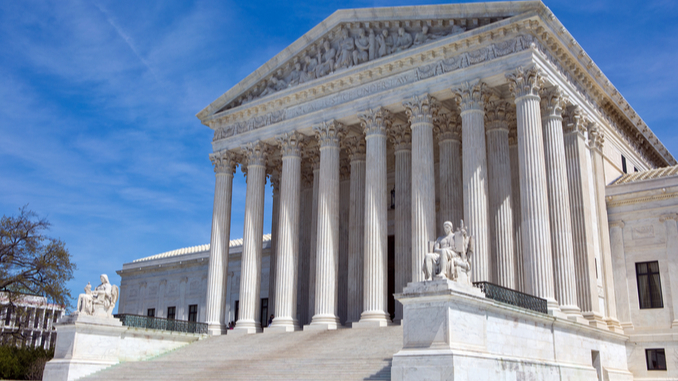
This week, the Department of Justice (DOJ) asked the Supreme Court to uphold Arizona’s proof-of-citizenship requirements for voting.
The DOJ filed a brief in Republican National Committee, et al. v. Mi Familia Vota, et al. (case Nos. 25-1017, 25-1019, and 25-1022).
The case will determine whether the National Voter Registration Act (NVRA) prohibits states from: removing noncitizens from voter rolls within 90 days of an election, requiring individuals to provide documentary proof of citizenship when registering to vote in federal elections using the state registration form, and denying individuals the ability to vote by mail if they don’t provide documentary proof of citizenship.
These questions emerged from House Bills 2243 and 2492; both passed in 2022. Together, these bills require the secretary of state and county recorders to regularly review voter rolls, mandate registrants using the state registration form provide proof of citizenship, and prohibit vote by mail for federal-only voters.
The Ninth Circuit Court of Appeals ruled that the NVRA does preempt that legislation, impacting any similar citizenship proof measures taken by other states concerning their voting laws.
The federal court ruled the provisions in the Arizona laws amounted to unlawful voter suppression and were therefore unconstitutional. The court determined that voters must be allowed to vote federal ballots at least, even when they fail to provide proof of citizenship.
The respondents in the present litigation — Mi Familia Vota, Voto Latino, Arizona Asian American Native Hawaiian and Pacific Islander for Equity Coalition, Democratic National Committee, and the Arizona Democratic Party — want to preempt Arizona and other states from imposing proof-of-citizenship limitations on voting.
Jesus Osete, principal deputy assistant attorney general for civil rights, said in the DOJ announcement that the NVRA doesn’t prohibit states from removing noncitizens from voter rolls.
In its filing, the DOJ argued the lower court’s ruling conflicted with the NVRA since it would effectively render state forms into mere replicas of the federal form. States would lack the flexibility afforded by the NVRA, said the DOJ.
The DOJ filing argued that proof-of-citizenship requirements were harmonious with NVRA requirements to increase the number of eligible citizens registered to vote and ensure the maintenance of accurate and current voter rolls.
“When noncitizens with no right to shape American government vote in American elections, the ballot box no longer speaks for the People, because its tally no longer reflects their voice,” argued the DOJ.
Senate President Warren Petersen (R-LD14) said he was “thrilled” by the Trump administration’s intervention.
“Only U.S. citizens should vote in our elections,” said Petersen. “Excited for SCOTUS to take up this important case.”
Thrilled the Trump DOJ is backing Arizona’s proof-of-citizenship requirements! Only U.S. citizens should vote in our elections. Excited for SCOTUS to take up this important case. https://t.co/xWBiciTxjV
The Supreme Court has already overruled the Ninth Circuit Court of Appeals on one of the issues in 2024. The Supreme Court allowed Arizona to enforce its proof-of-citizenship requirement for state voter registration forms, but refused to allow enforcement of the requirement for those registering with federal forms.
That follows the precedent set in 2013, when the Supreme Court ruled that the NVRA prohibited Arizona from requiring proof of citizenship of those voters registering to vote with the federal voter registration form.
AZ Free News is your #1 source for Arizona news and politics. You can send us news tips using this link.