Arizona House Republicans on the Natural Resources, Energy, and Water Committee have taken action to address skyrocketing gas prices and utility bills, passing a sweeping package of bills designed to lower fuel costs, enhance energy reliability, and defend ratepayers.
✅House Republicans Advance Energy Affordability Package to Lower Costs for Arizona Families
“The cost of living for Arizona families, including gas and electricity, continues to increase, and Republicans are acting. This package puts affordability first by lowering fuel costs,… pic.twitter.com/4a3T1JOIPo
Under the leadership of Chairman Gail Griffin (R-LD19), the measures align with the House Republican Majority Plan’s core priorities of unleashing economic prosperity, promoting government efficiency, and protecting individual rights and liberties.
The legislation, which advanced on a party-line vote with Democrats in opposition, targets the challenges faced by Arizona families, particularly in Maricopa and Pinal Counties, where severe summer fuel blend requirements have driven up prices at the pump. By prioritizing affordability and reliable power, these bills aim to ease the financial burden on households amid rising energy demand.
“The cost of living for Arizona families, including gas and electricity, continues to increase, and Republicans are acting,” stated Chairman Griffin. “This package puts affordability first by lowering fuel costs, protecting ratepayers from higher utility bills, and making sure Arizona has dependable power as demand grows. The Majority Plan is clear: government should work to ease the cost burden on families, not make them worse.”
Bills Tackling High Gas Prices
HB 2145 (Rep. Griffin): Amends motor fuel statutes to empower the President of the Senate and Speaker of the House to jointly request EPA fuel waivers during shortages if the Governor does not act, providing a defense against price surges.
HB 2400 (Reps. Willoughby, R-LD13, and Biasiucci, R-LD30): Implements a seasonal suspension of the state’s 18-cent gas tax from May through September in Maricopa and Pinal Counties. The bill ensures local governments are reimbursed for lost highway revenue through allocations from the Arizona Highway User Revenue Fund, including $27.588 million to counties, $39.93 million to cities and towns, and $5.082 million to larger municipalities. It also includes an emergency clause for immediate implementation and exempts the Department of Transportation from rulemaking for one year.
HB 2696 (Rep. Willoughby): Directs the Arizona Commerce Authority to prioritize reducing fuel and gas prices as its primary objective for two years, expiring December 31, 2029. The authority must collaborate with the oil and gas industry to study repealing the cleaner-burning gasoline blend, building new pipelines, establishing a strategic reserve, and exploring in-state refineries, including reviving a proposed facility in Yuma County. Status updates will be provided to legislative committees, with a final report due by October 1, 2026.
HB 2955 (Rep. Willoughby): Amends motor fuel standards to end the expensive summer fuel blend in populous counties, subject to EPA waiver under the Clean Air Act. It allows for gasoline compliant with ASTM D4814 and vapor pressure limits, addressing supply shortages and enabling lower-cost alternatives.
HCM 2008 (Rep. Willoughby): A concurrent memorial urging Congress and the EPA to eliminate the federal gas tax on Arizona’s cleaner-burning gasoline in Maricopa and Pinal Counties from May to September or grant the EPA administrator emergency waiver authority for costlier blends. This recognizes Arizona’s progress toward National Ambient Air Quality Standards while highlighting the undue tax burden on specialized fuels.
Supporting these efforts are additional bills to promote long-term solutions:
HB 2014 (Rep. Fink, R-LD27): Requires the Department of Environmental Quality (ADEQ) and Arizona Department of Agriculture to conduct air emissions modeling and feasibility studies on alternative gasoline blends, including federal reformulated, California phase 3, and conventional options. Reports must be published by September 30, 2027, with $100,000 appropriations each for modeling and studies.
HB 2401 (Willoughby and Biasiucci): Mandates biennial reviews by ADEQ of fuel formulations available under federal standards, assessing air quality impacts in regulated areas, and submitting recommendations to the Department of Agriculture, the Governor, the President of the Senate, the Speaker of the House, and the Secretary of State by December 31 of each review year.
HB 2428 (Griffin): Authorizes voluntary mobile emissions reduction credit programs, permitting emissions credits for nonroad engines under Clean Air Act guidelines, with permits issued by ADEQ for up to 20 years, supported by chambers of commerce, utilities, and Maricopa County.
“Today we heard from organizations with the time and resources to lobby against affordable prices for Arizona families, but not from the families paying more at the pump,” explained Majority Whip Julie Willoughby. “Working families cannot take time off to come to the Capitol and ask for relief; that is why we are here to help be their voices.”
“Eighteen cents a gallon may sound small to some, but it matters to families trying to make ends meet,” Willoughby added. “I will do everything in my power to deliver relief now while we continue working to fix the fuel blend and supply problems. Families need lower prices, not excuses.”
Bills Ensuring Energy Reliability and Ratepayer Protections
HB 2331 (Reps. Marshall, R-LD7 and Heap, R-LD10): Renames and expands energy reliability statutes to require public power entities and service corporations to prioritize domestically produced fuels, minimize foreign reliance, and evaluate resources for affordability, reliability, and cleanliness. Defines “clean energy” to include low-emission sources like nuclear and natural gas, with reliable sources needing at least 50% capacity factor and rapid ramp-up capabilities. The bill emphasizes hydrocarbons and finds domestic sourcing essential for public health and safety.
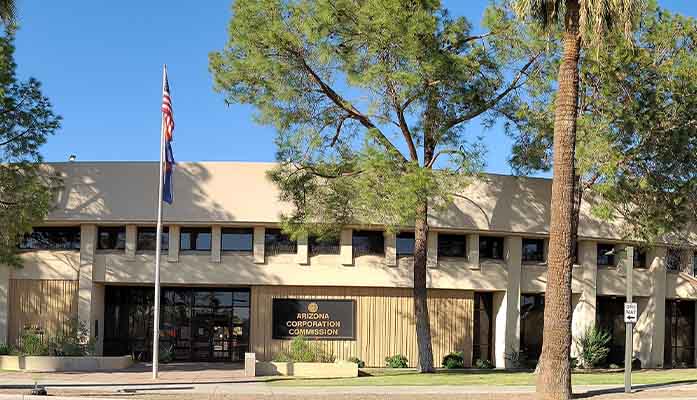
HB 2756 (Reps. Griffin and Blackman, R-LD7): Adds provisions for public power entities and electric corporations to report quarterly on new extra-high load factor customers, including interconnection requests and completions. These customers must be factored into load growth projections. The Arizona Corporation Commission (ACC) is directed to adopt rules on contracts, minimum billing, and pre-execution reviews to protect other ratepayers, excluding member-owned cooperatives. Requires cost-of-service studies within 180 days and an ACC workshop within 90 days to assess impacts on residential bills and potential new customer classes.
These bills now advance for further legislative consideration.
Ethan Faverino is a reporter for AZ Free News. You can send him news tips using this link.
State Representatives David Marshall (R-LD7) and Ralph Heap (R-LD10) introduced House Bill 2269, a measure to eliminate the state sales tax on electric and gas utility bills for Arizona residents and businesses.
The proposed legislation would suspend the state’s 5.6% sales tax on electricity and natural gas utilities until either $2.3 billion in cumulative tax relief has been provided to Arizonans or December 31, 2046—whichever comes first.
Once the $2.3 billion threshold is reached, the Legislature would then decide whether to extend, modify, or reinstate the exemption.
“People are getting crushed by rising costs, making it harder to live and do business in our state,” said Representative Marshall. “Almost everyone pays a local utility for electricity or gas. Eliminating the tax on this expense represents one of the most immediate and direct ways we can help working families keep costs affordable.”
The 5.6% tax on electricity and gas quietly adds up on monthly bills, leaving the average household paying more than $100 a year in utility tax—funds that could instead support necessities like groceries, housing, and childcare.
Representative Marshall highlighted a structural concern with the current system: “Taxing electric and gas utilities creates a perverse incentive for the government to support increased rate hikes. If rates go up, the state gets more money. That leads some to view rate increases as a source of potential funds for their liberal pet projects. That’s not right; it’s time to put the people of Arizona first.”
“While we’re unsure of any legal way to get ratepayers’ money back, there are things we can do to help reduce costs today,” Marshall continued. “In my opinion, the next best thing we can do is try to provide justice by eliminating taxes on electric and gas utilities moving forward. That’s why, over the next 20 years, we are proposing no state tax on utilities until every penny of the $2.3 billion that was wrongfully extracted from the Arizona ratepayer is metaphorically ‘paid back’ to hardworking families.”
He added, “This bill will save most residents between $100 and $120 per year, on average. Once the $2.3 billion threshold has been met, then the state can determine what it wants to do with the exemption from there, including whether to reassess the tax or extend the exemption even further.”
Representative Heap pointed to actions taken by the Arizona Corporation Commission as the basis for the bill’s $2.3 billion figure: “In 2006, Arizona Corporation Commissioner Kris Mayes catered to outside special interests and adopted expensive renewable energy surcharges that cost ratepayers more than $2.3 billion over the last 20 years. This special interest slush fund also led to foreign-owned boondoggles like the Solana Generating Station, which Kris Mayes personally supported, and which cost ratepayers more than three times the above-market rate of power.”
“While repealing these mandates may help to prevent new costs,” Heap added, “it will do nothing to compensate customers for the unjust surcharges that Kris Mayes forced ratepayers to pay over the last 20 years.”
Ethan Faverino is a reporter for AZ Free News. You can send him news tips using this link.
Data centers are coming to Pima County, whether residents like it or not.
The Pima County Board of Supervisors has approved a new data center despite major community opposition and no end user formally lined up.
Amazon was outed earlier this summer as the longtime, unofficial end user lined up for the 290-acre data center, Project Blue, but the e-commerce giant reportedly backed out around the beginning of this month after the developer, Beale Infrastructure, nixed water cooling in favor of the more electricity-dependent air cooling process.
Amazon’s departure was uncovered during the Arizona Corporation Commission (ACC) hearing earlier this month by sources first reported on by the Arizona Daily Star. ACC approved, 4-1, a decade-long Energy Supply Agreement between Tucson Electric Power (TEP) and the developer to power Project Blue.
Beale Infrastructure made the cooling process switch after the Tucson City Council voted unanimously to deny access to their reclaimed water system back in August. Tucson Mayor Regina Romero also pledged to place limits on future data centers.
The days leading up to the council vote were filled with contentious community information meetings on the project.
Per 13 News, multiple unnamed sources told Pima County Supervisor and Tucson City Councilman Paul Cunningham that up to eight other companies expressed interest in taking Amazon’s place. Sources conflicted on whether one of the companies is Meta, or whether Meta had already backed out as Amazon had.
Project Blue’s developer, Beale Infrastructure, presented the proposed data center as both an economic driver and environmentally friendly operator: “no risks or financial burdens [will be] passed on to other customers,” their representatives promised in their presentations during the community information meetings.
Opponents argue these data centers will further strain an already stressed water supply and electric grid, ultimately leading to scarcity as well as higher fiscal and health costs for the consumer.
It was the promised economic benefits that won over the 3-2 majority of Pima County supervisors. The two supervisors against the data center, Andres Cano and Jen Allen, expressed concerns over the long-term unknown impacts on the environment and community health.
Pima County’s vote came several weeks after ACC approved Beale Infrastructure’s application for Project Blue.
Data centers are the powerhouse for platforms covering virtually every aspect of modern life online: government, streaming, remote work, cloud storage, e-commerce, education, finance, and healthcare.
An independent Economic Impact Study on Project Blue projects a $3.6 billion total capital investment, $250 million in tax revenues, 180 new jobs by 2029, and over 3,000 direct construction jobs during the building phase.
The project will be located north of Pima County Fairgrounds, at the I-10 and Houghton interchange. The development site is over a mile away from the nearest resident, located within an unincorporated area that’s part of the Southeast Employment & Logistics Center.
Beale Infrastructure is also moving on another, equally controversial data center development in Marana totaling 600 acres. Two rezoning applications were filed recently for potential data center development: Luckett North and Luckett South. Earlier this month, the town’s planning commission recommended rezoning for development.
As with Project Blue, the closest resident lives about a mile away from the proposed data center campus. It will also be an air-cooled facility.
In preparation for consideration of the data center, town officials produced two podcast episodes on the town’s data center ordinance and potential for development.
Marana Town Council is scheduled to consider the data center project on Jan. 6, 2026. Progress on the project is available for viewing on the town’s development projects and activity portal.
AZ Free News is your #1 source for Arizona news and politics. You can send us news tips using this link.
The Arizona Corporation Commission (ACC) and the North American Securities Administrators Association (NASAA) are cautioning investors to remain vigilant this Christmas season amid an increase in sophisticated fraud schemes.
Drawing on data from NASAA’s 2025 Enforcement Report and its annual survey of investor threats, the ACC identified a dozen types of scams that state securities regulators say investors should watch for as fraudsters employ new technology, including artificial intelligence (AI), to target victims.
According to NASAA’s report, state securities regulators conducted more than 8,800 active investigations in 2024, resulting in fines and restitution totaling over $259 million. The report found that while scammers increasingly use technological tools to make schemes appear legitimate, the underlying goal remains to separate victims from their money.
“The rapid growth of technology and the rise of artificial intelligence gives scam artists new tools to steal your money,” said NASAA President Marni Rock Gibson.
ACC Chair Kevin Thompson echoed Gibson, emphasizing the role of advancing technology in enabling fraud, saying in the release that AI and other tools give “scam artists new tools to steal your money,” and that many fraudulent investment pitches play on investors’ fears rather than genuine innovation.
“Fraudsters are pitching new investments that often have nothing to do with latest tech developments and instead play on the fear of missing out on the next ‘best thing,’” he explained.
The 12 investor threats outlined by the Commission’s Securities Division include:
Affinity or “Pig Butchering” schemes — long-term romance-based cons that build trust before prompting victims to invest in bogus platforms.
Deepfake impersonations — use of AI-generated video and voice clones of celebrities or contacts to solicit funds.
Phantom AI trading bots — fraudulent algorithms marketed as guaranteed return systems.
Digital asset and crypto fraud — scams involving unregistered securities and exaggerated return promises.
Fake AI equity pitches — sales of equity in fictitious AI companies or “pump and dump” schemes.
Social media lures — investment scams originating on platforms such as Facebook or X.
Short-form video hype — slick social media clips touting “get rich quick” opportunities.
Text and WhatsApp traps — unsolicited messages that pivot into fraudulent investment offers.
Targeting older investors — senior citizens are disproportionately targeted with both traditional and digital scams.
Account takeovers — phishing and AI-assisted hacks that seize control of accounts to solicit funds from contacts.
Website and app spoofing — cloned sites designed to harvest login credentials and funds.
Unregistered solicitors — individuals selling investments without proper licensing; regulators opened 944 investigations in 2024 involving unregistered sellers.
The ACC’s Securities Division encourages investors to exercise skepticism, conduct independent due diligence, and contact a trusted third party before committing funds to any investment, the commission said, quipping they should review the list of threats and “check it twice to avoid ending up with a stocking full of coal.”
Investors looking to check the license status or disciplinary history of an investment promoter can contact the Securities Division’s Duty Officer at 602-542-0662 or SecuritiesDiv@azcc.gov, or visit azcc.gov/azinvestor for more information.
The Arizona Corporation Commission (ACC) is preparing to roll out a new online business filing system, Arizona Business Connect, which is scheduled to go live on January 12, 2026. The new platform will replace the Commission’s current eCorp system and is intended to modernize how businesses file and access corporate records in the state.
According to the ACC, Arizona Business Connect will offer updated technology, improved security features, and enhanced functionality designed to streamline the filing process and improve the overall customer experience for corporations and other business entities.
To complete the transition, the Commission will temporarily shut down the existing eCorp portal to transfer and verify a large volume of data before launching the new system. As a result, online filing and business searches through eCorp will be unavailable beginning at 5:00 p.m. Mountain Standard Time on Friday, January 2, 2026.
During this transition period, corporations will not be able to file documents or search business records online. However, the Commission says customers will still be able to submit filings using paper forms. Paper filings may be delivered in person at ACC offices in downtown Phoenix or Tucson or sent by mail or fax.
All paper documents received after the eCorp shutdown on January 2 will be assigned an effective date based on when they are received by the Commission. Those documents will not be entered into the new Arizona Business Connect system until January 12 or shortly after the portal becomes operational.
Jonathan Eberle is a reporter for AZ Free News. You can send him news tips using this link.