Responding to a letter issued by Arizona Democrat Attorney General Kris Mayes, Arizona Superintendent of Public Instruction Tom Horne issued a statement that Mayes is “misleading the public with claims she has leveled at the management of the Empowerment Scholarship Account (ESA) program.” In an 8-page letter with 12 pages of testimony from the Arizona Department of Education’s John Ward in the case of Velia Aguirre v. State of Arizona, Mayes outlined an investigation from her office, making allegations regarding the Department of Education’s use of a risk-based audit approach, which echoes a similar exchange between Horne and Governor Katie Hobbs in December 2024.
Mayes directly critiqued Horne and the ADE writing in part:
“Your failure to appropriately monitor ESA spending has created an untenable situation. Again, I do not want to disrupt the process for ESA holders who are following the law, but this cannot continue. Accordingly, you must act immediately to develop and implement appropriately rigorous purchase review standards and risk-based audit procedures so that ESA families may access their funds in a timely manner and public funds are not spent illegally. The Department’s purchase review and audit standards should employ appropriate controls to safeguard public funds. These controls, and any automatic payment thresholds, should consider the level of risk associated with different categories of expenses, vendors, methods of payment, and individual ESA holders.”
Mayes went on to cite a 12 News report that “the Department has automatically approved [$]1.2 million ESA purchases since the automatic approval policy took effect in December 2024.”
As Matt Beienburg wrote in an op-ed for AZ Free News, the Arizona Capitol Times issued a retraction of its initial report that “Education department under fire for approving $124M in improper ESA [education savings account] purchases,” clarifying with a formal correction that “an inaccurate dollar amount,” was reported. However, no similar retraction has been issued by 12 News as of this report.
"Facts don't lie, even if the media does."
Here are two MAJOR lies 12News "reported" in its bogus ESA attack 👇
❌ Dollar amounts were exaggerated up to 100 times!
Beienburg notes that blatantly inappropriate purchases such as iPhones, televisions, and other non-educational items “haven’t been approved, as the State Board of Education’s ESA Handbook—ratified by members appointed by both former Gov. Doug Ducey and Gov. Katie Hobbs—makes clear. The document expressly states that while families’ ESA purchases under $2,000 are promptly reimbursed by the state, these items ‘are not deemed ‘approved’ by the Department, until they are audited OR the timeframe to audit the orders has passed [2 fiscal years].’ Just like their tax returns filed with the IRS, these families’ ESA purchases are processed up front and subject to enforcement afterwards.”
For immediate release: August 29, 2025 Horne calls out AG Mayes for misleading attack on ESA program AG sent letter to Superintendent today Link: : https://t.co/ul3JSKLudp Contact: Communications@azed.gov pic.twitter.com/xGEPdsrHqB
— Arizona Department of Education (@azedschools) August 29, 2025
In a lengthy statement, Horne addressed the allegations raised by Mayes and accused the AG of making false statements:
“In your letter today, and in a recent television interview, you misled the public by stating that improper ESA purchases had been approved, without any reference to the fact that under risk-based auditing dictated by the legislature the money has been recovered or is in the process of being recovered. We have collected or are in the process of collecting more than $600,000 that was paid out for improper purchases. You also criticize risk-based auditing. Risk-based auditing is a very common and appropriate practice used by auditors, and the ESA Director has more than 16 years’ experience as an auditor. The risk-based approach involves not approving purchases prior to review, but paying amounts under $2,000 subject to later review, which is how we were able to collect or be in the process of collecting more than $600,000.”
He went on to chide Mayes writing, “You state that this is not partisan. That is disproved by all the false statements you made on the television interview.”
Horne continued, “Your argument is not with me but with the legislature. The legislature recently passed ARS section 15–2403B. It provides in part: ‘The department, in consultation with the office of the auditor general, shall develop risk-based auditing procedures for audits conducted pursuing to this subsection.’
“The statute was passed because the department is operating with the same number of people to check purchases as had been given by the legislature when the program was 1/7th as large. The most recent House budget included an appropriation for more people to check purchases, but it had to drop that provision when the governor said that if it did not do so, she would veto the entire budget. The limit on personnel had meant delays for reimbursement or more than two months, which was an unbearable burden for parents who had already paid the money and needed reimbursement. This explains why the legislature wanted to add more staff to serve parents.
“Again, you misled the public in your interview by stating that these improper items have been approved. They were not approved, and as to all the items you mentioned, the accounts have already been frozen. This is as egregious as ignoring the recovery of over $600,000, not to mention your failure to state that this procedure was dictated to us by the legislature and the ESA parent committee that you referred to set the limit at $2,000 pursuant to the legislative command to adopt risk-based auditing. It has been made clear to ESA users in multiple communications that payments of under $2,000 do not imply approval, which can be obtained only after the risk-based auditing dictated by the legislature.
“You referred to a July 21 meeting of the legislative audit committee. Within four days we consulted with the auditor general. Some have erroneously interpreted the word ‘consultation’ to mean that the auditor general has the right to dictate terms to us. That is incorrect. The normal English language use of the word consultation is that we have a discussion, which we have done, and then proceed. However, we have agreed to have further consultations with the auditor general and will do so.
“We will provide at a later date further responses to your long-winded letter of seven pages single space. We are responding now to the main points so you will have no further excuse to mislead the public.”
The legacy media seem to be on a mission: tear down Arizona’s groundbreaking school choice program with false accusations and inaccurate reporting.
Fortunately, facts don’t lie, even if the media does.
The Arizona Capitol Times declared this week in astonishing terms, “Education department under fire for approving $124M in improper ESA [education savings account] purchases.”
Such astronomical levels of fraud would seem to threaten the very foundations of the historic school choice revolution that has swept the nation. There was just one problem, the headline was completely false.
Not only were the supposed dollar amounts exaggerated up to 100 times greater than the amounts of improper spending actually reported by the department, but these purchases weren’t even approved in the first place.
Here’s the story the media won’t tell: Arizona’s 2022 adoption of a fully universal ESA program has been a nation-leading success, allowing parents across the state to give their children an education best suited to their needs.
To its credit, the Times quickly retracted its original headline and issued a formal correction admitting “an inaccurate dollar amount” in its first draft and eliminating the suggestion that the purchases were “approved.” Unfortunately, such journalistic ethics appear not to be shared by the Times’ more ideological media counterparts in Arizona, particularly those of the teachers’ union-aligned 12News team, who have resolutely declined to correct or retract their false reporting.
12News’ Craig Harris, for instance, has repeatedly and falsely declared that the state has “approved” ESA purchases for iPhones, televisions, and other non-educational items over the past year.
But all those purchases haven’t been approved, as the State Board of Education’s ESA Handbook—ratified by members appointed by both former Gov. Doug Ducey and Gov. Katie Hobbs—makes clear. The document expressly states that while families’ ESA purchases under $2,000 are promptly reimbursed by the state, these items “are not deemed ‘approved’ by the Department, until they are audited OR the timeframe to audit the orders has passed [2 fiscal years].” Just like their tax returns filed with the IRS, these families’ ESA purchases are processed up front and subject to enforcement afterwards.
Yet, 12News either knowingly misrepresented the status of these orders or else incompetently failed to perform basic due diligence to learn how the program operates.
By 12News’ anti-ESA logic, the IRS should apparently also withhold refunds to taxpayers until their tax returns have been audited potentially years later, rather than promptly when the returns are filed.
Unfortunately, this is not the first time that 12News’ anti-school choice reporters have been exposed in such light. In 2018, Harris (then with the Arizona Republic) falsely reported that Arizona charter schools produced worse student graduation rates and worse outcomes on the state A-F letter grade system than district schools. Both claims turned out to have been fabricated results stemming from a faulty, agenda-driven data analysis by Harris’ team.
In 2024, 12News’ Joe Dana likewise doubled down on false claims that ESAs cost state taxpayers more than the public school system per student by conveniently ignoring major sources of public school funding. The state’s Classroom Site Fund, for example, allocates over $1,000 for every public school student in the state and gives not a penny to ESA families.
Undeterred by journalistic standards, Dana’s 12News team also went further, deceptively extracting a fragment of a statement given by the state’s budget director (given in response to a completely different question) to suggest the ESA program had created unprecedented strain on the state budget.
The Heritage Foundation’s Matt Ladner and Jason Bedrick have already exposed a litany of deceptive claims flowing from outlets like 12News, while more prestigious national news organizations like The Washington Post have seen their recent anti-ESA narratives similarly debunked. Yet none of these outlets have expressed any contrition for their deceptive coverage.
Indeed, in perhaps the richest of ironies, Harris’ 12News team recently attacked ESAs for “hurting” high-performing schools like Arizona charter network BASIS by competing with it for students. Never mind that Harris previously attacked BASIS for its alleged poor stewardship of taxpayer funds. Now that it is clear he and the media were on the wrong side of that school choice debate as well, they have simply shifted to a new enemy in their war on parents.
Looking at the whole of Arizona’s education landscape, there is no question that those who seek to defraud the state—whether via the traditional public school system or its competitors—should be prosecuted to the full extent of the law. But if there is a scandal in our education system, it is the dishonest reporting by journalists who are more disturbed by parental empowerment than by the tens of billions of dollars squandered year after year in chronically poor performing public schools.
Matt Beienburg is the Director of Education Policy at the Goldwater Institute.
The Arizona Republic bled over 25,700 subscriptions from 2022 to 2023, in line with an overall trend from its major sister companies across the nation. Daily, Sunday, and digital-only subscriptions totaled about 184,700 last year, compared to over 210,400 in 2022.
The losses were reported by the outlet’s parent company and nation’s largest newspaper publisher, Gannett Company, in their latest annual report released this week. Total subscriptions for Gannett’s 20 major publications dropped by over 200,700: from about 2.2 million to over 1.9 million.
The Republic had about 48,300 daily subscriptions last year compared to over 56,800 daily subscriptions in 2022; about 70,500 Sunday subscriptions last year compared to over 83,600 in 2022; and 65,946 digital only subscriptions last year compared to 69,956 digital only subscriptions in 2022.
Evidently, the lowest losses occurred with digital-only subscriptions. Gannett noted later on in its annual report that growth of digital-only subscriptions remains its best bet for gaining readership.
“To continue growing and accelerating our digital-only subscription base, we intend to capitalize on our large organic audience and leverage data to understand our users’ interests and curate an experience that will drive engagement and loyalty,” said Gannett. “We continue to believe we have significant opportunity to grow paid digital-only subscriptions in the future as we expand our content and our product offerings.”
Gannett also reported having less than half the workforce it boasted prior to its merger with GateHouse in 2019. As reported in 2022, the company initiated mass layoffs following multiple poor quarterly performances.
Per this latest report, the media giant has about 10,000 employees, compared to over 21,200 employees leading up to 2019. Downsizing is likely to continue: Gannett disclosed that it planned to continue doing so.
“We believe we are able to reduce future capital expenditure needs by having fewer overall pressrooms and buildings,” said Gannett. “By clustering our production resources, utilizing excess capacity for commercial work, or outsourcing where cost-beneficial, we seek to reduce the operating costs of our publications while increasing the quality of our small and mid-size market publications that would typically not otherwise have access to high quality production facilities.”
These layoffs were a double-edged sword, according to Gannett. The lack of talent has put a limit on their papers’ abilities to conduct solid enough operations to yield profitability.
Poor performance and the struggles resulting from forced layoffs don’t seem to be the only issue for Gannett. The company noted that the current state of the economy has forced the company to divert cash flow from operations into pension plan contributions, and that health and welfare benefits have increased significantly in cost.
Gannett also noted concern over the unionization of its workforce, remarking on the unknowns of labor costs, productivity, and flexibility that may result from labor disputes.
Gannett agreed to its first union contract with The Republic journalists last month, a process four years in the making. The agreement raised all reporter wages, with a guaranteed start minimum of $50,000 and pay increases averaging 13 percent for the two-year contract.
We are proud to announce we have ratified our first contract with 100% voting in favor of ratification. This first contract was four years in the making, and we appreciate all of the support we received from our community. pic.twitter.com/NqaKEPZ7YJ
Gannett’s other Arizona subsidiaries — not named among its major publications — are Phoenix Newspapers (TheArizona Republic), Arizona News Service (produces Arizona Capitol Times and Yellow Sheet Report), and TNI Partners (produces Arizona Daily Star and the defunct Tucson Citizen).
Gannett also reported the following Arizona-based subsidiaries: Citizen Publishing Company, FoodBlogs, Sedona Publishing Company, and Thanksgiving Ventures.
Gannett reported owning and/or operating 21 production facilities producing an average of 16 publications; in addition to Arizona, each of the following states have one production facility: Alabama, California, Delaware, Florida, Illinois, Indiana, Iowa, Massachusetts, Michigan, Mississippi, Missouri, New Jersey, North Carolina, Ohio, Rhode Island, Tennessee, and Wisconsin.
Correct: A previous version of this story listed The Republic’s digital only subscriptions at 65,956 for 2022. The Republic’s digital only subscriptions for 2022 were 69,956, and the story has been corrected.
Corinne Murdock is a reporter for AZ Free News. Follow her latest on Twitter, or email tips to corinne@azfreenews.com.
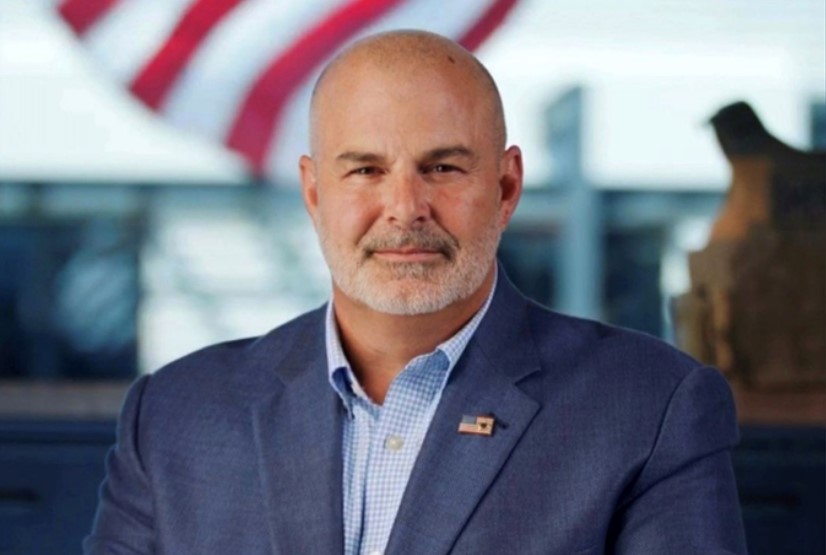
A first-year mayor is getting recognition for his emerging leadership as a government official.
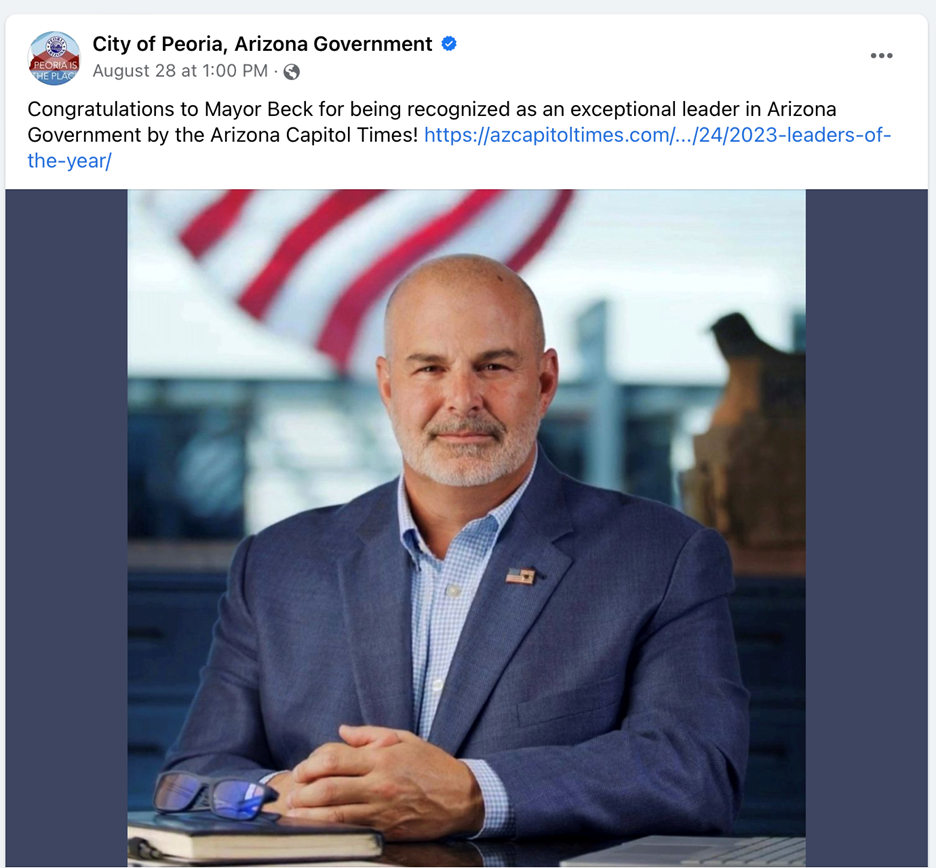
Late last month, the Arizona Capitol Times released its 2023 Leaders of the Year awards, highlighting Peoria Mayor Jason Beck as a winner for the “Government” category.
In addition to congratulating Mayor Beck and others who earned recognition under various categories, the Arizona Capitol Times wrote, “These individuals have demonstrated a commitment to serving their communities that are second to none. Their passion and talent have made Arizona a better place for all that live here.”
Since entering office at the beginning of this year, Mayor Beck has proven he is up for the task of leading his city forward, working with the council to keep several of the promises he made during his 2022 campaign. Beck made public safety a key focus of his campaign, and he has delivered on multiple fronts to increase funding and resources for Peoria’s police, fire, and school.
In July, Beck announced that there would be a police presence at all Peoria Unified School District schools during the 2023-2024 year. He added that there would be four new SLOs (School Liaison Officers) and rotating SLOs at every school, that this presence would be expanded to all elementary schools, and that there would be 22 Peoria schools with police coverage and an increase in SLO salary.
The action to provide additional school safety personnel for Peoria schools comes on the heels of an earlier announcement from Mayor Beck on funding for the city’s police pension funding. In a social media post, Beck noted that the Peoria City Council had moved $6 million to the police pension funding, which was now 80% funded – compared to 48% funded in 2020.
Earlier this spring, the mayor highlighted his vote “to approve the Peoria Police Association’s proposal for a wage increase for Peoria Police Officers.” His communication on March 16 stated that the Peoria City Council “unanimously voted to increase police wages by a 10% market adjustment and a one time lump sum payment of $2,500 to go in effect March 18th.”
Beck also revealed that his city had just arranged for the acquisition of land for a new, “state-of-the-art” police and fire station, which would ensure “efficient collaboration between the two crucial services in times of emergency.” Mayor Beck explained that he is “committed to ensuring that Peoria remains a safe and secure place for everyone,” and that he “understands the vital role that our police officers and firefighters play in maintaining this safety.” He expressed his pride in supporting the city’s first responders in “their tireless efforts.”
The mayor’s success at the helm of his city comes as no surprise to those who have interacted with him in the private sector before he entered the political realm. Before taking the oath as Peoria’s chief executive, Beck founded TYR Tactical, which manufactures police and military equipment. Beck has served as the company’s CEO since its inception in 2010, growing his operation into one of the city’s top businesses. In a letter posted on TYR’s site, Beck asserts that “protecting and serving the men and women of U.S. and Allied Armed Forces, as well as Law Enforcement and Federal Agencies, has always been my number one priority.”
At the beginning of March, Beck announced that he had been presented with the Patriotic Employer Award from the Office of the Secretary of Defense’s Employer Support of the Guard and Reserve. The honor is a recognition for “contributing to national security and protecting liberty and freedom by supporting employee participation in America’s National Guard and Reserve Force.” Beck wrote, “Those that have worked at TYR know the intensity in which we focus on perfection of the product and why we say every stitch matters. Every Police Office, Every Soldier and Every Life Matters! It’s what I am proud of TYR’s performance and we are proud of Renato and the many vests that have worked for us in the past and currently working for us now.”
Daniel Stefanski is a reporter for AZ Free News. You can send him news tips using this link.
A state government agency is earning accolades for its positive workplace environment.
On Tuesday, the Arizona Department of Revenue made the 11th annual list of 2023 Top Companies to Work for in Arizona, giving the agency this honor for the second straight year. The list comes from the Arizona Capitol Times, Best Companies Group, and BestCompaniesAZ.
According to the Department of Revenue, “this highly selective list is the result of comprehensive, anonymous employee surveys measuring culture, work environment, leadership, and employee pride and satisfaction, combined with rigorous evaluations of workplace practices, policies, benefits, and demographics.”
“The Arizona Department of Revenue is honored to receive this award for the second year in a row, and all the credit goes to our incredible people,” said Rob Woods, Director of the Arizona Department of Revenue. “We have a diverse team with a culture of inclusion who daily display that they care about one another, lift each other up personally and professionally, and are consistently seeking excellence in their service to Arizona’s taxpayers. We are grateful that our people and culture have been recognized and are looking forward to the coming year as we celebrate this achievement and incorporate new initiatives for our team members.”
Woods was “appointed as Director of the Arizona Department of Revenue in March 2021, having joined the Department in January 2020 as Deputy Director.” He previously “founded the Government Transformation Office for the State of Arizona, led the development of the Arizona Management System, and served as Vice President at JP Morgan Chase.”
After then-Governor Doug Ducey appointed Woods to the Director’s position, Ducey said, “He continues to find innovative ways to improve operations and enhance efficiency, and he stepped up to a leadership role during a crucial time for our state.”
On January 17, Governor Katie Hobbs announced that Woods would remain as the Department’s Director. Hobbs released a statement about Woods (and two other members of her expanding cabinet included in the release), saying, “I have the utmost confidence that these directors have the expertise and wherewithal to take on the challenges and opportunities in their department.”
The Department also took time to share some features about itself in the news release about its inclusion in the exclusive list, writing, “ADOR offers a healthy work-life balance and a culture of personal and professional development, with educational opportunities and in-house training. The Department excels at helping our team members find meaningful, fulfilling careers with us. We recognize our people in several ways, highlighting those who exemplify our agency’s Core Values of Commit to Excellence, Care About Each Other, and Do the Right Thing. ADOR truly thrives in our collaboration and open communication. We excel in being transparent with each other and bringing everyone to the table. Our leaders are coaches, encouraging input from all and helping teams discover solutions to foster our culture of continuous improvement. At ADOR, we know we aren’t just developing employees; we’re developing leaders.”
Daniel Stefanski is a reporter for AZ Free News. You can send him news tips using this link.