by Matthew Holloway | Dec 15, 2024 | News
By Matthew Holloway |
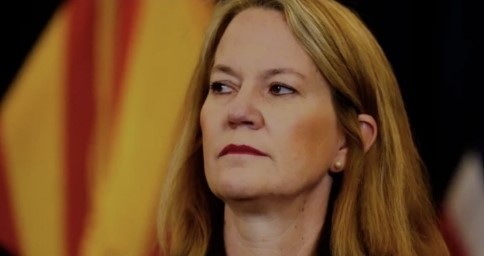
The State of Arizona has engaged in legal battle against a Saudi Arabian firm: Fondomonte Arizona, LLC., on allegations that the agribusiness has violated public nuisance law by aggressively pumping groundwater from the Ranegras Plain Basin of La Paz County. The move could signal a split between Democrats Attorney General Kris Mayes and Governor Katie Hobbs whose chief campaign advisor is partnered with a lobbyist for the Saudi company.
Announcing the lawsuit on Wednesday, Mayes said the company, which enjoys a strong lobbying connection to Democrat Gov. Katie Hobbs, does not have “the right to endanger an entire community’s health and safety for its own gain,” according to KJZZ. She added, “The law is clear on that point.”
Mayes said the consequences are immediate and visible. She cited that the firm has operated in the Ranegras basin since 2014 and has several wells that pump up to 4,000 gallons of water per minute. She also shared that in 2023, it used approximately 31,196-acre feet of water.
“Fondomonte came to Arizona to extract water at an unreasonable and excessive rate because doing so was banned in its home country – another arid desert with limited water,” the lawsuit claims. “Fondomonte is taking advantage of Arizona’s failure to protect its precious groundwater resource.”
The Saudi firm called Mayes’ allegations “totally unfounded,” according to spokesman Barrett Marson.
“We believe the attorney general is setting a dangerous precedent attempting to penalize farming and the wider agricultural industry within the state of Arizona. The company complies with all state and local regulations.”
The amount of water drawn by the alfalfa farms is reportedly enough to serve approximately 93,000 single family homes. Neighboring wells serving homes less than a mile away went dry about five years ago. Mayes noted that the well for the Friendship Baptist Church a little under two miles away ran dry in 2017.
“The land is literally sinking in La Paz County with as much as 9.8 inches of subsidence documented in the immediate vicinity of Fondomonte’s farms,” she told reporters adding that under the nuisance law, action can be taken. However the AG pointed to what she described as the Arizona legislature’s failure to regulate the water use of corporate farms outside active management areas. “They have been completely AWOL when it comes to addressing rural Arizona’s water needs and these situations where people are being harmed,” she said, according to the outlet.
According to the Associated Press, Mayes said, “While laws regulating groundwater pumping could have prevented this situation, the legislature’s inaction has allowed the crisis to grow. When the legislature fails to protect our most basic resources, the attorney general must step in.”
Republican La Paz County Supervisor Holly Irwin praised the move, while castigating Arizona lawmakers for failing to weigh in. “That is why we are seeing foreign companies come over to these areas, purchase land and pump water out so that they can supplement their alfalfa and send it back home,” said Holly.
“Attorney General Kris Mayes is the first one who has stepped up and done anything about it. I know my constituents will be thrilled that somebody’s actually paying attention to the real problems here, which are wells that are going dry, the land subsidence that we’ve seen, and the concern that we have for the future of our basin.”
In March, Fondomonte was reportedly stripped of the ability to use Arizona’s water resources when the State Land Department inspected the company’s land leases in western Arizona’s Butler Valley and determined they were no longer irrigating in the area. The company allegedly pumped over 5.3 billion gallons of groundwater in Butler Valley throughout 2022, stopping after Gov. Hobbs canceled their leases on its thousands of acres of land in October according to The Center Square.
Mayes said in a statement at the time, “The Arizona Attorney General’s Office worked closely with Governor Hobbs’ administration on these inspections, which confirmed what we have suspected — Fondomonte has been in violation of its leases for many years.”
However, she was critical of the delayed reaction. “And while today’s announcement is commendable, it should have been taken by state government much earlier. The failure to act sooner underscores the need for greater oversight and accountability in the management of our state’s most vital resource.”
As reported by AZ Free News in July, Chad Guzmán, who co-manages the lobbying firm Fillmore Strategy with Hobbs’ senior campaign advisor, Joe Wolf, is now working as a lobbyist for Fondomonte. The move came after Fondomente enlisted Guzmán’s company, Signal Peak Consulting, according to a Fondomonte spokesman. Wolf referred to the development as a “nothingburger” at the time, telling the Arizona Republic the he is no longer paid by the Hobbs campaign and has no business dealings with Fondomonte.
Speculation is rife that Mayes could seek to challenge Hobbs in the 2026 Democrat Primary for the Governor’s office, though the Arizona Capitol Times reported in November that Mayes said she is looking at running for a second term as AG in 2026. Stacey Barchenger, state politics reporter at the Arizona Republic, confirmed to KJZZ’s Laren Gilger a day later that she had reached out to Mayes who indicated she intends to seek re-election as Attorney General. Despite these assurances, the outlet noted that the groundwater controversy has proven to be a high-profile dispute between the two Democrats.
With Hobbs’ favorability ratings critically low, the divide on groundwater, an issue that often garners bipartisan support for regulation, could prove to be a wedge issue in 2026 that places Mayes in a position to challenge Hobbs on equal footing, despite the Governor’s hefty $3 million war chest.
Matthew Holloway is a senior reporter for AZ Free News. Follow him on X for his latest stories, or email tips to Matthew@azfreenews.com.
by Seth Leibsohn | Dec 13, 2024 | Opinion
By Steve Twist & Seth Leibsohn |
With the major election season behind us, voters are undoubtedly recovering from the fatigue of non-stop political ads flooding their TVs and social media apps, but potential candidates are already setting their sights on 2026, which—while not the presidential Superbowl—will have hugely impactful consequences for Arizona. Fresh off a nationwide red wave, Republicans in Arizona are hoping to capitalize on this momentum by taking back important statewide offices won by Democrats in 2022. Fortunately for Republicans, Arizonans, and the rule of law, we have an excellent candidate who could be the next Arizona Attorney General. In many ways, he already is.
Both of us have worked with or closely observed every Attorney General since Bob Corbin in 1979. Sadly, we’ve never seen an Attorney General whose decisions about the use of power are more partisan than Attorney General Kris Mayes. Lawlessness, wokeness, and injustice have become recurring themes under her leadership. In response, Arizona Senate President Warren Petersen has taken her on, thwarting and mitigating her run-a-way train of progressivism.
Thanks to a law passed by a prior legislature, the Senate President may intervene in cases where the Attorney General refuses to defend the law. Over the past two years, this tool has proven to be invaluable, and Warren Petersen has deployed it, both smartly and aggressively.
When Attorney General Mayes bowed to the radical left and refused to defend Arizona’s law ensuring biological boys and men could not compete on female-only sports teams, President Petersen got involved to protect our girls and women, serving as the last line of defense for the Save Women’s Sports Act. When Mayes gave bogus legal advice to provide cover for the lawlessness of Katie Hobbs and her violations of the separation of powers, Petersen checked Mayes in court and made sure Arizona laws were followed, stopping a Mayes-approved illegal scheme, where Governor Hobbs avoided confirmation of agency directors.
When Mayes tried to hijack the state budget and assert control of $115 million in state opioid settlement funds, Petersen fought back, won, and was awarded over $40,000 in attorneys’ fees against Mayes. Perhaps nothing more clearly demonstrates that Petersen is already fulfilling the role of moral leader of the Attorney General’s Office than his call to Mayes to end her illegal delay in following court ordered executions. Within a week of Petersen’s public statements, Mayes reversed course.
President Petersen has not only filled the void in state court litigation, but he’s also picked up the slack to fight the Biden administration’s big government overreach in federal court, while Mayes has remained silent. Petersen led the legal fight on national issues of importance to Arizona. From Covid vaccine mandates to forced-electric vehicle mandates, infringement of second-amendment rights, homeless encampments, immigration enforcement, and business-crushing federal regulations, Petersen has intervened in a variety of issues important to the lives and livelihoods of our citizens. Meanwhile, Mayes has been AWOL, seemingly driven by a leftist ideology instead of objective law enforcement.
And now comes the astounding revelation that a “far-left” group, the States United Democracy Center, gave Mayes a forty-seven-page memo which served as her “plan” to prosecute the 2020 alternate electors. If true, it represents an unprecedented abdication of the independence we need from our Attorney General.
We do not need four more years of highly partisan bias and selective application of the law for Arizonans to appreciate the value of having a true advocate in the Attorney General’s Office. And while there are two more years to go under Mayes, we should be thankful that we have two more years of Arizona Senate President Warren Petersen there to continue his protection of our state constitution and laws.
We’ve worked with President Petersen on legal issues for over a decade. Whether as Judiciary Chairman, or now as Senate President; time and time again, he has demonstrated the ability, courage, and leadership to put Arizona first and fight for its interests, whether at the legislature, or in the courts. In many ways, for the last two years, Petersen has been the moral voice for justice in our legal affairs. Now is the right time for him to run to become the actual Attorney General.
Steve Twist is a lawyer in Scottsdale. Seth Leibsohn is a radio host in Phoenix and Senior Fellow with the Claremont Institute.
by Staff Reporter | Nov 10, 2024 | News
By Staff Reporter |
On Thursday, the Arizona Supreme Court rejected a challenge to the validity of the 2022 attorney general election results.
Congressman-elect Abraham Hamadeh — formerly Arizona’s Republican attorney general candidate challenging Attorney General Kris Mayes’ 2022 claim to the seat — said in a response to the ruling that the court system had set their challenge up to fail. Hamadeh lost the race by less than 300 votes with thousands of provisional votes not counted.
“The closest race in Arizona history (280 votes with 9,000 uncounted ballots) was sanctioned, delayed, and now won’t be heard by the Supreme Court even though it’s the only case that has had a split decision at the Court of Appeals,” said Hamadeh.
Hamadeh said that he knew many of the justices involved in his case personally, and that their ambition to advance in their careers had compromised them where it mattered. He noted that he would do the opposite with his newly won seat: champion Arizonans’ interests to “Make America Great Again” in Congress.
“I will never forget when the people were counting on them to deliver justice they remained silent, became controlled opposition, and were complicit in the corruption — their legacy will be remembered as cowards,” said Hamadeh.
Hamadeh filed his appeal over a year ago, last September. One of the issues that came about in Hamadeh’s attempt to challenge the election was delays to rulings. Provisional votes were discovered late according to response delays from counties.
Issues argued in court pointed to a significant number of undervotes and misread ballots, a total believed to be, at minimum, hundreds of votes greater than the lead Mayes had on Hamadeh.
In her time as attorney general, Mayes has focused her office’s energies on the prosecution of those who contested the 2020 election results on behalf of President Donald Trump. Like the attorneys general of other states, she is currently going after the Trump electors for that election.
Just before Election Day, Mayes also announced that she had tasked her office with investigating Trump over his remarks at a recent rally.
While in Arizona at an event with personality Tucker Carlson last week, Trump had said that former Congresswoman Liz Cheney wouldn’t be eager to thrust America into another war if she actually fought in one. Trump said that Cheney ought to face down the guns of war before advising the U.S. enter another war.
“She’s a radical war hawk. Let’s put her with a rifle standing there with nine barrels shooting at her,” said Trump. “Okay, let’s see how she feels about it. You know when the guns are trained on her face — you know, they’re all war hawks when they’re sitting in Washington in a nice building.”
Later, on Truth Social, Trump said that Cheney lacked “the guts” to fight.
“It’s easy for her to talk, sitting far from where the death scenes take place, but put a gun in her hand, and let her go fight, and she’ll say, ‘No thanks!’” said Trump.
Vice President Kamala Harris, who Trump defeated in a landslide this week for the 2024 presidency, pushed to have the public believe that Trump should be disqualified from the race over his remarks.
“This must be disqualifying. Anyone who wants to be president of the United States, who uses that kind of violent rhetoric, is clearly disqualified and unqualified to be president,” said Harris.
AZ Free News is your #1 source for Arizona news and politics. You can send us news tips using this link.
by Staff Reporter | Sep 14, 2024 | News
By Staff Reporter |
Attorney General Kris Mayes has been asked to investigate the city of Surprise over its alleged violation of one citizen’s free speech rights.
Republican State Senator John Kavanagh sent a letter to Mayes on Tuesday requesting an investigation into the arrest of a Surprise citizen after criticizing the city attorney during a city council meeting last month. The arrested citizen, Rebekah Massie, sued the city of Surprise last week with the aid of Foundation for Individual Rights and Expression (FIRE).
Mayor Skip Hall, who ordered Massie’s removal, cited city policy prohibiting public comment from lodging any “charges or complaints” against city employees or elected officials.
State law requires the attorney general to investigate local governmental ordinances, regulations, orders, or other official actions alleged to be in violation of the state law or Arizona Constitution. Under this law, Mayes’ office would have to issue a written report of their findings within 30 days of receiving the investigation request.
In a press release, Kavanagh claimed that the city of Surprise had violated both state law and the Constitution with Massie’s arrest.
“In Arizona statutes, we have a provision that specifically says, ‘[a] public body may make an open call to the public during a public meeting, subject to reasonable time, place and manner restrictions, to allow individuals to address the public body on any issue within the jurisdiction of the public body,’” said Kavanagh. “Protecting freedom of speech, especially in public government settings, is incredibly important to our democracy. Regardless of where they stand, members of the public deserve the opportunity to voice their opinions and concerns to city leaders.”
Kavanagh’s letter to Mayes asked the attorney general’s office to investigate whether the city of Surprise’s policy restricting public speech by prohibiting complaints against city employees and elected officials violates the Arizona Constitution and state law governing public comment within public meetings.
Were Mayes to determine that the city of Surprise’s public comment policy violates state law or the Arizona Constitution, her office would provide notice to the city by mail of its violation and give the city a 30-day deadline to resolve the violation. Should the city fail to resolve the violation, Mayes would notify the state treasurer to withhold and redistribute state shared funds.
Or, were Mayes to determine that the city’s public comment policy may violate certain state law or the Arizona Constitution, the attorney general would file a special action in the state Supreme Court to seek a resolution. The court would then require the city to post a bond equal to the amount of state shared revenues paid to the city in the last six months.
AZ Free News is your #1 source for Arizona news and politics. You can send us news tips using this link.
by Elizabeth Troutman | May 27, 2024 | News
By Elizabeth Troutman |
Rep. Josh Brecheen, R-Okla., sent a letter to Arizona Attorney General Kristin Mayes asking the Democrat to drop her “frivolous lawsuit” against allies of former President Donald Trump by June 1.
“I just sent a letter to Arizona Attorney General Kristin Mayes demanding that she resigns and drops the frivolous lawsuit against former Trump officials for questioning the results of the 2020 election,” Breechen said in a post on X.
Brecheen’s letter to Mayes, joined by representatives Troy Nehls, R-Texas, and Andy Biggs, R-Ariz, called for her to drop the lawsuit against former White House Chief of Staff Mark Meadows and other conservative activists indicted for questioning the results of the 2020 election.
“Not only is this a violation to the 1st Amendment, it is blatant interference in the 2024 election,” the Republicans wrote in a letter first obtained by Breitbart News.
An Arizona grand jury indicted Meadows, former Trump attorney and former New York City Mayor Rudy Giuliani, former Arizona Republican Chair Kelli Ward, and others on May 24 for their roles in disputing the results of the 2020 presidential election.
“Every American has the right to free speech, including the right to question the results of elections,” the letter reads. “Your choice to indict American citizens for expressing constitutional rights represents the worst of machine politics, and we intend to take every action available to Congress to rectify your decision.”
This comes as Trump leads President Joe Biden in the polls in several key swing states, including Arizona. Trump led by seven points in the Grand Canyon state, receiving almost 50% support from voters who said they would vote for him, while Biden received only 42%.
The indictments “rely on a shaky legal framework and are malicious in nature,” the representatives wrote in the letter, which breaks down the charges against the Trump allies.
“Clearly, your intention is not to follow the law but to initiate a political witch hunt,” Brecheen, Nehls, and Biggs wrote.
The congressmen promised to continue fighting lawsuits against Trump from Congress.
“If you do not, we the undersigned look forward to using the full extent of our authorized powers to rectify your abuse of office,” they said.
Elizabeth Troutman is a reporter for AZ Free News. You can send her news tips using this link.