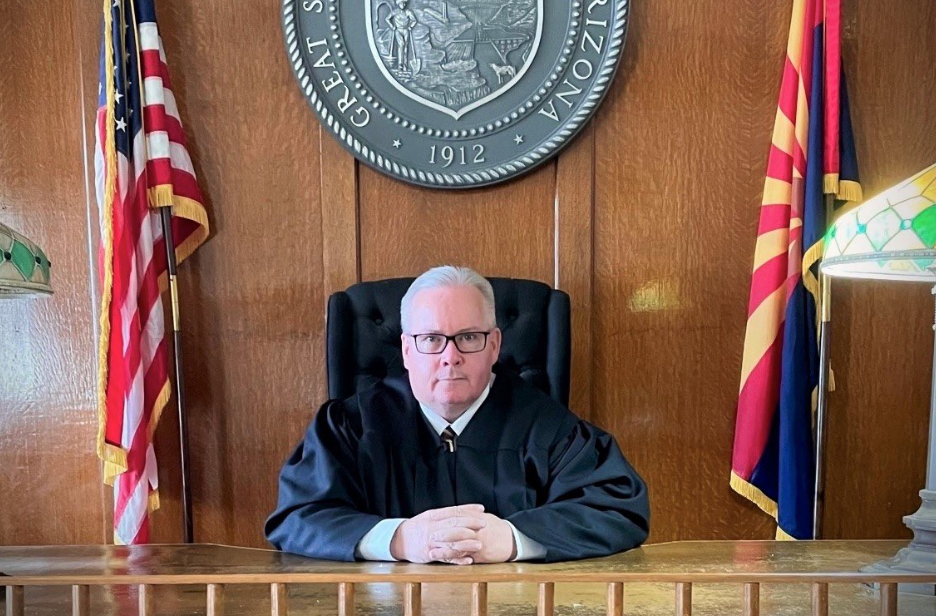
Republicans are hoping to field a candidate against Mohave County Superior Court Judge Lee Jantzen should he decide to run for re-election in 2026. Jantzen, who presided over the 2022 Arizona Attorney General election challenge by now-Congressman Abe Hamadeh, was accused in that case of gross incompetence by lawyers on both sides of the political aisle.
“Lee Jantzen reached levels of incompetence that I honestly did not know were possible,” tweeted Brian Anderson, a Republican influencer and owner of Saguaro Group. “Kept ‘forgetting’ to issue rulings, then ‘forgot’ to sign the rulings, then ‘accidentally’ labeled the AG race as the SOS race, etc. Historic miscarriage of justice.”
Lee Jantzen reached levels of incompetence that I honestly did not know were possible.
Kept "forgetting" to issue rulings, then "forgot" to sign the rulings, then "accidentally" labeled the AG race as the SOS race, etc.
In 2023, after a series of serious missteps, attorneys on both sides of Hamadeh’s election contest discovered that Jantzen signed what should have been a final order, but left matters pending, resulting in an “unfinal” final order. The judge’s failure delayed final judgment, leaving Hamadeh without the opportunity to file an appeal on the denial by Jantzen for a new trial.
At that time, Mohave County residents reached out to the Arizona Daily Independent, telling the outlet that they were “embarrassed and frustrated by the continued missteps by Judge Jantzen. Residents are concerned about Judge Jantzen’s history of malfeasance and how his conduct in this case could indicate issues with other more routine cases that he presides over.”
An X account operated by supporters of Congressman Hamadeh weighed in on the discussion started by Mohave County Republicans last week, asking:
“Do we have any brave attorneys in Mohave County who want to run to become a judge in Superior Court? ‘Judge’ Jantzen, who inexplicably ruled against @AbrahamHamadeh’s election lawsuit WITHOUT considering the evidence is up for election again in 2026. He helped disenfranchise THOUSANDS of voters. We have to uproot the corruption in Arizona. We can start with this judge.”
Jantzen’s repeated mistakes left court watchers wondering if he was intentionally slow walking the case, saying that it created an increased air of distrust in both the judicial system and the electoral process.
That distrust of the judicial system only worsened when nine months to the day after Jantzen denied Hamadeh’s election challenge did the Arizona Supreme Court issue an order to Jantzen to do his job “forthwith” and sign-off on two overdue judgments in the case, one of which dated back to Dec. 23, 2022.
Hamadeh’s case was not the first time Jantzen ran afoul of the Arizona Supreme Court. According to public records obtained by the Arizona Daily Independent through Hamadeh’s attorney, Jen Wright, Jantzen stipulated in May 2018 to a censure by the Arizona Supreme Court for “misconduct in office” following an investigation that showed the judge missed the 60-day deadline by more than one year.
Jantzen, who became a superior court judge for Mohave County in 2009, acknowledged as part of the censure that “he has previously received a warning from the Commission for similar misconduct involving a delayed ruling.”
He was also reprimanded in 2021 for the same problem.
A censure is one step down from a suspension and one step above a public reprimand. A censure can be imposed by the Arizona Supreme Court while a reprimand can be imposed by the Court or the Court’s Commission on Judicial Conduct (CJC).
The Arizona Judicial Branch has two check-and-balance systems in place in an attempt to guard against judges accidentally or intentionally ignoring the 60-day deadline.
“The 2018 censure noted Jantzen had, from June 2015 to September 2017, falsely signed statements pursuant to ARS 12-128.01 by certifying he had no matters outstanding more than 60 days,” according to the Arizona Daily Independent. “Jantzen’s 2021 Reprimand Order shows the judge signed his March 2020 payroll certification with a notation that a ruling in a 2020 case was overdue. The ruling was finally issued at 78 days.”
AZ Free News is your #1 source for Arizona news and politics. You can send us news tips using this link.
The Arizona Free Enterprise Club escalated its call for accountability, urging the County Attorneys of Mohave, Pinal, and Yuma Counties to launch investigations into Arizona State University (ASU) leadership for allegedly manipulating 2022 gubernatorial debate rules to favor Democratic Katie Hobbs over Republican Kari Lake.
The action follows a complaint filed by the Club in August 2025, with the Arizona Attorney General and Maricopa County Attorney, which was dismissed without a thorough review, prompting a broader push for enforcement under state law.
Breaking: The Arizona Free Enterprise Club has filed a Hatch Act complaint against ASU for using taxpayer-funded resources to meddle in the 2022 Governor’s race.
Internal communications reveal ASU leadership broke long-standing debate rules, blocking equal airtime for Kari Lake… pic.twitter.com/yqyB7eRHkK
In a sharply worded letter addressed to the Mohave County Attorney Matt Smith, Pinal County Attorney Brad Miller, and Yuma County Attorney Karolyn Kaczorowski, Club President Scot Mussi detailed evidence of ASU’s deviation from established debate protocols, accusing university officials of using public resources to influence the election in violation of A.R.S. § 15-1633.
The statute states: “A person acting on behalf of a university or a person who aids another person acting on behalf of a university shall not spend or use university resources for the purpose of influencing the outcomes of elections or to advocate support for or opposition to pending or proposed legislation.”
This call-to-action stems from a September 2022 debate co-sponsored by ASU, Arizona PBS, and the Citizens Clean Elections Commission (CCEC).
Under longstanding CCEC regulations (Ariz. Admin. Code § R2-20-107(K)), a candidate declining an invitation to debate their political opponent forfeits airtime, granting the attending opponent a 30-minute solo interview.
When Hobbs announced she would skip the debate, ASU and PBS bypassed set regulations, granting her an exclusive 30-minute interview, a first in years to do so.
Internal communications, obtained and reported by the Arizona Republic, exposed the intent behind the decision. ASU President Michael Crow, Chief of Staff James O’Brien, and ASU Media Enterprise Managing Director Mi-Ai Parrish allegedly prioritized Hobbs’ comfort over neutrality.
Parrish’s emails to O’Brien highlighted concerns that “Katie is getting roasted hard” for dodging the debate and pressed CCEC staff to limit Lake’s discussion of election integrity, arguing that airing “a person with those views was wrong.” CCEC Executive Director Tom Collins confirmed to the Republic that Parrish sought to suppress Lake’s platform.
Correction: A previous version of this story incorrectly listed the names of the County Attorneys. They have now been corrected.
Ethan Faverino is a reporter for AZ Free News. You can send him news tips using this link.
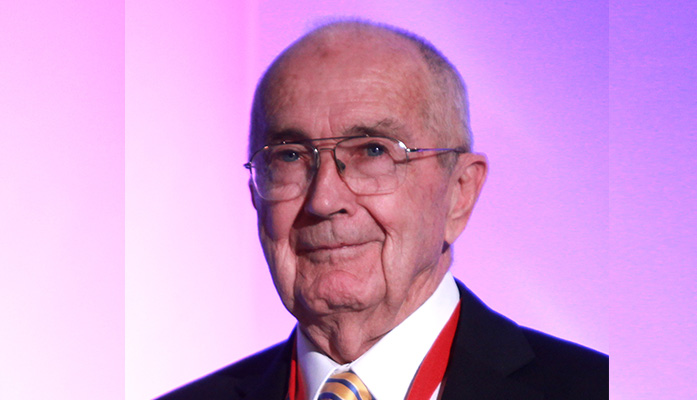
Robert “Bob” Corbin, a longtime Arizona public official who served as state Attorney General and played a pivotal role in some of the state’s most high-profile legal cases, has died. He was 96.
Corbin’s career in public service spanned decades, beginning as Maricopa County Attorney and later as a member of the Maricopa County Board of Supervisors. In 1979, he was elected Arizona’s Attorney General, a position he held through the 1980s.
Known for his commitment to integrity in government, Corbin gained recognition for prosecuting public officials accused of corruption and for pursuing justice in the 1976 car-bomb killing of Arizona Republic reporter Don Bolles — a case that shocked the state and the nation. His work in that era helped shape Arizona’s reputation for taking on organized crime and political misconduct.
Maricopa County Chairman Thomas Galvin expressed condolences, saying Corbin “was a man of integrity and a selfless public servant” whose leadership left a lasting mark on the state. “He played a central role in landmark judicial cases, went after officials who violated the public trust, and prosecuted those responsible for the murder of journalist Don Bolles,” Galvin said in a statement. “As both an attorney and elected official, I am humbled to follow in the footsteps of someone so influential and principled.”
Beyond his courtroom and public service record, Corbin was respected across party lines for his measured approach to law enforcement and governance. He also served as president of the National Rifle Association in the early 1990s, a role that reflected his deep involvement in public policy beyond Arizona.
Corbin is survived by his wife, former state senator Lori Klein Corbin, along with family, friends, and colleagues who remember him as a man deeply devoted to both his work and the people of Arizona.
Jonathan Eberle is a reporter for AZ Free News. You can send him news tips using this link.
This week, Arizona Senate President Warren Petersen delivered a clear message: Arizona will not stand by while abortion providers try to dismantle the protections that defend women and children in our state. At the center of the lawsuit Isaacson v. Arizona is a basic truth: our laws were written to protect the vulnerable, not to support the bottom line of the abortion industry.
President Petersen made it plain that this case is about one fundamental question: will women keep their right to informed consent before an abortion? In every other area of medicine, informed consent is a non-negotiable standard of care. Women deserve the right to know their medical situation fully, to see an ultrasound, and to hear their baby’s heartbeat before making a life-altering decision. To deny them that right is not empowerment, it is exploitation.
But the stakes go even further. Arizona’s Prenatal Non-Discrimination Act makes it illegal to end a child’s life simply because of their race, sex, or disability. Just as America rejected slavery and other injustices that denied whole classes of people their humanity, we must not allow a new form of discrimination to take root in the womb. Every life has value, and no child should be targeted for elimination simply for who they are.
President Petersen is a champion for life, and he is willing to speak on hard truths and act to defend laws that reflect the dignity of every human being. His courage stands in sharp contrast to our current Attorney General Kris Mayes, who has made “reproductive rights” one of her central causes and even gone so far as to file consumer fraud reports against pregnancy resource centers that offer help and hope to women.
As Petersen runs to be Arizona’s next Attorney General, voters will have a choice between two very different paths. One leads toward a state where the powerful and profitable abortion industry writes the rules. The other leads toward a state that defends women’s health, protects children, and affirms that equality must extend to every human life, born and unborn.
Discrimination in the womb is still discrimination. Arizona must not go backwards. We must continue to stand on the side of life, justice, and truth. President Petersen has shown he is ready to fight that battle, and Arizona’s future depends on it.
Here’s where the case stands: on September 15th, there will be a motion to dismiss certain aspects of the lawsuit without even needing a hearing. And a trial is scheduled for November 5th through 7th.
Katarina White serves as Board Member for Arizona Right to Life. To get involved and stay informed, visit the Arizona Right to Life website.
Arizona Senate President Warren Petersen has formally announced his interest in running for State Attorney General and ousting Democrat incumbent AG Kris Mayes in 2026.
Petersen filed his statement of interest with the State of Arizona on last week, and the effort to gather signatures for his nomination has begun according to reporting from KJZZ. Petersen, who has been consistently critical of Mayes’ performance as AG, has regularly opposed her in litigation in his capacity as Senate President, supporting legislation challenged by the AG on largely political grounds.
He has also stepped in to defend state laws that Mayes has refused to defend in good faith, a core tenet of her role as Attorney General, and described her as an “activist.”
“We have been defending laws she has not. Not only have we done our job but hers as well,” Petersen told KJZZ via text.
In a statement reported by AZCentral, Petersen said, “Voters have delivered a message: they want legislators and top law enforcement officials to secure the border and make our neighborhoods safer. They want someone who will abide by and enforce our laws. Unfortunately, we have an activist Attorney General who has blatantly failed to enforce our laws.”
In an op-ed published by AZ Free News in December, Attorney Steve Twist and Phoenix radio host & Claremont Institute Senior Fellow Seth Leibsohn offered a fulsome endorsement of Petersen writing, “Whether as Judiciary Chairman, or now as Senate President; time and time again, he has demonstrated the ability, courage, and leadership to put Arizona first and fight for its interests, whether at the legislature, or in the courts. In many ways, for the last two years, Petersen has been the moral voice for justice in our legal affairs. Now is the right time for him to run to become the actual Attorney General.”
Incredible endorsement from respected lawyer and former Assistant Attorney General Steve Twist and conservative radio show host Seth Leibsohn.
At their behest and that of many in the legal community I have taken the first step to run for AG. Yesterday I filed a statement of…
In a post to X announcing his intent to run, Petersen wrote, “Incredible endorsement from respected lawyer and former Assistant Attorney General Steve Twist and conservative radio show host Seth Leibsohn. At their behest and that of many in the legal community I have taken the first step to run for AG. Yesterday I filed a statement of interest.”
According to AZCentral, former Democrat and 2022 GOP Primary candidate Rodney Glassman has also filed a statement of interest for the 2026 race, and Duwayne Collier of the Green Party has as well.