by Matthew Holloway | Mar 17, 2026 | News
By Matthew Holloway |
Legislation introduced by U.S. Rep. Eli Crane (R-AZ02) to speed recovery efforts at the North Rim of the Grand Canyon passed the U.S. House of Representatives with unanimous, bipartisan support.
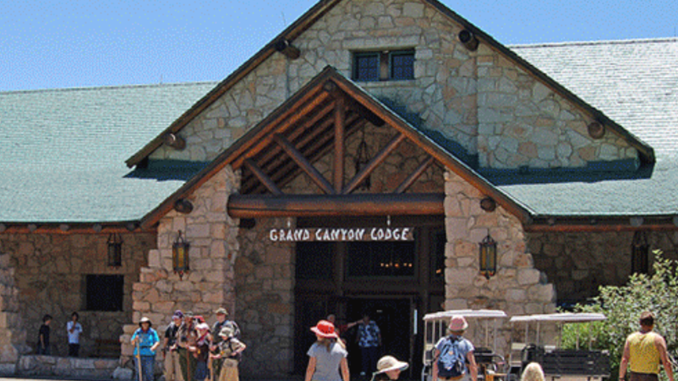
According to a statement released by Crane’s office, the House approved the North Rim Restoration Act of 2025, which aims to accelerate rebuilding efforts following the Dragon Bravo Fire that damaged infrastructure and surrounding areas in 2025.
The bill, cosponsored by Reps. Andy Biggs (R-AZ05), Abe Hamadeh (R-AZ08), and Paul Gosar (R-AZ09), seeks to streamline the federal contracting process by granting the National Park Service (NPS) emergency contracting authority to expedite recovery projects.
“Five months ago, I introduced the North Rim Restoration Act of 2025 after listening to folks on the ground who were directly impacted by this devastating fire,” Crane said in a statement. “Whether speaking with small business owners, local officials, or park staff, it became clear that removing red tape and bureaucratic hurdles would benefit all stakeholders. Today’s unanimous vote sends a clear message that America refuses to abandon our iconic landmarks and storied communities. This timely response would not be possible without the leadership of Chairman Westerman, the Coconino County Board of Supervisors, and everyone else who helped build this blueprint. I urge my colleagues in the Senate to embrace our strong momentum and send this critical bill to the president’s desk.”
In a post to X, Crane wrote, “It’s time for the Senate to harness this strong bipartisan momentum.”
The Dragon Bravo Fire, sparked by a lightning strike in July 2025, destroyed more than 100 structures on the North Rim, including the historic Grand Canyon Lodge. The damage disrupted tourism and impacted park employees, local businesses, and nearby communities that rely on visitation to the park.
Crane introduced the legislation on October 9, 2025, after meeting with park officials, local leaders, and business owners about recovery efforts in northern Arizona.
According to the text of the legislation, the measure authorizes the Secretary of the Interior to use federal emergency acquisition flexibilities when contracting for recovery work within the affected areas of Grand Canyon National Park. The authority would apply to forest restoration, infrastructure rebuilding, and other recovery improvements.
The bill also requires the National Park Service to provide Congress with a comprehensive report every 180 days detailing recovery progress and federal expenditures.
The legislation advanced through the House Committee on Natural Resources with unanimous support before receiving approval from the full House. Local officials have expressed support for the measure, including the Coconino County Board of Supervisors, which endorsed the legislation during the legislative process.
The North Rim Restoration Act now moves to the U.S. Senate for consideration.
Matthew Holloway is a senior reporter for AZ Free News. Follow him on X for his latest stories, or email tips to Matthew@azfreenews.com.
by Andy Biggs | Mar 12, 2026 | Opinion
By Arizona State Representative Gail Griffin and U.S. Representative Andy Biggs |
After decades of finger pointing and failed negotiations over the rights and distribution of the Colorado River, the future of the West stands at a crossroads. The stalemate over water scarcity between seven western states threatens America’s economy and national security. It’s the kind of stalemate that only a grand deal and a major investment can break through to save our region.
With the Colorado River under strain, and time running out, America needs a visionary, a builder and a deal maker. Thankfully, we have all three of those in President Donald J. Trump.
For over half a century, the construction of large dams and canals was the mark of a truly great president. Beginning with Teddy Roosevelt, the first major water reclamation project in the West—the Roosevelt Dam—was authorized to provide Arizona with water that expanded our country’s agricultural, industrial, and military base.
That achievement proved Washington could turn big ideas into reality. Following Roosevelt, nearly every U.S. President across the political spectrum championed large-scale water infrastructure projects in the West, building the dams, canals, and reservoirs that allowed western states to grow. In fact, the West would not be what it is today had it not been for great presidents building great water infrastructure.
Calvin Coolidge authorized the Hoover Dam and All-American Canal; Franklin D. Roosevelt approved the Colorado—Big Thompson Project; Dwight D. Eisenhower authorized the Glen Canyon Dam, Central Utah Project, and initial storage units in the Upper Basin; Lyndon B. Johnson authorized the Central Arizona Project; and John F. Kennedy authorized the San Juan—Chama Project.
Our nation’s greatest modern presidents have left their mark through building major water infrastructure projects and the time is right for the next wave of investment to begin. Americans want their leaders to put America first, refocusing federal spending at home.
By building something big and meaningful, President Trump could save the West and leave a lasting legacy for the next 250 years in America. President Trump could “Make American Water Great Again.”
Few political figures have had President Trump’s instinct for sensing when a looming issue is about to explode into a defining national moment—spotting opportunities before others see them and acting decisively when others freeze. That instinct, combined with his willingness to act, has led some to speculate that Trump may already be eyeing a major water play in the West. Trump also understands the value of strategic federal assets—such as the Panama Canal—which advance the nation’s interests on a grand scale.
As a builder, constructing a new water resource would fit perfectly with Trump’s identity. A new dam or canal would be the crown jewel of his American portfolio, a monumental project built not for private business but for the American people, turning big ideas into physical steel, concrete, and—most importantly—water that can sustain America for generations.
And he wouldn’t have to start from scratch. Long-shelved proposals—intended to be built but killed by environmental activists—still loom in the background. Big projects like the Marble Canyon Dam (Arizona), Echo Park Dam (Colorado), and Temperance Flat Dam (California)—assumed to be dead—could be revived at any time. President Trump would have the opportunity to succeed where others have failed.
At the same time, numerous new projects have been proposed that could increase water supplies in the West. Large-scale desalination projects, interstate water pipelines, storage facilities, reservoirs, and advanced water reuse systems have all been proposed and are ready to go. Arizona has taken the lead on developing these projects, but multiple western states would benefit from them if any were constructed. With President Trump’s support and blessing, these projects could be moved from a hope to a real revitalization of American infrastructure.
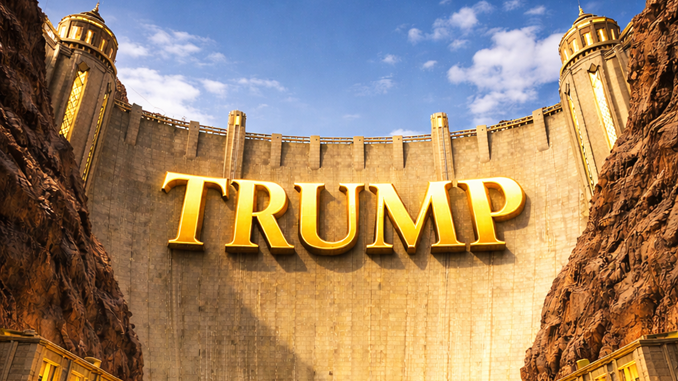
Building any one of these would make a difference. Building all of them would define an era. All President Trump would need to do is pick one, announce it, and build—instantly taking credit and moving us closer to saving the Colorado River for our nation’s economy and national security. Perhaps one could even be named after him: the Donald J. Trump Imperial Dam.
Such a project would not only grant the President unprecedented negotiating power in the West, but also provide thousands of blue-collar jobs that would help to reinvigorate America’s working class. Over 21,000 workers were employed during the construction of Hoover Dam, which created critical jobs at a time when many Americans felt uncertain about the economy.
America remembers its greatest presidents because of what they built—big, bold projects constructed at a scale worthy of a great nation. President Trump can do the same. If President Trump wants to build a lasting legacy, the path forward is clear: solve the Colorado River crisis by building big, bringing new water resources to the West, and increasing the supply for everyone.
Representative Gail Griffin chairs the Arizona House Natural Resources, Energy & Water Committee and has been a leading voice on water and resource policy in the Southwest. Congressman Andy Biggs represents Arizona in the U.S. House of Representatives and has long advocated for policies that strengthen the economy, protect American resources, and support the future of the West.
by Staff Reporter | Mar 9, 2026 | News
By Staff Reporter |
Gov. Katie Hobbs vetoed legislation to establish a memorial license plate honoring the late Turning Point USA (TPUSA) founder, Charlie Kirk.
Kirk was assassinated last September while speaking at Utah Valley University. Kirk’s assassin, Tyler Robinson, was motivated by Kirk’s Christianity and conservatism. Prosecutors are seeking the death penalty in the ongoing case.
Hobbs said license plates should remain nonpartisan, though she said she condemned the political violence that killed Kirk.
Gubernatorial candidate, Congressman Andy Biggs blasted Hobbs’ veto.
“Charlie Kirk was one of America’s most influential voices and leaders. He made his home in Arizona, building a company and raising a family in this state before he was assassinated because of his political beliefs,” said Biggs. “Katie Hobbs had a chance to honor Charlie and she vetoed it. A simple license plate for Arizonans to show they stand with Charlie for freedom and Katie Hobbs vetoed it. We should not forget this petty and callous act.”
“Charlie Kirk’s assassination is tragic and a horrifying act of violence. In America, we resolve our political differences at the ballot box. No matter who it targets, political violence puts us all in harm’s way and damages our sacred democratic institutions,” said Hobbs. “I will continue working toward solutions that bring people together, but this bill falls short of that standard by inserting politics into a function of government that should remain nonpartisan.”
The state does offer at least one other license plate that could be considered partisan: Arizona Life Coalition has a “Choose Life” license plate.
Hobbs has exhibited zero tolerance for advocacy for political violence in her office. Months into office, Hobbs’ press secretary at the time, Josselyn Berry-Barker, resigned after promoting the shooting of those opposed to transgenderism.
Several months after her resignation, Berry posted on Threads that she wasn’t “sorry for sh*t,” and bragged about her immediate hiring by the progressive nonprofit, ProgressNow, which reportedly hired her on with a six-figure salary. According to her social media and LinkedIn posts, Berry no longer lives in Arizona, is no longer employed with that nonprofit, and has been out of work since early 2025.
Sen. Jake Hoffman, the bill sponsor, issued a response calling Hobbs “hypocritical” and partisan for her veto. Hoffman said Hobbs’ reduction of Kirk’s legacy to partisanship was an inappropriate diminishment of his impact on civic education and voter turnout.
“Even in the wake of a global civil rights leader — an Arizona resident and her own constituent — being assassinated in broad daylight for his defense of the First Amendment, Hobbs couldn’t find the human decency to put her far-left extremism aside simply to allow those who wish to honor him to do so,” said Hoffman.
Hoffman cited other cases of the memorialization of individuals that could be said to invoke partisanship, such as the freeway named after Democratic Congressman Ed Pastor.
AZ Free News is your #1 source for Arizona news and politics. You can send us news tips using this link.
by Ethan Faverino | Mar 5, 2026 | News
By Ethan Faverino |
The Biggs for Arizona campaign has announced that it has filed more than 20,000 ballot nomination signatures with the Arizona Secretary of State’s Office—nearly three times the minimum required for Republican candidates. The strong showing should ensure Congressman Andy Biggs will qualify for the July 2026 Republican primary ballot for governor.
The filing marks the highest number of nomination signatures submitted by any candidate for any office in 2026 to date, underscoring the campaign’s strong grassroots momentum.
Rep. Biggs has emerged as the only current Republican candidate leading in polls for the GOP primary, consistently holding double-digit advantages over his opponents in third-party surveys conducted since September 2025. Polls from GrayHouse, Emerson College, and Pulse Decision show him ahead by 41, 42, and 28 points, respectively—all with three Republican candidates in the field—and he has not trailed any current primary opponent in any published poll.
“Cindy and I are incredibly grateful for every volunteer and supporter who stepped up to help us collect over 20,000 signatures in support of our campaign,” stated Congressman Andy Biggs, announcing his 20K ballot qualification signatures. “It’s a testament to the grassroots nature of our campaign that we hit this monumental number without the need for paid canvassers or digital advertising for signatures. Arizonans are tired of the weak and ineffective Katie Hobbs and are ready for a leader to restore the American Dream in our state. We’ve got a lot of work to do as a campaign, but we’re very excited to hit this first major milestone.”
Rep. Biggs stands as the only candidate in the Arizona Republican gubernatorial primary endorsed by both President Trump and the late Charlie Kirk. He has also secured endorsements from Turning Point CEO Erika Kirk, Arizona Congressmen Eli Crane (R-AZ02) and Paul Gosar (R-AZ09), Maricopa County Board of Supervisors Debbie Lesko and Mark Stewart, as well as 33 current and former state legislators.
Financially, Rep. Biggs has demonstrated consistent momentum throughout 2025, setting multiple personal fundraising records in Q2, Q3, and Q4. He leads all Republican gubernatorial candidates in the cycle with $1.9 million raised and $782,000 cash on hand.
Congressman Eli Crane praised the effort, saying, “From the first day of the campaign, Congressman Biggs and his supporters have done a great job of taking their message of Restoring the American Dream to voters across Arizona. The rural Arizonans I represent are supporting Congressman Biggs because he’s a man of principle that will get things done for our state without compromising his conservative values. He’s the best choice to defeat Katie Hobbs in November, and I urge all Republicans to unite behind his campaign now.”
Ethan Faverino is a reporter for AZ Free News. You can send him news tips using this link.
by Staff Reporter | Feb 14, 2026 | News
By Staff Reporter |
Karrin Taylor Robson announced the suspension of her gubernatorial campaign on Thursday.
Robson cited concerns about the possible effects of “a divisive Republican primary” as the November 2026 election approaches as her reason for stepping out of the race.
“It only weakens our conservative cause and gives the left exactly what they want: a fractured Republican Party heading into November,” said Robson. “With so much on the line in 2026, I am not willing to contribute to that outcome.”
Robson shared an endorsement from President Donald Trump with another primary opponent, Congressman Andy Biggs, this go around.
Trump handed Robson the endorsement first in December 2024 during Turning Point USA’s annual “AmericaFest” convention in Phoenix. When Biggs announced his run early last year, Trump made an unusual but not altogether unprecedented decision and put up a second endorsement for Biggs: the less moderate Republican and former Freedom Caucus chair.
When he announced his dual endorsement, Trump said he had endorsed Robson because there were no other candidates at the time.
“I like Karrin Taylor Robson of Arizona a lot, and when she asked me to Endorse her, with nobody else running, I Endorsed her, and was happy to do so,” said Trump. “When Andy Biggs decided to run for Governor, quite unexpectedly, I had a problem — Two fantastic candidates, two terrific people, two wonderful champions, and it is therefore my Great Honor TO GIVE MY COMPLETE AND TOTAL ENDORSEMENT TO BOTH. Either one will never let you down. MAKE AMERICA GREAT AGAIN!”
Trump split his endorsement in the 2024 congressional race between Blake Masters and now-Rep. Abe Hamadeh.
About a month after Trump split his endorsement between Robson and Biggs, three key allies from Trump’s circle split from Robson’s campaign. Two of those individuals served as Robson’s advisors after playing key roles in engineering Trump’s successful 2024 reelection. Sources said the allies left after Robson refused to run campaign ads with Trump’s endorsement immediately; instead, Robson waited until after Biggs got his endorsement to announce.
Robson, a former Arizona Boards of Regents member appointed by former Gov. Doug Ducey, made an unsuccessful primary run against failed Republican candidate Kari Lake in the 2022 gubernatorial election. That year, Lake was the sole Republican gubernatorial candidate to enjoy Trump’s endorsement.
With Robson out of the race, that leaves Biggs, Congressman David Schweikert, and local business owner Scott Neely gunning to win the primary in July.
Republican leaders responded to Robson’s campaign suspension with gratitude for her service to the state. Right-wing political and grassroots leaders also signaled Robson’s suspension as a unifying call to back Biggs in the race. Robson didn’t endorse another candidate.
State Senate President Pro Tempore T.J. Shope (R-LD16) told Robson he would continue to work with her on policy, and further expressed his endorsement of Biggs.
Likewise, Turning Point USA affiliates and leaders issued statements thanking Robson and encouraging voters to get behind Biggs.
A majority of the latest polls predicted Biggs would have double-digit leads in the upcoming primary election over Robson.
AZ Free News is your #1 source for Arizona news and politics. You can send us news tips using this link.