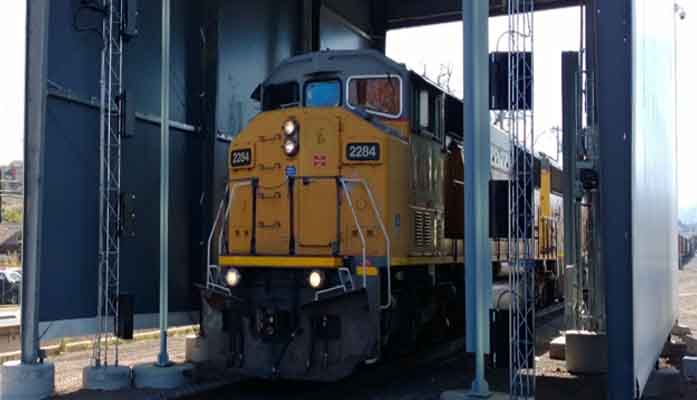
After 28 years, the sound of passenger trains arriving in Phoenix could return as soon as 2030. The Federal Railroad Administration has approved the essential scoping documents that will allow the Arizona Department of Transportation to create a Service Development Plan, completing the first stage of the Phoenix-Tucson Intercity Passenger Rail Corridor Study.
The effort will propose passenger rail service along a 158-mile corridor between the greater Phoenix and Tucson metropolitan areas and will include re-routing the Amtrak Sunset Limited back through Phoenix according to ADOT.
According to Federal Railroad Administration’s FY22 Corridor Identification and Development Program Selections, “The proposed corridor would reconnect Phoenix (Buckeye) to Tucson, AZ, with multiple daily frequencies. The proposed corridor would reinstate service on an existing alignment over which Amtrak discontinued service in 1997, rerouting the long-distance Sunset Limited to a more southerly alignment through Maricopa, AZ (the corridor would use the same route as the existing Sunset Limited/Texas Eagle between Picacho and Tucson, AZ). The corridor sponsor would enter Step 1 of the program to develop a scope, schedule, and cost estimate for preparing, completing, or documenting its service development plan.”
Step 1, as described by the 2022 document, has now been completed.
The Sunset Limited Route, and Amtrak service overall, was diverted from Phoenix following the attack that resulted in the derailment of the train at 1:35 a.m. on October 9, 1995, near Palo Verde, Arizona, 70-miles southwest of Phoenix.
The infamous derailment caused the death of an Amtrak employee and serious injuries to 12 others, along with minor injuries to 100 of the 258 passengers aboard. It remains one of the most famous cold cases in FBI history with no suspects despite a $310,000 reward still offered by several agencies for information leading to the arrest and conviction of the attacker.
Since 1997, Phoenix has remained disconnected from the Amtrak Intercity Rail system with riders required to use buses or drive to the Amtrak depot in Maricopa, Arizona, 38-miles to the south, or about an hour’s drive in traffic.
Democrat Congressman and former Phoenix Mayor Greg Stanton hailed the announcement in a post to X writing, “I’ve been fighting to restore Amtrak service to Phoenix for a long time, and today it’s one step closer to becoming a reality.”
In a written statement, current Arizona Gov. Katie Hobbs commented, “This is a big step forward for Arizona. I am committed to creating a bright transportation future for our state that fosters economic growth, creates jobs and expands transit opportunities for working people and families.”
The second stage of the process, the creation of a Service Development Plan, is expected to take two to three years after a crucial federal grant is approved, which is anticipated in the weeks to come per ADOT. The study, already funded with a $10.6 million budget, will include technical analysis of “capital and service requirements for passenger rail service; preliminary engineering and costs for capital improvements, such as stations, parking lots and trains; station locations; [and] service scenarios based on ridership potential.”
Phoenix Mayor Kate Gallego heeded the call of Amtrak CEO Stephen Gardner, urging for the addition of a public railroad to the city.
Gallego said that the railroad, or passenger railway, would make long-distance travel easier for both locals and visitors.
“An @Amtrak connection in Phoenix would make long-distance travel easier for Phoenicians and bring more visitors. Let’s get it done!” said Gallego.
An @Amtrak connection in Phoenix would make long-distance travel easier for Phoenicians and bring more visitors. Let’s get it done! https://t.co/2NYqU7AuTN
The renewed calls for a public railway came after Gardner singled out Phoenix in recent public comments on his company’s intent to expand nationally. Gardner said it was an “embarrassment” that Phoenix doesn’t have his passenger railway company.
“(It is) frankly an embarrassment that we don’t serve such a major, prominent city,” said Gardner.
Amtrak applied for $716 million in federal funding from the Bipartisan Infrastructure Law to launch 16 projects nationwide, including Phoenix. The Arizona Department of Transportation (ADOT) submitted a proposal to the federal Corridor Identification and Development Program (Corridor ID Program) to assist in the expansion. Additionally, ADOT provided $3.5 million.
Another proponent of the Amtrak expansion into Arizona, Rep. Greg Stanton (D-AZ-04), claimed that passenger railway would reduce the number of cars and therefore result in significant emissions reductions.
In a press release, Stanton also claimed that a public railway would provide an economic boost for the state.
“[It’s an] opportunity to connect our communities, make them more accessible and productive, and more internationally competitive,” said Stanton. “Opportunity to boost our regional economies with better access to jobs and more private investment along the route. Opportunity to ease congestion along Interstate 10 and help reduce air pollution.”
Likewise, Sen. Mark Kelly (D-AZ) said Phoenix needed to join the other major cities in the country served by Amtrak.
“Phoenix is the largest city in the country not served by Amtrak, but thanks to our Bipartisan Infrastructure Law, we’re working to fix that,” said Kelly. “This support for the Return to Phoenix Project will finally bring together Arizona communities, the railroads, and Amtrak to develop a comprehensive plan to connect Phoenix and Tucson with passenger rail and connect Phoenix to Amtrak’s nationwide network.”
Public railway, like other forms of public transit, suffers from high crime rates. According to Amtrak police, there were around 6,000 incidents and over 456,400 calls for police assistance in 2021. That’s based on the latest National Incident-Based Reporting System (NIBRS) data from the FBI.
That’s compared to about 5,000 incidents and 412,000 calls in 2020; around 6,700 incidents and 419,700 calls in 2019; around 6,100 incidents and 254,700 calls in 2018.
Amtrak has 30 routes consisting of 500 stops along 46 states. Based on their latest crime data report (2021), that’s about 12 incidents and 912 calls to Amtrak police at each stop annually.
In a press release on Monday, Amtrak explained that their applications were submitted through the Federal Railroad Administration (FRA) programs funded by the Infrastructure Investment and Jobs Act (IIJA): the Corridor ID Program and the Federal-State Partnership for Intercity Passenger Rail Program. The essential goal of the programs is to establish a comprehensive national passenger rail network.