
TIFFANY BENSON: Arizona K-12 Community Members: Do You Know Your Superintendent?
By Tiffany Benson |
K-12 superintendents are the CEOs of public schools, spearheading a cabinet of professionals who manage district resources and implement safety and academic programs. Superintendent qualifications may include a doctorate of philosophy (Ph.D.) or education (Ed.D.) and some experience in finance, communications, and organizational leadership.
Superintendents are paid exorbitant salaries topping close to $1 million, depending on the district size. This amount does not include performance bonuses, work vehicles, mobile devices, or lavish vacation packages—er, I mean, “out-of-state professional development conferences.” Whether superintendents do good or evil, employment agreements stipulate that they receive full compensation and benefits, largely at the taxpayers’ expense.
Arizona public schools are home to some of the most ethically challenged and morally questionable high-level administrators. K-12 superintendents across the Valley primarily care about aesthetics and the “business of the district.” Below is an incomplete list of superintendents with controversial reputations, alongside the elected officials who bow to their almighty paper-pushing agenda.
Newly hired Higley USD Superintendent David Loutzenheiser now sits on the dais with governing board members, leaving his cabinet on the floor. This arrangement was approved by the purple-haired board president, Amanda Wade, who once advocated for striking the word “immoral” from teacher-student communication policies. Radical board member Tiffany Schultz—who once declared that professional dress codes “sexualize children’s bodies”—backed Wade’s decision to disrupt the chain of command. No one but Loutzenheiser benefited from this stunt. He set a bad precedent for what’s to come. Read more in AZ Free News.
Earlier this year, a resident in the Cartwright Elementary School District sued two board members for nepotism, citing A.R.S. 15-421. Cassandra Hernandez (elected at age 19) is the daughter of board president and state representative Lydia Hernandez (D). Despite using different addresses on their campaign applications, constituents cried foul and called for their resignations. The Hernandezes led a charge to install the disgraced former Maricopa County Superintendent Steve Watson as district superintendent. Watson is accused of fraud and leaving behind an infestation of financial deficits, lawsuits, and dysfunction in the county office. Cartwright residents have no reason to expect Watson will leave their district any better than he found it.
Deer Valley USD residents constantly complain across social media about Superintendent Curtis Finch’s dismissive “leadership” style. Residents are also suspicious of Finch’s camaraderie with board president Paul Carver, who once told a room full of conservatives that Finch is the best superintendent in the state. Both men support a twice-failed ballot measure that would allow the district to exceed its budget. Finch defended the 15% override, stating: “The anti-public school movement is growing here in Arizona, which is a crime against humanity.” Whether or not good things are happening in DVUSD is up for interpretation, but declining enrollment numbers are the telltale sign of a district in freefall. Go Parents!
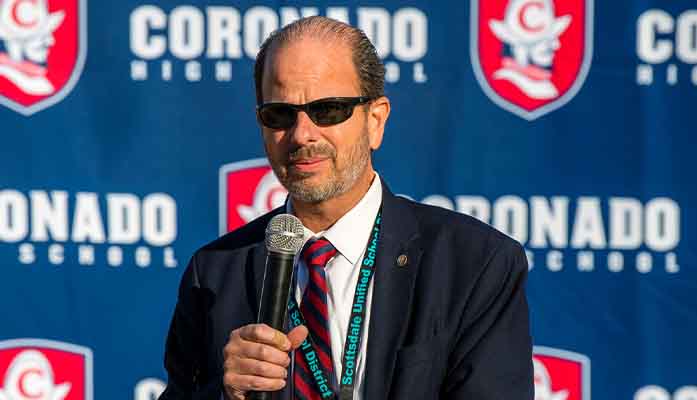
No list of sketchy superintendents is complete without Scottsdale USD’s Scott Menzel. He is a freak show in his own right, accounting for the majority of the district’s media exposure. Menzel is widely known for shaming white people who don’t feel guilty about their skin color. Before vacating their seats, debased board members Zach Lindsay, Libby Hart-Wells, and Julie Cienawski extended Menzel’s contract through 2025. Under his “leadership,” SUSD chartered more student-led sexuality clubs, adopted an anti-police curriculum, and circulated hundreds of pornographic books in school libraries. As a result, in 2024, the Arizona School Administrators organization proudly named Menzel the National Superintendent of the Year (this title must be reserved for clowns).
Peoria USD has a slightly better handle on its administration problem since board president Heather Rooks removed Superintendent K.C. Somers from the dais. This establishes a clear separation of employer and employee while respecting the expertise each brings to the district. Unfortunately, though, Somers is developing a reputation for operating in subtle forms of manipulation and subversion, as if he’s trying to sabotage the board members he can’t control. I once attended a meeting where Somers yowled at board members when they ripped off the COVID-19 funding band-aid. Interestingly, before coming to Arizona, Somers was the superintendent of a Colorado school district steeped in scandal and cover-up. He would do well to note that PUSD residents won’t sit for that.
(Dis)honorable Mentions: Tolleson Union HS Superintendent Jeremy Calles morally and financially bankrupted his district. Former Mesa Public Schools Supt. Andi Fourlis oversaw an untold number of social gender transitions without parental knowledge. Tucson USD Supt. Gabriel Trujillo encouraged and attended a student-led drag show on campus, even after one teen was sexually abused by a high school counselor who organized the opening event. Chandler USD Supt. Frank Narducci declared a “week of kindness” and distributed 9-1-1 stickers after unchecked bullying led to one student’s murder and another student’s suicide. There’s more, but we’re out of time.
Those who can’t get elected apply for high-power jobs. Most K-12 superintendents have no campaign grit and no winning personality. Thus, they depend on compromised board members to execute their agenda. Superintendents don’t represent the whole community—they represent the educated community. They may be intellectual experts, but they don’t swear an oath to the U.S. Constitution, and they are not the final governing authority.
The board of education—elected officials who report to taxpayers (that’s you!)—hires the superintendent, and they ultimately decide what to approve or reject. No one is demanding perfection. Arizona families simply want integrity, transparency, and common sense. K-12 community members who experience dissatisfaction with bloated, overcompensated administrative teams should call, email, request meetings, alert the media, and speak at school board meetings. When superintendents refuse to operate within the scope and ability of their job description, expose them.
Tiffany Benson is the Founder of Restore Parental Rights in Education. Her commentaries on education, politics, and Christian faith can be viewed at Parentspayattention.com and Bigviewsmallwindow.com. Follow on Facebook @TiffanyBenson and Instagram.
