by Staff Reporter | Mar 1, 2026 | News
By Staff Reporter |
The Arizona House has passed a bill banning gender transitions for minors.
HB 2085 not only bans gender transition procedures to minors, it bans referrals and distribution of public funding to gender transition procedures. The bill defined procedures to include puberty blockers and hormone replacement drugs.
The legislation did include exemptions for individuals who were born with sex development disorders; who were endangered due to a physical disorder, physical injury, or physical illness; or who sustained an infection, injury, disease, or disorder caused or exacerbated by a gender transition procedure.
It is likely this bill is dead on arrival should it pass the Senate and hit the governor’s desk. Gov. Katie Hobbs supports gender transition procedures for minors, and her husband, Patrick Goodman, assisted children with gender transitions as a Phoenix Children’s Hospital Gender Support Program counselor.
The partisan divide was clear during House floor arguments for and against the bill.
Democrats argued HB 2085 violates parental and medical freedom.
Rep. Nancy Gutierrez (D-LD18), assistant minority leader, claimed parents had the right to decide for their children to transition their children.
Rep. Betty Villegas (D-LD20) argued puberty blockers and hormone therapies should be acceptable for gender transitions since they’re used to treat other ailments and defects.
Rep. Janeen Connolly (D-LD8) said gender transitions were a personal decision that should be beyond the scope of lawmakers. Connolly shared that one of her grandchildren, now 17 and identifying as “they/them,” had transitioned genders at 12 years old.
Rep. Stephanie Simacek (D-LD2) argued these decisions to transition genders weren’t made in haste since minors relied on parental consent to make the decision.
Across the aisle, Republicans argued the gender transitions of minors amounted to child abuse.
Rep. Lisa Fink (R-LD27), the bill sponsor, argued that allowing the puberty process to occur uninhibited was the prevailing treatment for gender dysphoria. Fink read off the myriad adverse health effects of puberty blockers and hormone replacement medications when applied to healthy children seeking gender transitions.
Rep. Rachel Keshel (R-LD17) accused those in support of gender transitions for minors of being inconsistent in their logic.
“It is my opinion that a parent that allows a child to permanently alter their body and potentially take away their ability to be parent one day, that is child abuse,” said Keshel.
Rep. Pamela Carter (R-LD4) countered that gender transitions don’t qualify as valid healthcare, and therefore not within the acceptable bounds of health decisions parents may make on behalf of their children.
“The physicians even now are stopping some of these procedures because they see the results of what happens to a minor when they realize what has happened: they cannot have children, or they are marred physically, emotionally for life,” said Carter. “Parents should be in charge of their children’s health, but to me this is not healthcare.”
Rep. Alexander Kolodin (R-LD3) questioned how Democrats could support irreversible procedures for minors given the universal agreement on age limits for other activities.
“Point of fact, there are many things our society does not allow minors to do: we don’t allow minors, at least up to a certain age, to drive. We don’t allow them to vote. We don’t allow them to drink. We don’t allow them to smoke,” said Kolodin. “We don’t even allow them to get tattoos because we’re worried that one day they will regret that decision. How much more so then should we not allow minors to engage in elective surgery that permanently disfigures them?”
AZ Free News is your #1 source for Arizona news and politics. You can send us news tips using this link.
by Staff Reporter | Feb 19, 2026 | News
By Staff Reporter |
A legislative committee advanced a bill to take away some of Attorney General Kris Mayes’ authority over the Arizona Department of Public Safety (DPS) on Monday.
House Speaker Steve Montenegro (R-LD29) said in his committee explanation of the bill that Mayes’ recent “political theatrics” had “endangered” law enforcement officers, therefore justifying the existence of this legislation. Mayes said in a January interview that individuals had legal justification for shooting ICE and other law enforcement agents based on Arizona’s “Stand Your Ground” law.
In a press release, Montenegro said Mayes no longer deserved the responsibility of providing legal protection to DPS.
“Attorney General Mayes does not get to put officers at risk with reckless talk and then expect DPS to trust her office for legal protection,” said Montenegro. “The House censured her, and we are taking the next step. HB 2993 gives DPS the authority to hire counsel it trusts, without political strings attached. It also moves $5 million out of the Attorney General’s control and into GIITEM, the mission that targets gangs, cartels, and transnational criminals. Arizona is choosing officer safety and enforcement over Mayes’ political games.”
Nick Debus with the attorney general’s office wrote down their office’s opposition to the bill during the committee hearing on Monday, but did not appear to testify against the bill.
The bill passed along party lines, with Democrats against and Republicans for the proposed legislation. Those Democrats who explained their vote did not address the “why” behind the bill — Mayes’ provision of a legal defense for shooting law enforcement — but rather the taking of CPCF Funds from the attorney general’s office.
State Rep. Lorena Austin (D-LD9) said Montenegro’s bill was also political posturing by impeding the administration of another democratically elected official.
“I don’t think this is a way to instill trust in our public entities, I think when someone is doing a good job regarding consumer protections we should continue to let them do those things,” said Austin.
Likewise, Minority Whip Quanta Crews (D-LD26) expressed concerns that depleting the CPCF Fund would result in further harm to consumers. State Rep. Kevin Volk (D-LD17) said the current economic climate made this “tit for tat” legislation more harmful than helpful.
Republicans argued the legislation killed two birds with one stone: mitigating wasteful spending as illustrated by recent consumer fraud actions while freeing law enforcement of their reliance on an individual who had jeopardized their safety.
State Rep. John Gillette (R-LD30) said Mayes was guilty of “frivolous spending” related to consumer fraud actions. As an example, Gillette cited the consumer protection lawsuit filed last year against the Reynolds Corporation for its labeling on bags intended to collect recycling because they’re not suitable for recycling. Mayes’ press release on the lawsuit did acknowledge the bags came with a warning that they were not suitable for recycling but intended as temporary containers for sorting and collecting recyclable materials.
“We spent millions of dollars for this lawsuit to go absolutely nowhere. I can think of no better use of that money than to give it to law enforcement,” said Gillette. “Let’s get the drugs, the criminals, the bad people off the streets so we can live freely.”
State Rep. Alexander Kolodin (R-LD3) said Mayes had created a “permission structure” for committing violence against law enforcement.
“When you’re telling people how to kill me and you’re going to let me get away with it, that’s not going to create that trust and confidence that’s necessary for effective representation,” said Kolodin.
The Arizona House passed a resolution censuring Mayes over her remarks on justified shootings earlier this month.
AZ Free News is your #1 source for Arizona news and politics. You can send us news tips using this link.
by Staff Reporter | Feb 11, 2026 | News
By Staff Reporter |
The state’s elections portal for candidates experienced another outage, prompting leaders of both political parties to cast blame at the other.
The E-Qual system experienced an outage that lasted from Friday through Sunday. This portal allows voters to sign candidate nominating petitions and give qualifying contributions. It also houses some sensitive candidate data.
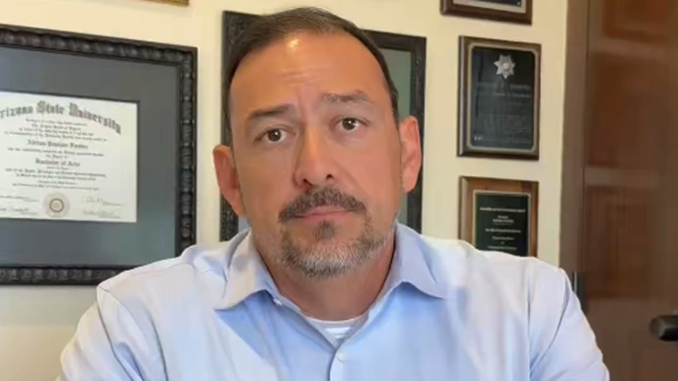
Secretary of State Adrian Fontes blamed the outage on the accelerated primary election schedule. Gov. Katie Hobbs signed a Republican-led bill into law on Friday that moved the primary election to the second to last Tuesday in July, a bipartisan decision to accommodate military voters.
Fontes said a “typo” caused the outage, which he promised was “temporary” on Friday. However, he said his team wasn’t to blame. Fontes said he was dealing with insufficient staffing and outdated systems caused by the GOP-controlled legislature.
The secretary of state put a price on his problems: $17 million to overhaul the election and candidate-facing systems. A one-time funding boost that occurred in 2024 wasn’t enough, Fontes said.
In a premature announcement on Friday that would quickly be proven false, Fontes claimed the system was fixed. Fontes again stressed that the outages his team was experiencing were preventable — the fault that caused the outage had less to do with a “typo” but inadequate funding from the legislature.
“System interruptions are preventable and my office will continue requesting the necessary funding to mitigate issues in the future,” said Fontes.
In a longer video statement from the comfort of his Super Bowl setup on Sunday, Fontes said E-Qual was “fragile,” “old,” and “outdated” due to the legislature’s refusal to provide fiscal support for updates. Fontes further promised that important data relating to tabulation and voter information weren’t impacted.
“Some people wanted to politicize this,” said Fontes. “The failure is the legislature that has been exploiting this longtime issue that I’ve been trying to get fixed for years and they’re not funding it. It’s as if they broke it and they want to blame someone else for breaking it.”
Fontes later disclosed to reporters that one single person was in charge of maintaining the main election management systems for their office. Fontes said he pays a lot to keep that individual on staff as a contractor.
Republican lawmakers rejected Fontes’ attempt to push the blame onto them.
State Rep. Alexander Kolodin (R-LD3), who is campaigning to unseat Fontes this November, said more money couldn’t fix incompetence.
“Even with millions in additional funding, voters are still being disenfranchised by his incompetence,” said Kolodin. “Waste of money!”
In a similar vein, State Rep. David Livingston (R-LD28) questioned how Fontes’ office caused such a major outage over a typo — and how another tens of millions of dollars could have prevented such an error.
“I think the other information, changing July 21, should just be standard operating procedure, and they shouldn’t need any money to do that,” said Livingston. “And if they can’t handle doing that, they probably shouldn’t be running the secretary of state’s office at all.”
Livingston is vice chair of the Joint Legislative Budget Committee, which Fontes called out when identifying those who were to blame.
Some lawmakers had a little less to say on the subject.
The new chairman of the Arizona Republican Party, Sergio Arellano, said Fontes was again proving his inability to own his mistakes.
“Arizonans expect elections to be administered with competence and seriousness, and when preventable failures occur, they demand accountability — not silence, not excuses, and not business as usual,” said Arellano.
Last summer, Iranian hackers breached the E-Qual system under Fontes’ watch.
AZ Free News is your #1 source for Arizona news and politics. You can send us news tips using this link.
by Ethan Faverino | Feb 7, 2026 | News
By Ethan Faverino |
On Friday, Arizona Governor Katie Hobbs signed a Republican bill passed on a bipartisan vote by the Arizona Legislature to change the date of the 2026 primary and permanently move Arizona primaries to the second to last Tuesday in July.
The legislation permanently shifts the primary election date earlier, ensures timely ballot access for military voters overseas, and mandates clearer guidelines for political party observers at polling sites, marking a significant step toward greater election integrity and consistency ahead of the 2026 election cycle.
HB 2022 addresses longstanding issues with Arizona’s election calendar by moving the primary from August 4 to the second-to-last Tuesday in July – specifically July 21 for 2026.
This two-week adjustment resolves conflicts with federal requirements under the Uniformed and Overseas Citizens Absentee Voting Act (UOCAVA), which mandates that ballots be sent to military and overseas voters at least 45 days before an election. Previously, Arizona’s timeline risked delays, potentially disenfranchising service members.
By advancing the date, the bill ensures that ballots are mailed on time, giving voters abroad ample time to receive, complete, and return them.
The measure also enhances transparency and oversight by explicitly requiring authorized political party observers to be permitted at all voting locations, including early voting centers and emergency voting sites.
The bill was sponosored by Rep. Alexander Kolodin (R-LD3) with a mirrored bill (SB 1425) sponsored in the Arizona Senate by Sen. Wendy Rogers (R-LD7).
“Arizona law has always intended to protect the integrity of our elections, including for military voters and at ALL voting locations,” said Rep. Kolodin. “I am delighted that Governor Hobbs agreed with me that this commonsense reform and legislation is necessary.”
“This was a unified Republican effort leading the way from start to finish,” Senator Rogers added. “By working together across chambers, we delivered a commonsense election bill that protects military voters, brings clarity to our election calendar, and strengthens transparency for Arizona voters. This is how the process should work.”
New voter deadlines are as follows:
- Voter Registration Deadline: June 22, 2026
- Ballots are mailed to voters on the Active Early Voter List and In-Person Early Voting Begins: June 24, 2026
- Primary Election Day: July 21, 2026
The Primary date change also impacts filing deadlines for candidates running for office.
Filing Dates:
- Partisan Primary Candidate Filing: Feb. 21, 2026 – March 23, 2026
- Precinct Committeemen Write-In Deadline: April 6, 2026
- Write-In Candidate Filing Deadline: May 22, 2026
The measure had the full support of the Arizona Freedom Caucus (AFC). In a statement, AFC Chairman Senator Jake Hoffman (R-LD15) said, “Governor Hobbs signing Representative Kolodin’s HB 2022 is a huge win for election integirty in Arizona. While Adrian Fontes is making radical and unserious legislative proposals, like expanding unaccountable, sprawling voting centers and reinstating a permanent early voter list, Representative Kolodin is leading with bipartisan supermajorities.”
Ethan Faverino is a reporter for AZ Free News. You can send him news tips using this link.
by Matthew Holloway | Feb 5, 2026 | News
By Matthew Holloway |
The Arizona House of Representatives approved bipartisan election integrity legislation on Monday intended to enhance voting oversight and protect the rights of military and overseas voters.
The measure, House Bill 2022, sponsored by State Representative Alexander Kolodin (R-LD3), cleared the full House after receiving bipartisan support. The bill’s passage comes amid ongoing discussions nationwide about election security and voter access.
According to the AZ House GOP, the legislation aims to protect Arizona’s military voters by ensuring election procedures account for service members and other Arizonans living or serving outside the state. Specific provisions in the bill address the handling and timely delivery of ballots for individuals covered under the Uniformed and Overseas Citizens Absentee Voting Act (UOCAVA), a federal law that safeguards absentee voting rights for military and overseas voters.
Specifically, the bill moves the Arizona primary election date to the second-to-last Tuesday in July, to better align with the federal election timeline adopted by the U.S. Congress and prevent military UOCAVA ballots from going uncounted.
In a statement announcing the bill’s passage, Representative Kolodin said, “This bill exists for one reason: to make sure Arizona voters, especially our men and women serving overseas in uniform, are not disenfranchised because Congress changed the rules and failed to check the calendar. HB 2022 locks in the fix that worked in 2024. Military ballots went out on time, and our men and women serving in uniform were able to exercise their right to vote as citizens of the United States. There is no excuse to walk away from something we know works.”
HB 2022 also includes a series of measures intended to strengthen election oversight and transparency, including requirements for updated reporting and procedural reviews by election officials, according to the bill summary.
The following changes will also be made:
- Modifying the deadline for ballot curing in elections that include a federal office to five calendar days, from the previous five business days.
- Broadening the type of locations that may be observed or challenged by party representatives, including ballot replacement locations, voting centers, in-person early voting locations, and emergency voting locations.
- And allowing permitting nomination and local initiative petition forms circulated under the previous law to be considered valid for the July 2026 primary.
State Representative Kolodin chairs the House Ad Hoc Committee on Election Integrity and Florida-style Voting Systems with Co-Chair Rep. John Gillette (R-LD30). The panel was formed to study election procedures and propose electoral reforms. This committee has previously advanced legislation to improve voter identification requirements, tighten security around mail-in and absentee ballots, and restrict certain external influences on Arizona elections.
HB 2022 will now move to the Arizona Senate for further consideration.
Matthew Holloway is a senior reporter for AZ Free News. Follow him on X for his latest stories, or email tips to Matthew@azfreenews.com.