by Corinne Murdock | Mar 24, 2022 | News
By Corinne Murdock |
The House Transportation Committee approved SB1356, legislation to give Maricopa County residents a vote for or against a transportation tax and excise tax plan. The committee passed with bipartisan support, with the exception of three: State Representatives Neal Carter (R-Queen Creek), Kevin Payne (R-Peoria), and Leo Biasucci (R-Lake Havasu City).Two didn’t vote either way: State Representatives Brenda Barton (R-Payson) and David Cook (R-Globe).
Arizona Free Enterprise Club Vice President Aimee Yentes expressed opposition to the bill, noting that 40 percent of the money was allocated for public transit. Yentes explained that the 1985 transportation tax plan was successful because it built freeways, but that over the decades the plan shifted from essential infrastructure like roads and freeways to “transit,” despite a steep, increasing decline in its use. That number sits at half a percent currently.
“As we’ve seen post-COVID, that ridership number has fallen off a cliff. There are actually more people who don’t own a vehicle that take a car to work than actually use public transit. That’s kind of astonishing,” said Yentes.
Yentes also noted that the bill sets aside funding for something already covered by statute: “regional programs.” She said the definition of that term was problematic because it doesn’t distinguish street intersection improvements but, rather, “arterial roads and regional programs.”
“It really is a catch-all that can be used to siphon off local city slush funds for whatever: complete streets, air quality,” said Yentes.
The bill sponsor, State Senator Tyler Pace (R-Mesa) said that the bill’s rejection, either by the legislature or by Maricopa County voters, would necessitate the Arizona legislature to find the funds for transportation projects themselves. Pace insisted that the committee members shouldn’t nitpick at the provisions of the bill because the greater good concerned Arizona’s legacy of quiet, fast roads superior to those of other states.
State Representative Richard Andrade (D-Glendale) compared SB1356 to previous efforts to expand and extend the state’s two major highways: Loop 101 and the I-17. Andrade argued that creating more public transit like light rails would increase their use.
Those in opposition explained that they weren’t confident this bill would actually meet transportation needs. Carter said that he supported infrastructure, but said that the legislation had room for improvement. Carter said his reservations included provisions for expenditures related to air quality, and the expansion beyond a 20-year authorization.
Payne expressed displeasure that legislators impacted by the bill weren’t included in stakeholder meetings. He explained that his constituents were requesting another bus route down Bell Road, for example, and that he couldn’t vote for the bill in good conscience because of that.
Echoing Carter and Payne’s statements in his “no” vote was Biasucci. Biasucci argued that the legislature should utilize its $4 billion in surplus instead of passing the costs on to taxpayers.
“I think this is, really, how it needs to be done: the money should come from the general fund to be spent on major projects, I’m talking billions of dollars’ worth, in my opinion. For me, when we’re sitting on this huge surplus, it’s hard for me to say, ‘Yes, I agree with a tax increase or an extension,’” said Biasucci.
Corinne Murdock is a reporter for AZ Free News. Follow her latest on Twitter, or email tips to corinne@azfreenews.com.
by Corinne Murdock | Mar 23, 2022 | News
By Corinne Murdock |
State Representative Jake Hoffman’s (R-Queen Creek) controversial proof of citizenship for voting bill passed the Senate on Wednesday along party lines. HB2492 now heads to the governor for final approval. The legislation requires that individuals provide proof of citizenship when registering to vote in the state, and further requires election officials to confirm with all available government databases that the applicant is an American citizen.
The bill advanced steadily through both the House and the Senate, moving out of Senate committee less than two weeks ago, shortly after it was passed by the entire House a few weeks before that. The legislation didn’t advance without pushback, however. Community activists attempted to stall the bill during its consideration by the Senate Judiciary Committee, forcing a recess with their antics such as shouting down the legislators and shouting, “Shame!” repeatedly after the bill passed.
In a statement to AZ Free News, Arizona Free Enterprise Club President Scot Mussi was hopeful that Governor Doug Ducey would sign the bill. Mussi applauded the legislature for passing a bill that aligned with the state and federal constitution, forecasting that the bill would prevent bad actors from interfering with elections.
Senate Democrats had a different perspective of the bill: they claimed that the legislation would force numerous Arizonans to register to vote again. They also claimed that the bill violated federal election law.
In regard to the constitutionality claim, Arizona Free Enterprise Club Deputy Director Greg Blackie explained during the Senate Judiciary Committee hearing that the 2013 Supreme Court ruling determined that the National Voter Registration Act didn’t stop states from denying an applicant’s registration based on information that proved the applicant’s ineligibility. Under this bill, that would mean proof that an applicant isn’t a citizen.
Corinne Murdock is a reporter for AZ Free News. Follow her latest on Twitter, or email tips to corinne@azfreenews.com.
by Corinne Murdock | Feb 16, 2022 | News
By Corinne Murdock |
This week, the Senate Appropriations Committee passed a plan to attract the film industry to Arizona. SB1708, introduced by State Senator David Gowan (R-Sierra Vista), would offer a tax rebate to movie studios, called “Credit for Motion Picture Production Costs,” or “Tax Credits,” under an “Arizona Motion Picture Production Program.” The committee passed the bill overwhelmingly, 9-1; only State Senator Kelly Townsend (R-Mesa) opposed the bill.
The bill reads like a promotional deal for a store: if a company spends up to $10 million, then they get 15 percent in tax credits. If they spend between $10 and $35 million, then they get $17.5 percent. And if they spend over $35 million, then they get 20 percent. Companies could get more: an additional 2.5 percent for total production labor costs associated with Arizonan employees, an additional 2.5 percent of total qualified production costs associated with filming at a qualified production facility in Arizona or primarily on location, and an additional 2.5 percent of total qualified production costs if they filmed in association with a long-term tenant of a qualified production facility.
A day after the committee’s decision, Arizona Free Enterprise Club Vice President Aimee Yentes told “The Conservative Circus” that the credits would be lining the pockets of “woke Hollywood elites” making movies that oppose American traditions and values.
“It outtakes $150 million a year of tax credits for production companies and producers, that’s a really, I would call, generous tax credit program. Usually these move through the system and you’ll see them for, I don’t know, $7 million here, $12 million here, but $150 million a year going to woke Hollywood elites who are going to produce anti-American movies and documentaries like Michael Moore’s,” said Yentes. “So if that sounds like a good use of your taxpayer money, I shudder to think.”
Yentes explained further that the bill gifted movie companies with a “sweetheart deal” through refundable tax credits, which zero out liability after the threshold is met. If there are excess tax credits that haven’t been used, the government will pay the difference to the companies — a perk not afforded to small Arizonan business owners.
“That’s [a deal] a lot of other businesses would love but they can’t afford while down there to cut their own deals,” said Yentes.
According to Yentes, the deals wouldn’t stop there. She said that movie companies’ promises to film in Arizona over this legislation were mere sweet nothings; she insisted that those executives would go back on their word as soon as another state offered a better deal.
“It is an absolute race to the bottom,” said Yentes. “We will wind up bidding against ourselves — and lose.”
Arizona has a history with Hollywood that goes beyond the filming of the many Westerns that ruled the 20th century entertainment industry. The following movies filmed in various parts of Arizona: the original “War of the Worlds,” the original and reboot “Planet of the Apes,” “National Lampoon’s Vacation,” “Indiana Jones and the Temple of Doom,” the original “Karate Kid,” “Revenge of the Nerds,” “Can’t Buy Me Love,” “Bill & Ted’s Excellent Adventure,” “Wayne’s World,” “Forrest Gump,” “The Shawshank Redemption,” “Star Trek: First Contact,” “Star Trek Generations,” “Transformers,” “Transformers: The Last Knight,” and “Transformers: Revenge of the Fallen.”
More recently, Disney’s “The Lone Ranger” was filmed in Chinle.
Corinne Murdock is a reporter for AZ Free News. Follow her latest on Twitter, or email tips to corinne@azfreenews.com.
by Corinne Murdock | Feb 1, 2022 | Economy, News
By Corinne Murdock |
Maricopa County residents may be called to a vote this November to determine the continuance of a transportation tax, according to a bill approved unanimously by the Senate Transportation and Technology Committee on Monday. The bill, SB1356, was described by its proponents as an emergency measure and not an additional tax for constituents.
SB1356 would be considered an updated extension to Proposition 400, a voter-approved transportation tax of half a cent — up to ten percent of the state transaction privilege tax. This latest legislation would have the Arizona Department of Transportation (ADOT) collect an advanced version of the 2004 transportation tax beginning January 1, 2026, when Proposition 400 sunsets, and lasting 25 years; in addition to collecting at a rate up to 10 percent of the state transaction privilege tax, the new tax would collect at a rate up to 10 percent of the jet fuel excise tax rate and the energy consumption rate for customers subject to use tax equal to the state transaction privilege tax.
However, Arizona Free Enterprise Club Vice President Aimee Yentes asserted that the tax was, in fact, an increase because the previous one was set to expire. That wasn’t Yentes’ biggest contention with the bill, however, calling it “grossly unaccountable to taxpayers” based on the language and true layout of funds allocation.
Prior to Yentes’ comments, Glendale Mayor Jerry Weiers and Mesa Mayor John Giles insisted in their presentations that the bill contained many compromises which left none of its creators overly pleased. The language of the bill tells a different story. Yentes declared that the bill relies on nebulous terms when eliminating the previously-established 67 percent of funds for freeways and roads to “virtually zero” by consolidating three funding buckets into two focused on major arterial streets as well as undefined “regional programs” and “implementation studies.” Ultimately, Yentes explained, that language assures that funds may be siphoned to virtually anything: bike paths, trails, and even public service announcements to encourage more walking.
“We cannot stress enough that the way this bill is drafted, zero percent of the funds have to be spent on roads and freeways. That is a big backdoor where all of the money can just go to God knows what,” said Yentes.
Yentes warned that SB1356 was likely the largest piece of tax policy to come before the legislature in several decades. Yet, Yentes pointed out that these private groups and local leaders wanted to have the legislature pass this bill without questioning it.
“I’m a little dismayed because I keep hearing almost a lamenting that this policy has to go before the legislature. What I’m hearing is that the insiders have already brokered this deal, it’s fully baked, it’s done with, and your job is to just push the green button. Quite frankly, I think the legislature has a very important role to play in authorizing this legislation,” said Yentes. “I think that you guys represent a more accountable body, even more so than the cities and towns — I say that on behalf of sitting on a city council — and this process is a more transparent one.”
Weiers claimed during his presentation that those opposed to the bill decided not to engage throughout the three years they spent developing the bill, warning that those who change the bill were “monkeying around” and would cause it to “blow […] up.” Yentes asserted that wasn’t true, that this bill was the first some were hearing of this intended tax.
Yentes also criticized that money would be pulled from the roads fund to “basically rig the election” on the subject, by requiring election offices to mail out publicity pamphlets about the tax. She added that it wasn’t comforting that the creators of the bill included their own ballot language rather than allowing for independent creation, which she called “egregious.”
That wasn’t the worst of it, according to Yentes. She lambasted the drafters for setting aside unlimited funds for political consultants, lawyers, election officials, information to voters about the tax, and assistance for conducting the election.
“In effect, the tax extension will function as a multimillion dollar get-out-the-vote effort paid for by taxpayers to drive supporters to the ballot box in support of the tax. It’s kind of like the new twist on Zuckbucks, I guess,” said Yentes.
Majority Leader Rick Gray (R-Sun City) insisted that the legislature has a duty to address potential concerns and tweak the bill accordingly. State Senator Sine Kerr concurred, indicating she had asks of her own.
“As we’re looking at the negatives, we’re not trying to derail — no pun intended. We’re not trying to just be a problem, a bump in the road, but I do think it behooves us as legislators to look at all the opinions. If there’s a way that we can, again, refine and develop and get consensus on that so that we don’t sabotage it but improve it, I think that’s necessary,” said Gray. “We just want to make sure we get the best plan possible because it will last 25 years.”
Giles told the committee that this bill wasn’t their “only chance to bite at the apple.” He warned that the county’s resources were dwindling and growth was only increasing as they spoke. Giles said that their county could address immediate needs, such as the freeway traffic congestion and extend State Route 24 in Pinal County. He concurred with Gray’s point that the bill would be the key to finishing State Route 30.
“We just literally cannot entertain the idea of stopping investing in transportation at this time,” said Giles. “[This bill] will be Maricopa County’s gift to the state, frankly.”
In response to a question from State Senator T.J. Shope (R-Coolidge) about whether the bill would bring more tourists and visitors out of Phoenix to areas like his, Giles confirmed and added that the bill wouldn’t penalize non-Maricopa County Arizonans through revenue-gathering initiatives like tolls. Giles added that they’d essentially made the impossible happen, likening their work to fitting 20 pounds of flour in a 10-pound sack.
State Senator Rosanna Gabaldon (D-Tucson) requested that they consider including trucker rest stops in their bill; Giles said her request wasn’t mutually exclusive. Shope further questioned whether there would be definitive consideration of truckers, especially in light of President Joe Biden’s supply chain crisis.
Giles insinuated in his response that Gabaldon and Giles were siding with groups that were attempting to prioritize their special interests. He noted that the trucking industry, specifically Swift Transportation, had a seat at the table for the past three years in developing this bill and ultimately voted in favor of it. Only recently did they reportedly rescind their support.
“My understanding is that the trucking industry has asked for 10 percent of this with really no specific plan as to how that would be spent,” said Giles. “This is an idea that is a wonderful idea that deserves merit, deserves to happen; but if everyone who contributed to this plan decided now that, ‘Oh wait, I’m now king for a day and I can withdraw my support and get my priorities put back in here after we’ve gone through a lengthy negotiation.’ That’s not a constructive way to going forward. That’s not how this body could get anything done.”
Arizona Trucking Association President and CEO Tony Bradley clarified that not all trucker groups agree with or speak for one another, saying he doesn’t speak for Swift Transportation. He argued that the bill wasn’t feasible.
“Blow it up and put it back together for something that works,” said Bradley.
Arizona State Mine Inspector Paul Marsh issued support of the bill and agreement with both Weiers and Giles’ presentation. Marsh insisted that the bill would ensure efficient transportation required to deliver needed items to customers and producers.
“With the current state in which we have traffic in Phoenix, without having additional infrastructure this will affect the ability to move products within the city and within the county,” said Marsh.
State Senator Tyler Pace (R-Mesa) responded that there was nothing stopping their legislature from tackling the other problems outside the bill, like truck parking. He insisted the senators should flip their concerns into budget bills rather than modifying this bill.
“Everything that we change in this bill changes something else,” said Pace. “We can fight all day and say we can change some, or we can say, ‘You know, that’s really important. I’m going to make that my budgetary ask for the general fund, because I think we should do that. I think we should expedite that plan.’”
After the committee approved the bill, Pace congratulated the members for their bipartisanship.
Corinne Murdock is a reporter for AZ Free News. Follow her latest on Twitter, or email tips to corinne@azfreenews.com.
by Terri Jo Neff | Sep 10, 2021 | News
By Terri Jo Neff |
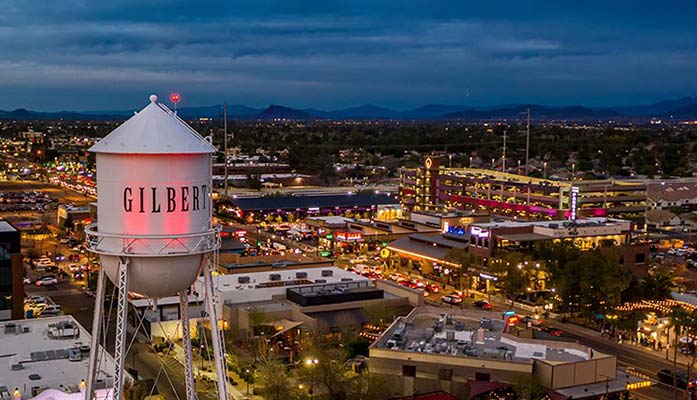
Development agreements such as the one which required a former Gilbert property owner to pay the town nearly $760,000 toward the cost of public infrastructure improvements such as streets and sidewalks are legally binding contracts and not assessments that expire after a certain period of time, the Arizona Court of Appeals ruled this week.
In a unanimous opinion released Sept. 7, the court of appeals affirmed a 2005 development agreement between the Town of Gilbert and the property owner of an 11-acre parcel on the northwest corner of East Ray Road and South Lindsay Roads. The contract called for the owner -Greater Phoenix Income Properties- to pay “a proportionate share” of public improvements.
Those improvements, which included irrigation measures and relocating utilities, were completed long ago, according to court records.
The agreement also allowed a lien to be placed on the land until full payment was made. There was also a provision in the agreement expressly binding successor owners to the contract.
Fast forward to 2016 when Ray and Lindsay 11 LLC purchased the vacant land. Company officials acknowledged knowing the terms of the development agreement, including the lien provision. Ray and Lindsay 11 sold the still-undeveloped parcel to Richmond American Homes of Arizona in 2019 and paid off the lien in order to provide the new owners with clear title.
But before that, the company sued in Maricopa County Superior Court in an effort to void the development agreement with the Town of Gilbert. The litigation initiated in 2018 has cost the town almost $155,000 in attorney’s fees to defend the agreement.
Ray and Lindsay 11 argued that the agreement’s infrastructure reimbursement requirement was an assessment which under Arizona Revised Statutes 9-243(C) abates or expires after 10 years if the property has not been developed. If the agreement was treated as an assessment, the company could have pursued a refund.
Judge Pamela Gates, however, ruled the contractual development agreements like the one Gilbert utilized are governed by a different statute, ARS 9-500.05, and that there was no assessment against the property.
Gates’ ruling was upheld by the Arizona Court of Appeals, which noted state lawmakers passed ARS 9-500.05 to provide cities and towns the ability to negotiate and enter into broad development agreements as to “the conditions, terms, restrictions and requirements” for public infrastructure as well as the financing of and subsequent reimbursements for the costs “over time.”
The appellate opinion also pointed out a key difference between an assessment and a development agreement – specifically the required mutual assent of the parties.
Gilbert officials have been represented in the case by Charles Wirken of Gust Rosenfeld. Last July, Gates signed an order and judgment against Ray and Lindsay 11 LLC for $123,603 plus interest to cover the town’s attorney fees.
The Arizona Court of Appeals affirmed the lower court award of attorney’s fees. It also awarded the town another $30,342 for Wirken’s fees expended to fight the appeal. That award has not yet been converted into a judgment. Ray and Lindsay 11 has until Sept. 22 to file a petition for review with the Arizona Supreme Court.
The Sept. 7 opinion is not the first time the Arizona Court of Appeals ruled on this case.
In May, the parties received a memorandum decision from the court with the same conclusion. However, Wirken asked the court to consider rewriting the decision as a published opinion which can be cited by other municipalities threatened with litigation over the same type of assessment argument. The court of appeals agreed, hence this week’s opinion.
Gilbert City Councilwoman Aimee Rigler Yentes told AZ Free News she welcomed the news coming out of the Arizona Court of Appeals.
Yentes has lived in Gilbert for 20 years, and is the co-founder of the Gilbert Small Business Alliance. She supports bringing development to the town and is pleased to see the town’s development agreement upheld in this case.
“The Town’s approach to ensure reimbursements were honored to make taxpayers whole was well within their authority, as affirmed by the Court of Appeals,” Yentes said. “When a municipality enters into a development agreement, it is most critical that the private interest benefits do not exceed the public returns.”