by Staff Reporter | Dec 13, 2025 | News
By Staff Reporter |
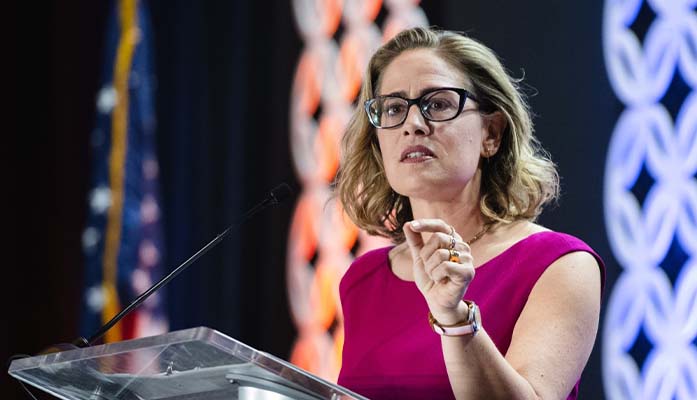
Former Senator Kyrsten Sinema claims she’s not a lobbyist, but her emails tell a different story.
Emails uncovered by FOIAzona revealed Sinema’s lobbying for a major new AI data center in Chandler.
When Sinema joined Hogan Lovells, global law and lobbying firm, as senior counsel back in March, she told reporters she wasn’t registering as a lobbyist. Sinema is also an advisory council member for Coinbase Global, a cryptocurrency company; and president and CEO of Arizona Business Roundtable.
Federal law requiring a “cooling off” period for former representatives and senators doesn’t apply to lobbying at local levels — only lobbying in Congress.
The federal lobbyist system doesn’t have Sinema registered. However it does have the registration of Hogan Lovell’s policy advisor: her former congressional aide, Daniel Winkler.
Emails revealed that Sinema met with Chandler council members in mid-June to discuss the data center. Following that meeting, Sinema used her Hogan Lovells email to push plan proposals for the data center to six city officials: a development agreement and a white paper advocating for AI data centers as an economic boon. Her emails to city officials were consistent thereafter.
“Single User – We demo the property and leave the front part open to attract the single use that [City Manager] Micah [Miranda] envisions. We build only the data center and the north building at the same time. R&D buildings along Dobson – We commence construction of these two eastern buildings within 18 months of C of O of data center. This gives Micah the time to attract a single user, but we still will process plans for these two buildings in the meantime to hit the 18 month mark. This leave the middle portion open to still attract a single user and build to suit. Full buildout – We commence spec construction of the middle building within 36 months of C of O of data center. This gives Micah the time to attract a single user, or a middle user but we still will process plans for all the buildings to hit the 36 month mark.”
Councilmember Matt Orlando then met with Sinema and Winkler in early August.
About a week later, Sinema was attempting to get the ear of another member of the council, Jennifer Hawkins.
In the days that followed, Orlando advised the city manager and economic development director that councilmembers were receiving constant communications about AI, and directed the pair to reach out to Sinema for possible development sites.
“We should not only look at the old Northrop Grumman site, but at the airport and other areas of our community for many AI clusters,” said Orlando. “We need to look at the economic model of such complexes. Please get with Kirsten [sic] Sinema, our existing companies and others in the industry and get us some ideas for a truly strategic plan to position our city for the future.”
The city’s economic development director advised in September that there wasn’t “any definitive cause relationship” between AI data centers and the desired location site for companies.
Then came the widely reported day in mid-October when Sinema argued for the data center at the Chandler Planning and Zoning Commission meeting.
It was there that Sinema threatened to use the power of the Trump administration against the city should they not approve the data center.
“[My coalition] works hand-in-glove with the Trump administration as we prepare for AI American dominance,” said Sinema. “We all know that the innovation campus has been vacant for over seven years. What I’d like you to know today is this: if we choose not to move forward with this development, the land will continue to sit vacant until federal preemption occurs.”
Sinema argued on behalf of the data center developer Active Infrastructure. She presented herself as the founder and co-chair of the AI Infrastructure Coalition (AIC), which formally launched with a swanky D.C. party last month.
AIC members include Andreeseen Horowitz, Cisco, ExxonMobil, Google, Lumen, Meta, Microsoft, and Pinnacle West. AIC’s executive director, Brian Walsh, formerly led the Congressional Leadership Fund and America First Action.
The Chandler City Council voted 7-0 against the data center in their meeting on December 11.
AZ Free News is your #1 source for Arizona news and politics. You can send us news tips using this link.
by Ethan Faverino | Nov 7, 2025 | News
By Ethan Faverino |
Axon, a global leader in public safety technology, has signed an agreement to acquire Carbyne, the cloud-native emergency communications platform trusted by agencies serving over 250 million people worldwide.
The $625 million transaction, expected to close in the first quarter of 2026, marks a critical milestone in Axon’s mission to transform public safety from the moment a 911 call is placed.
By combining Carbyne’s modern call-handling core with Axon’s AI-driven Prepared platform, the company introduces Axon 911–the industry’s first fully integrated, start-to-finish emergency response system.
Axon 911 seamlessly links callers, dispatchers, and field responders through real-time data, live video, multilingual translation, and automated evidence workflows. From the initial alert to final case resolution in Axon Evidence, every critical detail is captured, shared, and actionable.
“Every year, more than 240 million 911 calls are made in the U.S., and in too many cases, vital information is lost between the call and the response,” said Axon Founder and CEO, Rick Smith. “By uniting Axon’s 30-year legacy of innovation with Carbyne’s cloud-based call management platform, we’re closing that gap, giving call takers and dispatchers instant visibility and connecting them directly to officers in the field. It’s how we transform a call for help into the first moment of intelligence.”
The transformation relies on two complementary engines. Prepared by Axon serves as an AI overlay that enhances any existing 911 system with real-time transcriptions, automated triage, and non-emergency deflection. It currently operates in over 1,000 centers across 49 states and serves nearly 100 million residents.
Carbyne functions as a cloud-native core with 99.9% uptime, intelligent routing for voice, text, and video, and real-time voice-to-voice translation. The platform currently processes more than 250 million data points annually.
Together, Prepared and Carbyne power Axon 911 as a unified platform. Call data instantly feeds Axon Fusus for real-time analytics and command visibility. Dispatchers can trigger Axon Drone as First Responder (DFR) directly from the call screen to help deliver real-time updates. Body-camera footage, drone feeds, and digital evidence are automatically archived in Axon Evidence.
Even though 80% of 911 calls now originate from cell phones, most centers still rely on decades-old landline systems. A survey done by Carbyne with the help of the National Emergency Number Association reveals that 86% of centers face high call volumes at least weekly, with 35% experiencing them daily. Additionally, 63% report that 50-80% of calls are non-emergencies.
“Carbyne was created to modernize how help arrives — by giving emergency professionals the clarity, resilience, and confidence they need in critical moments,” said Carbyne Founder and CEO, Amir Elichai. “Joining Axon allows us to scale that mission globally and integrate more deeply into the broader public safety ecosystem. Together, we’ll help agencies save time, reduce uncertainty, and improve outcomes for the people and communities they serve.”
Ethan Faverino is a reporter for AZ Free News. You can send him news tips using this link.
by Jonathan Eberle | Oct 31, 2025 | News
By Jonathan Eberle |
The Arizona Freedom Caucus announced that Representative Alexander Kolodin will lead a special hearing on “The Implications of Artificial Intelligence for Democratic Governance and How to Preserve Meaningful Elections” on Friday, November 14, 2025, at 9:30 a.m. in House Hearing Room 4 at the Arizona State Capitol.
The hearing, open to the public and livestreamed through the Arizona Legislature’s website, will focus on how the rapid development of artificial intelligence (AI) is reshaping democratic institutions and the electoral process. Lawmakers plan to explore both the opportunities AI presents for improving government efficiency and the potential threats it poses to election security, voter confidence, and public trust.
Representative Kolodin, who chairs the House Ad Hoc Committee on Election Integrity and Florida-style Voting Systems, will be joined by four other Arizona House members, including fellow Freedom Caucus member Representative Rachel Keshel.
“The states cannot be complacent when it comes to the rapid development of AI,” Kolodin said in a statement. “The risk of insufficient oversight of AI is literally what dystopian nightmares are made of. Although it is reasonable to be excited about the prospects of AI to improve human life and society, it is equally critical to be vigilant about the ways it can be abused to erode our freedoms, including threatening democratic governance and our elections.”
The Arizona Freedom Caucus said it views the hearing as a proactive step toward crafting policy that anticipates how AI could be weaponized to undermine democratic processes. The group emphasized that while AI offers enormous benefits, its misuse could have far-reaching consequences for liberty, privacy, and electoral integrity.
“There is perhaps no greater concern than how AI will impact our elections,” the caucus said in its release. “We believe the best way to prevent destructive scenarios is to address AI’s prospective impacts and uses on the frontend.”
The November 14 session is expected to feature expert testimony and legislative discussion on strategies to safeguard Arizona’s electoral systems while responsibly integrating emerging technologies.
Members of the public can view the livestream of the hearing here.
Jonathan Eberle is a reporter for AZ Free News. You can send him news tips using this link.
by Staff Reporter | Oct 27, 2025 | Education, News
By Staff Reporter |
Arizona education leaders want their students to be ready for the dawning age of artificial intelligence (AI).
The state is now the leader in the nation for percentage of students using AI tools. State Superintendent Tom Horne announced this development on Thursday in a press release.
“I am a strong supporter of AI as a classroom tool to assist, but not replace, educators,” said Horne. “So far, about 4,000 educators statewide are using this system, and I encourage more teachers to sign up. It is an invaluable resource that helps educators do their jobs more effectively.”
Over 170,000 students — representing 16 percent of the state’s public school student population — are using AI-powered tutoring to improve their academic performance.
These students rely on the AI education system Khanmigo within Khan Academy. Horne called the sweeping adoption of the tools “tremendous.” The Arizona Department of Education invested $1.5 million for Khamingo access last year.
Horne said he selected Khanmigo for its tutoring approach: guiding students through the critical thought process, rather than merely providing answers.
“It engages students by asking questions that guide them to discover solutions on their own,” said Horne. “This approach delivers rigorous, individualized Socratic-style tutoring — a proven method for improving academic outcomes.”
The “Socratic” method referenced by Horne concerns arriving at answers through a series of open-ended questions structured to encourage critical thinking.
An example of Khanmigo’s phrasing provided in the press release (solving for “m” in the sample math problem, 3 – 2(9+2m) = m) showed how the tool prioritizes guiding the student to work through problems.
“Let’s work through it together! What do you think the first step should be to solve this equation?”
Khanmigo conversations are also recordable and viewable by teachers.
The over 4,000 Arizona educators mentioned by Horne rely on an online AI platform called the Arizona Digital Educators Library (ADEL). This platform assists educators with creating lesson plans and classroom materials that meet the state’s academic standards.
ADEL also has 50 ambassadors to increase educator usage throughout the state. There are over 57,000 educators in the state: over 47,000 in district schools and nearly 10,000 in charter schools.
As Horne explained in his State of Education speech in January, educators can use Khanmigo to strengthen student weaknesses revealed through testing.
“Today, when a teacher gives a test, some students get 90 percent, others get 70 percent. Those with 70 percent are moved to the next grade, missing 30 percent of the knowledge they need for continuing their studies. They are lost,” said Horne. “With Khanmigo, the teacher can say ‘here is what you did not learn, use Khanmigo to tutor you on that subject.’”
State Senator Jake Hoffman, founder of the Arizona Freedom Caucus, expressed support for the implementation of AI tools in schools. Hoffman said AI posed a greater threat to the American worker than Russia, China, and nuclear war.
“If K-12 public schools and public universities are not aggressively retooling every aspect of their operation to equip students with the skills to survive in this new AI age, they’ve already failed,” said Hoffman.
AZ Free News is your #1 source for Arizona news and politics. You can send us news tips using this link.
by Jonathan Eberle | Jun 2, 2025 | News
By Jonathan Eberle |
Health insurers in Arizona will soon be required to involve a licensed physician before denying medically necessary care, under a new law aimed at increasing oversight and accountability in coverage decisions. House Bill 2175, introduced by Republican House Majority Whip Julie Willoughby (R-LD13), was signed into law after receiving strong bipartisan support in the state legislature.
The legislation mandates that an Arizona-licensed medical director must personally review any denial based on medical necessity, whether it involves a prior authorization or a claim. Crucially, the reviewing physician must exercise independent medical judgment and cannot rely solely on automated tools or artificial intelligence systems.
“This law ensures that a doctor, not a computer, is making medical decisions,” said Willoughby in a statement. “If care is denied, it should be by someone with the training and ethical duty to put patients first.”
The law is set to take effect on July 1, 2026, allowing insurers more than a year to adapt their internal procedures. The delayed implementation aims to give companies time to bring their policies into compliance, including staffing licensed physicians for the review process.
The measure comes amid growing national scrutiny over how insurers use algorithms and automated decision-making tools in the claims process. Critics argue that such systems can lead to denials of care without adequate clinical oversight, potentially putting patient health at risk.
Supporters of HB 2175 say the law provides a necessary check on those systems and re-centers medical decision-making around qualified professionals who are accountable to both patients and state standards.
“Arizona families deserve real oversight when it comes to life-changing medical decisions,” Willoughby said. “This law puts patients ahead of profits and restores a layer of accountability that’s long overdue.”
The new policy aligns with the House Republican Majority Plan, which emphasizes individual rights and system transparency. While the law’s primary sponsors are Republican, it passed with bipartisan support, reflecting broad legislative agreement on the need for more oversight in insurance determinations.
The implementation of HB 2175 will be closely watched by healthcare advocates, insurers, and policy analysts as Arizona becomes one of the latest states to regulate the use of AI in healthcare decision-making.
Jonathan Eberle is a reporter for AZ Free News. You can send him news tips using this link.