by Staff Reporter | Oct 11, 2025 | News
By Staff Reporter |
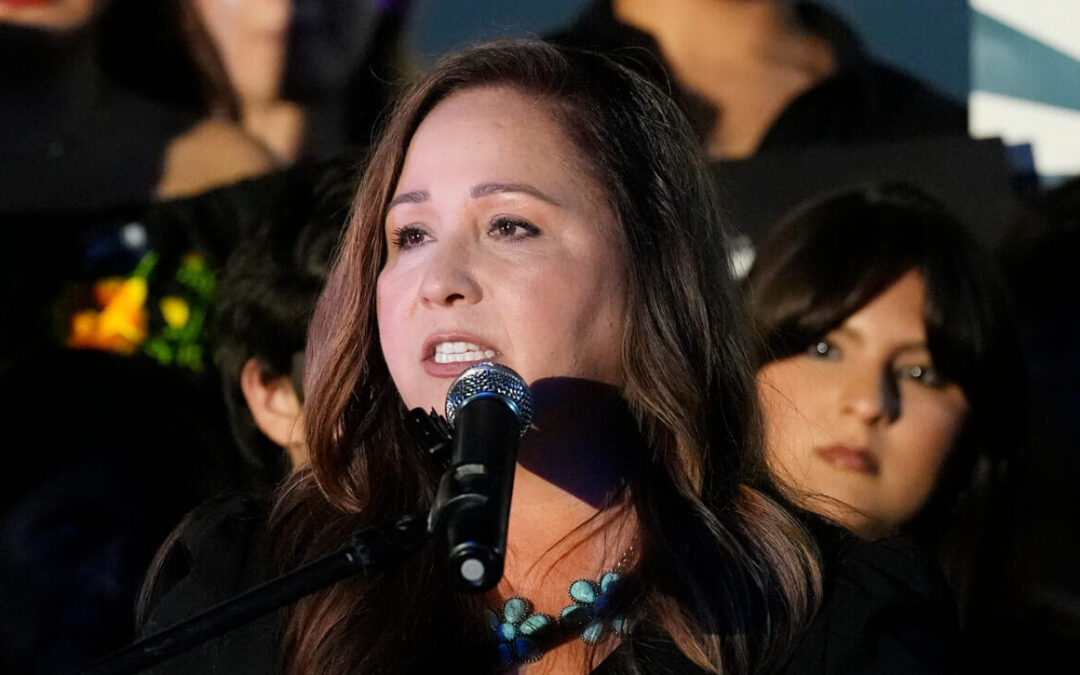
Representative-elect Adelita Grijalva says her district deserves representation, though she was silent on the absence of her father, the late Raúl Grijalva, from office.
The younger Grijalva has yet to be sworn in. She says Republicans are to blame for their refusal to agree to Democrats’ desired Obamacare continuations to lift the ongoing government shutdown.
“Speaker Johnson continues to make excuses but all the while southern Arizona still does not have a voice in Washington,” said Grijlava.
Senator Ruben Gallego also blamed House Speaker Mike Johnson and the rest of his Republican colleagues for Grijalva not being sworn in, claiming Johnson was telling “lies” to the public.
Contrary to Grijalva’s characterization of the situation, Grijalva can’t be sworn in because the statewide certification has yet to take place.
Grijalva’s desire to secure representation for her district is also a newfound one. She had little to say during the final years of her father’s term.
The late Grijalva missed most votes from last year and this year amid a lung cancer battle that would ultimately claim his life in March at 77 years old. The longtime Democrat had held his seat for 20 years when he announced his lung cancer diagnosis in 2023.
The late Grijalva missed nearly all votes (about 97 percent of votes) this and the last session before his passing. The only vote he took this session was for Democratic Rep. Hakeem Jeffries for House Speaker at the start of session. He defended his absence with the claim his vote wouldn’t have any impact in a Republican-controlled Congress.
“They’re inconsequential because the Republicans are in charge and it’s the worst performing Congress in decades, if not a hundred years,” said Grijalva at the time.
Tucson residents were quick to point out the successor Grijalva’s hypocrisy.
“A lung cancer diagnosis in April 2024 led Grijalva to miss most of his votes in the House of Representatives throughout the year and into 2025,” said one user. “[You] didn’t say a damn word.”
Grijalva couldn’t be sworn in sooner than next Tuesday, anyways, because that’s when the statewide canvass is scheduled.
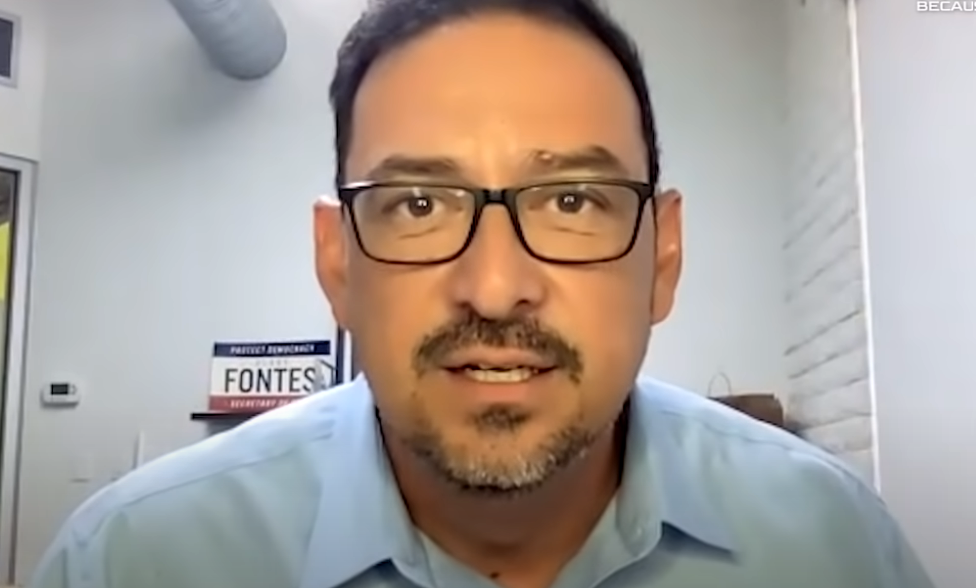
Arizona Secretary of State and fellow Democrat Adrian Fontes issued a press release on that point. The deadline to file an election contest, also, will not occur until October 20.
Next Tuesday is also the earliest date the Senate will reconvene to possibly agree on a continuing resolution to cease the government shutdown.
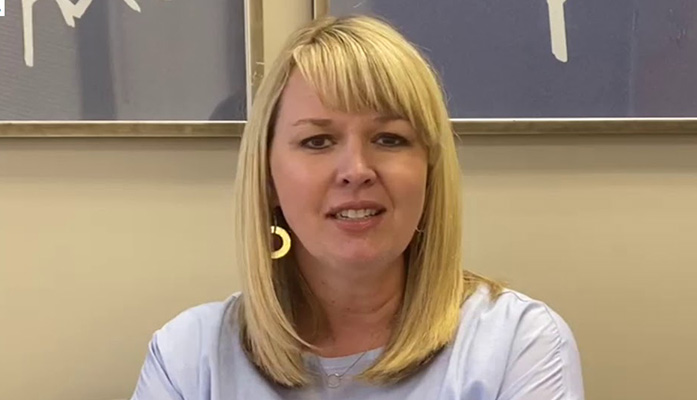
Debbie Lesko, Maricopa County Supervisor and former congresswoman, reminded the public that she wasn’t sworn in until the House began its session that year, in 2018.
“[This is] what’s happening with Grijalva,” said Lesko. “The Democrats and media are making a big deal over nothing.”
Congress had its longest shutdown on record from December 2018 to January 2019. The shutdown has lasted for over a week now.
AZ Free News is your #1 source for Arizona news and politics. You can send us news tips using this link.
by Ethan Faverino | Sep 24, 2025 | News
By Ethan Faverino |
Arizona House Speaker Steve Montenegro, alongside Senate President Warren Petersen and House Republicans, announced the filing of an amicus brief with the Arizona Supreme Court in the case Republican National Committee v. Fontes.
The brief urges the Court to require Arizona Secretary of State Adrian Fontes to adhere to Arizona’s Administrative Procedures Act (APA) when drafting the Elections Procedures Manual (EPM), a critical set of rules governing the state’s election process.
The APA mandates a transparent public notice and comment period before new rules take effect, ensuring accountability and alignment with Arizona’s election statutes.
The brief, filed in support of the Republican National Committee, the Republican Party of Arizona, LLC, and the Yavapai County Republican Party, argues that the EPM must comply with the APA’s procedural requirements, as neither the APA nor the authorizing statute (A.R.S. § 16-452) explicitly exempts it.
“The integrity of Arizona’s elections is absolutely vital. House Republicans are committed to the rule of law and to ensuring that Secretary Fontes stays within the limits of his authority,” said Speaker Montenegro. “We already convinced a judge to strike down unlawful provisions in the 2023 EPM in our own lawsuit. We fully support this case, which asks only that Secretary Fontes follow long-standing notice and comment requirements when drafting the manual. Arizonans deserve accountability and transparency from every public officer, especially when it comes to election rules.”
The brief emphasizes that Arizona’s comprehensive election laws, which cover voter registration, early ballots, polling places, and vote tabulation, limit the Secretary of State’s authority to draft an EPM.
The APA’s notice and comment process serves as a check, promoting transparency and preventing deviations from legislative intent.
The brief cites the Court of Appeals’ ruling in Republican National Committee v. Fontes, which affirmed that the EPM is subject to the APA’s requirements due to clear statutory language.
The filing highlights two key benefits of APA compliance. First, it reinforces constitutional and statutory limits on the Secretary’s authority, preventing overreach. Second, the public comment process allows for early identification of legal or practical flaws in the EPM drafts, potentially reducing litigation and supporting public confidence in Arizona’s elections.
The brief also notes issues with the 2023 EPM, where provisions added without public input led to legal challenges.
The ongoing litigation, Petersen v. Fontes, further highlights the importance of APA compliance, as it challenges the 2023 EPM’s deviation from state law. The amicus brief, submitted by Montenegro and Petersen in their official capacities, reflects the Arizona Legislature’s commitment to upholding the rule of law and protecting the integrity of the state’s electoral process.
Ethan Faverino is a reporter for AZ Free News. You can send him news tips using this link.
by Matthew Holloway | Sep 22, 2025 | News
By Matthew Holloway |
The Legislative District 10 Republican Committee in East Mesa has unanimously censured Councilwoman Julie Spilsbury for using her non-partisan office to campaign for Democrats in 2024. The censure also condemned her for voting in favor of allowing men to use women-only facilities.
Spilsbury, who is facing a recall challenge this year, became embroiled in a scandal after making public endorsements of Vice President Kamala Harris in the 2024 Presidential Election, in addition to endorsing Arizona Democrats Congressman Greg Stanton, Arizona Secretary of State Adrian Fontes, and Senator Ruben Gallego. The recall campaign, supported by Turning Point Action, submitted the 5,000 required voter signatures in May. Spilsbury is facing a challenge for her seat from conservative Dorean Taylor.
The censure from the LD10 Republicans lays out a case against Spilsbury for her endorsements of Harris, Stanton, Fontes, and Gallego despite her membership in the Republican Party, as well as her vote for “a non-discrimination order that allows men in women’s private spaces, and potentially penalizes business owners, forcing them to disregard or contradict their religious convictions and compromise their religious freedom and rights or be fined due to the ordinance,” according to a statement from the Committee.
The Committee also alleges that Spilsbury, “has benefited from her endorsements and publicly announced the offer of support and assistance in the current recall election, including Democrat Senator Ruben Gallego, the Democrat CD4 Representative, Greg Stanton, and the Democrat Secretary of State, Adrian Fontes.”
Spilsbury told Axios in July that the three Arizona Democrats have reached out to her to offer their support in her recall. She openly acknowledged the likely outcome of her endorsement of Harris in the 2024 Presidential election, telling the outlet, “I did what I did with my eyes wide open. I knew it wasn’t going to be popular.”
In the text of the censure, the committee resolved, “The Republican Committee of Legislative District 10 calls on Republican voters in Mesa to heed this vote of no confidence, cease recognition of Recalled Councilwoman Spilsbury as a Republican in good standing and cease support for Julie Spilsbury in any elected or appointed capacity, or future election for any prospective office.”
Earlier this month, the Arizona Freedom Club PAC officially endorsed Dorean Taylor in the Mesa Recall Election. Scot Mussi, Chair of the Arizona Freedom Club PAC said in a statement posted to X, “Dorean Taylor is exactly the kind of leader Mesa needs—someone who will stand up for taxpayers and put families first. Her vision for safer communities, responsible government, and protecting hard-working families from higher taxes aligns with the values we fight for every day.”
Matthew Holloway is a senior reporter for AZ Free News. Follow him on X for his latest stories, or email tips to Matthew@azfreenews.com.
by Jonathan Eberle | Sep 6, 2025 | News
By Jonathan Eberle |
Arizona Senate President Warren Petersen is calling on Secretary of State Adrian Fontes to revise the state’s draft of the 2025 Elections Procedures Manual (EPM), warning that lawmakers may pursue legal action if disputed provisions remain in place.
The Elections Procedures Manual, which outlines how elections are conducted in all 15 Arizona counties, must comply with state law and receive approval from both the governor and attorney general before taking effect. Petersen contends the current draft includes measures that exceed the secretary of state’s legal authority.
“The Elections Procedures Manual cannot be used as a vehicle to rewrite Arizona law,” Petersen said in a statement released Monday. “If these provisions are not corrected before submission, litigation will follow.”
Among the concerns identified by Petersen and Republican legislators are provisions they say weaken election safeguards. These include extending the time for non-citizens to “cure” invalid registrations, bypassing voter ID requirements on registration forms, limiting ballot challenges, and reducing oversight on ballot chain-of-custody procedures.
Lawmakers also raised objections to proposed rules that they argue diminish political parties’ role in selecting poll workers, relax standards for petition circulators, and require election officers to adhere to policies they believe infringe on constitutional rights.
Petersen said the secretary of state has a “pattern” of resisting statutory requirements, adding that changes to election rules should be made through the legislative process rather than administrative directives.
“Our election laws are passed by the Legislature and signed by the Governor — not invented by one officeholder,” Petersen said.
Jonathan Eberle is a reporter for AZ Free News. You can send him news tips using this link.
by Matthew Holloway | Aug 28, 2025 | News
By Matthew Holloway |
Last week, Arizona’s Democrat Attorney General Kris Mayes issued an opinion stating that roughly 200,000 voters mistakenly listed in state election records as having provided proof of U.S. citizenship should remain on the rolls, despite questions about their citizenship status and potential conflicts with Arizona law.
As reported by AZ Free News in November of last year, 218,000 voters were confirmed by Senate President Warren Petersen to have obtained their driver’s licenses prior to the 1996 requirement to apply with proof of citizenship, went on to get a duplicate license, and then registered to vote for the first time or re-registered to vote after 2004.
For over 20 years, they were caught up in a compatibility issue between the Arizona Department of Transportation (ADOT) and the state’s voter registration system.
According to VoteBeat’s Jen Fifield, AG Mayes’ opinion marks a notable departure from how election officials have been working to remedy the problem with counties issuing notices to voters in an attempt to collect the information.
“If an Affected Voter responds by providing such evidence, that should dispel doubt,” Mayes wrote. “But if an Affected Voter does not respond, the mere lack of response does not, under current law, authorize the county recorder to cancel the voter’s registration, in whole or in part.”
Fifield, citing the Arizona Attorney General’s manual, noted that it is unclear whether or not the county election officials will conform to Mayes’ formal opinion, which is advisory in nature and does not carry the force of law.
“County recorders may take steps to inquire whether the affected voters are U.S. citizens, including by asking them to provide satisfactory evidence of citizenship,’’ Mayes wrote.
Mayes’ opinion came in response to a request made in May by fellow Democrat Arizona Secretary of State Adrian Fontes. In a statement, Fontes said he has appreciated Mayes’ guidance, writing, “The opinion stands for the notion that these folks have a right to vote,’’ he told the AZ Capitol Times.
“And it falls to the government to prove otherwise–which is the way every other accusation, every other denial of rights exists,” Fontes said. “So the burden has shifted back to where it belongs.’’
In a statement, Fontes wrote, “The consistent treatment of voters caught up in this situation between counties is most important to ensure everyone’s voting rights are protected. I am glad we now have a clear path forward.”
Arizona Republican Party Chairwoman Gina Swoboda agreed with Mayes’ opinion, in particular her assessment of the county recorder’s limited authority to cancel registrations.
“If the recorders have affirmative proof that one of the voters is a non-citizen, they may initiate a notice and cancellation process,” Swoboda told the AZ Capitol Times. “But they may not otherwise do so because of this error.”
Coconino County Recorder Aubrey Sonderegger told the Arizona Republic that the news was welcome. “It’s exactly what Coconino County has been doing all along,” she said. “We have more than cut our list in half.”
She added that “These people weren’t doing anything nefariously” but were merely caught up in the timing of the voter registration standard changing. “I’m very relieved to hear the AG opinion,” she said. “It just means we can keep doing what we’ve been doing.”
According to the Secretary of State’s office, the current number of affected voters stands at 202,760. Maricopa County Recorder Justin Heap issued a notification on June 26, 2025, to the 83,000 county voters on the list, informing them that they must submit proof of citizenship within 90 days. Failure to do so will result in reclassification as federal-only voters, and they will not be issued state and local ballots.
Matthew Holloway is a senior reporter for AZ Free News. Follow him on X for his latest stories, or email tips to Matthew@azfreenews.com.