A bill to limit a certain government agency’s arsenal of communications is advancing through the Arizona Legislature, though it became a tough sell for Democrats on the House floor after earlier bipartisan votes in committees.
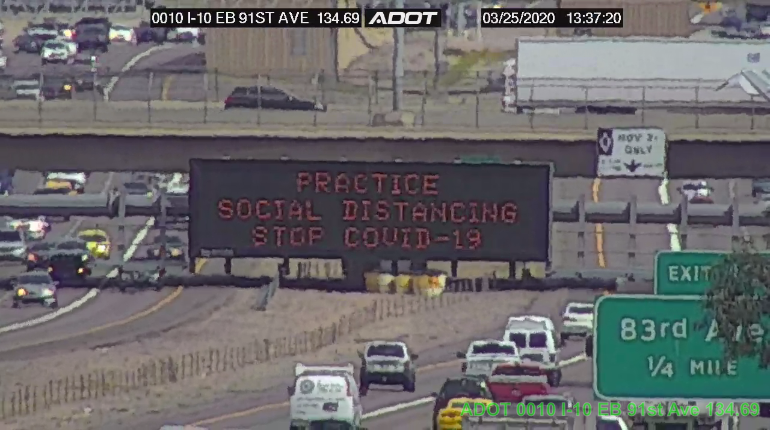
HB 2586, sponsored by Representative Neal Carter, “restricts the Arizona Department of Transportation’s (ADOT) dynamic message signs (DMSs) to display only messages that are directly related to transportation or highway public safety and outlines exceptions,” according to the purpose provided by the State Senate.
During his testimony to the House Transportation & Infrastructure Committee, the bill sponsor, Representative Carter, explained that “this bill is the law in other states.” His reasons for introducing the bill were that some of the ADOT freeway signs are a “little bit distracting” because there are messages that may not be related to transportation and otherwise inappropriate to share with commuters; and that there was good cause to worry “about government effectively using it as an advertisement for other things.” He told the committee that this would be worrying “because the people making those decisions should be elected people,” and it would be a “slippery slope” to have bureaucrats at ADOT deciding what to market or message.
When questioned about the legislation by the committee chairman, Representative David Cook, Carter clarified that it would not be the intent of HB 2586 to “specify how to make the messaging” – for example, limiting the creativity of the content as long as it was directly related to transportation. Representative Carter’s chief concern was signs that aren’t communicating directly about transportation – like “No Burn Days.”
Chairman Cook and Carter both agreed that ADOT messaging about vaccines would be a good example of what should not be included on the signs for passersby.
Representative Carter amended his bill to allow “the Arizona Department of Transportation to display reminders to vote on dynamic message signs.”
The bill passed out of the House Transportation & Infrastructure Committee with a 7-4 vote, with one member absent from the final deliberation. One Democrat voted in support. The Rules Committee unanimously approved the legislation with an 8-0 tally.
On the House floor, Democrat Representative Cesar Aguilar highlighted his opposition to the bill, arguing that the policy “would impact Arizona’s culture of signs we see on the road,” noting his perception that the ADOT “Don’t Drink and Drive” signs would be banned should this legislation be signed into law. Carter rejected that assertion, saying that the aforementioned signs were transportation-related and would not be subjected to the updated regulations of his bill. Carter also touted the bipartisan support for the bill during the committee process. Unlike in committees, though, HB 2586 did not receive any support from Democrats on the House floor, passing 31-28 – with one Democrat member not voting.
HB 2586 was transmitted to the Senate and was approved by the Transportation and Technology Committee earlier this month with a party-line 4-3 vote. It awaits further action from that legislative body.
Daniel Stefanski is a reporter for AZ Free News. You can send him news tips using this link.
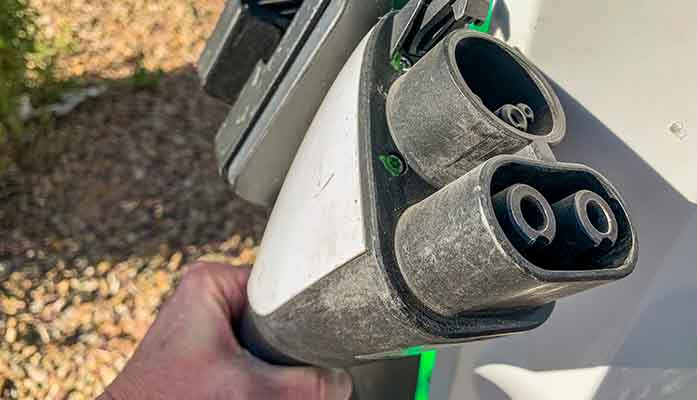
Despite mounting evidence debunking the environmental friendliness of electric vehicles (EV), Arizona’s leaders continue to roll out EV infrastructure.
The Arizona Department of Transportation (ADOT), Tucson, and Phoenix have all rolled out plans to expand EV infrastructure, as well as encourage citizens to switch to electric while transitioning government vehicles to electric. Democratic gubernatorial candidate Katie Hobbs pledged to electrify all state vehicle fleets as part of her “clean” energy plan. The state legislature also considered bills to advance EV usage earlier this year, such as SB1102 to require new homes to have EV charging.
In the latest episode of acclaimed reporter John Stossel’s “Stossel TV,” Manhattan Institute physicist Mark Mills shared that EVs won’t change oil use and carbon dioxide emissions “in any significant way.” Mills revealed that even 300-500 million EVs would only reduce world oil consumption by 10 percent. That’s the entire US population, and 5-8 percent of the world population over 16 years old. There are approximately 15-18 million EVs in the world presently.
Most oil use comes from airplanes, buses, and big trucks — even the mining equipment to obtain copper required for EVs.
“It won’t change because those trucks last 40 years,” said Mills.
President Biden: “the future of vehicles is electric!"
Green activists agree.
But an electric car creates “10-20 tons of carbon…before you drive the first mile,” says @MarkPMills.
That’s another debunked claim of EV’s environmental friendliness: the mining process requires a lot of the earth for very little. One battery requires about 500,000 pounds of minerals and rock to be mined. The mining process pollutes the surrounding environment, resulting in most operations to take place abroad in Chile and the Democratic Republic of Congo.
Altogether, the mining, manufacturing, and shipping process for EVs emits 10 to 20 tons of carbon dioxide.
Claims that EVs reduce carbon emissions are only true insofar as an EV is driven 100,000 miles at minimum. Even then, that mileage reduces emissions by up to 20 or 30 percent. The average EV battery lasts around 200,000 miles, though an EV warranty is 100,000 miles. (Tesla projects that it may develop a million-mile battery, though their cars are among the most expensive on the market). With every charge cycle, the battery pack loses capacity and reduces driving range.
Further, only 12 percent of electricity production comes from wind or solar power. Most comes from burning natural gas or coal. That’s nothing to say of the potential strain on the country’s energy grids under the Biden administration’s planned EV network, or under varying weather conditions such as cold snaps and heat waves.
EV sales increased 66 percent this year, following government and corporation efforts over the past several years to eradicate gas-powered vehicles and encourage EV buying through incentives like tax credits. California banned the sale of gas-powered cars by 2035, with Massachusetts and Washington following via trigger laws. Other states are on track to phase out gas vehicles over the next few decades, including Connecticut, Hawaii, Maine, New York, North Carolina, New Jersey, New Mexico, Oregon, and Rhode Island.
That’s in addition to nearly all major car brands pledging to shift toward mostly or exclusively EV within the next several decades, including General Motors (Chevrolet, GMC, Buick), Mercedes-Benz, BMW, Rolls-Royce, Volvo, and Audi.
Corinne Murdock is a reporter for AZ Free News. Follow her latest on Twitter, or email tips to corinne@azfreenews.com.
What will Arizona’s highways and other roadways look like 25 years from now, and what will the transportation needs be across the state?
Those are the key questions the Arizona Department of Transportation must answer as the agency begins updating its 2050 Long Range Transportation Plan, and state officials are turning to the public for help with the answers.
ADOT has launched a survey to seek the public’s input on what priorities should be included in the Long Range Transportation Plan for how ADOT should invest limited resources to meet future transportation needs across the state. The survey is available here and will be open through Dec. 21.
The Long Range Transportation Plan, which ADOT expects to be finalized in May 2023, is not project-specific. Instead, it establishes the strategic priorities, goals, and objectives which will guide ADOT’s transportation investments based on anticipated funding levels. The plan will also identify projected funding gaps to meet transportation system needs.
According to ADOT, the plan will include recommended investment choices, which will define how ADOT intends to allocate future resources across three major investment types:
Preservation: Activities to maintain the current state highway system, such as replacing, repairing, or maintaining pavement and repairing or replacing aging bridges.
Modernization: Activities to improve safety and operations of the existing state highway system, such as adding shoulders and implementing smart road technologies.
Expansion: Activities to add new highways, add lanes to existing highways, or add interchanges.
More information about the plan is available here. The website also includes an option for being added to the mailing list for future updates.
More than $13 million in federal grant money has been awarded to the Arizona Department of Transportation (ADOT) for Phase Two of a long-awaited improvement to U.S. Highway 95 between the city of Yuma and the U.S. Army’s Yuma Proving Ground.
The U.S. Department of Defense awarded the funds to ADOT last month through the Defense Community Infrastructure Pilot Program intended to make travel safer, and more reliable, for military personnel and equipment near installations such as the Yuma Proving Ground where a wide variety of weapons systems are tested.
According to ADOT, the nearly $13.3 million will be used to widen about three miles of the two-lane US 95 northeast of Yuma into a five-lane roadway from Rifle Range Road to the Wellton-Mohawk Canal bridge. The project, which is slated to begin later this year, will include a new bridge over the canal.
Meanwhile, ADOT has already been at work widening a 3.6-mile section of US 95 between Avenue 9E and Fortuna Wash as part of Phase One of the improvement project which included a new Gila Gravity Canal bridge.
Overall, ADOT is spending about $29 million for the much-needed improvements to US 95, which is an important thoroughfare not only for military purposes but also for agriculture users and residents of the greater Yuma area.
Lane restrictions and delays along US 95 are expected for several months.
The Arizona Department of Transportation is hoping to protect consumers from having a bad time buying a used vehicles.
An increased demand for certified pre-owned or used vehicles has been seen in recent months in response to manufacturer supply chain interruptions and the increased cost of new vehicles coming off the assembly line. Add that to tightened underwriting rules for new vehicle loans, and the used car market has become the next best option for many Arizonans.
But purchasing a used vehicle comes with its own risks, whether buying from a private party or a car dealer. Which is why ADOT urges consumers to use care in such transactions, and to “walk away” if anything seems off with the car, the deal, or the seller.
Most used cars sold in Arizona come with only an implied warranty of merchantability lasting 15 days or 500 miles, whichever comes first. Therefore, ADOT recommends consumers not buy a used vehicle until a trusted mechanic has performed an inspection.
In addition to checking the vehicle’s general mechanical condition, the inspection should look at whether the odometer was tampered with and whether the vehicle has any water or collision damage which was not reported or properly repaired. Such damage could lead to future malfunctions of the electrical system or engine.
A prospective buyer should also obtain a Motor Vehicle Record to ensure the vehicle’s title is not encumbered by a lien. When a vehicle title has a lien, it cannot be transferred to a new owner without a release first being recorded.
“Unfortunately, there are unscrupulous sellers that go to an auto-title / loan business and receive a loan against their vehicle one day before they sell it. The auto-title / loan business applies a lien to that particular vehicle so it can’t be sold until the loan is paid,” according to ADOT.
A Motor Vehicle Record is available at MVD offices and authorized MVD third party office. Private companies such as CarFax and Experian Automotive also sell similar records, often referred to as a vehicle history report.
A third way to avoid fraud is to ask the vehicle seller to be present with the buyer to transfer the title at an MVD or Third Party office where the payment can be exchanged.
ADOT even has advice for anyone selling a used vehicle, as seller’s too can be targeted by scammers. First, make sure to obtain the buyer’s name and address. Second, make sure to remove the license plate and any handicap placard before the new owner drives away.
It is also critical to complete an ADOT-MVD “sold notice” and submit it to ADOT. This step ensures the seller is not held responsible for any tickets or liability connected with the vehicle after the sale is reported.
Additional consumer information concerning auto purchases is available from the Arizona Attorney General’s Office here.