by Staff Reporter | Oct 13, 2026 | News
By Staff Reporter |
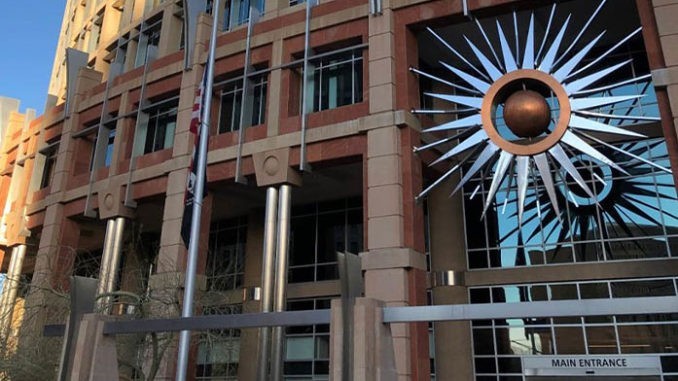
The city of Phoenix is operating a program to investigate federal agencies under President Donald Trump, according to public records.
The city publicly promotes its Community Transparency Initiative (CTI) as a complaint intake system and informational resource for the public on immigration matters.
However, records obtained by Judicial Watch reflect that the city of Phoenix tasks its employees and law enforcement with documenting, reporting, and investigating more than just federal immigration officials.
CTI, developed through the Office of Transparency and Accountability (OAT), was initially developed to take in reports and complaints concerning Immigration and Customs Enforcement (ICE) personnel.
The city’s employee training materials reveal that CTI has a much larger scope of oversight beyond ICE to include more federal agencies. City employees are trained to document and report all encounters involving federal law enforcement personnel. They are also trained to maintain records of time and resources devoted to work done concerning CTI.
Agencies under city of Phoenix employees’ purview were indicated to include the Federal Bureau of Investigation; United States Secret Service; Alcohol, Tobacco, Firearms, and Explosives; United States Postal Inspection Service; Border Patrol; Drug Enforcement Agency; United States Marshals Service; Federal Air Marshal Service; Federal Protective Service; Capitol Police; and the Transportation Security Administration.
Under CTI, the Phoenix Police Department uses its Special Investigations Division to review CTI complaints, investigate for criminal or civil rights violations, and pass along findings to Arizona Attorney General Kris Mayes. Both the police and fire departments have been involved in implementing CTI.
The initiative also connects residents with multiple progressive nonprofit organizations: the national and Arizona chapter of the ACLU, Immigrant Legal Resource Center, National Immigration Law Center, Informed Immigrant, Florence Project, International Rescue Committee, Phoenix Legal Action Network, and the Immigrant Advocacy Network.
CTI also refers residents to its Office of Refugee and Immigrant Support, established in March 2023 amid the height of the illegal immigration crisis under former President Joe Biden. The office provides refugees and asylum seekers with integration services, including access to healthcare, housing, childcare, education, and employment.
Around the same time in 2023, Gov. Katie Hobbs’ administration allocated $60 million to house, feed, and provide other resources to the homeless and illegal immigrants. $13 million went to the city of Phoenix.
In recent years, the city spent around $8 million of its $396 million in American Rescue Plan Act funds on refugee and immigrant services.
In early March of this year, the city authorized spending up to $500,000 through June 2028 for legal counsel through Coppersmith Brockelman PLC, a favorite law firm among top Democrats such as Gov. Katie Hobbs, though the CTI website and later reporting stated that the city spent $1 million to hire the firm. Sam Coppersmith, a managing partner to the firm, was formerly a Democratic congressman for the 1st Congressional District and a chairman of the Arizona Democratic Party.
Judicial Watch didn’t receive any records confirming that the city formally considered any other law firms to provide outside legal counsel for CTI.
Following this authorization for outside legal counsel, the city passed a policy banning ICE enforcement operations from city-owned property. Mayes later issued a defense of the city’s action.
AZ Free News is your #1 source for Arizona news and politics. You can send us news tips using this link.
by Staff Reporter | Sep 10, 2026 | News
By Staff Reporter |
On a Friday in July 2022, the Department of Justice (DOJ), under President Joe Biden, arrested a man for a bomb threat he’d made a year and a half earlier to the Arizona secretary of state at the time, Katie Hobbs.
According to the DOJ’s public announcement of that arrest, that threat was sent online in mid-February 2021 through the secretary of state’s Elections Division contact form. Yet, it took law enforcement more than a year to nab the perpetrator: a Massachusetts man named James Clark.
Media outlets promptly picked up the news of Clark’s arrest, framing it as the latest in what was then an ongoing scourge of threats to election officials following the contentious 2020 election.
Hobbs was reaffirmed in the public eye as a face of resistance to former President Donald Trump’s purported election denialism. And she was deep into a contentious race of her own for the governor’s office against Trump-backed candidate Kari Lake.
“Election officials across the country are being threatened regularly for doing their jobs,’’ said Hobbs in a prepared statement at the time. “It’s unconscionable and undermines our democracy. This harassment won’t be tolerated and can’t be normalized. We thank the FBI for their persistence on further investigating this incident.”
The one detail that never received much attention was the timing of Clark’s arrest.
On the same day that the DOJ sparked a flurry of media coverage on their delayed arrest of a Trump-defying Democrat’s would-be assassin, a Hobbs campaign operative quietly registered Will of the People, a political action committee (PAC) that would go on to raise more than $5 million from dark money and labor union heavyweights across the nation.
The listed address for the PAC is a virtual office in downtown Phoenix. Its treasurer from day one was Dacey Montoya, founder and president of The Money Wheel, a well-known political and nonprofit compliance firm in Democratic circles. Montoya is currently the treasurer for both Gov. Katie Hobbs’ campaign and Hobbs’ alleged campaign finance fund-washing fund.
Montoya has offered her Money Wheel services to numerous Democratic candidates, party organizations, and progressive dark money operations both in Arizona and nationally over the years. Past clientele include Gov. Katie Hobbs, Secretary of State Adrian Fontes, Rep. Yassamin Ansari, Sen. Mark Kelly, Jevin D. Hodge, Kirsten Engel, Reginald Bolding, Arizona Democratic Party, Maricopa County Democratic Party, Progress Now Arizona/Progress Arizona, Our Voice Our Vote Arizona, Copper State Victory, and the Arizona Education Association.
The Money Wheel has received more than $5.2 million since 2017 at the federal level according to Federal Election Commission records, and more than $1.9 million since 2017 at the state level according to secretary of state campaign finance records. Since 2022, Montoya’s company has received more than $119,000 from the PAC.
Will of the People PAC
Most of Will of the People PAC’s millions came in 2022 and 2024.
- $2.3 million from SEIU-UHW and SEIU-COPE, the nation’s largest labor union and a PAC
- $1 million from Open Society Action Fund, an organization by the Soros family, who are top Democratic dark money donors
- $680,000 from ProgressNow AZ
- $600,000 from the National Education Association
- $360,000 from the Fairness Project
- $200,000 from the American Civil Liberties Union (ACLU) of Arizona
The PAC has not reported any income this year, and the only significant reported expenditures so far have been $8,000 from January through April given to The Money Wheel.
The PAC has spent an undisclosed amount of funding on lawfare to kill Republican-led ballot initiatives; in recent months, they filed two lawsuits to stop Propositions 142 (called the “Prohibit Mandatory Support for Discrimination or Preferential Treatment by Government Entities Amendment”) and 318 (called the “Require All Schools and Athletic Associations to Restrict Sports Participation and Access to Private Spaces Based on Sex Measure”).
Prop 142 would prohibit the state and government agencies from compelling, promoting, or implementing practices rooted in preferential treatment or discrimination based on race or ethnicity.
Prop 318 would restrict access to private spaces like restrooms and locker rooms based on biological sex, bar male students from participating in female sports, and establish a definition of sex rooted in biology.
In the case of Prop 318, the PAC also created a website called “Vote No on Prop 318.” However, per media coverage and the website itself, the PAC is now claiming to be a program under Progress Arizona, a progressive 501(c)(4) nonprofit. This website has not been disclosed under the PAC’s campaign finance reporting as of this report. The PAC’s logo is displayed on the website.
“Will of the People is a program of Progress Arizona,” states the website. “Email info@progressarizona.org. Paid for by Will of the People.”
Concerning the media — as previously reported, the PAC once identified The Arizona Republic as an endorser of their efforts.
It appears that the PAC may have failed to file some of its required expenditure disclosures. Four television advertisements urging Arizonans to vote “no” on Prop 132 (called the “60% Vote Requirement for Ballot Measures to Approve Taxes Amendment”) weren’t reflected in the PAC’s ballot measure expenditures for 2022, because none were issued.
Voters approved Prop 132 in 2022, which established a 60% vote threshold for ballot measures approving taxes.
Will of the People Is Also a Nonprofit
The PAC also has a similarly named nonprofit, “Will of the People Arizona.” The two share a launch year, an address, and leadership.
One of the first leaders of the nonprofit arm, Betsy Boggia, was not listed on PAC documentation. Boggia served as the director/secretary from 2022 through 2024, based on Arizona Corporation Commission records.
Will of the People: Articles of Incorporation
Will of the People Annual Reports: 2023, 2024, 2025, 2026
Boggia is a League of Women Voters board member and a recent former president of its Tucson chapter, according to her active and up-to-date LinkedIn profile. Notably missing from her work history and posts were any references to her leading a nonprofit that raised more than $5.5 million in three years.
Boggia’s silence on the matter may be explained by the nonprofit’s tax filings, which reported that Boggia spent an average of just one hour per week running the multi-million dollar operation.
Between the nonprofit and PAC, the two apparently affiliated entities have raised and spent approximately $11 million in four years.
The nonprofit didn’t disclose its revenue sources on its available tax filings from 2022, 2023, and 2024. Only four contributions totaling $2.1 million were publicly available through other organizations’ tax filings:
Only the ACLU provided a detailed explanation for the purpose of their contribution: paid communications to defeat Propositions 128, 129, and 132.
Propositions Targeted by Will of the People PAC and Nonprofit
Based on various sources, the PAC and nonprofit together targeted at least 14 Republican-led propositions from 2022 through this year.
Nine were defeated and five passed. Five are to be determined this year.
The PAC and nonprofit also successfully advocated for the passage of Prop 139 in 2024, which made abortion a constitutional right in Arizona.
On publicly available archived versions of the PAC’s site from 2024 through 2025, the PAC clearly disclosed which propositions it opposed: Props 134, 136, 137, and 139.
Prop 134 would have set a signature distribution requirement in all 30 legislative districts for citizen-led initiatives: 10% for statewide initiatives, 15% for constitutional amendments, and 5% for statewide referenda.
Prop 136 would have allowed individuals to sue to stop voter-proposed initiatives from being put on the ballot if they believe them to be unconstitutional.
Prop 137 would have ended term limits for state supreme court justices and superior court judges.
Then, earlier this year, the PAC changed its website to offer a ballot proposal guide in exchange for donations. The linked donation button led to a donation page hosted by ActBlue Civics, which disclosed that the donated funds would be given to Progress Arizona, a 501(c)(4) nonprofit, not the Will of the People PAC.
In 2024, the PAC disclosed giving $8,000 to Progress Arizona’s policy and research director, Casey Clowes, in 2024 to run digital ads opposed to multiple propositions and in favor of one proposition, Prop 139, which created a constitutional right to abortion.
The PAC has also paid $55,000 to ProgressNow AZ and Progress Arizona PAC, and $706,000 to the Arizona Democratic Party.
The current version of the site as of this report no longer includes the promise of a ballot proposal guide in exchange for fundraising. Instead, the PAC website now urges individuals to endorse a “no” vote on Props 142, 144, 318, and 320.
“A group of power-hungry politicians have voted to put a set of highly deceptive propositions on your ballot this November,” states the present version of the site. “They are aiming to make voting more difficult for Arizonans, hollow out our schools with funding cuts, and institute blanket discrimination in youth sports. You can help stop these propositions by adding your name to the list of Arizonans endorsing a NO vote on these dangerous measures.”
Despite its grassroots-sounding name, Will of the People has been funded by millions of dollars from national labor unions, progressive organizations, and Democratic-aligned dark-money groups, while its leadership and vendors have extensive ties to Arizona’s Democratic political establishment.
The organization has opposed numerous Republican-led ballot measures. With five targeted measures still awaiting a vote, its influence over Arizona’s ballot initiatives remains active heading into November.
AZ Free News is your #1 source for Arizona news and politics. You can send us news tips using this link.
by Staff Reporter | Aug 15, 2026 | News
By Staff Reporter |
The American Civil Liberties Union (ACLU) has ended its lawsuit about a month after it filed to challenge the constitutionality of Proposition 314 — at least, for the time being.
The ACLU filed a notice of voluntary dismissal with the Arizona District Court on Wednesday. It made that filing a day after the preliminary injunction hearing was initially scheduled to occur, but which had been vacated the Friday prior.
Prop 314, passed by Arizona voters in 2024, gave law enforcement the authority to enforce federal immigration laws. An ACLU attorney representing Florence Immigrant & Refugee Rights Project (Florence Project), the plaintiff challenging the proposition, says their team can find no evidence of law enforcement exercising this new authority.
Prop 314 made illegal immigration a state crime. That means state and local police may arrest illegal aliens and state judges may order deportations of illegal aliens. The proposition also required immigration verification for financial aid and public welfare, and made it a Class 6 felony to submit false information or documents for purposes of employment or public benefits.
The proposition went into effect in mid-July.
ACLU attorney John Mitchell said their team would wait for evidence that law enforcement or state judges had acted upon Prop 314 before relaunching their challenge.
“The trajectory of this litigation has always depended on when and how the state chooses to enforce Section 5,” said ACLU attorney John Mitchell. “In the first month that Section 5 has become fully enforceable, we’ve just seen none. So, from a litigation standpoint, it means our best strategy is to hold off until we get evidence of that enforcement.”
Mitchell’s take appeared to be the ACLU heeding arguments made by Attorney General Kris Mayes, who was named as a defendant in the lawsuit. Mayes’ team warned in a filed response that the lawsuit was premature since no law enforcement or courts had exercised Prop 314 authority.
“Because Section 5 has barely gone into effect, Florence Project has not shown and likely cannot show that anyone has been subject to arrest, detention, or prosecution for violating the illegal entry provision,” stated the attorney general’s office. “Likewise, no one has been subject to an order to depart the country under [the law], because such orders are tied to a charge or conviction for violating the illegal entry provision.”
The Florence Project, with the support of the ACLU and the ACLU of Arizona, filed its lawsuit in early July, claiming Prop 314 violated the Supremacy Clause of the Constitution. The organizations stated that only the federal government may regulate immigration.
“Immigration is a quintessentially federal authority. Congress has created a carefully calibrated immigration system, with detailed procedures that determine whether a person may remain in the United States, when to pursue criminal entry charges in the exercise of prosecutorial discretion, and what protections people receive to ensure that they do not face persecution or torture upon removal,” stated their complaint. “Congress placed all relevant authority in the hands of federal officials — in keeping with the federal government’s exclusive immigration powers and the sensitive foreign policy implications of these powers.”
The Arizona District Court denied the organization’s motion for a temporary restraining order about two weeks ago.
Living United For Change, another progressive group, lost their lawsuit challenging the constitutionality of Prop 314 last year.
AZ Free News is your #1 source for Arizona news and politics. You can send us news tips using this link.
by Matthew Holloway | Jan 24, 2026 | News
By Matthew Holloway |
A proposed constitutional amendment aimed at reshaping Arizona’s election system passed its first major legislative hurdle in a hearing on Wednesday, as the Arizona House Committee on Federalism, Military Affairs & Elections (FMAE) approved Rep. Alexander Kolodin’s (R-LD3) Arizona Secure Elections Act.
The Committee advanced House Concurrent Resolution 2001 with a 4-3 vote. It now heads to the House Rules Committee. If approved by both chambers of the Arizona Legislature, the measure would be referred to voters on the November 2026 general election ballot.
Kolodin announced the committee hearing on social media ahead of the meeting.
According to supporters, HCR 2001 is intended to address concerns about voter confidence following recent election cycles. If approved by voters, the constitutional amendment would establish several requirements for statewide election administration.
Those provisions include limiting voter registration and participation to U.S. citizens, prohibiting foreign contributions to candidates or ballot initiatives, and requiring government-issued identification in order to vote.
Additional requirements would mandate that early voting concludes no later than 7:00 p.m. on the Friday preceding a Tuesday general election, prohibit the acceptance of ballots after polls close on Election Day, preserve in-person voting options at accessible polling locations, and require mail-in voters to verify their address each election cycle.
Committee Debate
During the hearing before the committee, Kolodin described HCR 2001 as an effort to overhaul Arizona’s election system by drawing comparisons to reforms adopted in Florida after the 2000 presidential election.
“This year the Arizona State Legislature will give the voters of Arizona the opportunity to transform our system of elections from a national embarrassment to a national model,” Kolodin told committee members, arguing that Florida’s reforms improved election security, sped up results, and increased voter satisfaction.
Kolodin urged lawmakers to advance the measure, saying the proposal would allow voters to address longstanding concerns about election administration.
Democrats raised concerns about voter access and election logistics. Rep. Aaron Márquez (D-LD5) argued that the proposal would effectively end the active early voting list and push large numbers of voters back into in-person voting without funding for additional polling locations, potentially creating longer lines on Election Day.
Kolodin rejected that characterization, emphasizing that HCR 2001 is a constitutional ballot referral rather than a statutory change.
“You have mistaken assumptions right off the bat,” Kolodin said. “It’s not a piece of legislation. It’s not modifying statutory law. This is a constitutional ballot referral.”
Kolodin explained that constitutional amendments are intended to establish broad governing principles, while election administration details are left to statute.
“In a statute, you want to be prescriptivist,” he said. “With a constitutional amendment, you must refrain from being overly prescriptivist,” noting that constitutional provisions are designed to endure for generations.
Addressing concerns about early voting, Kolodin said the proposal would not eliminate early or mail-in voting but would require voters to confirm their address each election cycle before automatically receiving a ballot.
Kolodin also defended the proposal’s voter identification requirements, arguing that the current signature verification system is imprecise and can result in lawful ballots being rejected.
“Our current system of signature verification, which is incredibly imprecise, leads to a large number of valid votes sometimes be[ing] rejected. It’s a very imperfect system. A more precise system, where a definite match can be obtained, where you don’t have to squint at the loops and the squiggles to try to figure out the signatures match, or if a ballot should be sent to curing, and potentially rejected, but where there’s something where it’s binary: it’s either a yes or no. There’s no matter of opinion there [that] will actually lead to fewer votes cast by lawful voters being rejected in the system,” Kolodin said.
Advocacy Groups Weigh In
The Arizona branch of the American Civil Liberties Union, represented by Katelynn Contreras, opposed the Resolution during the public comment period, stating, “HCR 2001 does not improve election integrity. Instead, it will restrict access for eligible voters to create confusion and rigid, unworkable rules in the Arizona Constitution. This resolution significantly curtails early and non-voting options that most Arizonans rely on.“ The ACLU representative cited what she described as survey data, claiming that 70 percent of Arizona voters say elections are fair and that roughly 80 percent vote by mail or early, and suggested that the ballot measure would “ban a method of voting that is widely used in the state.”
The figures cited by the ACLU couldn’t be independently verified by AZ Free News.
Asked to clarify the claim, Contreras said the measure would create “new discretionary areas that could be used to restrict mail voting for future.” Kolodin responded, “Mr. chair, I just wish to point out that that is untrue. OK, I just want to put that very clearly.”
The Arizona Freedom Caucus has promoted the proposal on its social media channels since the resolution’s prefiling in November, identifying it as a legislative priority and encouraging public engagement ahead of committee consideration. Arizona House Republican accounts have also circulated prior statements from Kolodin outlining the proposal’s intent.
Arizona Freedom Caucus Chairman Jake Hoffman (R-LD15) urged legislative leaders to advance the proposal following committee review.
“The Arizona Freedom Caucus is grateful that AFC Member Representative Alexander Kolodin has once again provided much-needed leadership in the critical mission to secure Arizona’s elections today and into the future,” Hoffman said. “Once it is heard by the FMAE Committee this week, I urge House Leadership to move it quickly to a floor vote and then send it to the Senate.”
Kolodin criticized the objections raised during the hearing, saying opponents had failed to cite provisions supporting claims that the measure would end early voting.
“We have now reached the point where the opposition to this measure has become truly silly,” Kolodin said, arguing that the proposal would expand, not restrict, voting opportunities.
He added, “It is time for the people of Arizona to have the opportunity to get their kids and their grandkids, my kids and your kids, an election system that we can be proud of, an election system that actually works, instead of inconveniencing and disenfranchising voters, and an election system that provides more opportunities for community participation by casting one’s vote at the polls or to return you ballot to the polls as you prefer. And it’s time, in other words, to take this choice out of the hands of politicians and put it in the hands of the people who actually deserve to have it: you, the voters of Arizona, and that’s where we’re sending it, despite the opposition.”
AZ Free News previously reported on Kolodin’s election integrity proposals and related legislative efforts, including the prefiling of HCR 2001 and its Senate mirror measure, SCR 1001, in November 2025. The Senate resolution, introduced by Sen. Shawnna Bolick (R-LD20), passed a hearing with the Senate Judiciary Committee 4-3 on Wednesday and will be heard next by the Senate Rules Committee.
The resolution must be approved by both the Arizona House and Senate before it can be referred to voters for consideration in 2026.
Matthew Holloway is a senior reporter for AZ Free News. Follow him on X for his latest stories, or email tips to Matthew@azfreenews.com.
by Staff Reporter | Dec 27, 2025 | News
By Staff Reporter |
Arizona’s legislative leaders issued a statement of support for a federal action establishing a new level of parental rights to access their children’s medical records.
The Department of Health and Human Services (HHS) announced earlier this month further protections for parental rights in healthcare. HHS Secretary Robert F. Kennedy, Jr., cited an incident in which a Midwestern school allegedly ignored a religious exemption and vaccinated a child without parental consent.
That school remains under investigation by the HHS Office for Civil Rights (OCR) for potential violation of the Vaccines for Children Program (VFC), which requires providers of vaccines received federally to comply with state laws on religious and other exemptions.
In addition to Kennedy’s announcement, the Health Resources and Service Administration (HRSA) issued an advisement to its health center grant recipients of their required compliance with federal and state laws on parental rights. OCR also issued a letter to healthcare providers advising of their duty to provide parental access to children’s medical records.
“If a provider is standing between you and your child, HHS is going to step in,” said Kennedy in an announcement video.
House Majority Whip Julie Willoughby (R-LD13) published a statement expressing gratitude for the HHS action to assist parents in Arizona and nationwide.
“Arizona parents know this problem because they’ve lived it. Families have been locked out of online medical portals and forced to fight for access to records needed to schedule appointments, refill prescriptions, and communicate with doctors,” said Willoughby. “Parents should not need a lawyer or a lawsuit to see their child’s medical records. This problem was identified years ago. It’s time for the state to stand with parents.”
Republican lawmakers attempted to offer a similar remedy last year (House Bill 2183) and this year (House Bill 2126), but Governor Katie Hobbs vetoed both.
Both bills would have required health care entities to provide parents with access to any electronic portal and delivery platform of their child’s medical records, even in cases where the medical treatment given didn’t require parental consent.
Hobbs cited health, safety, and privacy rights as reasons for vetoing the bills.
“The measure as written could put the health and safety of vulnerable Arizonans at risk,” said Hobbs in her House Bill 2183 denial letter.
“Patient privacy is a longstanding tenet of American healthcare and this bill would create legal ambiguity for healthcare providers who have existing obligations to patient privacy,” said Hobbs in her House Bill 2126 denial letter.
The only community member to speak on the latest vetoed bill during its House committee hearing was a representative of the ACLU of Arizona and Planned Parenthood Advocates of Arizona, Marilyn Rodriguez with Creosote Partners.
The two activist organizations argued the existence of a distinct class of children — “mature minors” — which should be exempt from parental oversight in their medical care. Rodriguez claimed the bill would be “impacting mature minors’ confidentiality when accessing critical care.”
There is no statutory language that distinguishes “mature minors.” Rodriguez further argued that medical providers should decide whether a minor qualifies as a “mature minor,” not the legislature.
On behalf of Planned Parenthood Advocates of Arizona specifically, Rodriguez argued that minors should have the ability to access abortions without their parents knowing or consenting.
Again, during the Senate committee hearing on the bill, only a representative of Planned Parenthood was present to speak against the bill. Aven Kelley, a policy analyst with Planned Parenthood Advocates of Arizona, argued that minors should have autonomy and privacy when it comes to obtaining abortions.
AZ Free News is your #1 source for Arizona news and politics. You can send us news tips using this link.
Page 1 of 11