by Corinne Murdock | Aug 21, 2022 | News
By Corinne Murdock
Phoenix leadership may prohibit the use of city resources to enforce abortion restrictions or bans, according to a forthcoming resolution.
Although the resolution isn’t available for public review yet, city officials gave confirmation of its existence to the newly-launched Phoenix arm of Axios on Monday. The city council tasked staff to craft the resolution in June, according to City Attorney Cris Meyer.
Following the Supreme Court (SCOTUS) ruling that rejected the existence of a constitutional right to abortion, Phoenix Mayor Kate Gallego declared that the city was pro-choice.
“A majority of the city council and I have no interest in using city resources to prevent women from accessing health care,” said Gallego.
Gallego’s communications director, Jeanine L’Ecuyer, announced earlier this summer that the council was deciding between three separate actions: formal opposition to the SCOTUS decision, a petition to the Arizona state legislature to legalize abortions, and the prohibition of city resources for enforcing abortion laws.
In July, Councilwoman Yassamin Ansari declared that prohibiting enforcement of Arizona laws on abortion was the city’s way of fighting back. Ansari has also called for cities to fund abortion travel expenses.
The abortion industry in Arizona has largely come to a halt, due to uncertainties of current law. Arizona has several laws regulating abortion. The oldest law predating statehood, thereby preceding SCOTUS’ Roe v. Wade decision, banned abortion completely. Another law codified in March restricts abortions after 15 weeks’ gestation.
Few are willing to provide abortion services. One Phoenix clinic, Camelback Family Planning, continued with its abortion services after a federal judge issued an injunction on a 2021 Arizona law recognizing the personhood of an unborn child. The clinic hasn’t only given abortions to Arizona women — according to abortionist Dr. Gabrielle Goodrick, the clinic has given abortions to women in other states as well.
“It’s inhumane, it’s unethical, it’s not sound medically to have women waiting and traveling,” said Goodrick.
The legal hurdles confronting pro-abortionists in Arizona and across the nation prompted Planned Parenthood to take action. The abortion giant pledged to spend $50 million in support of pro-abortion candidates — Democrats — ahead of the upcoming midterm elections in November. The funds will hit Arizona as well as Georgia, Nevada, Minnesota, Pennsylvania, North Carolina, New Hampshire, Michigan, and Wisconsin.
So far this year, Federal Election Commission (FEC) records reflect that Planned Parenthood has only contributed $2,000 to Congressman Tom O’Halleran (D-AZ-01). He’s facing Republican, Trump-endorsed opponent Eli Crane.
In 2020, Planned Parenthood put $28,000 into Arizona through its Arizona division, Planned Parenthood Advocates of Arizona (PPAZ), and several federal leaders: O’Halleran, Senator Mark Kelly (D-AZ), and failed Democratic congressional candidate Hiral Tipirneni.
This year, according to the secretary of state’s campaign finance database, PPAZ has spent over $74,700 so far this year on pro-abortion Democratic candidates. In 2020, PPAZ spent over $211,000.
Corinne Murdock is a reporter for AZ Free News. Follow her latest on Twitter, or email tips to corinne@azfreenews.com.
by Corinne Murdock | Jul 14, 2022 | News
By Corinne Murdock |
On Monday, a federal judge determined that a 2021 law recognizing the personhood of unborn children was unconstitutionally vague and in conflict with other state laws.
The law, referred to as the “Interpretation Policy,” declares that all state laws should be interpreted and construed to acknowledge that unborn children have the same rights, privileges, and immunities as all other Arizonans. The statute includes specific cause of action exemptions for individuals who perform in vitro fertilization procedures and women who indirectly harm their unborn children due to improper or insufficient self-care.
The law also defines “unborn child” as the “offspring of human beings from conception until birth.” Conception is synonymous with fertilization, although the federal judge in the case, Arizona District Court Judge Douglas Rayes, an Obama appointee, contended that certain medical journals recognized conception as the moment a fertilized egg implants in the uterus.
READ THE LAW HERE
Rayes opined that Arizona’s Interpretation Policy was unclear in what it meant to “acknowledge” the equal rights of the unborn, pointing to the lack of definition anywhere in Arizona statutes and comparing the variety of definitions offered by Merriam-Webster and Black’s Law Dictionary. He agreed with the plaintiffs that authorities might employ a maximalist view of acknowledging the equal rights of the unborn.
On the subject of definitions, Rayes further contended that neither the Interpretation Policy or any other Arizona law amended the definition of “person” to include unborn children. Rayes added that the legal team of the lead defendant, Attorney General Mark Brnovich, couldn’t explain why that was in court proceedings.
“The Interpretation Policy either does absolutely nothing, or it does something. What that something might be is a mystery or, as Defendants put it, ‘anyone’s guess,’” wrote Rayes. “A law which requires such extraordinary effort to decipher fails to give ordinary people fair notice of the conduct it permits and proscribes.”
Brnovich hasn’t issued a statement on Rayes’ ruling. His latest press release announced a lawsuit excoriating the U.S. Department of Energy’s (DOE) latest dishwasher and laundry machine regulations. On the day Rayes issued his ruling, Brnovich only tweeted a statement about an ongoing lawsuit to prohibit charitable donations from being an alternative to class payouts.
Further on in his ruling, Rayes argued that the Interpretation Policy’s personhood requirement conflicted with other current laws regulating abortion: abortion providers’ licensing and credentialing requirements in A.R.S. §§ 36-2155, 36-2153(E), 32-3531(B), 36-449.03(C)(3)(a)–(b); abortion clinic licensing requirements in A.R.S. §§ 36-449.02; 36.449.03; abortion informed consent requirements in A.R.S. §§ 36-2153, 36-2156; abortion statistical and demographic data reporting requirements in A.R.S. §§ 36-449.03(I), 36-2161–62; second trimester abortion method restriction in A.R.S. § 13-3603.01; ban on abortion for reasons of race or sex in A.R.S. § 13-3603.02(A)(1); consent requirements for minors in A.R.S. § 36-2152; and restrictions on telemedicine for abortion care in A.R.S. § 36-3604.
Additionally, Rayes expressed concern that other parts of Arizona’s criminal code could leave abortion providers vulnerable to prosecution since they didn’t have exemptions for lawful abortions, such as statutes on assault, child endangerment, and child abuse.
“Abortion providers do not have fair notice of whether, if they conform their conduct to these laws, they nonetheless may face criminal, civil, or professional liability under other statutes based solely on what licensing, law enforcement, or judicial officials think it means to ‘acknowledge’ the rights of the unborn,” wrote Rayes.
In his concluding remarks, Rayes clarified that his ruling didn’t focus on abortion but rather the law’s justice.
“[This motion] is about giving people fair notice of what the law means so that they know in advance how to comply,” wrote Rayes. “The Interpretation Policy is so vague that it ‘makes it impossible for plaintiffs to do their work with fair notice of conduct that is forbidden or required, in violation of their procedural due process rights.”
The American Civil Liberties Union (ACLU) and Center for Reproductive Rights (CRR) filed the initial complaint on behalf of doctors Paul Isaacson and Eric Reuss, the National Council of Jewish Women Arizona (NCJW AZ), the Arizona National Organization for Women (AZ NOW), and the Arizona Medical Association (ArMA).
Isaacson is a Phoenix-based abortionist with Family Planning Associates (FPA) Medical Group, and previously a University of Arizona College of Medicine professor. After SCOTUS denied the existence of a constitutional right to abortion last month, Isaacson began crowdfunding $100,000. FPA Medical Group closed due to the current legal limbo concerning abortion in the state.
In an update last Saturday, Isaacson shared that the funds raised — at the time, just under $6,000 — enabled FPA Medical Group to keep its staff employed another week.
“We continued to dismantle the clinic today — very emotional moment taking my diplomas off the wall,” wrote Isaacson.
Reuss is a Scottsdale-based OBGYN who served previously on the board of Planned Parenthood of Arizona (PPAZ). Phoenix Magazine named Reuss a “Top Doc” seven times from 2010 to 2018.
Both Isaacson and Reuss have engaged in pro-abortion legal battles alongside ACLU and CRR before. Most recently, the parties came together to defeat Arizona’s requirement that abortion providers inform their patients about reversal procedures prior to taking an abortion pill.
Reuss wrote an opinion piece for the Arizona Republic in 2015 claiming that abortion pill reversal wasn’t evidence-based, calling the requirement “legislative overreach” and “hearsay.”
“There is absolutely no evidence-based data that the process can be reversed,” wrote Reuss.
Certain studies and current treatments for reducing risks of recurring miscarriage and premature births conflict with Reuss’ claim. A study specific to abortion pill reversal found that 64 to 68 percent of pregnancies were saved within 72 hours of taking the first abortion pill.
The Interpretation Policy was one part of a larger bill introduced by State Senator Nancy Barto (R-Phoenix), SB1457. The bill also made it a class 6 felony to abort children due to a genetic abnormality, except in a medical emergency. This provision added to current protections prohibiting the abortion of a child based on its sex or race. Last September, the court issued a preliminary injunction for that restriction. At the end of last month, the Supreme Court (SCOTUS) vacated that injunction.
Additionally, the bill prohibited public education institution facilities from performing or providing abortions except in a medical emergency. Instead, the bill required that abortion clinics either cremate or inter fetal remains, with the decision of the child’s final resting place given to the mother.
The bill also required that only qualified physicians provide abortion-inducing drugs and prohibited anyone from delivering or mailing those drugs.
Finally, the bill prohibited public or tax money from allocation to research projects using aborted fetal remains.
Corinne Murdock is a reporter for AZ Free News. Follow her latest on Twitter, or email tips to corinne@azfreenews.com.
by Corinne Murdock | Jul 10, 2022 | News
By Corinne Murdock |
The Tucson-based Arizonans for Reproductive Freedom canceled their Thursday filing appointment with the secretary of state’s office to put a constitutional right to abortion on November’s ballot after collecting less than half of the signatures required. That might explain why the abortion rights group never responded to our June 20 press inquiry on their signature-gathering progress.
In a tweeted statement, Arizonans for Reproductive Freedom insisted that they hadn’t failed. They also compared their effort to a Michigan campaign that qualified for the November ballot this week. The group touted that its signature-gathering pace far exceeded that of the Michigan campaign, which began two years ago.
However, the Michigan ballot measure in question doesn’t concern abortion at all — it concerns term limit requirements for state legislators and financial disclosure requirements for state executive and legislative officials.
The group pledged that they would be continuing their efforts to ensure a 2024 ballot measure.
The abortion rights group first launched their effort in late May. They reported collecting over 175,000 signatures — about 49 percent of the over 356,400 signatures they needed.
The proposed constitutional amendment is reproduced below:
Every individual has a fundamental right to reproductive freedom, which entails the right to make and effectuate decisions about all matters relating to pregnancy, including but not limited to prenatal care, childbirth, postpartum care, contraception, sterilization, abortion care, miscarriage management, and infertility care.
Neither the state nor any political subdivision shall restrict, penalize, frustrate, or otherwise interfere with the exercise of the right to reproductive freedom, including: any individual’s access to contraception; pre-viability medical and surgical termination of pregnancy; or medical and surgical termination of pregnancy when necessary to preserve the individual’s health or life.
Neither the state nor any political subdivision shall restrict, penalize, frustrate, or otherwise interfere with a qualified, licensed healthcare professional providing medical services or any person providing non-medical services necessary for the exercise of the right to reproductive freedom.
The term ‘viability’ means the point in a pregnancy at which, in the good-faith medical judgment of the qualified, licensed healthcare professional, based on the particular facts of the case before the healthcare professional, there is a reasonable likelihood of sustained fetal survival outside the uterus with or without artificial support.
Corinne Murdock is a reporter for AZ Free News. Follow her latest on Twitter, or email tips to corinne@azfreenews.com.
by Corinne Murdock | Jun 28, 2022 | News
By Corinne Murdock |
Arizona has two pathways for addressing abortion: an outright ban as old as the state itself, or the 15-week restriction codified in March.
On Friday, the Supreme Court (SCOTUS) ruled that Roe v. Wade invented a nonexistent constitutional right to abortion, wrongly forcing the states to surrender their authority on the subject. Arizona’s elected officials must decide whether to honor the state’s original outright ban on abortion or, instead, enforce the 15-week ban passed earlier this year. The latter will likely go into effect in the second-to-last week of September; the SCOTUS ruling will be effective near the end of next month.
The Senate’s Republican caucus declared in a press release that the original outright ban is in effect. However, the attorney general’s office hasn’t issued a formal statement of which law it will enforce. It explained in a statement that it’s conducting a legal review.
“This law, that is already on the books, bans most abortions, unless the procedure is necessary to save the life of a mother,” wrote the Senate majority. “Last year, the legislature amended this law, so that the mother who chooses to have an abortion will not face any punishment.”
Long before the legislature revised the ban, the Arizona Court of Appeals enjoined the law as unconstitutional in its 1973 ruling in Nelson v. Planned Parenthood Center of Tucson. That decision was directed by the SCOTUS precedent in Roe.
Insecurity over current law prompted Arizona’s abortion providers to suspend abortions until further notice. Chris Love, the chairwoman of Planned Parenthood Arizona’s advocacy arm who bragged about her husband assaulting a black Trump supporter at a pro-abortion rally last month, explained that they didn’t want providers to lose their licenses or police engaging with their patients.
Cathi Herrod, the president of the Center for Arizona Policy, spoke with “Conservative Circus” host James T. Harris about the viability of restoring Arizona’s original abortion ban.
Herrod opined that Arizona’s original abortion ban would stand because it preceded Roe v. Wade and that was never repealed after. Arizona outlawed abortion from 1901, prior to achieving statehood, up until it was required by the Supreme Court to allow abortions in 1973. The original ban is A.R.S. 13:3603, which only punishes abortion providers and not the pregnant women.
“I believe that is still good law and that it should be enforceable,” said Herrod.
Herrod clarified that the 1973 Arizona Court of Appeals decision rested on the SCOTUS decision at the time, indicating that the law was no longer enjoined as a result of Friday’s ruling.
Herrod also noted that even the most recent limitation on abortion — SB1164 banning abortions after 15 weeks, signed into law in March — stipulated that it didn’t repeal the state’s original abortion ban.
“This act does not: […] Repeal, by implication or otherwise, section 13-3602, Arizona Revised Statutes, or any other applicable state law regulating or restricting abortion,” reads the latest law.
In a Facebook post, Herrod added that the state’s original ban had greater enforceability than the 15-week restriction, unless a court enjoins that ban. In that case, Herrod stated that the 15-week restriction would be enforceable.
In response to claims that the legal system would punish expectant mothers for obtaining abortions, Herrod clarified that no state laws extended punishment to mothers. She noted that Governor Doug Ducey codified a repeal of a pre-Roe law punishing women who received abortions with jail.
Herrod predicted that there would be lawsuits on Arizona’s abortion bans. Pro-abortionists undertook legal action on Saturday, a day after the SCOTUS ruling. ACLU of Arizona, the Center for Reproductive Rights, the Arizona Medical Association, and the National Council of Jewish Women Arizona filed an emergency motion in the Arizona District Court.
According to the latest data from the Arizona Department of Health Services (AZDHS), there were nearly 13,300 abortions completed in 2020 — over 36 a day across the dozen facilities that provide abortions in the state. Over 85 percent of those who obtained abortions were unmarried. The greatest number of abortions occurred in women aged 20-24 years old: about 4,000. Over 1,200 of the abortions came from teenagers, from under 15 years old to 19 years old. Over 7,600 of the abortions came from women in the 20’s, and over 3,800 came from women in their 30’s.
Corinne Murdock is a reporter for AZ Free News. Follow her latest on Twitter, or email tips to corinne@azfreenews.com.
by Terri Jo Neff | Jun 26, 2022 | News
By Terri Jo Neff |
The reactions to Friday night’s initially peaceful protest at the State Capitol which was turned into a melee by agitators eerily echo the response to the January 6, 2021 events in Washington DC, only this time the political shoes are on different feet.
Many Republicans back in 2021 urged Americans to not paint all attendees at protests and rallies across Washington DC on Jan. 6 as criminals. In fact, less than 2,000 of the estimated 40,000 who gathered in the city that day have ever been investigated or charged for engaging in criminal conduct.
Yet some leaders of the Democratic Party have sought since then to paint anyone who attended a “J6” protest or rally as domestic terrorists.
Their tune has changed, however, at least as it relates to Friday night’s gathering of what an Arizona Department of Public Safety spokesman said was 7,000 to 8,000 people present to protest the U.S. Supreme Court’s ruling in Roe v. Wade.
Among those who promoted the protest was Raquel Teran, the chair of the Arizona Democratic Party and a LD30 state representative. Teran tweeted a flyer which called on those who opposed the SCOTUS ruling to show up at the Capitol on Friday at 7 p.m.
The same event was publicized by a group going by the name RadicalWomenPHX which advised those attending to use a Sharpie to write the group’s arrest hotline on their arms “as an extra safety precaution” if the protest went “sideways.”
Teran is another Arizona Democrat who does not shy away from calling on supporters to “fight” in the streets, despite national Democrats who continue to blame former President Donald Trump’s call for supporters to fight election fraud as the cause of the incursion into the U.S. Capitol in 2021.
Twenty-four hours later, Teran had not tweeted any condemnation of those seen in multiple videos attempting to kick in doors at the Senate Building. Or those belonging to what an Arizona Department of Public Safety spokesperson called “splinter groups” who turned the initially peaceful protest into “anarchical and criminal actions.”
According to Graves, when some of the attendees realized the Arizona Legislature was in session, “they attempted to breach the doors of the Arizona Senate and force their way into the building. The violence of their efforts literally shook the building and terrified citizens and law makers who occupied the building.”
At one point some of the glass doors of the Senate building bowed from the attempts of forced entry, which Graves said triggered security and law enforcement officials to instruct everyone inside the building to move to secure locations.
“Due to the direct threat to the occupants of the Senate building and damage to the building itself, Arizona State Troopers took immediate action and utilized tactics including the deployment of field force teams and tear gas,” Graves noted.
On Saturday, Senate President Karen Fann tweeted a short video recorded by Sen. Michelle Ugenti-Rita from inside the Senate building. The video shows protestors outside the building, which has several glass doors and windows on the ground floor.
In her tweet, Fann described the crowd as an “insurrection” but the DPS statement makes clear no one unlawfully entered any of the Capitol buildings. In fact, the video taken by Ugenti-Rita shows most of the large crowd of protestors yelling and carrying signs. Only a handful of agitators are seen pounding on the windows and kicking at the glass doors.
There were also false social media reports about educators “invading” the Arizona Senate as part of the protests, which Fann quickly refuted. She noted the educators seen in photos wearing Red for Ed shirts on the Senate floor were guests seated in the gallery and then brought to the floor in an effort to get them to safety along with Senators and staff.
Ugenti-Rita tweeted a second video taken later on Friday night when a DPS tactical team was deployed inside the Senate building. By then many of the protestors and rioters had left the area after tear gas was fired at the unruly crowd. .
Sen. T.J. Shope supported the decision by DPS command to utilize tear gas when the crowd failed to stop the attack on the building.
However, the situation at the Senate building was not the only one which triggered a law enforcement response in the area.
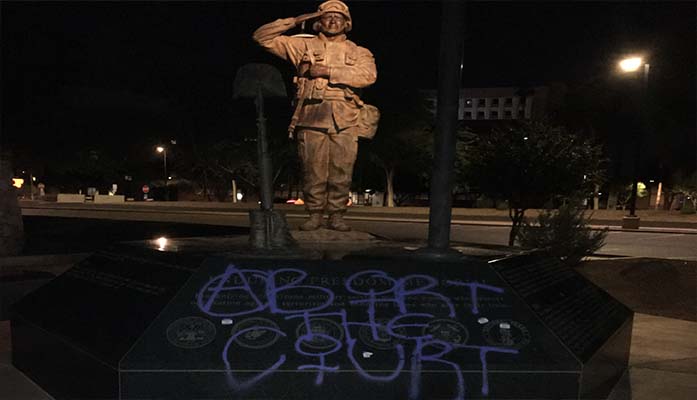
“As the riotous behavior at the Legislature was taking place, concurrent and spillover criminal misconduct in the form of felony criminal damage and the defacing of state memorials was occurring in Wesley Bolin Plaza,” Graves said.
The response of troopers and other law enforcement officers was complicated by the fact some people had brought children to the protest which turned into unlawful assembly, according to Graves.
“After multiple warnings, and notifications of trespass and unlawful assembly, state troopers deployed gas and strategically moved to clear the plaza,” Graves said, adding that as rioters were cleared from one area they damaged state property in the next area. Those properties and publicly funded memorials which suffered what Graves called “significant criminal damage” include:
- Arizona Law Enforcement Canine Memorial
- Arizona Peace Officers Memorial
- Lt. Frank Luke Jr. Memorial
- Korean War Memorial
- Operation Enduring Freedom Memorial
- Wesley Bolin Memorial Amphitheatre
- 158th Regimental Memorial
Estimates for the cost of cleaning and repairing the damage is not yet available. DPS released no information about any arrests which may have been made in connection with the damage, but among those calling for prosecution of those who marred the various memorials is Republican gubernatorial candidate Karrin Taylor Robson, who shared several photos taken by Sen. Kelly Townsend the morning after.