From the South Lawn of the White House to the pulsing heartbeats of North America’s bustling metropolises, Democrats are stepping into the 2024 electoral fray armed with a transgender-dominated platform that makes the riots of 2020 look like a block party.
This time, the spotlight is focused on the very future of the country: our children.
In a repudiation of the family as the foundation of society, the Democrat platform contends, “Your children are not your children.” And it doesn’t stop there. The Democrats are loud and proud that they’re “coming for your children.”
This was echoed by President Biden himself in April when he proclaimed at a White House event, “There’s no such thing as someone else’s child. Our nation’s children are all our children.”
His sentiment was further reinforced by the LGBTQ activists during their Pride Month celebrations. The rallying cry of “We’re here. We’re queer. We’re coming for your children!” may have escaped the notice of those consuming mainstream media, but as Tucker Carlson has demonstrated, the traditional news platforms no longer control the narrative.
America is turning to Twitter for an unfiltered snapshot of reality, and reality is not pretty. The videos of the LGBTQ agenda are being shared, as citizen journalists take over telling a truth that legacy media won’t touch.
One could write off a single declaration of seizing the children as a mere slip of the tongue, but the unwavering commitment of the progressives suggests deliberate intent to make it a bedrock principle woven into the very fabric of the Democratic Party.
The party finds itself flanked by a president whose mental acuity is questionable at best and demonstrators whose behaviors set a new standard for raunch. By raunch, I refer to the naked men dangling their parts at children along the Pride parade route, and naked women in heavy makeout sessions in a public fountain, while children played nearby.
These individuals are the ones taking over our schools, libraries, parks, and city councils.
Even a top cabinet official – Rachel Levine, the Secretary of Health and Human Services – has officially declared that it’s not just Pride Month but Pride Summer.
Levine, a transgender individual, is determined to see the Democratic Party transgender platform permeate the cultural fabric of America. Levine’s aim is to dismantle the traditional family unit and supplant it with the state, utilizing the powers of the DHHS to cement this agenda ahead of the 2024 elections.
Democrats like Levine appear to be drawing from the Marxist ideology of Frederick Engels and Karl Marx, who famously critiqued the family and foresaw its inevitable demise.
Engels said “On what foundation is the present family, the bourgeois family, based? On capital, on private gain. In its completely developed form, this family exists only among the bourgeoisie. But this state of things finds its complement in the practical absence of the family among the proletarians, and in public prostitution.”
Thus, he predicted, the family “will vanish as a matter of course.”
His colleague Marx explained how that would be achieved: “The education of all children, from the moment that they can get along without a mother’s care, shall be in state institutions at state expense.”
The American middle class, with its inherent kindness and compassion, has proven to be fertile ground for this Democrat redefinition of “love,” which amounts to actual hatred of the nuclear family.
Leveraging the tolerance of centrists, the Left has weaponized the Christian principle of “What Would Jesus Do” to quell debate and sway major Christian denominations to their cause. It has worked with many mainstream Christians, who haven’t found a good response to that rhetorical question.
The platform for 2024 looks set to feature a triumvirate of transgender dominance, the sexualization of children, and a critique of the traditional family. Why this direction? Because the Democratic Party, now under the influence of its most radical elements, finds itself incapable of reining in its fringe. The genie cannot be returned to the bottle.
Parents, brace yourselves: They are coming for your children. Alphabet agencies and unions like the National Education Association, and even the State of California, have made it clear and are leading the charge.
California Republican State Sen. Scott Wilk issued a warning: A new bill that would criminalize parents who don’t affirm their child’s “gender transition” is a bridge too far. It’s time for parents to run for the border.
“If you love your children, you need to flee California,” he said.
Democrats, seemingly emboldened by favorable polling in the 18- to 34-year-old demographic, are confident they have the winning issues for 2024.
For much of America, however, Democrats have simply packed the powder keg, stretched out the fuse, and are holding a match aloft.
Last year, Arizona was the most popular state for people to relocate to. Those new arrivals helped boost our economy and put the state’s budget in the black. That’s the good news. But the bad news is that the state is falling behind in building homes to meet the needs of current families as well as newcomers.
Some may say that is just fine because they liked the Grand Canyon State before those people moved here. But they likely haven’t considered the consequences when the government restricts new housing.
The demand for housing goes up as families have children, residents get pay raises, and workers bring their skills and talents to our state. We celebrate these events, and to make sure it continues, we must allow the supply of housing to meet this increased demand.
When governments restrict the supply of new housing, it reduces the choices available to buyers, which drives up the cost of their new homes. It is the buyers who bear the cost of these restrictive policies. This year Arizona has a shortfall of 270,000 housing units, and that deficit in housing will continue for years to come.
This shortage of housing is quickly putting our state beyond the reach of many qualified young workers. If businesses can’t attract capable workers, the owners will think long and hard before moving their business here or expanding their current operations. And that’s bad news for all Arizonans because businesses pay the lion’s share of our taxes. Without a healthy economy, the state budget will slide into deficits again. And that means cutbacks for schools and roads.
If Arizona is to remain prosperous, we must be attractive and affordable for new businesses and new residents. As The Wall Street Journal wrote, “The shortfall of affordable housing hurts America’s businesses and the broader economy by preventing workers from living in areas with economic opportunities but high housing costs. Employers are forced to operate below their potential because they can’t attract or retain workers.”
Local land use restrictions bear most of the blame for the housing shortage. In many areas, it is hard or impossible to add a casita for an aging parent or young renter. Local regulations often prohibit empty nesters from renting a single bedroom to a senior. And cities often dictate design elements such as floor plans, styles, and materials for homes. Such restrictions do not protect public safety or health. They merely impose the preferences of politicians and bureaucrats and limit the choices for property owners.
Navigating through the planning bureaucracy is difficult and there are frequent delays. Not long ago, it took about six months to complete the planning process. Now, it often drags on for a year or more. The clerks handling the applications do not have to pay the price for those delays. It is the new buyer who bears the added costs. But these huge added costs are not obvious to home buyers.
One way to inform consumers would be to have a sticker price for each home, much like we see when buying a car. The sticker would list the actual costs of the land and construction. Then, the sticker would lay out the costs of the myriad government requirements, then list the multiple fees for the city, the county, and all special districts, and finally the costs for connections for electricity, gas, sewer, etc. The sticker would make it clear how much the land and construction actually cost, and what was added on by government regulations and processing.
The Legislature had the opportunity to deal with the shortage this year but dropped the ball. Speaker Ben Toma’s HB 2536 proposed allowing property owners to build casitas attached to or in the backyard of their home, and would have allowed owners to rent a single bedroom to seniors. The bill would have also prevented cities from dictating design elements and aesthetics. Arizonans should have the right to choose the style and layout of their homes, and not have their aesthetics dictated by the bureaucracy.
After passing the House unanimously, the Senate killed it under pressure from local politicians. Those politicos want to protect their monopoly on housing decisions, even if their decisions cause young families and seniors to be priced out of their city. I was surprised that ten Senate Republicans voted against this important bill: Bennett, Borrelli, Carroll, Hoffman, Kavanagh, Kern, Kerr, Mesnard, Rogers, and Wadsack.
They claim they voted to kill the bill to protect the prerogatives of local government. While I agree that most decisions are better left up to officials closest to the people, I strongly dispute that local governments have unfettered power to ignore the rights of their residents. Local governments do not have the authority to dictate the color and floor plan for new homes. That goes far beyond the proper scope of their duties and interferes with the basic rights of property owners.
I am particularly troubled that several members of the Freedom Caucus helped kill this bill. I don’t understand how they can believe that their votes to allow local politicians to excessively interfere with the rights of property owners doesn’t infringe on our basic rights. The members of the Freedom Caucus would do well to re-read Alexis de Tocqueville’s warning about the terrible impact imposed on the people by bureaucratic rules:
“It covers the surface of society with a network of small, complicated rules, minute and uniform, through which the most original minds and the most energetic characters cannot penetrate, to rise above the crowd. The will of man is not shattered, but softened, bent, guided; men are seldom forced by it to act, but they are constantly restrained from acting: such a power does not destroy, but it prevents existence; it does not tyrannize, but it compresses, extinguishes, and stupefies a people, till each nation is reduced to be nothing better than a flock of timid and industrious animals, of which the government is the shepherd.”
It is the duty of our state representatives to forestall efforts to make us sheep under the care of government bureaucrats. Our legislators are not elected by local governments; they are elected directly by the people. They should not think of themselves as protectors of local governments’ prerogatives; rather, they should be vigilant guardians of our freedoms no matter which level of the government tries to violate them. I would remind our legislators that our Constitution does not begin with the words “We the state and local governments” but “We the people.”
Pat Nolan is the Director Emeritus of the Nolan Center for Justice at the American Conservative Union Foundation. He and his wife live in Prescott.
America is losing faith in its system of free public education. Test scores are down. Violence in schools is up. There’s a growing perception that things are out of control.
What’s odd about it all is how no one, seemingly, is interested in exploring why. State legislators don’t want to do it. Local school boards have other things on their minds. And the press is too busy covering real problems, like Donald Trump’s refusal to return classified documents to the National Archives, to spend any time exploring the reason kids are still being allowed to graduate from public schools without anything close to the mastery they need to get ahead in life.
Occam’s razor, named for its progenitor, 14th-century English philosopher and theologian William of Ockham, suggests the simplest answer is most likely the correct one. This would mean, one can infer, that the plight of our children is the fault of the teachers and administrators who run the schools.
Before continuing it is important to reflect on how teachers, especially, are like Members of Congress. Most voters believe, and have for decades, that while Congress as an institution is corrupt, moribund, and beholden to special interests, their representative is a fine, upstanding individual who is not part of the problem. That is also, the evidence suggests, how parents feel generally about the teachers whose responsibility it is to educate their children.
They too, it is reasonable to suggest, may fall victim to bureaucrats who, in telling them what to teach and how to teach it, end up perverting the process of education until our children’s minds are filled with mush.
Then again, perhaps not. It has been reported – but not as widely as it deserved – that some weeks back the Colorado Education Association, which claims to be the voice of 39,000 public educators in the Centennial State, adopted a resolution condemning capitalism. To wit:
The CEA believes that capitalism inherently exploits children, public schools, land, labor, and resources. Capitalism is in opposition to fully addressing systemic racism (the school-to-prison pipeline), climate change, patriarchy (gender and LGBTQ disparities), education inequality, and income inequality.
It is as alarming as it is illuminating. If most teachers in Colorado or indeed throughout the nation believe this, it becomes quite clear why the education system is failing our children. Those who teach are unable, unwilling, or unprepared to make our children see the world they are being prepared to enter as responsible adults.
Helpfully, and thanks of all things to the unnecessary pandemic-era lockdown of the nation’s schools undertaken at the apparent insistence of teachers’ unions and professional associations, parents have had enough.
There is no way to replace the learning and socialization lost to school closure. Leaders in some states like North Carolina, Oklahoma, Florida, and Arkansas are heeding the cries for help coming from parents by expanding education savings accounts and reforming the system so that education dollars follow the students rather than fund the systems.
To do this, they are showing great courage. They have taken on “Big Education” and in many places are defeating it by giving parents a role in deciding which school their child will attend.
As a practical matter, that means more and more children will be able to attend schools where Marxist doctrine is not presented as scientific fact, where a greater emphasis is placed on the “Three R’s” than the various ways to avoid pregnancy, and no one is going to be fighting over who gets to use what locker-room to shower and change after an athletic event.
Restructuring public education using free market principles like the supremacy of individual choice will break up the “Big Education” monopoly that is wrecking our children’s futures. Finally, after many years, there’s light at the end of the tunnel.
Peter Roff is a contributor to The Daily Caller News Foundation. A former UPI senior political writer and U.S. News and World Report columnist, he is a senior fellow at several public policy organizations including the Trans-Atlantic Leadership Network. Contact him at RoffColumns@gmail.com. Follow him on Twitter and TruthSocial @TheRoffDraft.
For years, Arizona has been a target of out-of-state special interest groups that want to put their radical ideas in our state. The process usually goes something like this.
Liberal groups from outside Arizona take an issue that is unpopular with the electorate, like tax hikes.
They come in and hire an army of paid circulators to flood the streets of Phoenix and Tucson to collect their signatures—hardly bothering with the rest of the state.
Bad policy and sweeping reforms are placed on our ballots with only a small fraction of the state’s support.
One of the most recent examples of this was Prop 208, which narrowly passed in 2020. Out-of-state teachers’ unions spent more than $30 million over four years in their effort to buy the largest tax hike in history—lying to Arizona voters to get signatures and lying to get the slimmest of majorities to approve it. Had it not been for the court system killing Prop 208 once and for all, Arizona would be a high tax state today.
Now, a proposed constitutional amendment sponsored by Arizona Senator J.D. Mesnard would put a stop to this abuse…
The Lancet was once a leading British medical journal. It was sober and medically exacting. It was so respected that it was often cited to settle controversial issues in the field of medicine.
Today, it is a shell of its former self, shot through with leftist political ideology. A recent editorial called out the UK Home Secretary for her “appalling and shocking” comments.
Was it about a drop in research funding or disputed medical opinions or something else of direct relevance to medicine? No, the Secretary opined that new migrants to the UK possessed “values which are at odds with our country” and brought “heightened levels of criminality.”
Some might dispute such statements and some not, but how is this discussion pertinent for a medical journal? Richard Horton, the editor, went on to call for “war” on the other side of the ideological divide.
Horton and The Lancet are hardly alone in degrading medicine by politicizing it. Science and scientists are in reputational decline because, well, they deserve to be.
Physicians were once respected for their integrity. They could be stodgy and paternalistic sometimes, but they couldn’t be influenced or bought.
Now, the medical doctors have morphed from being dedicated stewards of their patients’ health to “medical providers,” as government payers describe them. Most owe their professional loyalty to a hospital-based system that operates pretty much like any other business, with the bottom line always in view.
Meanwhile, on issues ranging from COVID to climate science to transgenderism, we are urged to follow “the “Science” as if Science were the collective pronouncements of the big shots rather than a process for rolling back the limits of knowledge. “The Science” is often determined by hacks who are especially successful at scoring research grants because they supply the answers our grant making elites want to hear.
Politicized science can lead to some bizarre and harmful conclusions. There is now a movement against randomized controlled trials (RCTs) because they didn’t produce the approved answer to the question of whether face masks prevent infection.
Scientific American stated “decades of engineering and occupational science” show they worked. So there. No silly trials needed to confirm what everyone knows anyway.
But RCTs are the only way to determine whether a premise is factual. They are the basis of the scientific method, which lifted us out of millennia of ignorance and produced the marvels of modern medicine. Exposing well regarded but ineffective practices are precisely why they are needed.
While real scientists encourage debate and discovery, pseudoscientists silence those who dissent from the status quo. For example, scientific journals demanded the retraction of research producing evidence that transgenderism can be a social contagion.
Dr. Lisa Littman of Brown University coined the term “rapid onset gender dysphoria” after her research revealed that although sufferers from the malady are customarily entered into transitioning protocols including hormones and surgery, they often present for treatment in clusters of young women who together discovered their supposedly mistaken gender identity. Dr. Littman’s research was retracted by Brown soon after it was published, due to the outrage of the medical mob.
Yet other researchers like Abigail Shrier and institutions like the UK’s Tavistock Center noted the same phenomenon. Springer Nature, a journal noted for its scientific soundness, was set to publish a review of 1,655 possible cases of rapid onset gender dysphoria but reversed course, deciding to retract it due to the suspiciously flimsy objection that “written informed consent” was possibly lacking in the study. Intellectual tyranny defeated open debate again.
We need a respected, honest scientific community more than ever. We need them to make more scientific advances, to train future scientists and to protect us from the befouling influence of politics on science. The antics of Dr. Fauci and others, bending the truth to seek political favor, did lasting damage to the reputation of the scientific community.
Climate science too has been hopelessly compromised by politics and the biased grant-making process. One of the results is an epidemic of existential depression among young Americans who believe their lives will end in devastation because of excessive carbon emissions (still wrong, no matter how many times it’s been predicted). It’s a shame.
Dr. Thomas Patterson, former Chairman of the Goldwater Institute, is a retired emergency physician. He served as an Arizona State senator for 10 years in the 1990s, and as Majority Leader from 93-96. He is the author of Arizona’s original charter schools bill.
A third Florida man has his eyes on the White House.
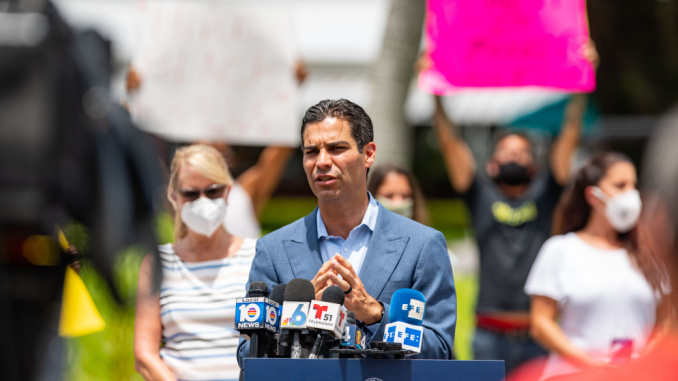
On Wednesday, after weeks of teasing an announcement, Miami Mayor Francis Suarez officially became the latest entry into the crowded Republican primary for president.
His speech at the Reagan Foundation the following day hit all the right notes—citing Miami’s “economic explosion” and “disciplined approach to spending” amid budget bloat in Washington—and there is little doubt that the mayor of Florida’s second-largest city will tout his role in the state’s booming economy.
Florida continues to stand out as a national model for conservative governance, with a low unemployment rate and record influx of new residents to prove it. But, before Suarez takes too much credit, voters would be wise to familiarize themselves with the mayor’s record, including how vehemently he fought against the very policies that have made Florida ‘Florida.’
After all, there would be no ‘Governor’ Ron DeSantis today if Suarez had had his way, only a ‘former Congressman.’ The mayor’s choice in the 2018 Florida gubernatorial race was Tallahassee Mayor Andrew Gillum, the progressive up-and-comer endorsed by Sen. Bernie Sanders and backed by Democratic mega-donor Tom Steyer.
Gillum’s radical campaign platform called for ‘Medicare for All,’ a 40 percent increase in the state’s corporate income tax, and other progressive priorities that would have slammed the brakes on the Sunshine State’s forward momentum. Yet Suarez campaigned for him ahead of Election Day and ultimately cast his ballot the same. (Two months later, he attended a special inaugural ball celebrating the victory of Agriculture Commissioner-elect Nikki Fried, the Democrat who would run for the state’s highest office in 2022.)
Thankfully, DeSantis ended up in the Governor’s Mansion, while Gillum’s 15 minutes of fame ended on the floor of a hotel room under less-than-ideal circumstances. Floridians rejected Suarez’s advice and have been better off for doing so ever since.
Case in point: COVID-19.
Perhaps no issue has defined DeSantis’ reputation more than his handling of the pandemic. The governor remained unwavering in his commitment to freedom and personal responsibility, even as opponents smeared him as “Ron DeathSantis,” as lockdown lobbyists in Grim Reaper costumes stalked families at his re-opened beaches, and as media properties like “60 Minutes” devolved into baseless fever dreams aimed at undermining his vision.
Miami’s mayor was not on the side you might think.
In April 2020, Suarez opposed the governor’s plan to “soon” resume in-person learning, insisting that “it would be particularly dangerous” to re-open schools considering the “incredible amount of children who could be at risk.”
He criticized DeSantis in September 2020 for his “acceleration” toward re-opening Florida’s economy “a lot faster … than what we had planned.”
Suarez also complained in January 2021 that “we’ve been restricted from being able to put in mitigation measures,” such as public mask mandates, by the governor, despite having “tried to reach him on multiple occasions” to lobby for the power to do so. The mayor called for a national mask mandate as well, strictly enforced with “the threat of fines” and “even arrest.”
This is not the record of a small-government conservative.
His recent hasty characterization minimizing DeSantis’ subsidy fight with Disney as a “personal vendetta”—all while lobbing personal insults at the governor (he “struggle[s] with relationships” and won’t “look at people in the eye”)—makes one wonder if Suarez doesn’t have a vendetta himself, with a campaign to dilute Florida’s primary vote as its main vehicle.
In short, the 2024 presidential race’s newest candidate may sing the right tune on the campaign trail, but the Sunshine State is the beacon of freedom it is today not because of Miami’s mayor, but despite him.
Suarez told “Face the Nation” host Margaret Brennan last month, “I’m someone who needs to be better known by this country,” and I agree, particularly by Republican primary voters—lest his happenstance proximity to Florida’s achievements be confused for actual contributions to them.
Brian Anderson is the president of the Saguaro Group, an Arizona-based research firm.