by Ethan Faverino | May 10, 2026 | Economy, News
By Ethan Faverino |
The Joint Economic Committee released its Monthly Employment Update for April 2026, showing the U.S. economy added 115,000 nonfarm payroll jobs, exceeding expectations. The gain was driven entirely by the private sector which added 123,000 jobs, while government employment declined 8,000.
Nonfarm payroll employment now stands at 158.74 million, with private sector payrolls at 135.43 million and government payrolls at 23.31 million. The headline unemployment rate (U-3) held steady at 4.3%, while the broader U-6 measure, which includes underemployment, rose 0.2 percentage points to 8.2%. The labor force participation rate declined 0.1 percentage points to 61.8%.
March’s job gain was revised upward by 8,000 to a total of 185,000, while February’s figure was revised downward by 64,000, resulting in a net loss of 156,000 jobs for that month.
In April, the strongest job gains occurred in trade, transportation, and utilities, which added 60,000 positions, and private education and health services, which added 46,000. Losses were recorded in information (-13,000) and financial activities (-11,000).
Over the past year, from April 2025 to April 2026, private education and health services led with 618,000 new jobs, followed by leisure and hospitality with 142,000. The largest declines came in federal government (-311,00) and information (-92,000).
Wage growth remained moderate over the year. Average nominal weekly and hourly earnings for all employees on private nonfarm payrolls both increased by 3.57%. For production and nonsupervisory employees, average nominal weekly earnings rose 3.97%, while average nominal hourly earnings increased 3.67%.
The Job Openings and Labor Turnover Survey for March 2026 showed job openings declining by 56,000 to 6.87 million, with the rate falling to 4.1%. Private education and health services and financial activities posted gains in openings, while professional and business services experienced the largest drop. Hires increased sharply by 655,000 to 5.55 million, and total separations rose by 356,000 to 5.38 million, with both quits and layoffs and discharges seeing notable increases.
In Arizona, the labor market softened in March as the state lost 2,600 net payroll jobs and the unemployment rate edged up 0.1 percentage points to 4.7%, following a gain of 10,100 jobs the previous month.
Over the past 12 months, Arizona has lost 8,600 net payroll jobs while its unemployment rate has risen 0.5 percentage points from 4.2%. The state’s private sector lost 2,400 jobs in March, and employment overall fell by 19,093 during the month. Arizona’s labor force participation rate declined to 61.4% ranking 34th in the nation.
From February to March 2026, Arizona saw gains in private education and health services and professional and business services, offset by losses in leisure and hospitality and trade, transportation, and utilities. Over the full year, private education and health services rained the strongest performer in the spare, while trade, transportation, and utilizes and financial activities posted the largest declines.
Nationally, the labor force participation rate stood at 61.9% in March.
Ethan Faverino is a reporter for AZ Free News. You can send him news tips using this link.
by Matthew Holloway | May 9, 2026 | News
By Matthew Holloway |
Arizona State Senator David Farnsworth (R-LD10) is pushing back against Democratic criticism of the Republican-backed state budget vetoed this week by Gov. Katie Hobbs. Farnsworth argues that the plan maintains core government services while reducing spending and providing tax relief.
In a statement released Wednesday, Farnsworth said claims that the Republican proposal would harm public safety, wildfire suppression, child welfare, and water protection efforts were “completely false.”
The Republican budget proposal would spend approximately $800 million less than Hobbs’ proposed budget while maintaining funding for K-12 education and public safety. Senate Republicans also said the proposal includes approximately $1.45 billion in tax relief over four years without raising taxes or defaulting on state financial obligations.
Arizona Senate Republicans said the proposal preserves funding for wildfire mitigation efforts and Colorado River protection programs, exempts the Department of Child Safety from a proposed 5% operating reduction, and supports law enforcement while focusing on reducing unnecessary spending and prioritizing relief for working families, seniors, and small businesses.
“The Republican budget proposal, which Hobbs vetoed on Tuesday, reflects a balanced approach,” Farnsworth said. “It protects essential services, supports public safety, and shows respect for taxpayers by focusing on responsible spending.”
The statement follows Hobbs’ veto of the Republican-backed budget proposal. Hobbs criticized the proposal as “unbalanced and reckless,” arguing it would jeopardize healthcare access, public safety funding, and services for vulnerable residents while prioritizing tax cuts.
Republican lawmakers have defended the proposal as a fiscally conservative alternative to the governor’s spending plan. Legislative leaders previously said the budget would reduce overall spending compared to Hobbs’ January proposal while implementing tax conformity measures tied to recent federal tax changes.
Farnsworth also said he had invited lawmakers from both parties and both legislative chambers to participate in budget discussions throughout the session and said that invitation remains open.
“While there may be disagreements about priorities, it is crucial that our discussions are based on facts rather than fear,” Farnsworth said. “Although the governor walked away from budget discussions, we look forward to renewing good-faith negotiations to ensure that Arizona families, communities, and critical services are supported both now and in the future with a responsible state budget.”
Budget negotiations between the Republican-controlled Legislature and the governor’s office remain ongoing as lawmakers work toward passage of a final spending plan before the end of the legislative session.
Matthew Holloway is a senior reporter for AZ Free News. Follow him on X for his latest stories, or email tips to Matthew@azfreenews.com.
by Staff Reporter | May 9, 2026 | Economy, News
By Staff Reporter |
Arizona’s Permanent Land Endowment Trust Fund (PLETF) market value surpassed $10 billion, the Arizona Treasurer’s Office announced.
PLETF reflects the deposits and investments of proceeds from public land sales. The federal government gave nearly 11 million acres to Arizona for endowment when it achieved statehood in 1912, just as it had done for other states.
PLETF has 13 beneficiaries, but its main beneficiaries are K-12 public schools, which includes the Arizona State School for the Deaf and Blind. Other beneficiaries include the state’s universities; state prisons; the State Hospital; the legislative, executive, and judicial branches; the Arizona Miners’ Hospital; and the Arizona Pioneers Home.
(State law slated the Arizona Pioneers Home and Arizona Miners Hospital for termination in July 2032).
Arizona Independent Redistricting Commission data reported the remaining total of state trust land to be about nine million out of the original 11 million acres. The state has a total of nearly 73 million acres.
That nine million acre estimate equals about 13 percent of total land in the state. Privately-held land only makes up 14 percent of Arizona land.
PLETF’s 10-year returns were reported to have outperformed the average U.S. college and university endowments for the past decade.
In February, the PLETF had a fair market value of $10.1 billion.
The latest reported all-time high, the newest in a succession of all-time highs, can be attributed to the treasurer office’s director of endowments, Tim White.
White has managed PLETF’s stock portfolio for nearly 30 years (since 1999). Per the treasurer’s office, White has the ultimate decision-making responsibility on all holdings and trades for PLETF.
White’s tenure has overseen a growth of the PLETF fair market value from $475 million in 1992 to repeated all-time highs, including the most present reporting.
Despite this progress, some argue the PLETF could be doing more.
The Common Sense Institute Arizona (CSI) issued a report critical of the approach to the PLETF last November. In it, CSI argued that the administration of PLETF has failed for a long time — not just for the duration of this administration, but for the last 100 years.
CSI claimed PLETF could have been worth more than $163 billion, over sixteen times this latest historic amount, and could have distributed $140 billion to beneficiaries.
CSI estimated in its report that the ordered sale of remaining trust land over the next ten years would generate more than $18 billion in revenue and $55 billion in new economic activity.
The organization’s director of policy and research, Glenn Farley, told KJZZ last December that the state has taken the most action on growing the financial account but hasn’t taken enough action on selling the physical land. Farley advocated for a “foundational reevaluation” of the state’s timeline for land sales and its PLETF priorities.
“[T]his is not an administrative problem,” said Farley. “This is a 100-year problem. No administration in this state has really taken full advantage of this asset.”
AZ Free News is your #1 source for Arizona news and politics. You can send us news tips using this link.
by Matthew Holloway | May 9, 2026 | News
By Matthew Holloway |
Arizona Rep. Cody Reim (R-LD3) is leading a legislative effort to strengthen protections for the Salt River wild horses. The move comes amid controversy over a state management agreement that could reduce the herd by more than half within five years.
Reim announced support for an amended form of Senate Bill 1199, legislation intended to clarify and reinforce provisions of Arizona’s 2016 Salt River Horse Act, which originally protected the horses from removal after widespread public opposition to federal proposals targeting the herd.
According to a statement released by the Arizona House Republicans, Reim said the legislation seeks to ensure the law reflects the original intent of preserving the horses and limiting removals. The bill would halt all removals of the horses for a period of three years. An amendment from Rep. Pamela Carter (R-LD4) added an emergency clause allowing the measure to take immediate effect once signed into law.
“The current management group is being forced to reduce the Salt River herd by as many as 150 horses, starting this year,” Reim said. “These horses are a cherished part of Arizona’s heritage, and Arizonans have made it clear they do not want them rounded up and removed to satisfy arbitrary population targets. This bill protects the herd and keeps these horses where they belong.”
The renewed debate follows a February agreement between the Arizona Department of Agriculture and the Salt River Wild Horse Management Group that calls for reducing the herd from approximately 274 horses to about 120 over a five-year period through fertility control measures and relocations to approved sanctuaries.
The Salt River Wild Horse Management Group, which has overseen the herd since 2018, said the agreement would require relocating roughly 25 horses annually while continuing birth control efforts intended to gradually reduce the population.
Supporters of the horses have opposed the reduction plan, arguing the removals are unnecessary and inconsistent with the intent of the original law. More than 30 advocates gathered at the Arizona Capitol in April to protest the proposal and urge state officials to preserve the herd.
In social media posts this week, Reim and House Republicans promoted the legislative push as an effort to preserve what supporters describe as a culturally significant and popular attraction along the Lower Salt River. Reim thanked fellow legislators for allowing him “to pause horse removals from the herd and protect them as a valuable asset to the state.”
The Arizona Department of Agriculture said in a February statement that the management plan is intended to balance ecological sustainability, available range resources, and long-term herd health. Department officials have also stated the reduction proposal originated from the contractor managing the horses rather than from a direct state mandate.
The Salt River Horse Act was signed into law in 2016 after the U.S. Forest Service considered removing the horses from the Tonto National Forest area. The legislation established state oversight of the herd and authorized humane population management practices.
Matthew Holloway is a senior reporter for AZ Free News. Follow him on X for his latest stories, or email tips to Matthew@azfreenews.com.
by Staff Reporter | May 8, 2026 | News
By Staff Reporter |
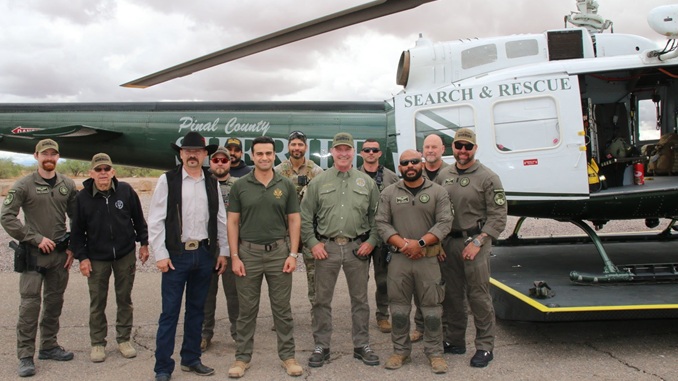
Rep. Abe Hamadeh (R-AZ-08) reportedly assisted with the capture of three illegal aliens while tagging along on a border security sweep.
Hamadeh traded the suit and tie preferred on Capitol Hill for military fatigues during a ride-along with Border Patrol on Tuesday. The congressman thanked the Pinal County Sheriff’s Office for arranging his participation in their immigration enforcement work.
The Pinal County Attorney’s Office and Board of Supervisors have been sparring over the former’s decision to enter into an agreement assisting Immigrations and Customs Enforcement with deportations. The board sued the county attorney, Brad Miller, over the agreement.
The Pinal County Superior Court issued a temporary restraining order on that agreement in February prior to the case’s transferral to the Maricopa County Superior Court, where it remains pending.
As part of that court-ordered halt, Miller agreed to not engage with ICE beyond information sharing.
Separately, a federal court ruled last month in favor of state laws enabling state and local police to arrest illegal aliens for immigration violations. The case was decided by the Fifth Circuit Court of Appeals on the fate of a Texas law (Texas Senate Bill 4); the Biden administration initiated that lawsuit, but the Trump administration dropped it recently.
The court dismissed the case after determining that the one county and two civil rights groups that remained as the sole challengers to the Texas law lacked standing.
That appeals court decision gave the green light to the Arizona Border Security Act, or Proposition 314, which was passed by Arizona voters in 2024. Gov. Katie Hobbs attempted to terminate that legislation through veto, but a majority of Arizona voters proved to support the measure.
The Texas and Arizona laws, and others like them, will likely face challenges for the foreseeable future. Civil rights groups filed a lawsuit to stop the Texas law on Monday.
A hearing is scheduled for May 15 at 9 am before Maricopa County Superior Court Judge Michael Gordon.
Southwest land border encounters have declined steeply since President Donald Trump took office. Border encounters went from all-time highs of several million per fiscal year (over 2.4 million in fiscal year 2023, and over 2.1 million in fiscal year 2024) to one-fourth previous totals (over 400,000 in fiscal year 2025).
At this point in the last fiscal year, southwest land border encounters were approximately 380,700. For this fiscal year, there have been just over 63,700 encounters: approximately one-sixth the total from the same point in time the last fiscal year.
U.S. Customs and Border Protection fiscal years run from October of the previous year to September of the current year (fiscal year 2026 runs from October 2025 to September 2026).
While Arizona’s Republican elected officials in Congress have offered their support for immigration enforcement, Democratic representatives have worked to slow or halt immigration enforcement.
Congresswomen Adelita Grijalva (D-AZ-07) and Yassamin Ansari (D-AZ-03) have both dedicated significant taxpayer resources to assisting illegal aliens and opposing ICE.
AZ Free News reported last week that nearly half of Grijalva’s press releases since taking office have concerned a defense of illegal aliens or opposition to ICE. Nearly one-third of her X posts since taking office were defenses of illegal aliens, demands to abolish ICE, or opposition to immigration enforcement. Three of her 14 non-recognition remarks on the congressional record were focused on opposing ICE and immigration enforcement.
Grijalva and Ansari, along with Rep. Greg Stanton (D-AZ-04) and Democratic Sens. Mark Kelly and Ruben Gallego, have made multiple trips to immigration detention centers, independently and as a group. The Democratic officials have referred to illegal aliens as their constituents.
Last week, Grijalva, Ansari, and Stanton introduced legislation to limit detention periods of illegal aliens to 12 hours.
AZ Free News is your #1 source for Arizona news and politics. You can send us news tips using this link.
by Staff Reporter | May 8, 2026 | News
By Staff Reporter |
The sole Maricopa County supervisor to extend support for the county recorder over the ongoing elections authority spat has requested court assistance with mediation.
In a filing last week in County Recorder Justin Heap’s case against the board of supervisors before the Maricopa County Superior Court, Supervisor Mark Stewart filed a response amending his vote from opposition against to support for his fellow supervisors’ motion to stay the ruling.
Some interpreted the filing as Stewart backtracking his support for the recorder. Stewart has sided with Heap generally on the proper division of elections authority.
Stewart said ongoing mediation attempts have failed and required court intervention.
“Supervisor Stewart supports a temporary stay solely for the purpose of mediation,” stated the filing. “Previous efforts at mediation have failed despite the parties all claiming a willingness to mediate based upon timing, preconditions, and disagreement over the mediator.”
Stewart requested the court order Heap and the board to attend a mediation before the court appointed mediator within the next two weeks.
In a video posted online, Stewart explained that his filing was not a challenge to the court ruling, like the motion put forth by his colleagues, but simply a means to “alleviate some of the operational ambiguity” within remaining questions of operations so that board and recorder staff could move forward.
“What we do not need is to prolong this conflict. We need a defined path forward,” said Stewart. “While we may have different views on the path forward, I know we all have the same goal of delivering reliable, secure, transparent elections for Maricopa voters.”
Stewart said he didn’t want the case to go to appeal. That was something his fellow supervisors desired.
Last month, the superior court ruled in Heap’s favor and restored the county recorder’s election powers. The court rejected the board’s claim of plenary authority and declared it had acted unlawfully beyond statutory authority. A specific finding of wrongdoing concerned the removal of personnel, systems, and equipment from the recorder’s office.
The court warned, further, that continued absconding of election powers by the board of supervisors would likely result in voter disenfranchisement.
“The evidence at trial established that the Recorder’s inability to exercise meaningful control over election systems and staff will likely cause concrete operational harms, including inability to timely process provisional ballots under A.R.S. § 16-134, resulting in voters being denied tabulation of the full ballots they had voted and to which they were entitled,” stated the ruling. “These harms will not resolve and may likely increase absent court intervention, particularly as general election cycles approach.”
The board argued in a filing earlier this week that the court’s ruling conflicted with state statute and would interfere with administration of the upcoming jurisdictional election scheduled to occur in less than two weeks.
“This ruling creates confusion about key aspects of election administration including chain of custody, on-site tabulation, and the handing of mail-in ballots on Election Day,” said Board of Supervisors Chair Kate Brophy McGee in a statement. “Making major changes in the middle of the election cycle is not just a terrible idea for voters, it’s going to be almost impossible to implement responsibly.”
AZ Free News is your #1 source for Arizona news and politics. You can send us news tips using this link.