by AZ Free News | May 14, 2021 | Economy, News
PHOENIX — Across the state, chambers of commerce are applauding Governor Doug Ducey’s decision that Arizona will no longer be taking the Federal Pandemic Unemployment Compensation, and instead will offer one-time bonuses to returning workers, along with child care support, educational opportunities and rental assistance.
The announcement follows reports from employers that they are having trouble competing with the federal government’s unemployment payments, which are paying individuals more to stay home and not work than to find a job.
Arizona will stop taking the federal government’s pandemic unemployment benefits effective Saturday, July 10. Instead, the state will offer a $2,000 Back To Work bonus for eligible workers — with a goal of getting as many Arizonans as possible to rejoin the workforce by Labor Day, September 6, 2021.
Arizona will also provide support for unemployed individuals seeking to upskill their careers with adult education programs as well as additional child care opportunities.
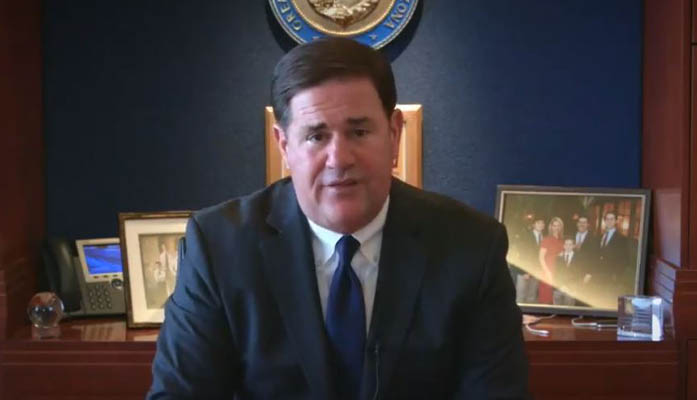
“In Arizona, we’re going to use federal money to encourage people to work…instead of paying people not to work,” Governor Ducey said in a video.
“With ample supplies of the COVID-19 vaccine on hand and millions of Arizonans vaccinated, people feel safer and are finally returning to life in Arizona as we knew and loved it before,” said Ducey. “People are back in the office, restaurants are at full capacity and tourists are flocking to our state.”
“There is dignity in work. Ronald Reagan said the best social program is a job. I agree with that,” Ducey said.
“We have worked tirelessly throughout the pandemic to ensure those who were displaced received the support they needed for themselves and their families,” said Arizona Department of Economic Security (DES) Director Michael Wisehart. “Now that employers in all sectors are hiring, we’re ready to transition and enhance our assistance to families, job seekers and employers. We are committed to ensuring the long-term strength of Arizona’s economy to provide self-sufficiency for Arizona’s families.”
The Governor’s Back To Work program is garnering support from community and business leaders across the state:
“Governor Ducey is breaking down many of the barriers that prevent people from returning to work. Getting people funding for GED programs, community college, providing funding for childcare, and bonus money for their hard work is the hand up Arizonans need,” said Arizona Regional Economic Development Foundation Executive Director Mignonne Hollis.
“After last week’s disappointing federal jobs report, Arizona is implementing a common-sense, conservative plan to ensure we continue our state’s strong economic rebound,” said Prescott Chamber of Commerce President and CEO Sheri Heiney.
“Across Arizona, restaurants of all sizes are ready to hire new employees and expand their teams,” said Arizona Restaurant Association President and CEO Steve Chucri. “When it comes to the food and beverage industry, things are much different than they were a year ago. Millions are vaccinated, we know how to keep patrons and staff safe, and people are ready to eat at restaurants again. Restaurants need to ensure they have enough staff to meet the demand, but many are struggling to fill positions. I’m grateful to Governor Ducey for encouraging Arizonans to find new employment opportunities so we can get our restaurants fully staffed and continue to move the state’s economy forward.”
“We’re excited to welcome new team members and provide great jobs for Arizonans,” said Westroc Hospitality President and Chief Operating Officer Bill Nassikas. “After weathering the pandemic, we know Arizonans are looking for employment opportunities. We’re ready to hire, along with countless other businesses across the state.”
“Arizona’s tourism and hospitality industry is poised and eager to welcome visitors,” said Arizona Tourism and Lodging Association President and CEO Kim Grace Sabow. We are prepared to offer safe and unique experiences to both leisure and business travelers. An array of quality jobs are available for those seeking a rewarding industry career path — and we’re ready to hire today!”
by B. Hamilton | May 14, 2021 | Education, News
By B. Hamilton |
On Thursday, the Senate Health and Human Services Committee, in a party line vote, approved HB 2035, legislation that will strengthen parental input in the Sex Education curriculum offered to their children. A previous version of the bill, SB 1456, passed this year, but was vetoed by Governor Doug Ducey.
According to Sen. Nancy Barto, sponsor of SB 1456, the issues brought forth in the governor’s veto formed the basis of the new version, sponsored by Rep. Gail Griffin. Griffin’s bill was turned into what is known as a “striker” or “strike-all-amendment” in order to attached the modified language of SB 1456.
HB 2305 “restricts sex education instruction for pupils in kindergarten through grade 4. Modifies requirements relating to sex education instruction, including curricula approval and parental permission and notification procedures.” In keeping with the governor’s recommendation, the specifies that age and grade appropriate classroom instruction on child assault awareness and abuse prevention is not prohibited.
RELATED ARTICLES:
Arizona Legislature Passes Bill Requiring Parental Permission for All Sex Ed Curriculum
Ducey Vetoes Sex Ed Bill, Issues Executive Order Instead
The bill does not prohibit or dictate any curriculum in grades 5-12; it “merely ensures that parents may opt their children into instruction on human sexuality,” according to supporters.
On April 20, 2021, the Governor issued an Executive Order related to sex education, which among other matters, requires a public review process to select sex education curricula, directs schools to make any approved sex education curricula available online and in-person and allows parents to review the materials before opting their child in to sex education courses, according to the legislative record.
by AZ Free News | May 14, 2021 | Economy, News
The American Legislative Exchange Council’s latest annual Rich States, Poor States report shows Arizona’s economic outlook ranking is slipping.
Of the 15 variables the report uses for its economic outlook ranking, Arizona received poor grades for its top marginal personal income tax rate (42), state minimum wage rate (44), and sales tax burden (45).
“While we slipped three places in the ranking, are no longer in the top ten, and are approaching what could be a crisis of competitiveness, hope still remains that we can correct course,” said Chad Heinrich, Arizona state director for the National Federation of Independent Business (NFIB).
“To help small businesses the State Legislature must focus on fixing the disparate tax treatment of commercial property, reforming Arizona’s individual income tax code with small businesses in mind, and making our unemployment insurance (UI) trust fund solvent without raising taxes on Main Street enterprises, the latter of which is not measured in the Rich States, Poor States report,” said Heinrich.
The NFIB poll released yesterday showed an increase in small business optimism over the previous month’s increase but keeping the small-business economy from soaring is the drag of record highs in unfilled job openings.
“Gov. Doug Ducey’s signing of liability protection legislation will help Arizona’s small businesses open with confidence as we return to pre-pandemic business operations, as will Arizona conforming with several small-business-focused tax provisions in the federal CARES Act. The two big questions Main Street entrepreneurs have are: Will they be hit with a double whammy if the legislature increases unemployment taxes while UI rates have also increased due to the pandemic and how deeply would a federal effort to raise the minimum-wage rate to $15 an hour affect their operations,” said Heinrich.
by Terri Jo Neff | May 13, 2021 | Education, News
By Terri Jo Neff |
Rep. Shawnna Bolick says a tweet she wrote Wednesday was not intended as a commentary on the Senate’s ongoing audit of Maricopa County’s election process. Instead, she was simply trying to draw attention to a double-standard by many state Democrats on the issue of public-private partnerships.
Bolick (R-LD20) is a strong supporter of Empowerment Scholarship Accounts (ESA) which thousands of Arizona families can utilize to provide school choice for students. As Chair of the House Ways and Means Committee, she has championed SB1452 which seeks to expand ESA eligibility to thousands more students.
But Bolick says she has seen many Democrats who do not support giving families more choice in a child’s education if that choice involves a privately run school. Then on Wednesday morning, Bolick was reading comments about the Senate’s election audit when an article caught her attention.
That article reported on how Maricopa County does not have the administrative passwords necessary to access key voting equipment the auditors want to review. Those passwords appear to be in the control of Dominion Voting Systems, a private company which leases voting equipment to the county.
And that, Bolick says, prompted a bit of a snarky retort “comparing how the Left is okay with our democratic process being turned over to a private entity for elections, but they are not okay with kids going to, say, a private school.”
“I see so much hypocrisy in the world, so it’s fun sometimes to point out an issue that might not even be related to another issue,” Bolick said, adding she did not mean to suggest private companies should never be involved in elections. “Just a little poke on hypocrisy between different governance structures and ideas. Nothing more, nothing less.”
An amended version of SB1452 which came through Bolick’s committee is slated to be considered by the House on Thursday. If it passes the legislation will have to return to the Senate for a final vote.
Bolick also serves as Vice-Chair of the House Criminal Justice Reform Committee.
by B. Hamilton | May 13, 2021 | Education, News
By B. Hamilton |
Two topics that arise year after year, teacher’s salaries and public-school budgets, are often misunderstood and misrepresented. In fact, many say the RedForEd movement was created and nurtured with those misunderstandings and misrepresentations.
The misunderstanding and misrepresentation has led to frustration for taxpayers and parents. Many of whom feel that no matter how much they pay in taxes, nothing seems to get better in kids’ classrooms.
A new study by the Goldwater Institute indicates those feelings and frustrations might be justified.
According to Goldwater, the “20×2020” plan, approved by Arizona lawmakers in 2018, was designed to provide enough funding to give Arizona teachers a 20% raise. However, Goldwater has discovered that schools are not allocating the funds the way lawmakers intended them to be.
In The Truth about Teacher Pay in Arizona: How Arizona School Districts Have Held Back Teacher Salaries, Blamed Lawmakers, and Continually Captured Public Sympathy, Matt Beienburg, Director of Education Policy at the Goldwater Institute found that “school districts used the majority of the new 20×2020 funds simply to replace, rather than add to, existing buckets of state money for teachers (and vice versa). The result: During the 2019-2020 school year alone, teachers received at least $170 million less from their school districts in salary increases than Arizona taxpayers provided for. And it’s part of a decades-long pattern in Arizona education.”

So what are schools doing with the extra funding that is being provided?
“District spending on administration, for instance, has risen by nearly $2,000 in inflation-adjusted terms per class of 20 students, even as teacher salaries were no higher through fiscal year 2020,” according to Beienburg.
Each year, teachers use their own money to buy supplies and decorations for their classrooms and to help offset the consistently growing list of “must buy” supplies sent to parents at the start of the school year. Yet, during the 1983-1984 school year almost 2,000 managers, supervisors, and directors were inexplicably added to Arizona school districts’ payrolls.
Many teachers have expressed frustration about not being a priority and tend to put pressure and blame on lawmakers as part of their demands for more money. It seems, though, that it is the school district administrators who need to feel the pressure and are to blame.
This last year has also placed additional stress on teachers and parents, with virtual and hybrid learning due to COVID-19.
Members of the state legislature requested that the COVID-19 stimulus revenue funds were given for school district use but the Arizona Department of Education (ADE) has declined to distribute much of the millions of dollars.
While it may be easy to blame political leaders and taxpayers for lack of support and failing to prioritize teachers, it seems to many observers that the attention should be on the ADE, school district administrators, and school boards who need to review and reconsider their budgets and priorities.
by AZ Free News | May 11, 2021 | News
Arizona’s Permanent Early Voter List (PEVL) is no longer permanent, after Gov. Doug Ducey signed one of Arizona’s most important pieces of election integrity legislation in years on Tuesday.
The Arizona Senate approved SB1485 earlier in the day to ensure Arizona voters receive a mail-in ballot only if they signed-up to and now wish to continue automatically receiving a ballot before each election. It provides for a voter’s removal from the newly named Early Voting List (EVL) if a voter did not cast a ballot in at least one of four consecutive elections and did not respond to messages from their county recorder to remain on the list.
“This bill is a modest, but critical step toward restoring confidence in our election system,” sponsor Sen. Michelle Ugenti-Rita stated in a press release.
Proponents of SB1485 touted its cost-savings impact for counties from only printing and paying postage for early ballots a voter expects to use. But the main impact, they said, would be ensuring that tens of thousands of early ballots are not mailed out to voters who no longer utilize the option.
Opponents of the bill deflected from the election integrity benefit and tried to characterize the bill as targeting minority populations to make it harder to vote.
However, being dropped from what is now EVL has no impact on a voter’s right to vote and all voters remain registered to vote. That was a message the governor focused on in his comments while signing SB1485 a short time after its passage in the Senate on a 16 to 14 vote.
“Let’s be clear — despite all the deceptive and heated rhetoric being used by some partisan activists to lobby against this reform, not a single Arizona voter will lose their right to vote as a result of this new law,” Ducey stated in a video his office released to announce that SB1485 had been signed.
Ugenti-Rita’s bill was amended several weeks ago to win the support of more Republican lawmakers in the House. The amendment softened the bill, according to experts, so that a voter would have to miss all elections within a two-year period -including any city or other minor elections- to be dropped from the EVL.
Ducey used the bill’s signing to push back on national companies inserting themselves into Arizona’s election laws.
“These big businesses have seemed to embrace a static view of elections,” he said. “Freeze the systems the way they are and view any change suspiciously. It’s wrong. Dead wrong.”