by AZ Free News | Jun 2, 2021 | Economy, News
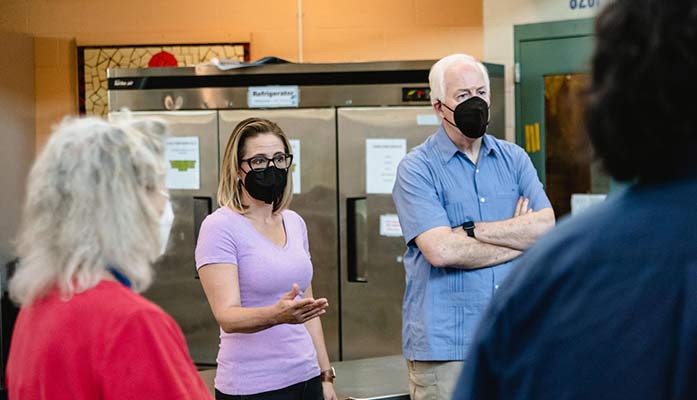
On Tuesday, Sen. Kyrsten Sinema was joined by Sen. John Cornyn of Texas on a tour of two facilities housing migrants in Tucson. Sinema and Cornyn will be in Texas today.
Sinema and Cornyn received a tour of the U.S. Customs and Border Protection’s “soft-sided facility” in Tucson, which is used to house migrants apprehended by Border Patrol.
Cornyn and Sinema then visited the Casa Alitas shelter. The senators received a briefing from Casa Alitas staff. Casa Alitas is operated by Catholic Community Services.
Cornyn, Sinema and U.S. Representatives Henry Cuellar (D-TX-28) and Tony Gonzales (R-TX-23) in April introduced The Bipartisan Border Solutions Act, their bipartisan, bicameral legislation to respond to the surge in migrants coming across our southern border.
The sponsors say the bill would “improve both the Department of Homeland Security’s and the Department of Justice’s capacity to manage migration influxes and adjudicate asylum claims in a timely manner, protect unaccompanied migrant children, reduce impact on local communities, ensure migrants are treated fairly and humanely, and ultimately deter those who do not have realistic asylum claims from placing themselves in danger by making the treacherous journey to our southern border.”
The Bipartisan Border Solutions Act:
- Establishes at least 4 regional processing centers in high-traffic Border Patrol sectors to properly handle the influx of migrants along the southwest border and improve interagency coordination.
- Creates pilot programs to facilitate fairer and more efficient credible fear determinations and asylum decisions, while ensuring fairness in proceedings through provisions to protect access to counsel, language translation services, and legal orientations.
- Establishes prioritized docketing of migrants’ immigration court cases during irregular migration influx events to deliver legal certainty for migrants., and disincentivize would-be migrants with weak asylum claims from making the treacherous journey to the southwest border.
- Expands legal orientation programming and translation services, and protects access to counsel for migrants.
- Implements new protections for unaccompanied migrant children released to sponsors in the United States, including regular follow-up and absolute bars on placement with persons convicted of certain crimes, such as sex offenders and child abusers.
- Increases staffing to better handle irregular migration influx events, including 150 new Immigration Judge teams, 300 asylum officers, ICE Enforcement and Removal Operations staff, ICE litigation teams, CBP officers, and Border Patrol processing coordinators.
- Improves DHS coordination with NGOs and local governments to prevent release of migrants into small communities that are poorly equipped to handle the influx of a large number of migrants.
- Improves DHS, DOJ, and HHS reporting to Congress to support future legislative efforts in areas in which bipartisan agreement does not yet exist.
The Bipartisan Border Solutions Act is supported by the U.S. Chamber of Commerce, National Immigration Forum, National Border Patrol Council, American Business Immigration Coalition, Major Cities Chiefs Association, U.S. Hispanic Chamber of Commerce, National Association of Evangelicals, Southern Baptist Ethics & Religious Liberty Commission, Niskanen Center, Mayor Luis Sifuentes of Eagle Pass, Texas, Texas Border Coalition, Border Trade Alliance, Texas Border Sheriff’s Coalition, Southwestern Border Sheriffs’ Coalition, Texas Association of Business, South Texans’ Property Rights Association, RGV Partnership, New American Economy, Americans for Prosperity and The LIBRE Initiative.
by Terri Jo Neff | Jun 2, 2021 | News
By Terri Jo Neff |
Some lawmakers say Gov. Doug Ducey had a “a temper tantrum” last week when he vetoed 22 Republican-supported bills over his displeasure with the how long it is taking the legislature to pass budget bills.
But with the House and Senate on recess possibly through June 10, other legislators are focusing on what needs to happen to pass a budget when lawmakers come back.
During interviews with KFYI’s James T. Harris on Tuesday, Sen. Warren Petersen (R-LD12) and Rep. Travis Grantham (R-LD12) agreed there have been problems in how the budget process has been handled so far, but both believe a consensus is possible before the end of the fiscal year on June 30.
Grantham acknowledged to Harris that “some folks” were at fault for how budget negotiations were handled prior to last week’s unexpected recess, but he thinks more lawmakers are seeing it is time to get a budget passed so the legislature can adjourn.
“You know the old saying that ‘nothing good happens if you stay out after midnight?’” Grantham said. “Basically, the Legislature is out after midnight, in fact it’s about 3 a.m. and we shouldn’t be there anymore, and we all need to go home.”
But Grantham says the biggest problem right now is that “too much money” is in play due to last year’s surplus and this year’s surplus. The surplus is there, he noted, because the state is collecting too much money, money he says needs to go back to the people via “a massive tax cut.”
And therein lies the dilemma, Grantham told Harris.
“The issue we’re having is there is so much money in the pot and there is so many people with so many wants and so many needs we’re having trouble staying focused on the finish line,” he said. “We just need to focus on the budget, we need to focus on cutting taxes, and we need to focus on getting out of there.”
Grantham added that lawmakers need to realize the surplus “is the people’s money, it’s not the government’s money” and then move forward with passing a budget that allows for tax cuts.
In his comments, Petersen acknowledged that some legislative leaders “tried to move the budget without the votes” instead of waiting to ensure there were 31 votes in the House and 16 votes in the Senate for passage. Petersen also told Harris he was “surprised” that the budget bills were being pushed without a consensus in place first.
“You can’t ignore people if people say they have issues,” Petersen said. “We had all heard about issues from different members, and if you just keep going I don’t know what other result you could possibly expect.”
Although some legislators are suggesting Ducey call a special session focused solely on the budget, Petersen is not sure that is the answer. Instead, he sees it as a matter of elbow grease and not leaving anyone out of the discussion.
“What we really just need to do is we need to do the work,” the senator said. “You’ve got to get the whole caucus together and you just keep working on the budget from whoever is on the far left of the caucus to whoever is on the far right. We’ve got to get those two to agree.”
Petersen did note another reason the budget is not garnering the support needed is that it includes non-budget bills which previously failed on the floor.
“That’s another bad policy. You don’t put bills that don’t pass into the budget to try to force a vote,” he said.
Meanwhile, Petersen and Grantham told Harris they are hopeful Ducey will work with legislators to ensure the 22 vetoed bills are reconsidered in some way once a budget is passed.
by AZ Free News | Jun 2, 2021 | News
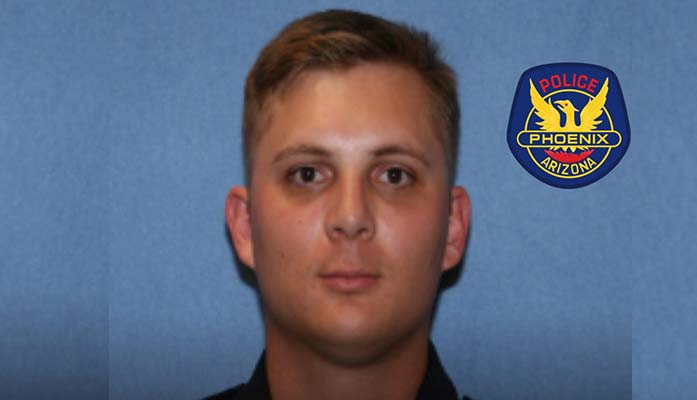
PHOENIX — Governor Doug Ducey ordered flags at all state buildings be lowered to half-staff until sunset on Tuesday, June 1, 2021, to honor Phoenix Police Officer Ginarro New, who died from a car accident while on duty last night.
“Officer Ginarro New of the Phoenix Police Department worked each day to protect Arizonans,” said Governor Ducey. “We are devastated by the loss of Officer New, who served with the Department for just under two years. He made safe communities his top priority, and we are grateful for his bravery and dedication to protecting others. Our prayers are with his wife and loved ones. I’ve ordered flags at all state buildings be lowered to half-staff in honor of Officer New’s life and service.”
Officer New was killed by a red light runner on Monday night. The crash occurred in north Phoenix at around 10:30 p.m. near Cave Creek Road and Greenway Parkway, according to the Arizona Daily Independent.
Officer New was transported to a nearby hospital, where he succumbed to his injuries. The driver of the other vehicle was pronounced deceased on the scene.
Officer New, age 27, is survived by his wife Kristen, his mother, Misty, his brother, Marcas, and his grandmother, Susan.
by Terri Jo Neff | Jun 1, 2021 | News
By Terri Jo Neff |
In a surprise reversal, the Occupational Safety and Health Administration (OSHA) is suspending its recently announced requirement that employers make a record of an employee’s adverse reaction to an employer-mandated COVID-19 vaccination.
In May, the U.S. Department of Labor and OSHA advised employers it would consider an employee’s adverse reaction as a “reportable incident” if the vaccination was required to obtain or keep employment, or to avoid repercussions such as a negative performance rating.
An adverse reaction would have to involve time away from work, medical treatment beyond basic first aid, restricted work duties, or even a job transfer in order to be recorded by the employer.
But OSHA has already changed its policy, according to new information on its website. The priority now is for federal agencies to encourage COVID-19 vaccinations.
“OSHA does not wish to have any appearance of discouraging workers from receiving COVID-19 vaccination, and also does not wish to disincentivize employers’ vaccination efforts,” the website states. “As a result, OSHA will not enforce its recording requirements to require any employers to record worker side effects from COVID-19 vaccination through May 2022.”
The backtracking by OSHA officials is seen as a response to “unprecedented” political pressure from the White House, according to Liberty Counsel chairman Mat Staver.
“OSHA’s suspension of the recording requirement so as not to discourage experimental COVID shots reveals that the Biden administration could care less about the collateral damage being caused by the COVID shots,” Staver commented last week. “The people can see this biased agenda. They are not stupid.”
Many civil liberties groups point to the fact the current experimental COVID-19 vaccines are only approved under an Emergency Use Authorization and therefore its use is not to be mandated.
Whether an employee in Arizona can seek recourse through the courts or a workers’ compensation claim after falling ill from an employer-required vaccination remains unclear.
RELATED ARTICLE: Employers Must Tell OSHA Of Employees’ Adverse Reactions To Mandated Vaccinations
by AZ Free News | May 31, 2021 | News
On Friday May 28, 2021, U.S. Navy Signalman Third Class Austin Henry Hesler entered his final resting place at the Southern Arizona Veterans’ Memorial Cemetery 80 years after his death during the attack on Pearl Harbor.
The Arizona Patriot Guard escorted Mr. Hesler’s hearse to the cemetery. The U.S. Navy Funeral Honors team escorted Mr. Hesler’s U.S. flag draped casket to the committal shelter with about 30 attendees, mostly family, following closely behind.
During the service, a seven-person team from the U.S. Air Force conducted the rifle volley before a bugler played “Taps.” The firing of three volleys over the grave of a fallen warrior has its origin in the old custom of halting the fighting to remove the dead from the battlefield. The U.S. Navy Funeral Honors team conducted the flag folding and presentation, presenting the flag to Mr. Hesler’s niece, Kathy Ayala.
“We would like to extend our most sincere condolences to the family of Austin Hesler,” said Cemetery Administrator Joe Larson to Mr. Hesler’s family and those in attendance. “It’s an honor to have him interred here at the Southern Arizona Veterans’ Memorial Cemetery.”
Larson noted that Mr. Hesler is the first WWII service member that was killed in action to be buried at the SAVMC.
Mr. Hesler was only 21 years old when he was killed. After enlisting into the U.S. Navy on August 8, 1939 in Kansas City, Missouri, Mr. Hesler reported for duty aboard the USS Oklahoma that October.
Just before 8 a.m. on December 7, 1941 the USS Oklahoma was attacked by Japanese forces killing 429 crewmen aboard, including Mr. Hesler. The ship would later be recovered in 1944, however the bodies could not be identified and were commingled and buried in several mass graves at the National Cemetery of the Pacific in Honolulu and marked as “Unknown.”
In 2015, the Defense POW/MIA Accounting Agency (DPAA) began reexamining the unidentified remains using advanced DNA testing. On February 24, 2021, DPAA confirmed that Mr. Hesler’s remains were identified which led to the notification of his loved ones before finally ending with a service fit for a hero.
by Terri Jo Neff | May 31, 2021 | News
By Terri Jo Neff |
The Arizona Court of Appeals issued a unanimous opinion earlier this month on a subject with no prior case law in the state, and the decision could save time and money for Arizonans involved in civil litigation, according to court records.
In 2018, Thomas H. Major II filed a lawsuit in Pima County Superior Court against Set for Set Fitness LLC and company owner Samuel J. Coleman. The nature of the dispute is not addressed in the appellate opinion, only that the parties ran into a problem when they tried to settle the case in 2019.
Judge Cynthia Kuhn refused to accept the terms of the stipulated settlement which called for the lawsuit to be dismissed with prejudice and for the court to retain jurisdiction in the event Coleman defaulted on payment. A dismissal with prejudice typically means all aspects of a case have been adjudicated and no further action is contemplated.
But a provision of the settlement would allow Major to simply file a stipulated judgment with the court if there was a default, and Kuhn would be required to sign it.
The stipulation ensured Major would not have to expend more time nor money to file a new lawsuit simply to enforce the terms of the settlement. However, Kuhn refused to dismiss the case with such a stipulation, ruling the parties’ requested relief “is not consistent with the Rules of Civil Procedure.”
The court of appeals got involved in the case for the first time in February 2020 by issuing an order to Kuhn that Major’s lawsuit should be dismissed without any language about retaining jurisdiction. Once that dismissal was done in June 2020, a three-judge appellate panel then took up the issue of retaining jurisdiction.
“The issue presented here centers on whether a superior court has the authority to issue an order retaining jurisdiction for the purposes of enforcement—allowing the parties to come back to it without having to file a new lawsuit.” Presiding Judge Karl Eppich of the Arizona Court of Appeals noted in the May 5 opinion. “No Arizona case has clearly decided this issue, and we are unaware of a statute or Arizona Rule of Civil Procedure expressly allowing or forbidding the superior court to retain jurisdiction in this circumstance.”
Eppich further noted that without prior case law in Arizona, the panel looked to several other states with similar civil court procedures and case law. “We find the cases allowing a trial court to retain jurisdiction persuasive and conclude their reasoning is consistent with Arizona law,” he wrote.
The appellate panel also reviewed a 1994 U.S. Supreme Court opinion (Kokkonen v Guardian Life Ins.) which allows federal judges to exercise ancillary jurisdiction to enforce the terms of a settlement agreement following a dismissal with prejudice, if the obligation to comply with the settlement was part of the order of dismissal.
“Although Kokkonen does not address a state trial court’s jurisdiction, and is therefore not binding precedent on this court, we find it persuasive as to how to approach this issue,” Eppich wrote.
The result of the research led the court of appeals to conclude there can be compelling circumstances for allowing trial courts the authority to retain ancillary jurisdiction.
“Permitting that authority when the parties have stipulated to it encourages settlement by providing parties certainty about the terms of an agreement and a mechanism to easily enforce performance of the agreement,” Eppich wrote. “Furthermore, this practice promotes judicial efficiency by enabling a trial court to clear the case from its docket until the time arises, if ever, to enforce the terms of the agreement.”
As a result, the case has been remanded back to Kuhn “to afford the trial court the opportunity to determine whether it should, in its discretion, accept the parties’ stipulation to retain jurisdiction to enforce the Settlement Agreement,” the opinion states.