by Corinne Murdock | Aug 27, 2021 | News
By Corinne Murdock |
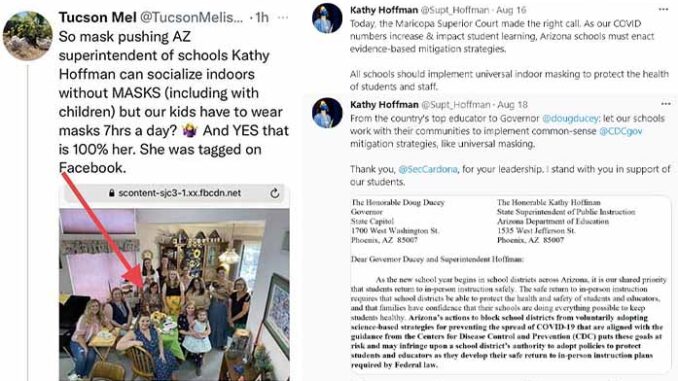
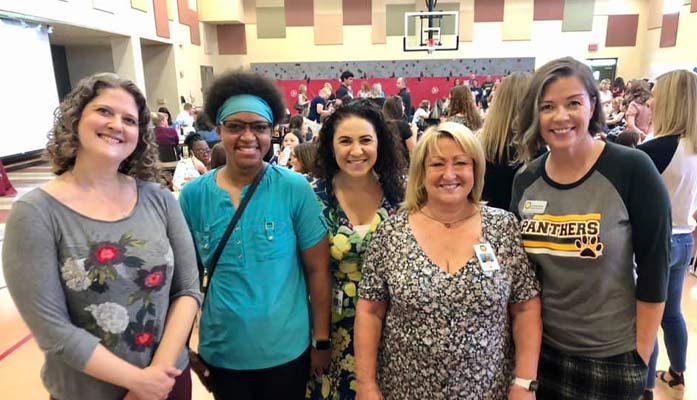
After months advocating for school mask mandates, Arizona Superintendent of Public Instruction Kathy Hoffman neglected to mask up for an indoors baby shower this past weekend. Hoffman has been a staunch advocate for universal masking.
Just one month ago, Hoffman issued a formal statement decrying Governor Doug Ducey’s ban on K-12 mask mandates. Hoffman sided with CDC guidance, which asks that all individuals wear masks – even those who’ve been fully vaccinated.
“We know masks work and, with rising cases, they’re a vital part of our effort to reduce everyone’s COVID-19 risks,” wrote Hoffman. “I encourage teachers, administrators, and families to listen to the CDC and take individual action to keep themselves and each other safe by wearing a mask during in-person school. Students, teachers, and parents are ready to get back to in-person learning, but it takes all of us.”
All of us, that is, except Hoffman. It appears that Hoffman’s personal life doesn’t align with the version she offers the public eye – even Hoffman’s Twitter and Facebook profiles have her wearing a mask.
The same weekend of Hoffman’s maskless party, another prominent politician and masking advocate, House Speaker Nancy Pelosi, was seen on video maskless at a fundraiser luncheon. Like Hoffman’s experience at the “Bee Tea” baby shower, neither Pelosi or any of the other guests caught on camera wore masks or were socially distant.
Corinne Murdock is a reporter for AZ Free News. Follow her latest on Twitter, or email tips to corinne@azfreenews.com.
by Corinne Murdock | Aug 26, 2021 | News
By Corinne Murdock |
Brophy College Preparatory (Brophy), a private all-boys Catholic school in Arizona, admitted in an email to segregating students based on race. In lieu of attending a class period, students of color were given the exclusive opportunity to gather together for a “healing” discussion on race. The email cited a previous email from a “Mr. Fisko” that discussed this race-based segregation.
“[S]tudents who identify as persons of color may choose to attend an affinity space – with other students of color – for their workshop day reflection instead of joining their regular 5th period class,” read the email. “What is an affinity space? Affinity spaces offer a useful, practical space for communities of color to lead their own conversations on race in their own terms. Doing so allows for healing and understanding to take place in a contextual and relevant way. Conversations in affinity spaces can help students of color develop the consciousness and tools to have more meaningful and constructive conversations on race in non-affinity spaces in the future.”
The “Mr. Fisko” cited in the email may refer to the religious studies faculty member, Paul Fisko. He once served as the assistant principal for ministry.
Republican Senate candidate Blake Masters revealed this information after it was shared with him by concerned parents. Masters also reported receiving pictures of controversial political posters inside one civics classroom. Several of the posters read “Protect Trans Youth,” “Stay Woke,” and “Sanctuary Cities Now.”
Brophy is one of the more expensive private schools in the nation. The national average for private school tuition hovers around $11,600; Arizona’s average cost for private high schools sits at just over $15,500. Brophy’s tuition reached nearly $17,000 this year.
While segregation is optional for Brophy students, certain COVID-19 measures aren’t. On top of requiring masks, the private school recently issued a version of a vaccine mandate that mirrored President Joe Biden’s – if students and faculty don’t get the vaccine, then they are required to undergo frequent testing and are limited from participating in certain school functions.
Corinne Murdock is a reporter for AZ Free News. Follow her latest on Twitter, or email tips to corinne@azfreenews.com.
by Corinne Murdock | Aug 26, 2021 | Education, News
By Corinne Murdock |
Litchfield Elementary School District (LESD) Governing Board member Dr. Tara Armstead announced her resignation during Tuesday’s special meeting. Armstead’s total time at LESD lasted five months. The only Black board member alluded to her frustrations with resistance to the district’s equity work.
Armstead’s resignation wasn’t originally a part of the meeting agenda. The ex-board member noted that she’d submitted her resignation on Monday, officially. She said it was her intention when she became a board member this spring to take her advocacy to another level on behalf of students and their families. Instead, Armstead said she’d faced many hurdles: slander against her character and intentions, court battles, and a general lack of support from the very community that purportedly requested her help.
However, Armstead insisted she wasn’t leaving due to these outside pressures. Rather, Armstead said the district was a “sinking ship” she could no longer help.
“I am not leaving because people are running me away, because of people scaring me, because of people pushing me in a position of fear where I feel like I can’t go on any longer, or because I’ve been asked. I am leaving because, even when I’m trying to fight for what is righteous and what is uncomfortably true, I am being treated as though I’m trying to destroy the entity with the intention of serving students,” said Armstead. “I was never here to be served, and I wasn’t here to serve adults. I was here to serve children. So after five months of constant, continuous situations letting me know exactly what they really want to have happen here in this district and in this community, I can no longer be a part of this sinking ship.”
Armstead emphasized that she wouldn’t show any thanks, gratitude, or appreciation for the opportunity to serve on the board. She expressed hope that the district would hire more people of color; she clarified that these hires shouldn’t be for the color of their skin, but for their ability.
“[I] will not say thank you for the time that I’ve served here, or express any gratitude or appreciation, because for the five months that I have been here, I have been treated as though I am not an expert in the field, like I have no idea what I’m talking about, and it’s sad that even a person who is invested in the field of education cannot come and help to improve education,” said Armstead.
Board President Danielle Clymer thanked Armstead for her service as a member, and for getting LESD where they are today.
No other members issued responses to Armstead’s resignation during the meeting.
On Wednesday, Armstead appeared on a “Wednesday Chat” episode with Jeanne Casteen, a failed candidate for Maricopa County Superintendent. Armstead clarified that the final straw had to do with reception to her stance on COVID restrictions. She said she took issue with people challenging her as a professional.
Armstead added that she was tired of her attempts to help falling on deaf ears.
Tuesday’s meeting, starting from Armstrong’s resignation, can be viewed here.
Corinne Murdock is a reporter for AZ Free News. Follow her latest on Twitter, or email tips to corinne@azfreenews.com
by AZ Free News | Aug 26, 2021 | News
Changes to state law mean that drivers who purchase alternative fuel vehicles will pay the same vehicle license tax (VLT) rate as other drivers by 2023. The change in VLT rates is phased-in, starting Jan. 1, 2022.
The VLT is paid during vehicle registration and is assessed in place of a personal property tax often charged in other states. The VLT funds transportation infrastructure in Arizona, including highways, bridges and local roads, and contributes to the general funds of cities/towns and counties.
In 2019, the Legislature amended Arizona Revised Statute 28-5805 (link is external) . This implemented a phased-in approach for making the VLT formula used for alternative fuel vehicles the same one used currently for traditional cars and trucks, bringing fairness to VLT assessments. The changes in the formula will begin taking effect this coming January and be completely phased-in by 2023. The changes ensure that drivers of alternative fuel vehicles contribute to the preservation and maintenance of the state’s 7,000-mile highway system at the same rate as drivers of traditional vehicles. Bringing parity to VLT assessments is especially important for the continued maintenance and expansion of Arizona’s infrastructure as alternative fuel vehicles continue to increase in popularity in Arizona.
Under current state law, an alternative fuel vehicle registered before Jan. 1, 2022, will have its VLT calculated using 1% of the manufacturer’s base retail price of the vehicle. For an alternative fuel vehicle registered between Jan. 1 and Dec. 31, 2022, the VLT will be calculated using 20% of the manufacturer’s base retail price of the vehicle. After Dec. 31, 2022, the formula used to calculate VLT for alternative fuel vehicles will be the same one used for other vehicles, as determined by ARS 28-5801 (link is external) .
What potential buyers of alternative fuel vehicles need to know
- It’s important to note that the VLT formula attached to an alternative fuel vehicle is determined by vehicle registration date, which can be different from the purchase date. A temporary registration permit issued by a vehicle dealer qualifies as the registration date and must be issued before Jan. 1, 2022, for a vehicle to have its VLT calculated using the 1% formula.
- For private party sales, new title documentation must be processed by an MVD or an Authorized Third Party office before Jan. 1, 2022, for the alternative fuel vehicle to have its VLT calculated using the 1% formula. Note: Arizona Department of Transportation Motor Vehicle Division offices will be closed Friday, Dec. 31, 2021, in observance of the New Year’s Day holiday.
What current owners of alternative fuel vehicles need to know
- A current owner of an Arizona-registered alternative fuel vehicle who makes no changes to their vehicle title will continue to have their car’s VLT calculated with the 1% formula. The VLT rate changes won’t affect these vehicles until a change is made to the vehicle title, triggering a new registration cycle.
- The VLT formula attached to the alternative fuel vehicle will be changed to the current formula in use if a new registration cycle is established. Examples of this include but are not limited to: selling the car, transferring ownership, adding or removing an owner from the title, and a lease buy-out.
- Paying off a vehicle loan and the lender’s name being removed from the title will not trigger a new registration cycle.
by Corinne Murdock | Aug 25, 2021 | Education, News
By Corinne Murdock |
The Arizona attorney general’s office found that Litchfield Elementary School District (LESD) violated open meeting law through its Diversity Empowerment Team (DET). In some reporting, social media posts, and even LESD communications and internal documents, the DET was referred to as the “Diversity Empowerment Committee,” or “DEC.”
Deputy Solicitor General Michael Catlett wrote the letter notifying LESD of their violations. For violating open meeting law with the DET, Catlett determined that there wouldn’t be any repercussions, but it would serve to inform the attorney general’s response to any further open meetings violations. LESD was also found in violation of open meeting law for allowing and defending the behavior of one board member, Kimberly Moran, when she interrupted public commentary critical of LESD’s equity statement with a sign that read, “Not True.” Catlett informed LESD that Moran would be required to undergo further training for this violation.
Catlett said that the DET qualifies as a public body, despite insistence from LESD that it didn’t. Information about the DET wasn’t made publicly available through LESD.
“Few government responsibilities are more important than the education of children and the issue of how to education children about discrimination and race is important and complex,” wrote Catlett. “Parents and other community members should be given significant opportunity for input on school curriculum or policies that have any possibility of being viewed as ‘characteriz[ing] the United States as irredeemably racist or founded on principles of racism (as opposed to principles of equality) or that purport to ascribe character traits, values, privileges, status, or beliefs, or that assign fault, blame, or bias, to a particular race or to an individual because of his or her race.’”
LESD’s equity statement was also a product of the DET. In addition to a commitment to diversity, equity, and inclusion, the equity statement announced that LESD pledged to antiracism.
Parents and community members also weren’t privy to DET members’ identities. In fact, the team wasn’t mentioned on LESD’s website at all. However, some parents did manage to learn the identities of DET members.
AZ Free News learned that DET members were parents Latrice Gettings, Tamillia Valuenzela, Kamaria McDonald; Palm Valley Elementary School special education teacher Brittany Austin; curriculum administrative assistant Eva Aguila; Verrado Heritage Elementary School behavior coach Grizellie Hedges; Litchfield Elementary School behavior coach Heather Maxwell; Mabel Padgett teacher Anthony Munoz; student transporter Jocelyn Zvosechz; Palm Valley Elementary School principal Jen Benjamin; Wigwam Creek Middle School assistant principal Kacie McQuarrie; Verrado Heritage Elementary School principal Meredith Noce; and LESD Title One director John Scudder.
Only one LESD governing board member was on the DET: Moran.
The parents chosen for DET have publicly shown their support for nearly all social justice beliefs, including: critical race theory, Black Lives Matter (BLM), anti-racism, transgenderism, LGBTQ+ lifestyles, ICE abolishment, and DACA continuance.
It also appears through a public post by McDonald that DET has a private Facebook page.
In addition to the DET issue, the attorney general’s office addressed the behavior of Moran at length. During LESD’s April 13 board meeting, Moran disrupted public comments criticizing the board’s equity statement by holding up a sign that read, “Not True[.]”
LESD defended Moran’s behavior, arguing that open meeting law allows board members to respond to public commentary. The attorney general’s office disagreed. They stated that the full text of the law allows board members to respond at the end of public commentary, not during. Catlett wrote that Moran’s behavior was “extremely concerning,” considering she’d just undergone open meeting law training.
“Ms. Moran’s actions violating the Open Meeting Law immediately following Open Meeting Law training are extremely concerning,” wrote Catlett. “Thus, the Office will require that Ms. Moran re-take the training received by the board during the April 13 meeting.”
The DET also had an Outside Facilitator named Amber Checky, the CEO and Founder of Inclusion Counts – a diversity training and consultation business.
Checky and the other DET members earned the ire of parents over the summer for their involvement in DET’s plans for increasing equity at LESD. These plans were published by Young America’s Foundation (YAF). The “Litchfield Elementary School District Transformational Equity Work” explained that the DEC (DET) created the following equity goals:
· Reduce disproportionality in discipline for Black students;
· Reduce disproportionality in achievement for Black and Hispanic students;
· Increase professional development for LESD staff on diversity, equity, inclusion, and anti-racism;
· Develop a diverse and inclusive curriculum by:
· Auditing existing curriculum materials for bias to ensure multicultural perspectives;
· Acquiring multicultural inclusive curriculum materials;
· Ensuring teachers have cultural competence: clarity, knowledge, and agency to adapt, modify, or enhance curriculum to bring cultural awareness and diverse voices and perspectives into curriculum;
· Recruit and retain culturally competent and diverse administrators, faculty, and staff (diversity refers to race, ethnicity, gender identity, faith, ability, sexual orientation, appearance, socioeconomic class, age, and life experience).
According to the internal document, these DEC (DET) goals were the primary focus of the 2021-22 school year.
Parents objected to Checky as an outside consultant – partly because of her beliefs, and partly because they didn’t get a say in the makeup of DET. Checky and her wife, Inclusion Counts CFO and Co-Founder Heather Checky, raise their daughter as a son. This is public knowledge: Checky’s foster daughter is widely publicized. The Checkys interviewed with several news outlets in 2019 about their daughter, claiming a summer camp refused her entry because of her transgenderism.
LESD Superintendent Jodi Gunning rebuked parents for taking issue with Checky and the DET. Gunning offered a veiled threat that law enforcement would intervene if parents continued to identify and criticize members of the DET.
“It has come to my attention that the names of our staff members and volunteers who served on the Diversity Empowerment Committee (DET), as well as screen shots from their personal Facebook pages, have been posted to social media as individuals to ‘get to know.’ This even included personal information about someone’s partner and child,” wrote Gunning. “Litchfield Elementary School District denounces any attempts to intimidate or threaten. We strongly oppose personal attacks and fear tactics by anyone attempting to persuade the professional business of our public institution. We are working closely with law enforcement partners to ensure the safety of all of our stakeholders.”
The family that Gunning referenced was the Checkys.
As of press time, LESD hasn’t updated its website with public information about the DET.
Corinne Murdock is a reporter for AZ Free News. Follow her latest on Twitter, or email tips to corinne@azfreenews.com.
by AZ Free News | Aug 24, 2021 | Education, News
The Arizona Attorney General’s Office announced that it has signed on to a tentative historic $26 billion multistate settlement with four pharmaceutical companies for their roles in the opioid crisis. The tentative agreement includes Cardinal, McKesson, and AmerisourceBergen – the nation’s three major pharmaceutical distributors – and Johnson & Johnson, which manufactured and marketed opioids.
According to the Attorney General’s Office, final details, including a critical mass of states and political subdivisions nationally, are necessary to finalize the settlement. If finalized, Arizona would receive up to $549 million from the settlement and the money would be used for opioid treatment, prevention, and education.
If the settlement is finalized, Arizona’s funds will be distributed through the Arizona Opioid Settlement Memorandum of Understanding (One Arizona Plan). In October 2020, the AGO and local governments (90 cities and towns and all 15 counties) signed on to the One Arizona Plan to maximize Arizona’s amount of recovery from opioid settlements. The One Arizona Plan also ensures that funds will be expeditiously distributed across Arizona. Read more on the One Arizona Plan here .
Funding Overview:
- Nationally, the three distributors (Cardinal, McKesson, and AmerisourceBergen) collectively will pay up to $21 billion over 18 years.
- Nationally, Johnson & Johnson will pay up to $5 billion over nine years with up to $3.7 billion paid during the first three years.
- The total funding distributed will be determined by the overall degree of participation by both litigating and non-litigating state and local governments.
- After attorneys’ fees and costs, the money is to be spent on opioid treatment and prevention.
- Arizona’s share of the national funding has been determined by an agreement among the states using a formula that takes into account the impact of the crisis on the state and the population of the state.
Injunctive Relief Overview:
- The 10-year agreement will result in court orders requiring Cardinal, McKesson, and AmerisourceBergen to:
- Establish a centralized independent clearinghouse to provide all three distributors and state regulators with aggregated data and analytics about where drugs are going and how often, eliminating blind spots in the current systems used by distributors.
- Use data-driven systems to detect suspicious opioid orders from customer pharmacies.
- Terminate customer pharmacies’ ability to receive shipments, and report those companies to state regulators, when they show certain signs of diversion.
- Prohibit shipping of and report suspicious opioid orders.
- Prohibit sales staff from influencing decisions related to identifying suspicious opioid orders.
- Require senior corporate officials to engage in regular oversight of anti-diversion efforts.
- The 10-year agreement will result in court orders requiring Johnson & Johnson to:
- Stop selling opioids.
- Not fund or provide grants to third parties for promoting opioids.
- Not lobby on activities related to opioids.
- Share clinical trial data under the Yale University Open Data Access Project.
In order for the multistate settlement to be finalized, a critical mass of participating states and local governments will need to sign on.
The settlement comes as a result of investigations by state attorneys general into whether the three distributors fulfilled their legal duty to refuse to ship opioids to pharmacies that submitted suspicious drug orders and whether Johnson & Johnson misled patients and doctors about the addictive nature of opioid drugs. The settlement would resolve claims of both states and local governments across the country, including the nearly 4,000 that have filed lawsuits in federal and state courts.
Tragically, last year, drug overdose deaths rose to a record 93,000, according to the Centers for Disease Control and Prevention. Arizona saw a 30 percent increase in overdose deaths over the prior year, claiming more than 2,600 lives in 2020. Countless more have seen their lives torn apart by the disease of addiction. The damage, which continues in part every day due to an insecure southern border, also impacts their families, friends and communities.