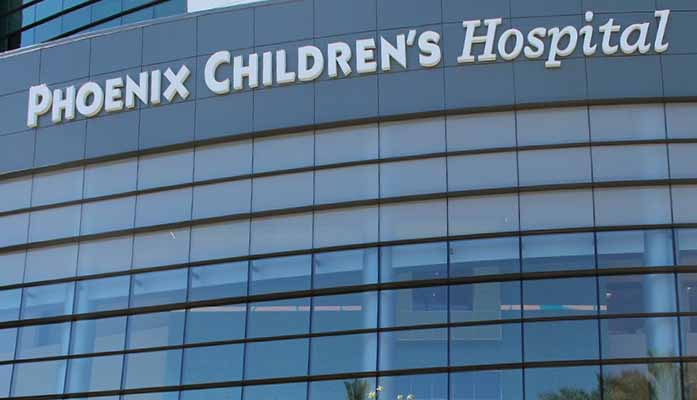
Phoenix Children’s recently announced the five winners of its inaugural Heart & Hand Clinical Excellence Awards which recognize exceptional contributions to pediatric medicine in the areas of clinical care, research, and medical education.
The Oct. 21 awards event was held at the Phoenix Country Club. Among the special guests were Phoenix Coyotes executive Shane Doan who provided the keynote speech, with Phoenix Children’s own Dr. Jared Muenzer, who is the hospital’s physician-in-chief, serving as emcee.
Other speakers included Phoenix Children’s President and CEO Robert L. Meyer along with Dr. Daniel Ostlie, the surgeon-in-chief.
“These awards are uniquely special because all of those nominated were done so by their peers,” said Steve Schnall, senior vice president of Phoenix Children’s Foundation. “With countless examples of excellence exhibited by our amazing physicians and advanced practice providers, we are honored to be able to recognize all of those who offer exemplary service and foster an environment of hope, healing, and world-class healthcare.”
Physician of the Year – Wendy P. Bernatavicius, MD, selected as the doctor “who lives and breathes” the values of exemplary service, while excelling clinically and going “the extra mile to demonstrate service” while communicating with staff and patient families.
Advanced Practice Provider of the Year – Katherine M. Harrison, MSN, RN, CPNP-AC, CCRN, selected for embodying family-centered care, placing the child’s needs first, and putting in the effort “to ensure the family is informed, empowered and valued as part of the care team.”
Researcher of the Year – Michael C. Kruer, MD, recognized for being actively involved “in the conversation around improvement and innovation, making contributions in clinical, translation and/or basic science research.” The researcher award is also designed “for the intensely curious.”
Teacher of the Year – Vasudha L. Bhavaraju, MD, selected from Phoenix Children’s teaching faculty for taking time to coach those around her and actively mentoring future clinicians “to carry on a shared mission of hope and healing.”
Advocate of the Year – Alexandra M. Walsh, MD, recognized for her passion every day “to help bridge the gaps in care in the surrounding community.”
Event sponsors recognized by the Phoenix Children’s Foundation include Arizona Coyotes, Gammage & Burnham, IES Communications, In-Group Hospitality, Littler, Maricopa Ambulance, Palo Alto Networks, Progressive Management Systems, Staybridge Suites, Stifel Hagen Wealth Management Group, and Trident Security.
Phoenix Children’s is one of the largest pediatric health systems in the United States, comprised of Phoenix Children’s Hospital – Main Campus, Phoenix Children’s Hospital – East Valley, 4 pediatric specialty and urgent care centers, 11 community pediatric practices, 20 outpatient clinics, 2 ambulatory surgery centers, and 6 community outpatient clinics throughout Arizona.
The Phoenix Children’s Care Network includes more than 850 pediatric primary care providers and specialists in more than 75 subspecialties.
The U.S. Supreme Court (SCOTUS) accepted Arizona Attorney General Mark Brnovich’s petition to defend previous President Donald Trump’s updates to a rule limiting green cards and citizenship to those who haven’t and won’t become dependent on welfare programs. Brnovich announced this update in a press release Friday.
“When other federal officials won’t defend the law, I will,” asserted Brnovich. “The Public Charge Rule is a commonsense policy based on a real inconvenient truth. Overrunning our welfare programs right now would be like pulling back the last safety net for Americans who need it most.”
Congress first enacted the “Public Charge Rule” in 1882: a concept that officials could deny immigrants entrance, visas, and even citizenship if officials deemed they were likely to become a “public charge.” The definition of “public charge” varied over the years. In 2019, the Department of Homeland Security (DHS) defined “public charge” as illegal immigrants who received one year’s worth of welfare benefits in the aggregate within a three-year period. Under that definition, two benefits received in one month counted as two months.
According to the latest available data analysis from the Center for Immigration Studies, about 55 percent of noncitizens relied on welfare in 2018. Noncitizens in their study included both green card holders and illegal immigrants. While the law does prohibit illegal immigrants from receiving welfare benefits, noncitizens may receive benefits on behalf of any children they have born in the U.S.
In April, SCOTUS rejected a previous petition from 14 states attempting to revive Trump-era litigation that the Biden Administration halted. Texas led the charge on that petition. The states claimed that dropping the Trump rule would force them to provide millions of dollars of government benefits to illegal immigrants.
SCOTUS determined that states would have to work through lower courts before they’d take up the case, if at all.
Their recent acceptance means that Arizona and 12 other states – Alabama, Arkansas, Indiana, Kansas, Louisiana, Mississippi, Missouri, Montana, Oklahoma, South Carolina, Texas, and West Virginia – may be eligible to defend the rule even though the Biden Administration has decided against doing so.
SCOTUS will not be deciding on the legality of the rule, and oral arguments haven’t been scheduled.
Corinne Murdock is a reporter for AZ Free News. Follow her latest on Twitter, or email tips to corinne@azfreenews.com.
Chandler Unified School District (CUSD) became the latest to join the trend of school boards and state associations leaving the National School Boards Association (NSBA). The CUSD Governing Board voted on Wednesday to cease their annual payment for “National Connection Fees” under the federation, which amounted to $8,620 for this upcoming year.
Only one board member, Lindsay Love, voted against leaving; board member Lara Bruner abstained from voting. The vote against paying the membership fees earned applause from the public in attendance.
NSBA’s national connection fees come with certain perks like advanced and discounted registration for their annual conference, additional leadership and legal resources, insider knowledge on federal policies and developments, national networks, and the latest news.
The advanced and discounted registration to NSBA’s annual conference is the biggest perk. Attendees have access to the premiere vendors and thought leaders in education. Their upcoming conference next April will be held in San Diego, California.
Board member Jason Olive said that he wasn’t aware of any board members attending the annual conference in recent years. Board President Barb Mozdzen confirmed that nobody to her knowledge had gone to the annual conference in four or five years.
Bruner claimed that being part of NSBA was required to maintain policy revisions from Arizona School Boards Association (ASBA). Mozdzen clarified that NSBA membership wasn’t required to get ASBA policies. Superintendent Franklin Narducci added that ASBA reviews state-legislated policies, but NSBA doesn’t.
“It’s my understanding you can be in one without the other, and that they aren’t mutually inclusive of each other,” said Narducci.
Love questioned why they were leaving the NSBA at all. Olive’s reply prompted laughter.
“Uh – so we don’t have to give them any money,” responded Olive.
At that point, Love cited her involvement with NSBA’s National Black Council (NBC). She insinuated that CUSD wouldn’t have representation in the NSBA if they rescinded their membership.
“So essentially [we] as Chandler have direct access to [NSBA] and we impact national policies just by being at the table,” argued Love.
Love’s remarks were met with stretches of silence from her fellow board members.
Bruner voiced her concern again that their withdrawal from NSBA would jeopardize their membership within ASBA. Mozdzen said that the membership fees weren’t due until January, indicating the council had time to revisit the topic until then.
The NSBA has received negative attention nationwide after sending a letter to President Joe Biden last month, asking him to invoke the PATRIOT Act to investigate parents and community members for potential “domestic terrorism.” Less than a week later, the Biden Administration obliged. Attorney General Merrick Garland issued a memo directing the FBI to investigate those concerns.
Shortly after the letter’s publication, open records requests revealed that the White House collaborated with the NSBA in their drafting of the letter. A day after the report on these records, the NSBA submitted an apology letter to its membership. Unlike their initial letter to Biden, however, the NSBA didn’t publicize this apology letter.
Flagstaff City Council indicated in a work session Wednesday that it will work on modifying its High Occupancy Housing (HOH) Plan. The plan caused pushback resulting in over $50 million in claims through the Arizona Private Property Rights Protection Act (Prop 207).
The council voted last week to waive the HOH policy application for those claimants. According to The Goldwater Institute – the think tank that assisted many claimants in submitting their demand letters – the city can anticipate even more claims.
A majority of the council’s discussion centered on the origins story, purposes, and strategies of the HOH Plan. At the end of a presentation from city staffers responsible for drafting and implementing the plan, the council was presented with the option of maintaining the plan, modifying certain aspects of it, or scrapping it entirely.
A majority of the council indicated that it would go back to the drawing board with a focus on the plan’s effects on environmental sustainability and housing.
Council members Adam Shimoni, Becky Daggett, Jim McCarthy, Regina Salas, and Austin Aslan indicated that repealing the HOH Plan wasn’t an option.
“We cannot allow the boogeyman of off-campus student housing to be the enemy of appropriate and healthy city development, especially so near the heart of the city,” asserted Aslan.
McCarthy added that the community needed more housing for families, and less apartments.
Only council member Miranda Sweet said she was in favor of repealing the plan entirely.
Corinne Murdock is a reporter for AZ Free News. Follow her latest on Twitter, or email tips to corinne@azfreenews.com.
Maricopa County Sheriff’s Office (MSCO) responded to criticisms from Phoenix City Council member Sal DiCiccio over their practice of stopping traffic to allow an NFL convoy through. DiCiccio submitted a letter to law enforcement on Tuesday, along with a series of posts on Facebook and Twitter to express his grievances with the practice. DiCiccio noted that he would assure this doesn’t happen again in his district in the future.
“This type of action is at the very least an inconvenience to our hard-working taxpayers. Granting special privileges to a select few is unacceptable in my district,” wrote DiCiccio. “This action also creates a great danger for our first responders during emergency calls as they are responding to critical life and death situations. Phoenix residents are already experiencing an increase in response times, worsened by this unnecessary action of special privilege that only hinders the ability for our first responders to answer calls, perhaps to save lives.”
MSCO was escorting a convoy of four or five buses carrying the Houston Texans football team. The councilmember called it a “special privilege for some really special people.”
Just saw 4-5 large buses at 24th St./Camelback get a special police escort blocking traffic. These “Special People” held up traffic so that their buses could get through while normal people waited for their escort. I will keep you apprised. Sick privilege
Maricopa County Sheriff Paul Penzone wasted no time issuing a response. Several hours after DiCiccio published his letter, Penzone sent back a letter of his own.
Penzone noted that their method of escorting professional athletic teams has been a regular practice for a little over a decade, one to two years before DiCiccio was elected. He asked DiCiccio why he hadn’t questioned the practice in years past, and whether the councilman actually had the authority to single-handedly stop this practice. Penzone also explained that the practice was necessary to protect visiting teams from hostility, as well as fines from the NFL due to tardiness. The sheriff estimated that the entire procession delayed regular traffic by about one to two minutes.
“In my estimation, the time allotted to your inconvenience was similar to, or less than the time you spent complaining on your social network platforms. When I calculate that time spent and the time I am now spending to respond to your petty complaint, I recognize the taxpayers deserve more from our time,” wrote Penzone.
Less than an hour later, DiCiccio shot back a response claiming that the sheriff’s remarks were dismissive of citizen concerns. “Crazy, now you know why there are two sets of rules, one for normal hard-working citizens and then the other for the elites,” wrote DiCiccio. “Sheriff Penzone came back saying he doesn’t care about the citizens of the district. He will continue stopping traffic so that his privileged players can skip through all the lights and hold up citizens in traffic.”
UPDATE Oct. 26th
Crazy, now you know why there are two sets of rules, one for normal hard-working citizens and then the other for the elites. Sheriff Penzone came back saying he doesn't care about the citizens of the district. https://t.co/BKC51lwLDq
Mexico’s cartels should be designated as foreign terrorist organizations (FTOs) for their role in President Joe Biden’s border crisis, according to governor-hopeful and previous congressman Matt Salmon. If cartels were designated as FTOs, federal prosecutors would have more power and reach to take action on them and their allies, such as drug traffickers or foreign nationals.
Previous President Donald Trump toyed with the idea of designating Mexican cartels as FTOs but scrapped it after multiple advisors recommended against it, suggesting that doing so would hurt relations with Mexico. Trump’s initial inclination to classify Mexican cartels as FTOs was prompted by the 2019 massacre of nine dual citizens, a Mormon family, by suspected drug trafficking members.
Federal law lists three criteria necessary to classify something as an FTO: it must be foreign, engaged in or planning terrorist activities, and posing a threat to the country’s national security or any nationals. Such a designation would fall under the Department of Homeland Security Secretary Alejandro Mayorkas’ purview. Texas Governor Greg Abbott suggested the same back in April in a letter to Mayorkas.
the highjacking or sabotage of any conveyance (including an aircraft, vessel, or vehicle)
the seizing or detaining, and threatening to kill, injure, or continue to detain, another individual in order to compel a third person (including a governmental organization) to do or abstain from doing any act as an explicit or implicit condition for the release of the individual seized or detained
A violent attack upon an internationally protected person (as defined in section 1116(b)(4) of title 18) or upon the liberty of such a person.
An assassination.
The use of any biological agent, chemical agent, or nuclear weapon or device, or explosive, firearm, or other weapon or dangerous device (other than for mere personal monetary gain), with intent to endanger, directly or indirectly, the safety of one or more individuals or to cause substantial damage to property.
A threat, attempt, or conspiracy to do any of the foregoing.
Salmon’s suggestion occurred during an interview with AZ Free News about his latest visit to the border in Vekol Valley last week. Salmon confirmed that he’s visited various parts of the border at least over ten times, including Yuma and Sierra Vista.
Americans learned last week that Biden drove by the border once 13 years ago. Other than that, the president has reportedly never visited the border in his life.
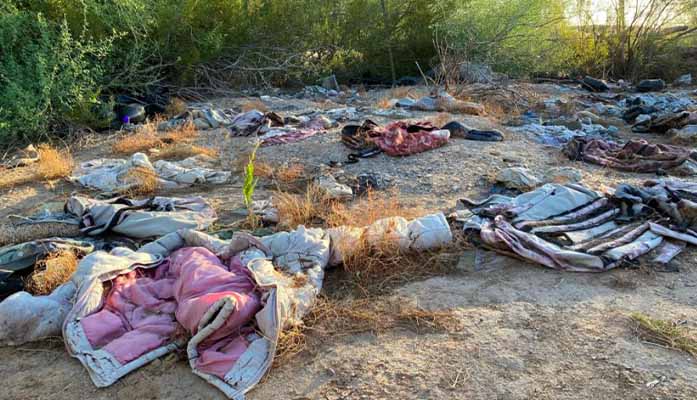
Salmon recounted to AZ Free News that the desert was covered with so much trash – like discarded clothes and water bottles – that it looked like a “rummage sale.” He also remarked on how the signs warning visitors of human and drug smuggling were riddled with bullet holes.
Most of the discarded clothing was similar, said Salmon: piles of camouflage gear and “carpet shoes,” which are cloth shoes that illegal immigrants and cartel members slide over their tennis shoes or boots to muffle their steps and cover up their tracks.
The discarded clothes are left behind by the historic number of illegal immigrants: 1.7 million. That’s only counting encounters and apprehensions, not “got-aways:” those never encountered at all. Leaked information from anonymous border patrol agents revealed that around 30,000 to 40,000 got-aways have occurred each month since Biden took office.
The cartels aren’t just bringing illegal immigrants. They’re trafficking drugs. The vast majority of fentanyl in the country comes from across the southern border. The effects of this are already evident in Pima County: their proximity to the border has made fentanyl overdoses the leading cause of death for people under 19. Cartels will sometimes have the migrants
“This is a human rights crisis of epic proportions,” said Salmon. “Why [is the Biden Administration] turning a blind eye to all this human suffering that’s going on at the border?”
Salmon knows of one family whose athlete son died from an overdose after unintentionally purchasing a muscle relaxer laced with fentanyl on the internet.
The gubernatorial candidate expressed his disgust for how the entire Biden Administration continues to ignore the border crisis.
“I’ve been very vocal that Mayorkas should step down and resign in shame. This has all happened on his watch,” asserted Salmon. “The current administration under Biden is dismal. They won’t recognize that this is a crisis.”
Corinne Murdock is a reporter for AZ Free News. Follow her latest on Twitter, or email tips to corinne@azfreenews.com.