Arizona was ranked the worst state to live in based on its quality of life and inclusivity scoring by one of the biggest news outlets in the country. Its weaknesses that gave it the bottom ranking were air quality, health resources, inclusiveness, and crime — earning it a “Life, Health, & Inclusion Score” of 67 out of 325 possible points.
As CNBC explained, the metric focused mainly on social justice issues:
Combine an era of enhanced social consciousness with a growing worker shortage, and it explains why, now more than ever, companies are demanding that states offer a welcoming and inclusive environment for employees. We rate the states on livability factors like per capita crime rates and environmental quality. We look at inclusiveness in state laws, including protections against discrimination of all kinds, as well as voting rights. While the pandemic may be past the crisis stage, health care quality, outcomes, preparedness and public health spending remain in the spotlight. All are key drivers in this category.
Part of the inclusivity scoring likely came from GLSEN — a national organization pushing LGBTQ+ ideologies onto minors through schools and communities — as well as the Brennan Center for Justice, Lumina Foundation, and National Education Association. CNBC relied on them as a source.
However, Arizona did rank within the top 10 states for several other categories. The state ranked fourth in business friendliness, sixth in infrastructure, and seventh in workforce.
CNBC published the ranking last week as part of their overall data from their annual “America’s Top States for Business” listing. The rankings were based on six different scoring criteria, weighted based on how frequently states use them as a selling point for economic development marketing materials: workforce, 410 points (16 percent); infrastructure, 380 points (15 percent); cost of doing business, 345 points (14 percent); economy, 325 points, 13 percent); life, health, & inclusion, 325 points (13 percent); technology & innovation, 250 points (10 percent), business friendliness, 200 points (8 percent); education, 165 points (7 percent); access to capital, 50 points (2 percent), and cost of living, 50 points (2 percent).
The other 9 of the 10 worst states to live in based on the Life, Health, & Inclusion Score were, in order: Texas, Oklahoma, South Carolina, Missouri, Louisiana, New Mexico, Indiana, Tennessee, and Nevada.
The outlet ranked the following as the top 10 states to live in based on their Life, Health, & Inclusion Score, in order: Vermont, Maine, Hawaii, North Dakota, Minnesota, Washington, Nebraska, Oregon, New Jersey, and Iowa.
With all factors considered, Arizona ranked 34th. The top ten states for business with all factors included were, in order: North Carolina, Washington, Virginia, Colorado, Texas, Tennessee, Nebraska, Utah, Minnesota, and Georgia.
Corinne Murdock is a reporter for AZ Free News. Follow her latest on Twitter, or email tips to corinne@azfreenews.com.
Nicole Solas, the Rhode Island mother who was sued by the nation’s largest teacher union for requesting public records, offered advice to Arizona parents facing similar transparency battles. As AZ Free News reported last week, Scottsdale Unified School District (SUSD) will post the names of individuals online who submitted records requests — an update that inspired controversy within the community.
The National Education Association of Rhode Island (NEARI), a teacher’s union, sued Solas last year for seeking records on Critical Race Theory (CRT) and gender theory from her child’s Rhode Island school. Not only was Solas sued — the school district attempted to charge Solas $74,000 for access to the requested records.
Solas advised Arizona parents to be loud and engaged until they achieved victory. Her examples of loud engagement were submitting public records requests and filing lawsuits. She advised that district officials would “fold like a paper tiger.” Solas offered the advice and discussed her ongoing legal battle on “Conservative Circus” with host James T. Harris on Tuesday.
Solas pointed out that parents speaking out at school board meetings serves to inform the public, which she says has a far greater impact on schools.
“Keep in mind that when you make public comment at school board meetings, you’re doing that to talk to, not the school board, you’re trying to talk to people that don’t know what’s going on,” said Solas. “You need to be brave.”
Parent Nicole Solas discusses being attacked by teachers' union on curriculum transparency and also being kicked of https://t.co/VT8Snw7eWJ
The Goldwater Institute, a Phoenix-based think tank and legal organization, represented Solas in the lawsuit, National Education Association of Rhode Island, et al. v. South Kingstown School Committee, et al. Most recently, the Rhode Island Superior Court denied Solas’ motion for summary judgment early last month.
Nicole Solas wanted to know what her daughter would be taught in kindergarten.
Her school district hit her w/a $74K bill for asking. But she hasn’t stopped fighting for academic transparency.
Most recently, Twitter deplatformed Solas with a permanent ban for speaking out against child grooming. She revealed that she is seeking legal representation currently to restore her account.
Corinne Murdock is a reporter for AZ Free News. Follow her latest on Twitter, or email tips to corinne@azfreenews.com.
Governor Doug Ducey told Democratic mayors of the nation’s capital and most populous city, respectively, that they shouldn’t complain to him about asylum seekers, but should petition their party since it bears ultimate responsibility. Since April, Texas and Arizona have sent over 4,000 migrants to D.C.
Washington, D.C. Mayor Muriel Bowser complained to CBS News that Ducey and Texas Governor Greg Abbott were “tricking” illegal immigrants seeking asylum into boarding buses headed for her city. Bowser said that these buses were overwhelming D.C.’s homeless shelters.
“I fear that they’re being tricked into nationwide bus trips when their final destinations are places all over the United States of America,” said Bowser.
Homeless shelters in Washington D.C. are filling up with asylum seekers from Texas and Arizona. Mayor Bowser says “I fear that they're being tricked into nationwide bus trips when their final destinations are places all over the United States of America.” pic.twitter.com/7OOH6F2Dpl
The D.C.-based news outlet, WUSA9, reported that several asylum seekers were told by Texas and Arizona officials that they would be given further transportation to their final destinations after traveling to D.C. These accounts would corroborate Bowser’s claim.
However, Ducey asserted that Arizona only provided asylum seekers with voluntary transportation to Washington, D.C. Additionally, the governor insisted that the mayor was getting a taste of her party’s own policies.
“Welcome to our world, @MayorBowser. Now work with your party, your Congress, and your President to do something about it,” stated Ducey.
Welcome to our world, @MayorBowser. Now work with your party, your Congress, and your President to do something about it. https://t.co/2I96OAFeJH
Ducey added that the only “trick” played on asylum seekers is one played by the Biden administration.
The only trick that’s being played on asylum seekers comes from the Biden Administration, which with their open border policy, has sent every possible signal to migrants to “head north.” @MurielBowserhttps://t.co/gTKHiYvvqJ
Ducey later tweeted that Bowser’s accusations were offensive to the homeless shelters and nonprofits of Arizona and other border states because they’re also overwhelmed.
.@MayorBowser's suggestion is offensive to border states whose homeless shelters and non-profit organizations are overwhelmed with the humanitarian crisis at our nation’s southern border.https://t.co/BYPxcZlgx4
In a statement to WUSA9, Ducey’s communications director, C.J. Karamargin, said that they were unaware of anyone misleading the asylum seekers.
“If anyone is being misled, we certainly want to know about it,” stated Karamargin.
Abbott spokespersons also declared to WUSA9 that they didn’t mislead the asylum seekers.
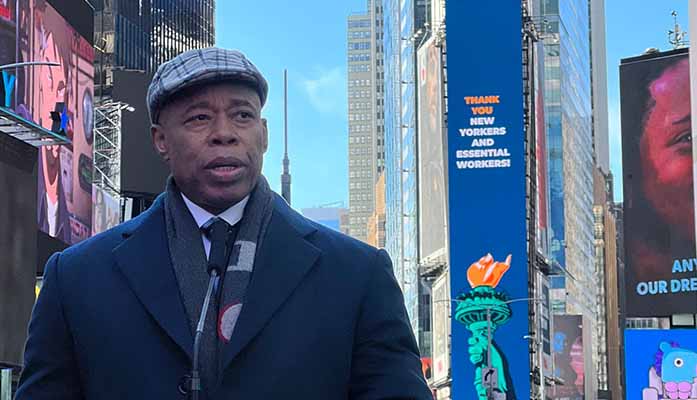
Ducey also dismissed New York City Mayor Eric Adams’ claim that Arizona sent migrant families to New York City, saying that Arizona only sent them to D.C.
“President Biden created the crisis at the border — he’s failed to respond to calls for action and refuses to even visit the border, so we’re bringing the issue a little closer to home for him,” tweeted Ducey. “The President’s policies have placed overwhelming burdens on Arizona communities. It’s convenient that these liberal mayors are finally speaking up on this humanitarian crisis once it affects their communities, even though our program does not charter to New York City.”
Mayor Adams needs to get his facts straight and pay closer attention to what’s really occurring because our nation’s security depends on it. The State of Arizona is providing voluntary transportation for asylum seekers only to Washington, D.C., not NY. 1/ https://t.co/LiVVJo7Esipic.twitter.com/AejYUEn3DG
The hot temperatures of June did not slow down the relentless flow of people hoping to enter the United States along the southwest border, according to data released by U.S. Customs and Border Protection (CBP).
While the majority of migrants crossing through Arizona are presenting themselves at CBP-operated ports of entry, there are still a number of people willing to pay big to be smuggled across remote areas along the border and then seek transportation to Tucson and Phoenix.
From Oct. 1, 2021 through June 30, 2022, U.S. Border Patrol (USBP) Yuma Sector reported more than 235,000 “encounters” – a nearly 300 percent explosion compared to the same eight months the prior fiscal year. The Tucson Sector reported more than 195,000 encounters so far this fiscal year, a 40 percent uptick.
Nationally, more than 1.6 million encounters were reported from October to June, compared to slightly more than 1 million the prior fiscal year. Those numbers only represent persons who turn themselves in to federal authorities or are intercepted by law enforcement.
However, the data does not represent the experiences faced by law enforcement officials, residents of border communities, and business owners. Which is why USBP Yuma Sector Chief Chris Clem and Yuma County Sheriff Leon Wilmot are offering law enforcement agencies across the country a firsthand look of the southwest border.
Last week the lawmen hosted two sheriffs from South Dakota, one day after Clem took to Twitter to announce USBP’s capture of Eloy Tecuanhuehue Hueyopa, a convicted sex offender previously removed by U.S. immigration officials. Clem noted that during his agents’ contact with Hueyopa they learned he had an extraditable warrant from the State of Indiana in a child molestation case.
And the week before, USBP agents assigned to Yuma Sector’s Wellton Station worked with a Border Patrol Search, Trauma, and Rescue (BORSTAR) unit as well as agents with CBP’s Air and Marine Operations to locate an 11-year-old boy who had been left in the rugged desert by his smuggler.
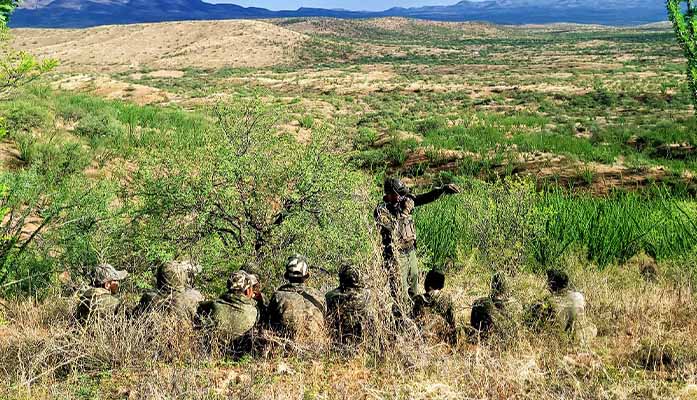
Many of those bypassing formal immigration channels are doing so in Cochise County, often wearing camouflaged clothing. Agents with USBP’s Tucson Sector are working with local, county, and state law enforcement personnel to address a growing lawlessness in the region fueled by Arizonans -mostly from Maricopa County- who come to the area to engage in human smuggling.
Earlier this month 15-year-old Emiliano Villalobos of Phoenix was arraigned on felony charges including aggravated assault on a park ranger with the U.S. Bureau of Land Management stemming from a traffic stop just a few miles from the international border near Bisbee. A 9mm handgun and four undocumented non-U.S. citizens were found in the car Villalobos was driving.
Villalobos is being prosecuted as an adult on two aggravated assault counts and unlawful possession of a deadly weapon by a minor. He remains in the Cochise County Sheriff’s Office in lieu of a $50,000 secured appearance bond and is scheduled for an Aug. 19 pretrial conference in advance of a Dec. 5 speedy trial deadline.
Court records show Villalobos was driving a Honda Accord on June 24 when federal agents initiated a traffic stop after several people were seen getting into the vehicle shortly after 8 a.m. The Honda was traveling on a side road approaching State Route 92, a busy road which connects the Bisbee / Naco border area to Sierra Vista.
A BLM Park Ranger, identified only as T.B., maneuvered his marked government vehicle in order to block the Honda’s ability to reach SR92. As the Honda approached, the ranger exited his vehicle and drew his weapon in preparation of the traffic stop.
The Honda initially stopped but then without warning the driver accelerated, spinning the car’s tires for nearly 20 feet in the direction of the ranger, according to a statement of probable cause authored by CCSO Deputy Marcus Gerow in support of Villalobos’ arrest.
“Ranger (T.B.) began backing up in fear of being hit by the vehicle,” Gerow wrote. “Ranger (T.B.) was about to discharge his weapon when the vehicle came to a stop.”
A search of the Honda after Villalobos and his passengers were taken into custody revealed the driver was in possession of a concealed Springfield XD 933 handgun with a full magazine and one round chambered.
The prosecution of Villalobos is just one of nearly 200 cases related to human smuggling that have been initiated by Cochise County Attorney Brian McIntyre since last summer. Most of the charges involve low-level felonies, but two Maricopa County residents are awaiting trial on murder charges in unrelated human smuggling incidents.
In January 2021, William Maurice Brown of Mesa on probation out of Maricopa County for felony aggravated assault when he attempted to flee from USBP agents in southern Cochise County while transporting several undocumented border crossers.
Brown drove his pickup at highspeed through a roundabout when the vehicle flipped, leaving two migrants dead. He is charged with 15 felonies including first degree murder, endangerment, and unlawful flight.
Another defendant indicted on a murder charge is Felix Mendez, who was 16 when he drove from Maricopa County on Oct. 30, 2021 to engage in human smuggling.
Court records show Mendez failed to stop for a USBP vehicle , then drove at high speed through a redlight at an intersection with three Mexican nationals on board. A Benson woman who had the right of way was killed instantly when her vehicle was broadsided by Mendez’s car. She was heading to her birthday party, according to public records released by Homeland Security Investigations.
Maricopa County Attorney candidate Julie Gunnigle has campaigned alongside a man and a woman that mocked Blue Alerts: a safety protocol enacted to counter law enforcement murders. The exchange occurred between Planned Parenthood of Arizona (PPAZ) Board Chair Chris Love and gender dysphoric Arizona Democratic Party leader and state legislature candidate Brianna Westbrook. The two tweeted criticism against the safety protocol in response to a Blue Alert for a man ambushed and shot at Arizona Department of Public Safety (AZDPS) troopers in September 2020.
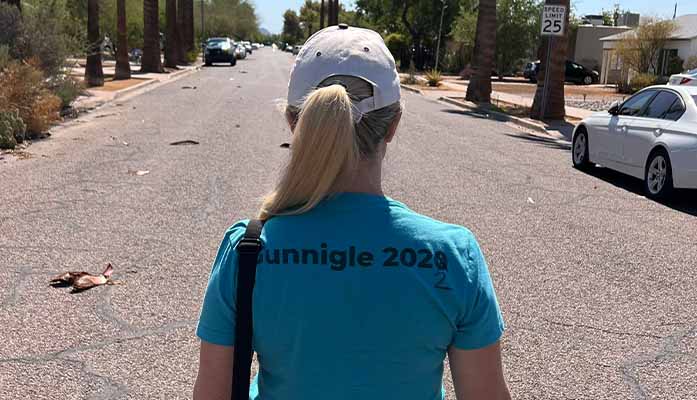
Brian Anderson, founder of the research company Saguaro Group, rediscovered the Twitter exchange between Love and Westbrook. He shared the posts in response to a recent tweet of Gunnigle’s, in which the candidate wrote over a t-shirt from her 2020 run to read “Gunnigle 2022.” Love and Westbrook supported Gunnigle during her 2020 run as well.
In 2020, violent criminals shot at @Arizona_DPS troopers, leading to a "Blue Alert."@PPAZAction's Chris Love and @AZDemParty's @BWestbrookAZ8 both mocked the attempted murder of law enforcement.
— Brianna Westbrook for AZ State Representative #LD5 (@BWestbrookAZ8) September 17, 2020
“Blue Alerts” are information lines dedicated to communications on violent criminals who pose a threat to law enforcement. The Arizona Department of Public Safety (AZDPS) will issue a Blue Alert when a suspect kills, assaults, or imposes serious or life-threatening injuries on an officer; the suspect is deemed an imminent threat to the public and other officers; and the suspect’s vehicle license plate number or detailed description of the vehicle exists.
Love has consistently called for and celebrated violence against those she dislikes. In May, Love bragged about her husband assaulting a supporter of former President Donald Trump.
They're currently testing these drugs on Black folks and prisoners, Next up? Natives and veterans. So, every time someone tells me they vote Republican because they're "fiscally conservative," should I punch them before or after they finish? Which sparks more joy?
Westbrook has approved of controversial protest tactics as well.
In response to the protesters that followed Senator Kyrsten Sinema (D-AZ) into the bathroom last October, Westbrook denounced condemnation against the protesters as the invalid complaints of “white folks.”
It never fails anytime Black and Brown folks protest. There are always white folks saying, “this is not the right way.” If this is you and you want to be an ally to communities of color, check your privileges, sit down, listen, and follow their lead.
— Brianna Westbrook for AZ State Representative #LD5 (@BWestbrookAZ8) October 5, 2021
Westbrook was also one of a small group of activists protesting for “housing rights” outside Governor Doug Ducey’s home in December 2020.
Activists protest outside Gov. Ducey's home, calling for an end to housing insecurity https://t.co/XpLotAdnji
— Brianna Westbrook for AZ State Representative #LD5 (@BWestbrookAZ8) December 26, 2020
In 2018, Westbrook was charged with criminal trespass for protesting against Supreme Court Justice Brett Kavanaugh’s nomination outside former Senator Jeff Flake’s office.
Thank you for your calls, letters, and emails. Three of the #FlakeFour have agreed to the Maricopa County Prosecutors plea deal for the #Kavanaugh protest at @JeffFlake’s office. All of our charges have been dropped, and the judge has waived all fines and court fees. pic.twitter.com/rdNqkHjIu5
— Brianna Westbrook for AZ State Representative #LD5 (@BWestbrookAZ8) October 19, 2018
CORRECTION: A previous version of this story accidentally listed Julie Gunnigle as the Maricopa County Attorney. She is currently a candidate for that office, and the story has been corrected.
Corinne Murdock is a reporter for AZ Free News. Follow her latest on Twitter, or email tips to corinne@azfreenews.com.
The Arizona Department of Health Services (ADHS) has been issuing warnings about the spread of monkeypox, an infectious viral disease mainly spread through intimate relations. ADHS noted that monkeypox is transmitted through “close contact” — to date, most cases have occurred in sexually active gay men.
According to the CDC’s latest data, Arizona has 11 of the 1,814 reported cases. Nearly all cases were located in Maricopa County. The first probable monkeypox case in the state occurred last month: a man in his late 30s. Most recently, one monkeypox case was discovered outside of Maricopa County: a man under 40 years old in Pima County.
REMINDER: People can only catch #monkeypox if they have close contact with someone who is infected.
The ten states with the most cases are: New York, 489; California, 266; Illinois, 174; Florida, 154; District of Columbia, 108; Georgia, 93; Texas, 76; Massachusetts, 51; Virginia, 44; and Pennsylvania, 43. As of the end of June, there were over 12,500 cases globally.
Both the World Health Organization (WHO) and the Joint United Nations Programme on HIV/AIDS (UNAIDS) noted that gay men comprise many of the monkeypox cases, though they didn’t disclose a specific number. A United Kingdom (UK) study of nearly 700 monkeypox cases earlier this month discovered that 97 percent were gay men. 54 percent of those men had another sexually-transmitted infection (STI), 30 percent had HIV/AIDS, and 31 percent had 10 or more sexual partners in the last three months.
I have asked numerous public health experts at universities, @WHO, @CDCgov and elsewhere what is driving the #monkeypox outbreak, and they all say the primary driver is close contact in the contact of sexual activity between men. 5/
Monkeypox’s spread and public response are reminiscent of the HIV/AIDS epidemic, though monkeypox is proving to be far less deadly. That may explain the ADHS’s ambiguity. Health care providers and government officials have vocalized concern over how to warn gay and bisexual men about monkeypox without inciting discrimination against those communities.
Monkeypox doesn’t spread as easily as common illnesses like COVID-19 or the flu. People can only catch #monkeypox if they have close contact with someone who is infected. Know what to look for. https://t.co/W06gLLu0VFpic.twitter.com/NLZrjXebmi
Raymond Embry, founder and CEO of the eponymous COVID-19 testing company Embry Health, questioned the lack of coverage of a monkeypox spread in Phoenix around Independence Day weekend.
🚨 There was a widespread MonkeyPox infection incident in Phoenix during the recent holiday. That is now resulting in a number of cases. Unknown why it isn't being more widely discussed. #MPX#MPXV
Embry’s mother, JoEllen, was Embry Health’s former medical director. The Arizona Board of Nursing fined her $10,000 and placed her on a 24-month probation in April for erroneous billing that resulted in too great of reimbursements.
Corinne Murdock is a reporter for AZ Free News. Follow her latest on Twitter, or email tips to corinne@azfreenews.com.