by Corinne Murdock | Aug 29, 2022 | News
By Corinne Murdock |
Following the Supreme Court (SCOTUS) rejection of a constitutional right to abortion, two Arizona organizations still advertise abortion funding. They’re the Abortion Fund of Arizona (AFAZ) and the Tucson Abortion Support Collective (TASC).
AZ Free News reached out to AFAZ and TASC for comment. AFAZ confirmed that they’ve continued providing abortion funding, but TASC never responded with comment.
AFAZ serves all of Arizona, offering funding on a first-come, first-serve basis according to their monthly budget, averaging 40-50 callers a month. In order to qualify, pregnant women seeking abortions must have an appointment scheduled at an abortion clinic. Pregnancies over 16 weeks gestation are prioritized. AFAZ also offers resources for other logistics: meals, gas, Rhogam vaccine, and childcare funding, as well as transportation and lodging arrangements.
In 2020, AFAZ pledged over $100,000 to women seeking abortions, and in 2021 they pledged over $80,000.
AFAZ launched in 2017 through Pro-Choice Arizona. Pro-Choice Arizona and AFAZ once operated under the NARAL Pro-Choice America network, but achieved independence in 2019. Pro-Choice Arizona is also a member of the Arizona Reproductive Justice Coalition.
Current members of the Arizona Reproductive Justice Coalition include Organized Poder, Parteras De Maiz, and Trans Queer Pueblo. Black Lives Matter (BLM) Phoenix-Metro was one of their past members.
TASC serves Southern Arizona. In addition to assisting with abortion funding, TASC offers logistical resources such as transportation, legal aid, “abortion doula services,” and walkthroughs of Arizona’s abortion law.
On their website, TASC warns pregnant women against crisis pregnancy centers. TASC claimed that these centers are “designed to intentionally mislead women” with “medically inaccurate information about pregnancy, fetal development, and abortion” and “lies, manipulation, and threatening or intimidating language.” As proof of their claims, TASC links to NARAL Pro-Choice America’s article, “The Truth About Crisis Pregnancy Centers.”
TASC then lists the crisis pregnancy centers in the Tucson area.
Playwright and actor Lin-Manuel Miranda, announced earlier this month that TASC was one of the abortion services receiving funds from his “Hamilton”-affiliated campaign to support abortions, “Hamilton 4 Choice.”
The announcement came about a week before Miranda served a cease-and-desist to a McAllen, Texas church for putting on a Christianized version of “Hamilton,” edited to discuss Biblical values.
Corinne Murdock is a reporter for AZ Free News. Follow her latest on Twitter, or email tips to corinne@azfreenews.com.
by Corinne Murdock | Aug 28, 2022 | News
By Corinne Murdock |
The two Yavapai County election leaders that made headlines for abandoning office in response to 2020 election-related threats have escaped to other elections-related roles.
Former Yavapai County Elections Director Lynn Constabile became the elections engagement manager last month for a nonprofit founded by former Big Tech leaders and advised by three chief technology officers from the Obama administration, U.S. Digital Response (USDR), and former Recorder Leslie Hoffman became Maricopa County’s director of recording services as of Monday.
Both abandoned their offices about a month before this latest primary election.
Constabile’s new employer, USDR, was co-founded in March of 2020 by its interim CEO, Jessica Cole: formerly a tech policy fellow at the Aspen Institute, an organization integral to the censorship of the New York Post’s Hunter Biden laptop story released weeks before the 2020 election.
USDR’s other co-founders were Alex Allain, CTO, formerly an engineering director for Dropbox; Emily Barlow, formerly an engineering program manager and global sourcing manager for Apple; Jessica Watson, formerly a product design director for Facebook; and Raphael Lee, formerly of Lob and Airbnb.
USDR admits that its founding purpose was to intervene in local election processes. Since 2020, co-founder Raphael Lee explained on LinkedIn that USDR has expanded operations to address a whole host of progressive initiatives: criminal justice reform, Afghan refugee resettlement, unemployment insurance reform, federal grant management, COVID-19 government messaging and vaccine distribution.
“In March of 2020, when COVID-19 came to the US, we organized a volunteer-run, non-partisan effort to help federal, state, and local government with technology, data, design, operations, communications, project management, and other needs during the crisis,” wrote Lee. “USDR became a fiscally sponsored nonprofit project in the summer of 2020.”
All three of USDR’s advisors hail were deputy chief technology officers in the Obama administration: Cori Zarek, Jennifer Pahlka, and Ryan Panchadsaram.
Among USDR’s partners is the Arizona Department of Health Services (AZDHS). USDR’s major funders include the Rockefeller Foundation.
USDR has worked with 48 elections offices and nonprofits. Additionally, they report impacting 42 million people throughout 36 states, and worked with over 230 governments and organizations on over 300 projects.
As AZ Free News reported, Big Tech companies took a major interest in the 2020 election as soon as the COVID-19 pandemic arose that March. As one example, Facebook founder and CEO Mark Zuckerberg pumped his elections-focused nonprofit with over $350 million to execute what USDR desired to carry out.
In a press release Monday announcing Hoffman’s hire, the Maricopa County Recorder Stephen Richer said that Hoffman was one of the first individuals he relied on when he assumed office.
“Leslie was one of the first people I reached out to upon taking office, and her experience and advocacy for the functions of this office make her a great fit for this position,” said Richer.
AZ Free News reached out to the recorder’s office for further comment on the implication of hiring an individual who resigned from office amid the midterms, days before the primary election. Their spokesman said that they had no comment beyond their press release, just that they were thrilled to have Hoffman’s experience.
Corinne Murdock is a reporter for AZ Free News. Follow her latest on Twitter, or email tips to corinne@azfreenews.com.
by Corinne Murdock | Aug 28, 2022 | Education, News
By Corinne Murdock |
Records obtained from the University of Arizona (UArizona) revealed that its bias reporting system inspired political correctness witch hunts among students.
UArizona provided the records to a College Fix reporter after initially denying their request for all 2021 reports submitted to the Bias Education & Support Team (BEST). The Goldwater Institute, a Phoenix-based public policy research and litigation organization, sent a letter on behalf of the reporter to UArizona insisting that the university must comply with public records law.
According to the records, a group of students reported one female peer for drawing a darker-toned person picking cotton when she was given the word “cotton” to depict for an Pictionary-like online game. The group complained that they felt “deeply ashamed” of her insensitivity, and wanted the school to help her understand why her actions were hurtful and how she could grow in the future.
“While she claimed that she did not specifically denote the race of the person, the witnesses claimed that she chose a dark brown color for their skin tone,” read the complaint. “[She] claims she was only trying to make a historical reference and did not have discriminatory intent [but] several members of the zoom call told her the drawing was inappropriate.”
“Cotton” is one of the well-known “Five Cs” of Arizona’s economy, in addition to cattle, citrus, climate, and copper.
In another bias complaint, one student reported a professor for using “outdated and offensive” terms: “transsexual,” “transgendered,” and “mentally retarded” during class discussions.
“[P]rofessors should be required and expected to use the modern and correct terminology when discussing these issues, especially when there may be students in the class who have intellectual disabilities or who have friends and family who have intellectual disabilities,” wrote the student.
Another report was filed against a professor for asking a student if she had a green card after the student mentioned that her family lived in Mexico. Another report was filed against a professor who was perceived as supportive of police, failed to exhibit grief over the deaths of George Floyd and Breonna Taylor, and discussed their deaths in the context of shared meanings between cultures.
“The classroom is not an appropriate place to discuss these matters,” the complaint read. “Supporting the police openly in class during such a sensitive time in this country, as well as during Black History Month, was completely unprofessional.”
Another complaint was submitted against a student for expressing that he didn’t want to reside in the same dorm hallway as “trannies,” slang for transgender individuals.
[SEE POST HERE]
Goldwater Institute Vice President of Litigation Jon Riches told AZ Free News that they were pleased that UArizona decided to comply with the law, but troubled that a reporter had to obtain a lawyer in the first place.
“These were public records. It was troubling that they originally denied the request, particularly since they fulfilled a similar records request two years earlier,” said Riches. “Public records custodians will sometimes deny a request despite knowing that they should produce it, hoping the requestor will just go away. It shouldn’t require a lawyer to get involved. The information is public. We’re glad they did the right thing.”
The resistance of UArizona and government entities to records requests prompted the Goldwater Institute to launch an initiative to increase public records compliance: “Open My Government.”
As AZ Free News reported, the UArizona public records coordinator that denied the College Fix records request into BEST, Kim Fassl, has a professional connection with one of the six women leading BEST, or the “Core Team.”
Prior to handling public records requests, Fassl was UArizona’s associate director of residential education for student behavioral education. BEST Core Team leader Nina Pereira was Fassl’s superior at the time, serving as the director of residential education that oversees behavioral education.
BEST says it offers educational and dialogue opportunities, but doesn’t conduct investigations, issue disciplinary sanctions, or require any participation. However, BEST does pass on perceived student or faculty violations of UArizona’s nondiscrimination and anti-harassment policy to higher administrative offices, such as the Dean of Students Office, the Office of Institutional Equity, and Human Resources.
[SEE POST HERE]
Corinne Murdock is a reporter for AZ Free News. Follow her latest on Twitter, or email tips to corinne@azfreenews.com.
by Corinne Murdock | Aug 27, 2022 | News
By Corinne Murdock |
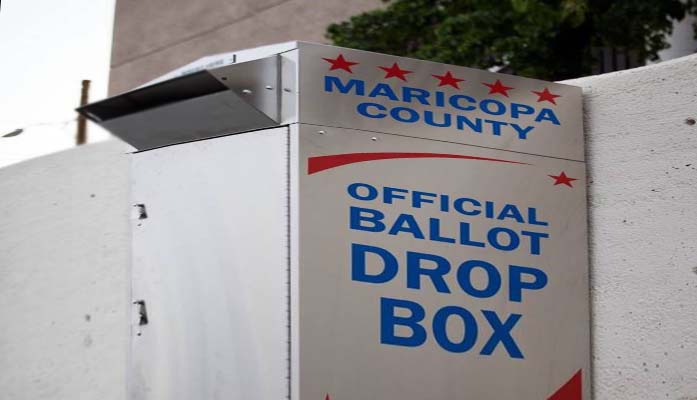
Maricopa County reportedly failed to record one of their unstaffed drop boxes for at least three weeks.
The Maricopa County Republican Committee (MCRC) discovered the error after they requested the video feed for two drop boxes late last month. In response to the request, the county reportedly discovered that they failed to record the unstaffed drop box located at the Maricopa County Juvenile Court. The county reportedly began to record the drop box the day after the MCRC request, on July 28.
MCRC explained in a Saturday press release that the county delayed their request and responded with the wrong video feed initially before admitting that they never recorded the footage due to “a glitch or human error.” They asserted that this mistake only worsened GOP voters’ sentiments about drop boxes.
“Maricopa County Republicans do not trust drop boxes. We have very serious concerns about unstaffed drop boxes. However, we have grave concerns about unstaffed and unmonitored drop boxes where the lack of video recording goes unnoticed for 3 weeks,” said MCRC.
The county confirmed to MCRC that the drop box footage was live-streamed — just not recorded for subsequent review.
MCRC requested that the county decommission the drop box’s further use for the upcoming November election.
MCRC said that the footage of the other drop box, located at the Maricopa County Tabulation and Election Center (MCTEC), contained no concerning issues.
AZ Free News reached out to the Maricopa County Elections Department multiple times for comment concerning the error. They didn’t offer comment or an explanation by press time.
Corinne Murdock is a reporter for AZ Free News. Follow her latest on Twitter, or email tips to corinne@azfreenews.com.
by Terri Jo Neff | Aug 27, 2022 | News
By Terri Jo Neff |
Arizona Free Enterprise Club (AFEC) is reveling in Friday’s Arizona Supreme Court ruling affirming that the attempt to get the Arizona Free and Fair Elections Act on the upcoming general election ballot as a voter initiative has failed.
“The ruling today vindicates what we knew all along: the radical Free and Fair election initiative lacked enough lawful signatures to qualify for the ballot,” AFEC President Scot Mussi said after the order was issued under Chief Justice Robert Brutinel’s name. “Arizona voters, the rule of law, and basic math were victorious today.”
What would have been known as Proposition 210 on the 2022 General Election ballot included numerous changes to state law drafted by the Arizona Democracy Resource Center (ADRC Action), such as a ban on legislative election audits and allowing election day voter registration.
AFEC took the lead in opposing the voter initiative, while some elections officials worried making that many hodge-podge changes to election and campaign finance laws at one time would have negative unintended consequences.
AFEC’s legal challenge alleged myriad problems with more than one-half of the 475,290 petition signatures submitted by ADRC Action. It ended with Brutinel’s order affirming Maricopa County Superior Court Judge Joseph Mikitish’s finding that the minimum 237,645 signature threshold was missed by 1,458 signatures.
The outcome is exactly what AFEC’s Mussi predicted. In a series of statements Friday, Mussi called out ADRC Action for the “rigged methodology” the group’s attorneys pushed the courts to use when calculating the number of valid signatures. He said the mathematic gymnastics was intended “to sneak their disqualified measure onto the ballot.”
“Their dubious formula cherry picked data that boosted their numbers, even including signatures that were disqualified by the counties in the random sample,” Mussi said. “None of their formula was rooted in statute or historical precedent and was a Hail-Mary attempt to resuscitate thousands of signatures that simply should not have counted.”
The justices ordered Arizona Secretary of State Katie Hobbs to rescind the prior determination that the initiative had qualified for the ballot.
by Terri Jo Neff | Aug 26, 2022 | News
By Terri Jo Neff |
The Arizona Attorney General’s Office (AGO) has been reached an agreement to provide $400,000 to fund a new radio dispatch system for the Colorado City Police Department in an effort to improve emergency response times along the Arizona / Utah border.
Earlier this year, the Arizona State Legislature appropriated the funds to the AGO via House Bill 2862 for the express purpose of identifying ways to replace the outdated communication system relied on by police, fire, and EMS personnel in Colorado City, its sister city of Hildale, Utah, and surrounding areas of Mohave County.
“Every second counts during an emergency, so law enforcement requires efficient communication technology,” said Arizona Attorney General Mark Brnovich. “Our office is pleased to work with Colorado City’s police department to help ensure that its officers have the equipment needed to provide the fastest response times for residents of Northern Arizona.” Rep. Regina Cobb (R-Kingman) chaired the House Appropriations Committee which earmarked the funds. It was then up to Brnovich’s staff to work with Colorado City Police Chief Robb Radley to ensure the money is spent as intended no later than June 30, 2023.
“Reliable radio communications are critical to ensure an effective and timely response in emergency situations, especially in rural communities,” said Representative Regina Cobb, Chairwoman of the House Appropriations Committee. “I’ve been proud to work with Arizona Attorney General Mark Brnovich and his office to help secure this important public safety funding for the Colorado City Police Department.”
Among the provisions of the agreement is that the new radio system must meet at least minimum industry standards. Copies of all quotes, bid proposals, purchase orders, invoices, and receipts must be submitted to the AGO within 30 days of purchase and any excess funds not expended by the deadline must be returned to the AGO.
Radley took over the beleaguered department in August 2019 despite the fact a 2017 federal court order was in effect related to years of corruption, illegal conduct by some officers, and discriminatory services toward non-members of the Fundamentalist LDS Church. The agreement signed earlier this month by Radley signals a major step in his continuing efforts to improve emergency response services to the community.
“The Colorado City Police Department’s police, fire, and EMS communications center are extremely grateful to the State of Arizona, Representative Regina Cobb, the Attorney General’s Office, and Attorney General Mark Brnovich for the opportunity to further upgrade the center with modern radio communications,” said Radley. “The radio system will ensure first responders have the best opportunity to provide the highest quality of services possible for the residents and visitors of Northern Arizona.”