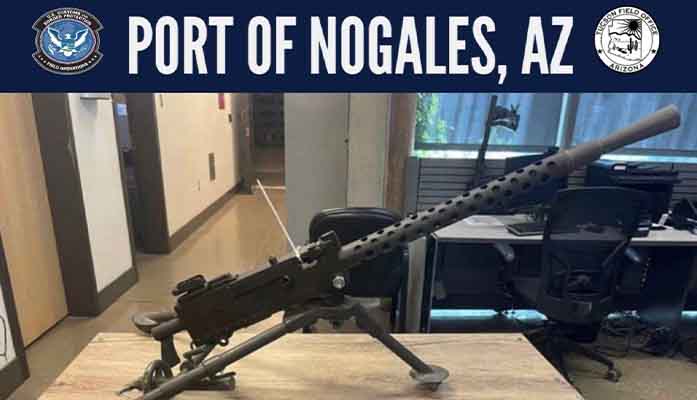
While the main focus along the southwest border is on who and what is coming into the United States, the director of one U.S. Port of Entry in Arizona is making the public aware of the strides his officers are having at keeping firearms from getting into the hands of cartel members in Mexico.
Michael Humphries has been the U.S. Customs and Border Protection’s Nogales Port Director since 2018. His responsibilities include two major border crossings—the Dennis DeConcini POE and the Mariposa POE—as well as the Morley pedestrian gate, the Nogales International Airport, and the Rio Rico railyard.
On Sunday, Humphries tweeted about a southbound vehicle that was preparing to leave the U.S. on Sept. 22 through the Nogales POE.
“As officers spoke to the driver, a K9 alerted to the trunk area of the vehicle and the driver fled,” Humphries wrote. “Officers were able to stop the car before it escaped into Mexico and found 3 AK style semi-auto rifles.”
Just days earlier, Humphries tweeted about a vehicle attempting to leave the U.S. with several firearms hidden in the cargo area.
9/18: CBP officers working outbound ops at the Nogales POE stopped a vehicle attempting to leave the US with 4 AK47 assault rifles and an AK47 pistol hidden in the cargo area of a vehicle. These weapons were most likely intended for Transnational Criminal Organizations in Mexico pic.twitter.com/81owvgVTxJ
— Port Director Michael W. Humphries (@CBPPortDirNOG) September 20, 2022
Federal officials estimate more than 200,000 firearms were illegally trafficked last year from the U.S. into Mexico, particularly through Arizona and Texas crossings.
A tracing program operated by the U.S. Bureau of Alcohol, Tobacco, Firearms and Explosives (ATF) and the Mexican government shows more than 70 percent of guns used in criminal activity in Mexico came from the U.S.
One of Humphries’ tweets from June featured the seizure of a machine gun, 20,000 rounds of ammunition, and other firearms, all of which were headed into Mexico.
Nogales seized a machine gun, an AR-15 assault rifle, a handgun and 20,000 rounds of ammunition before exiting the US. Thanks officers for keeping these powerful weapons from reaching dangerous criminal organizations. pic.twitter.com/GgIzwAQ6DL
— Port Director Michael W. Humphries (@CBPPortDirNOG) June 7, 2022
A few days before, CBP officers encountered two men attempting to walk into Mexico with assault weapons taped to their bodies.
CBP Officers seized four assault rifles strapped to the body of two males attempting to walk into Mexico. Excellent job #Nogales for your vigilance and protecting both sides of the border. pic.twitter.com/glXSorKjGh
— Port Director Michael W. Humphries (@CBPPortDirNOG) June 9, 2022
And in May, Humphries tweeted about the seizure of 10 rifles concealed in one vehicle headed to Mexico.
SEIZURE OF ASSAULT RIFLES Great work CBP Nogales! @CBP Officers conducting outbound operations seized 10 rifles of which 9 were assault rifles concealed within compartments in a vehicle. Thank you for preventing these powerful weapons from reaching violent criminal organizations! pic.twitter.com/F8hbcWVRNG
— Port Director Michael W. Humphries (@CBPPortDirNOG) May 18, 2022
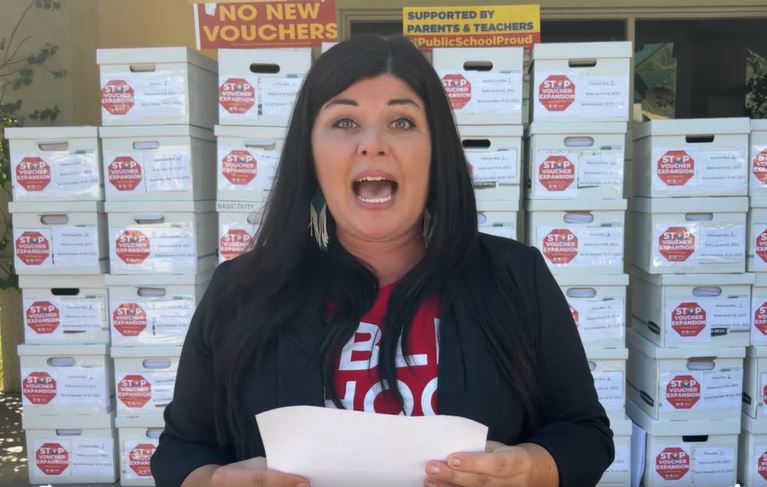
Save Our Schools Arizona (SOSAZ), the teachers union-backed group, claimed to have turned in more signatures than they did for a ballot initiative to end Arizona’s universal school choice.
SOSAZ claimed to have just over 141,700 signatures, above the minimum requirement of over 118,800.
However, an open records request by one pro-school choice mother, Christine Accurso, revealed that a sample of the petitions yielded about 10 signatures per page, not nearly 14 as SOSAZ claimed.
There’s been a pattern of lies coming straight from @azbethlewis over the past 3 months. Her claim of nearly 142,000 signatures was just the latest. After a weekend of hard work at the Secretary of State’s office, the petition count is final and it’s only 8175 total. 1/
Accurso leads AZ Decline to Sign, a countermovement to SOSAZ’s ballot initiative. She told AZ Free News in a statement that she wasn’t surprised by SOSAZ’s overestimation.
“I am not surprised at all that Save Our Schools lied again,” said Accurso. “Saying you are turning in 10,200 petitions when in reality it was only 8,175 is not a rounding error, it’s another way they are deceiving the public. To what end, I don’t know, but the public isn’t buying what they are selling, so I am not surprised.”
The 8,175 petitions that were submitted by Save Our Schools only appear to have 88,866 signatures on them. That is WELL below the minimum required.
It's not official yet until the Secretary of State announces it, but Arizona parents can claim the VICTORY! ESA's for all SOON! https://t.co/TrsiPOIQVs
Accurso credited SOSAZ’s shortcoming to AZ Decline to Sign and its supporters. She noted that even the overestimation by SOSAZ was a number able to be overcome by school choice supporters.
“Thousands of Arizonans pushed back against their tactics this summer,” recalled Accurso. “Without our efforts, they should have easily been able to get 250k – 300k signatures, so even when they reported 142k we were thrilled because challenging that number is very doable. With the new evidence of 8,175 petitions, we are confident more than ever on how this battle ends.”
On Friday, Secretary of State (SOS) Katie Hobbs, Democratic gubernatorial candidate, accepted SOSAZ’s claims without scrutiny. Within hours of SOSAZ turning in its signatures, Hobbs announced that implementation of universal school choice would be suspended while her office reviewed their petition signatures.
Today a Citizen Referendum has filed with our office to refer part of HB2853 to the ballot! The committee is reporting 141,714 signatures which is above the min required: 118,823 signatures.
Neither SOSAZ or Hobbs’ office have addressed the open records discovery. We reached out to both SOSAZ Director Beth Lewis and the secretary of state’s office for comment, but neither responded by press time.
Through a public records request I was given access to all of the 🆘 petitions. They uploaded 8,175 yesterday. When I inquired if more would be uploaded, they responded. ⬇️
It seems mathematically impossible to reach the required # of 118,832, but we will know very soon. pic.twitter.com/dcX0OowHTF
Kevin Gemeroy, a parent involved with AZ Decline to Sign, told AZ Free News that he and other school choice advocates witnessed SOSAZ signature gatherers providing false information to petition signers for weeks about universal school choice through the state’s Empowerment Scholarship Account (ESA) Program.
“Just last weekend, I heard an SOSAZ representative tell a woman that HB2853 would ‘steal $2 billion from public schools,’ which is over $182,000 per child that applied for the universal ESAs,” stated Gemeroy. “I’m unfortunately not surprised Save Our Schools lied to the media and Secretary of State’s office on Friday, and I hope the proper authorities are alerted and take action to protect our democratic process from these lies and attacks in the future.”
The Arizona Department of Education (ADE) hasn’t addressed the open records discovery, either. However, ADE Superintendent Kathy Hoffman has made it clear that she opposes school choice programs of any kind and fully supports the SOSAZ initiative.
As of last Tuesday, the Arizona Department of Education (ADE) received over 10,900 applications for the universal ESA Program.
As of September 19th, @azedschools has received 10,906 total ESA applications since opening the universal application on Aug 16th. 10,338 applied under universal eligibility, an addition of 1,087 in the last week. https://t.co/6UNzVySrz1
If the U.S. Senate agrees, the post office in Fountain Hills will be designated the Dr. C.T. Wright Post Office Building.
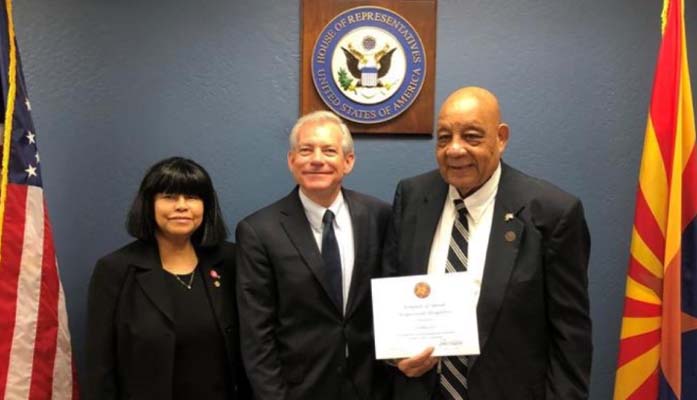
The U.S. House of Representatives unanimously passed H.R. 5650 this month. The bill introduced by Rep. David Schweikert to honor the life of Dr. Wright was co-sponsored by the other eight members of Arizona’s Congressional House delegation.
“The legacy of Dr. C.T. Wright is one that should never be forgotten,” Schweikert said in announcing the House vote. “With the House passage of my bill, we are one step closer to seeing his passion for family, faith, and freedom immortalized in our community.”
When Wright died in 2020, a state biography described his “diverse life experiences” which included being a day laborer in Georgia cotton fields, becoming an elementary school teacher, moving on to college professor and administrator, and being named a university president. He spent much of his education career working at many of America’s historically black colleges.
Wright, who was also a faith leader, later turned his focus to human rights and justice issues. He became a criminal justice expert who developed and supervised several training programs for law enforcement officers as well as an education program for inmates.
Around 1999 Wright moved to Arizona where he went on to serve as a member of the Arizona Electoral College and was appointed to the Arizona Board of Executive Clemency which he later chaired. He also served as a delegate to three national political conventions, was involved with the Fountain Hills Unified School District Governing Board and Fountain Hills Kiwanis Club, and was President of the Arizona African Society.
In 2019, Schweikert presented Wright with the Congressional Lifetime Achievement Award.
“Dr. C.T. Wright’s contributions to Arizona are unparalleled,” Schweikert said after the recent House vote. “I look forward to seeing this important piece of legislation advance in the Senate.”
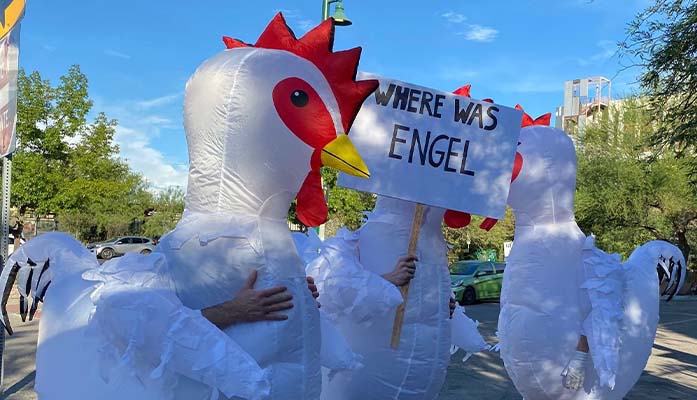
Several people in chicken costumes showed up Friday at a campaign event for former State Rep. Kirsten Engel (D), carrying signs asking where she was the night before.
Those signs refer to Engel’s absence on Sept. 22 from a well-publicized debate in Casa Grande with Republican nominee Juan Ciscomani. The livestreamed event was intended to give Pinal County voters a chance to compare the two candidates for Congressional District 6.
Engel’s campaign said after the no-show that the candidate was advised of the event nearly two months ago, but Engel’s calendar “was still up in the air” at the time. After that, Engel was “not provided with any further details” about the event before last Thursday, according to the statement.
That explanation did not set well with some people. The next night Engel had a campaign event at Club Congress inside Hotel Congress in downtown Tucson.
Hotel Congress is not within CD6.
Engel’s absence renewed attention to the fact other Democrats, including Katie Hobbs, have avoided face-to-face debates this election cycle.
Hobbs, the current Arizona Secretary of State and Democratic nominee for governor, has admitted she wants to avoid a face-to-face debate with her Republican rival Kari Lake. Her decision leaves voters across Arizona with no opportunity to hear her in direct comparison to an opponent.
In fact, Hobbs took the same “no debate” position in her primary contest against former Nogales mayor Marco Lopez.
For his part, Ciscomani appeared to benefit from Engel’s no-show last week by having an opportunity to speak about his policy positions without any distractions or interruptions.
Next month, teams from all over the world will participate in the Arizona State University (ASU) “Hacks for Humanity,” a 3-day hackathon to develop socially beneficial technical solutions — but participants don’t have to have coding knowledge to win.
Hacks for Humanity encourages non-coder participants in order to expand the creation of social justice solutions.
The purpose of the annual hackathon is to problem-solve social justice issues locally and globally. This year, the hackathon theme challenges participants to answer whether or not people are losing their humanity, citing the contexts of social disparities, racial injustices, and the COVID-19 pandemic generally.
“An unforgiving global pandemic as the backdrop for ongoing social disparities and racial injustice nationally and globally once again draws attention to this critical question: ‘Are we losing our humanity?’” stated the page.
Hacks for Humanity encouraged any member of the public to participate. The event page specifically named activists, artists, entrepreneurs, educators, scientists, and social workers as desired participants.
“When these diverse perspectives come together, innovation is the exciting result,” stated Hacks for Humanity.
Participating teams must select one of three topics: aging and wellbeing, civic engagement, and environmental justice. The winning hackathon team will receive $10,000 in cash prizes and $1,000 per team member.
The annual hackathon began nearly a decade ago through Project Humanities, an ASU initiative founded in 2011 by Neal Lester focused on social justice theories such as diversity and intersectionality. Lester has defended controversial concepts like Critical Race Theory (CRT) and gender ideology.
This year’s sponsors are State Farm, ASU University Technology Office, ASU Entrepreneurship + Innovation Institute, JDT Family Foundation, and Jenny Norton & Bob Ramsey. Additional supporters are the Odysea Aquarium, ASU School of Social Transformation, Heard Museum, Arizona Cardinals, Desert Botanical Garden, Japanese Friendship Garden of Phoenix, the Nile, Tempe Boat Rentals of America, and the Phoenix Symphony.
The hackathon will take place from October 7-9, and is open to individuals aged 16 and older.
Corinne Murdock is a reporter for AZ Free News. Follow her latest on Twitter, or email tips to corinne@azfreenews.com.
In 2020, illegal immigrants cost Arizona public schools over $748 million — an economic burden that will likely increase due to the ongoing border crisis. 99 percent of these funds come from Arizona taxpayers’ local and state taxes, not the federal government.
The cost estimate comes from a report released this month by the Federation for American Immigration Reform (FAIR). Despite the hundreds of millions poured into these limited English proficiency (LEP) programs, only 32 percent (about 23,900) of illegal immigrant students in Arizona graduate on time.
As of 2020, there were over 74,800 LEP students. That’s just over half of a percent of the total student population at most: 1.1 million. Nationwide, that number is 5.1 million students costing taxpayers over $78 billion.
American taxpayers spend nearly $80 billion a year to educate students with limited English proficiency.
More than one in ten U.S. public schoolchildren are enrolled in LEP programs.https://t.co/18CoV9YNlO
Under President Joe Biden, there have been over 277,300 accompanied minors and unaccompanied children that crossed the border illegally. That doesn’t account for those apprehended minors within family units, nor does it account for gotaways.
The Arizona Department of Education (ADE) handles LEP students, which they refer to as English Learners (EL), through their Office of English Language Acquisition Services (OELAS). Arizona schools’ LEP programs are known as Structured English Immersion (SEI) programs.
In May, the ADE invested $10 million of American Rescue Plan (ARP) funds to train teachers for SEI programs.
Today, @azedschools is proud to announce support for English Language Learners through a $10 million investment in @WestEd's Quality Teaching for English Learners program. The funding will assist #WestEd in preparing educators to meet the needs of Arizona's multilingual students. pic.twitter.com/Eb9hQ5Jlje
ADE Superintendent Kathy Hoffman opposes the SEI programs. Hoffman supported Arizona legislators’ efforts to repeal Proposition 203, which has required Arizona schools to educate EL students in English only since 2000, not their native language.
Repealing the English-only was a cornerstone of my campaign and remains critically important to my administration as we advocate for equity for all students to achieve their full potential. https://t.co/GeNEzVpv1L
American schools weren’t always required to provide taxpayer-funded public education to illegal immigrant children. That changed in 1982 when the Supreme Court (SCOTUS) ruled in Plyler v. Doethat illegal immigrant children were entitled to public schooling.
The taxpayer burden of illegal immigrant education may not end with K-12 schools. Come November, voters must decide whether to approve Proposition 308, which will grant in-state college tuition to illegal immigrants so long as they’ve graduated from an Arizona high school.
Arizona voters don’t just vote on people, we vote on policy too!
Prop 308 gives AZ Dreamers equal affordability if they attend a state school, has bipartisan support, and puts no additional costs on the taxpayer.
The state legislature approved the resolution last year through the combined efforts of Arizona House Democrats and several House Republicans: State Representatives Michelle Udall (R-Mesa), Joel John (R-Buckeye), David Cook (R-Globe), and Joanne Osborne (R-Goodyear).
Corinne Murdock is a reporter for AZ Free News. Follow her latest on Twitter, or email tips to corinne@azfreenews.com.