by Corinne Murdock | Nov 5, 2022 | News
By Corinne Murdock |
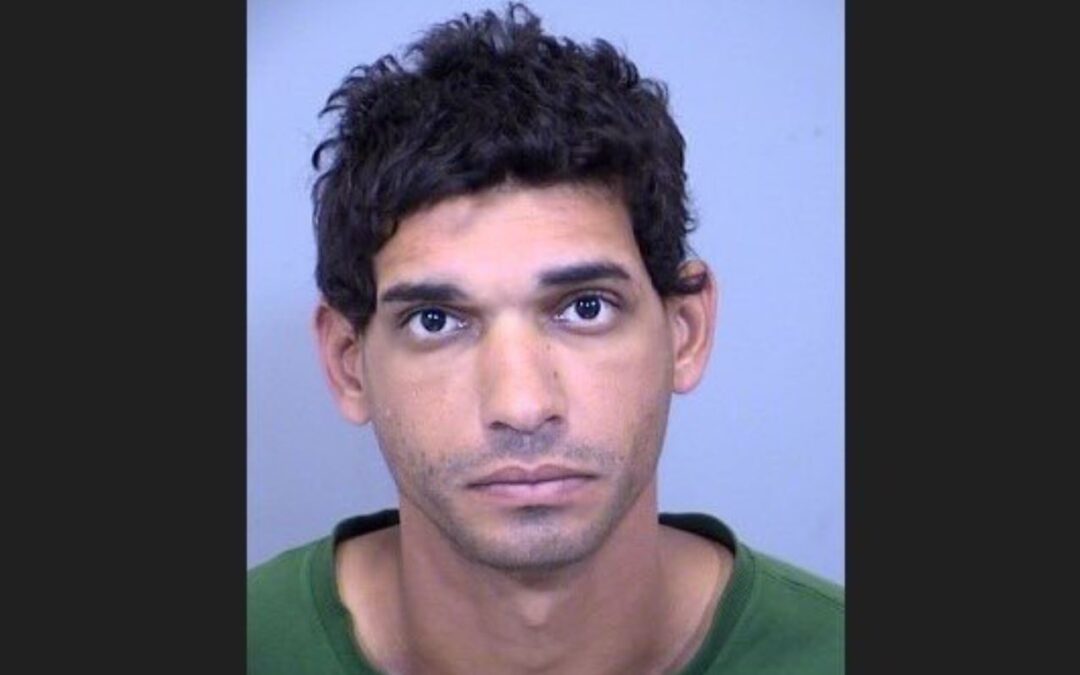
The man allegedly behind the burglary of Democratic gubernatorial candidate Katie Hobbs’ campaign office is an illegal immigrant sought by Immigrations and Customs Enforcement (ICE).
Sources informed the Arizona Daily Independent this week that the fugitive, a 36-year-old Portuguese citizen named Daniel Mota Dos Reis, failed to maintain his immigration status through a student visa. Reis earned his MBA from Grand Canyon University (GCU) last December. According to ICE records, Reis entered the country on a student visa in 2018, when he started at GCU.
As AZ Free News reported last week, Hobbs alleged that Reis was prompted to burglarize her campaign office due to rhetoric from her opponent, Kari Lake. Reis likely wasn’t motivated by the gubernatorial race or politics at all.
Rather, the timeline of events offered by Reis’ social media accounts indicates that he was motivated by financial distress. Reis worked as an accountant for four years until March, when it appears that he either left or lost his job. At that point, Reis began searching for other job opportunities abroad. It is unclear whether his immigration status was a factor in his job status.
In April, Reis posted to social media that it was difficult to obtain work authorization papers.
“Work authorizations and work-related paperwork can be a huge issue in the US,” stated Reis. “I see friends deeply impacted by these policies on a daily basis.”
Police relayed that Reis was homeless at the time of his arrest for several burglaries, including that of Hobbs’ campaign office.
Corinne Murdock is a reporter for AZ Free News. Follow her latest on Twitter, or email tips to corinne@azfreenews.com.
by Corinne Murdock | Nov 4, 2022 | News
By Corinne Murdock |
Democratic gubernatorial candidate Katie Hobbs’ husband, Patrick Goodman, serves as a counselor for Phoenix Children’s Hospital’s (PCH) Gender Support Program (GSP).
As AZ Free News reported in August, PCH’s program provides the only comprehensive “gender-affirming care” via transition in the state. After widespread reporting of the program, PCH removed much of the content related to its programs and services from its website.
Goodman and his colleagues within the GSP consult with children for the application of puberty blockers and cross-sex hormones. Goodman also testified in an ongoing lawsuit to force the state to issue corrective birth certificates based on gender identity, filed by several transgender children and their parents against the state, Roe, et al v. Herrington, et al.
Goodman was the mental health provider for one of the children in the case, then a 10-year-old referred to as Jane Doe. The lawsuit was filed almost exactly two years ago, in November 2020. The latest action to occur in the case concerned the depositions of the Arizona Department of Health Services interim director Don Herrington this week.
Goodman’s medical notes concerning Jane Doe are sealed in the court case.
The state allows birth certificate changes after a sex change operation. The state doesn’t allow minors to undergo gender transition surgery, though they may still take puberty blockers and cross-sex hormones.
Hobbs opposed the most recent law banning gender transition surgeries for minors, as well as a law excluding males from female sports.
Hobbs said that preventing children from transitioning genders wasn’t protecting them.
Corinne Murdock is a reporter for AZ Free News. Follow her latest on Twitter, or email tips to corinne@azfreenews.com.
by Corinne Murdock | Nov 4, 2022 | News
By Corinne Murdock |
In the final six days before Election Day, young pro-life activists are deploying in Mesa and Scottsdale to mobilize voters.
That impacts State Senate Districts 4 and 9, both swing districts. District 4 candidates are Republican Nancy Barto and Democrat Christine Marsh. District 9 candidates are Republican Robert Scantlebury and Democrat Eva Burch.
Behind the grassroots activists is Students for Life Action (SFLA), the political action committee (PAC) arm of the Students for Life (SFL) nonprofit. SFLA stated in a press release that their goal in Arizona is to inform voters about the abortion lobby’s endorsed candidates and Senator Mark Kelly’s record on abortion.
SFLA comes into play weeks after it was revealed that Kelly campaign staffers were likely telling voters that the senator is pro-life for months. Kelly supports abortion.
SFLA also deployed groups into 10 other states: Montana, Nebraska, North Carolina, Minnesota, Ohio, Iowa, Colorado, Pennsylvania, Indiana, and Washington. Notably, one SFLA captain, 18-year-old Kaitlyn Ruch, is the Republican candidate for the Montana House.
Arizona won’t enforce its ban on abortion until next year. In response to the agreement with Attorney General Mark Brnovich last week, Planned Parenthood resumed abortion services throughout the state (with the exception of a Tucson clinic, which continued operations prior to the agreement).
Even if the state’s abortion ban goes into effect, there’s no guarantee of uniform enforcement. The cities of Tucson and Phoenix both passed resolutions effectively decriminalizing abortions. Pima County Attorney Laura Conover also pledged to not prosecute violations of abortion law.
The upcoming election will further determine the fate of the state’s abortion law. Democratic Maricopa County Attorney candidate Julie Gunnigle pledged to disregard state bans and restrictions on abortion.
“I will #NotNowNotEver prosecute people or their providers for performing abortions or undergoing an abortion procedure,” tweeted Gunnigle last month.
Democratic gubernatorial candidate Katie Hobbs supports elective abortions without any restrictions, even up to birth.
Hobbs told CNN on Wednesday that she would veto any new legislation further restricting abortion in the state.
Corinne Murdock is a reporter for AZ Free News. Follow her latest on Twitter, or email tips to corinne@azfreenews.com.
by Corinne Murdock | Nov 4, 2022 | News
By Corinne Murdock |
Arizona’s food banks are faced with a burgeoning number of clientele, some maxing out their resources — a byproduct of the inflation crisis. This increase in families seeking out assistance was further prompted by the ending of pandemic-era stimulus checks, tax credits, and public benefits.
The Arizona Food Bank Network (AZFBN) told AZ Free News that their clientele has grown steadily since April. AFBN is a coalition of five regional food banks and nearly 1,000 pantries and agencies, including: Community Food Bank of Southern Arizona, HonorHealth Desert Mission Food Bank, St. Mary’s Food Bank, United Food Bank, and Yuma Community Food Bank.
According to AZFBN President and CEO Angie Rodgers, clients say that inflation’s adverse impact on family budgets was a chief reason for turning to food banks. Rodgers noted that inflation has impacted their network’s purchasing power. Rodgers didn’t say definitively whether their network is struggling currently to meet the needs of their increased clientele.
“The food bank network has relied on donations and more increasingly, on the purchase of food, to help meet that demand,” said Rodgers. “Of course anytime demand goes up, we need a corresponding supply to meet that need. Some food banks are able to purchase additional items when donations are low. Others rely entirely on donations.”
Rodgers had a positive outlook: she said that the holidays tend to increase food and monetary donations as well as volunteers.
“We are grateful for this support. Many food banks this season will likely be asking for additional contributions to address the need,” said Rodgers.
According to the AZFBN, an average of 1 in 7 Arizonans face food insecurity — nearly 800,000 adults and 270,000 children. Food insecurity is defined as the occasional or constant lack of access to food.
AZ Free News also spoke with Paradise Valley Community Food Bank (PVCFB). Their executive director, Kay Norris, told us that food and monetary donations aren’t meeting their community’s need for the first time in 30 years. Their food bank feeds those in need who are working.
Norris shared that they’re booked up five days a week. They had to open up on Saturdays to meet the demand for the first time in 30 years — but even that day is booked up. Norris said they saw an increase in demand last year of 60 percent.
“I can tell you we’re seeing people that I know that have never been to a food bank before,” said Norris. “We can no longer take people who walk up, because we’re booked. They have to walk away.”
PVCFB relies on 140 to 150 volunteers a week during the school year to keep up with the demand. Even with an expansion in operations, Norris said that they’re in need of more donations to meet the growing community need.
“Eventually it’s going to catch up with us if we don’t have more donations,” said Norris.
The new class of faces lining up for assistance isn’t unique to PVCFB. St. Mary’s Food Bank told 12 News that many of those seeking assistance are first time clients, leading their clientele to nearly double compared to last year, from up to 650 clients daily to over 1,100 clients last Friday.
Corinne Murdock is a reporter for AZ Free News. Follow her latest on Twitter, or email tips to corinne@azfreenews.com.
by Corinne Murdock | Nov 3, 2022 | News
By Corinne Murdock |
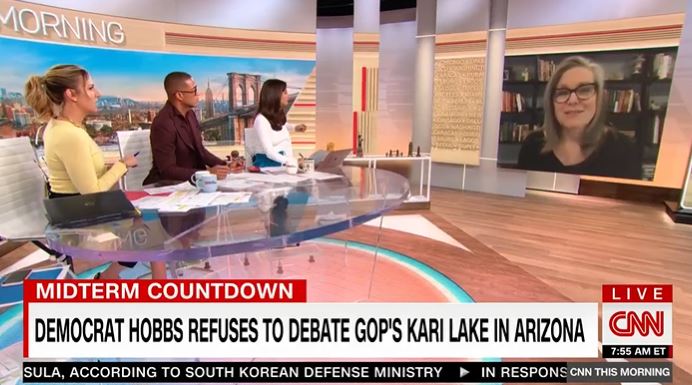
On Wednesday, Democratic gubernatorial candidate Katie Hobbs said debates don’t matter when explaining why she won’t debate Republican opponent Kari Lake.
Hobbs made the remarks during a CNN interview. Voters upset over Hobbs’ refusal to debate were told to accept it as part of her campaign strategy. Hobbs added that a debate at this point was too late anyway.
“Look, we’re six days out from the election and our campaign strategy is our campaign strategy,” said Hobbs. “We’re moving forward and I’m continuing to make my case to the voters of Arizona. Whether or not we debate in this race is not going to decide this election.”
Hobbs also claimed that Lake wasn’t interested in a debate, just in creating a spectacle. The CNN “This Morning” hosts — Don Lemon, Poppy Harlow, and Kaitlan Collins — insisted that Hobbs could challenge Lake’s narratives in real time.
Hobbs also neglected to debate her primary opponent, Marco Lopez. When asked the reason for avoiding that debate, Hobbs said she didn’t need to because of favorable polling. Effectively, Lopez wasn’t worth the time or effort required for a debate. Hobbs didn’t mention her initial excuse for skipping the debate with Lopez: a purported COVID-19 infection and a conflicting campaign event.
“I was miles ahead of him and won handily,” said Hobbs.
LISTEN: CNN INTERVIEWS HOBBS (timestamp: 1:26:40)
Hobbs initially told the public that she skipped the debate against Lopez because of a COVID-19 illness. Yet just several days later, Hobbs participated in an Independence Day parade in Flagstaff.
In September, Hobbs fled from in-person questions posed by media and supporters concerning her refusal to debate Lake.
Last month, Hobbs advised voters that they should forget about her refusal to debate and, instead, focus on her platform.
When Hobbs questioned Lake’s water crisis policies on social media last week, Lake pointed out that these sorts of questions were best answered in a debate. Lake has invited Hobbs repeatedly to debate her.
Corinne Murdock is a reporter for AZ Free News. Follow her latest on Twitter, or email tips to corinne@azfreenews.com.
by Terri Jo Neff | Nov 3, 2022 | News
By Terri Jo Neff |
As the city of Phoenix prepares to navigate through a U.S. Department of Justice civil rights investigation, there is a new chief at the helm.
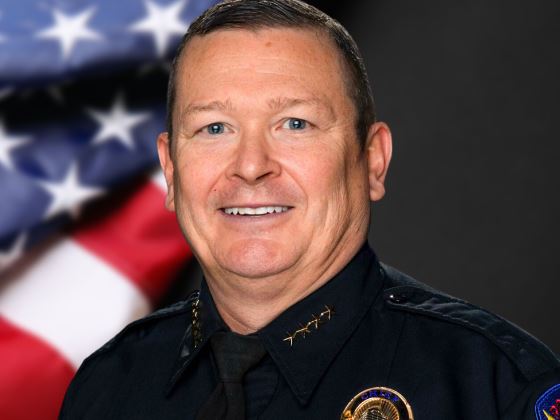
Michael G. Sullivan was sworn-in last Friday as Interim Chief, several weeks after he officially began working for the city under a one year contract with a base pay of $232,000. His swearing-in ceremony came just days after the Arizona Peace Officer Standards and Training (AZPOST) board approved Sullivan’s application for a restricted certification
The restriction bars Sullivan from being assigned “any duty likely to result in the need to apply physical force.” His contract signed in September gives Sullivan six months to pass all AZPOST training requirements and “satisfactorily perform the practical demonstrations of proficiency in physical conditioning, vehicle operations, pursuit operations, and firearms, including firearms qualifications as required by AZPOST.”
In the meantime, city officials are planning to conduct a nationwide search for a permanent police chief, although no promises have been made to Sullivan if he wishes to stay longer.
Sullivan was hired by Phoenix PD from Baltimore PD where he has spent the last few years helping that agency deal with the fallout of a US DOJ investigation. He previously spent 20 years with Louisville PD in Kentucky.
In public comments, Sullivan has acknowledged there are many challenges facing the department beyond the US DOJ investigation. He has mentioned the agency’s understaffing problem, its lack of accountability and transparency to the community, and dwindling department morale as just some of the issues he needs to tackle while also trying to appease investigators with the US DOJ’s Civil Rights Division.
In August 2021, the US DOJ announced it was undertaking a “comprehensive review” of Phoenix PD’s policies, training, supervision, and force investigations. Also under scrutiny will be the department’s “systems of accountability, including misconduct complaint intake, investigation, review, disposition, and discipline.”
The investigation is authorized under the Violent Crime Control and Law Enforcement Act of 1994, which prohibits state and local governments from engaging in “a pattern or practice of conduct” by law enforcement officers that is in violation of federal law or which deprives individuals of the constitutional rights. The Act allows the U.S. Attorney General Merrick Garland to seek a number of remedies through civil litigation.