Gov. Katie Hobbs wants to ensure that illegal immigrants get a taxpayer-funded college education; she proposed an initial $40 million investment to realize this goal.
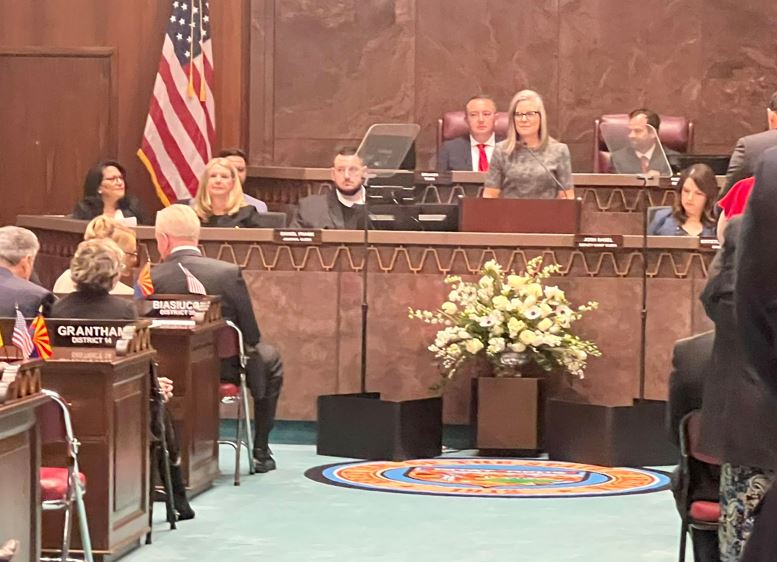
Hobbs issued the proposal during her State of the State Address on Monday in the Capitol. She named the proposed investment after those qualified to remain in the country under former President Barack Obama’s Deferred Action on Childhood Arrivals (DACA) program.
“In line with the will of Arizona’s voters in passing Proposition 308 this past November, my budget allocates $40 million to create the Promise For Dreamers Scholarship Program to cover all students, regardless of immigration status,” stated Hobbs.
Hobbs’ proposal brought some of the loudest cheers from the Democrats on the floor.
In a subsequent statement on Twitter, Hobbs described opposition to Prop 308 and outrage over illegal immigration as “politicized.” She relieved President Joe Biden of much of his responsibility for the border crisis, instead insisting that both Democrats and Republicans were to blame.
“Unfortunately, immigration has been politicized for far too long. Arizona voters told us in November they don’t want or need political stunts designed solely to garner sensationalist TV coverage and generate social media posts,” stated Hobbs.
When I speak to leaders in Arizona’s border communities, they agree they need real solutions after decades of failed leadership by both parties. #HobbsSOTS#SOTS2023pic.twitter.com/EbOBUHaAyJ
Hobbs’ remarks follow the narrow passage of Proposition 308, which awards in-state college tuition rates to Dreamers. The proposition was backed by at least $1.2 million of out-of-state dark money network funding.
Following Prop 308, the state’s universities moved quickly to offer scholarships to illegal immigrant students. Northern Arizona University (NAU), one of the latest, partnered with a scholarship program fund operated by the New Venture Fund, one nonprofit arm of one of the nation’s leading leftist dark money networks, Arabella Advisors. Those eligible for these scholarships include illegal immigrant students eligible for deportation.
Arizona voters don’t just vote on people, we vote on policy too!
Prop 308 gives AZ Dreamers equal affordability if they attend a state school, has bipartisan support, and puts no additional costs on the taxpayer.
Hobbs proposes this additional $40 million, though Arizona already spends hundreds of millions on K-12 illegal immigrant children’s education. In 2020, illegal immigrant students cost Arizona public schools over $748 million. 99 percent of those funds come from local and state taxes, not the federal government.
Some Republicans have supported improving tuition affordability for illegal immigrant students. Last summer, the Arizona House awarded a proclamation to an illegal immigrant activist group for advocating for in-state tuition and education for illegal immigrants. The group, Aliento, was co-founded by a DACA recipient or “Dreamer,” Reyna Montoya.
Montoya graduated from Arizona State University (ASU) with degrees in political science and transborder studies, with recognition as “Most Outstanding Undergraduate Student,” before earning a master’s degree there in secondary education.
During Hobbs’ address, members of the Arizona Freedom Caucus staged a walkout in protest of Hobbs’ agenda. The caucus criticized Hobbs, claiming that she failed to address the real concerns facing Arizonans. State Sen. Jake Hoffman (R-LD15), the caucus chairman, claimed that Hobbs was exploiting her executive power to a tyrannical degree.
“We’re seeing a new breed of Democratic Fascism take hold of the Governor’s office,” stated Hoffman.
State Rep. Jacqueline Parker (R-LD15), vice chairwoman of the caucus, said that it was wrong for legislators to remain before Hobbs while she spoke, claiming it was complicity in Hobbs’ use of office for activism.
“We could not sit idly by while she repeatedly declared her intention to advance her woke agenda that stands at odds with the people of our state,” said Parker.
Several Republican lawmakers opted to walkout or turn their backs as a sign of protest during Monday’s State of the State address by Gov. Katie Hobbs. And the same group intends to move forward with plans to initiate a lawsuit challenging Hobbs’ first executive order.
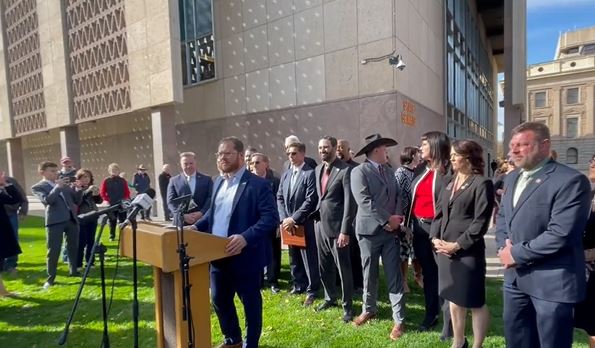
The protests were organized by the Arizona Freedom Caucus, whose members are committed to upholding the Constitution and preserving personal freedom. Their actions at the State of the State event came just hours after a press conference was held to discuss a lawsuit they intend to file against Hobbs.
The lawsuit will challenge the constitutionality of Executive Order 2023-01, which seeks to extend anti-discrimination protections to LGBTQ+ individuals seeking employment in most state offices and state contractors. Hobbs’ order, however, has come under attack for likely violating an Arizona law which protects the religious autonomy of organizations that work with state agencies.
Sen. Jake Hoffman said during Monday’s press conference that Hobbs believes “she has the ability to legislate with the power of the pen, attempting to create law that simply does not exist.” The lawsuit hopes to rein in the type of policy changes Hobbs seeks to implement through executive orders.
Hoffman is one of the lawmakers who later left the House of Representatives chamber during Hobbs’ speech.
While Katie Hobbs was speaking I took the once-in-a-lifetime opportunity to meet one-on-one with our guest speaker – Holocaust survivor Hanna Miley. Then Chairwoman Parker and I got right to work on legislation of importance to the people of Arizona. pic.twitter.com/IgDp1SpnT1
State Rep. Jacqueline Parker is a founding member of the Arizona Freedom Caucus. She explained her protest action in a press release issued after Hobbs’ address.
“We could not sit idly by while she repeatedly declared her intention to advance her woke agenda that stands at odds with the people of our state,” Parker said.
& she wants to take the money (for illegals) from ESA’s which help the children of actual Arizona citizens 👇 https://t.co/WDqgRr9Uth
“The Arizona Freedom Caucus will never back down in the face of Katie Hobbs’ attempts to implement her fascist agenda in our state,” vowed Rep. Joseph Chaplik.
Terri Jo Neff is a reporter for AZ Free News. Follow her latest on Twitter, or send her news tips here.
Her office says Gov. Katie Hobbs intends to unleash “Arizonan innovation” in order to grow the State’s workforce. This includes the first executive order of Hobbs’ term along with a 100 Day Initiative which was announced Tuesday.
“Right now, Arizona’s working families face ongoing economic uncertainties,” a statement by Hobbs’ office reads. “Governor Hobbs knows what’s possible when leaders work together to improve the lives of those they represent. That’s why she will work with the legislature to put more money in pockets and provide meaningful relief for so many working families in Arizona.”
According to the statement, Hobbs plans to prioritize lowering the costs for families with children through state level child tax credits, sales tax exemptions for diapers, and a sales tax holiday for back to school shopping.
She also intends to push for sales tax exemptions to help working families, and to help Arizonans secure good-paying jobs by creating more career and technical education opportunities and expanding child care assistance.
But how the governor intends to pay for her plan has not yet been announced.
In the meantime, concerns are being raised about Hobbs’ first Executive Order which was promoted by the governor’s office as “protecting employment opportunities” for Arizona’s workers.
As previously reported by AZ Free News, much of the emphasis of Executive Order 2023-01 involves barring gender identity discrimination.
Yet Hobbs appears to be trying to expand discrimination protection by dictating how religious organizations must operate if they want to contract with the State. It is a sort of reverse discrimination which Arizona law actually prohibits, according to critics of the governor’s effort.
EO 2023-01 directs the Arizona Department of Administration to establish procedures for use by all State agencies to ensure that hiring, promotion, recruitment, compensation, and tenure “is on the basis of merit and qualifications” is in accordance with all existing federal, state, and local laws, rules, policies, or executive orders.
It also mandates that “all new state contracts or subcontracts” include the same provisions to prohibit discriminatory practices based on race, color, sex, pregnancy, childbirth or medical conditions related to pregnancy or childbirth, political or religious affiliation or ideas, culture, creed, social origin or condition, genetic information, sexual orientation, gender identity or expression, national origin, ancestry, age, disability, military service or veteran status, or marital status.
But many state agencies, like the Department of Child Safety and the Department of Health Services, heavily rely on religious organization such as Catholic Charities and other faith-based groups to provide much needed services, particularly for Arizona’s at-risk children.
Cathi Herrod, president of the Center for Arizona Policy, expressed concern that the anti-discrimination effort of Hobbs’ first executive order might actually violate Arizona law and the rights of non-secular agencies.
“The question is does the state want to continue to have faith-based agencies providing such critical foster care and adoption services?” Herrod says. “Because if they didn’t award the contract because of the religious entity’s beliefs, then they’re violating their constitutional and statutory rights.”
EO 2023-01 does not address how Hobbs will ensure those critical social services remain available nor how competing discrimination arguments would be resolved. But state law generally trumps an individual governor’s wishes.
And while the executive order will apply to thousands of state jobs, all state offices headed by one or more statewide elected officials—such as the Attorney General, Treasurer, and Secretary of State—are exempted from compliance. This likely leaves hundreds of other state jobs outside the scope of Hobbs’ order.
“Although these organizations are not included they are encouraged, along with all private employers operating in Arizona, to adopt similar employment opportunity protections,” Hobbs noted in EO 2023-01.
EO 2023-01 does not confer any legal rights or remedies upon any persons and “shall not be used as a basis for legal challenges to a State Agency’s refusal to consider an applicant for employment, the removal of an applicant from consideration for employment, the denial of an employment application, or any inaction of a State Agency.”
Terri Jo Neff is a reporter for AZ Free News. Follow her latest on Twitter, or send her news tips here.
New year, new policy: the University of Arizona (UArizona) began paying for gender reassignment surgeries for both employees and their children on Jan. 1.
UArizona will cover up to $10,000 for these procedures through a newly established Health Reimbursement Arrangement (HRA): an employer-funded, tax-free health benefit that reimburses employees. Both employees and their dependents are eligible for the HRA.
The HRA would also cover fertility treatments, but only up to $2,500.
UArizona announced the reimbursement plan in the week after Thanksgiving. The HRA administrator is Navia Benefit Solutions, and offered through enrollment in the Arizona Department of Administration’s High-Deductible Health Plan or Triple Choice Plan.
The university has supported transgenderism openly over the past few decades. In 2013, UArizona lifted up a transgender former professor, Susan Stryker, who established their Transgender Studies Initiative.
Stryker retired, but is a visiting professor for Yale University, distinguished chair for Mills College, and co-editor for a Duke University Press book series on gender. Buzzfeed named Stryker as one of 24 individuals who radically reformed public perception of transgenderism.
The UA's Susan Stryker has been listed as an American who has changed the way we think about transgender rights: http://t.co/ciVVsElHgw.
UArizona also offers a “Gender Affirming Treatment” through their student health insurance plan, a benefit which is also available at Arizona State University (ASU) and Northern Arizona University (NAU). UArizona offers insurance through UnitedHealthcare.
The university also issues room assignments based on students’ preferred room gender through “open housing rooms” within “Gender Inclusive Housing” groups on certain floors or in certain dorms. Preferred names and pronouns are permitted to be changed for class rosters, emails, and other non-legal uses.
The university allows individuals to use restrooms corresponding with their gender identity, as well as offering restrooms that allow both genders.
UArizona received over $327.6 million from the state general fund in the last fiscal year. Current tuition rates are set at over $13,200 for residents, and over $39,500 for non-residents.
The university has a 50 percent four-year and 68 percent six-year graduation rate.
Corinne Murdock is a reporter for AZ Free News. Follow her latest on Twitter, or email tips to corinne@azfreenews.com.
Gov. Katie Hobbs selected as her spokeswoman a leader of two leftist dark money organizations and supporter of an FBI Most Wanted terrorist.
Hobbs’ spokeswoman, Josselyn Berry, served as leadership in two organizations that managed funds from Democratic dark networks. Berry served as the program manager for Arizona Wins from 2015 to 2016, and executive director for ProgressNow Arizona (now Progress Arizona) from 2016 through 2019.
Progress Arizona’s sponsor, Way to Win, launched in response to former President Donald Trump’s 2016 victory as a national donor network for defeating Republicans. It spent $110 million in key states, including Arizona, to ensure Democratic victories in 2020. Its major funders include George Soros’ Open Society Foundations and family, Stryker Corporation heiress Patricia Stryker, prominent D.C. consulting firm Arabella Advisors’ Sixteen Thirty (1630) Fund, and the Tides Foundation-backed One Arizona.
Specifics about Progress Arizona’s financials (filed under “ProgressNow AZ”) aren’t publicly available. IRS public documents for the 501(c)(4) nonprofit only include the organization’s tax-exempt notification letter. ProPublica, a nonprofit newsroom site, was only able to obtain the extracted financial data for their fiscal year 2020 filing, but no specific details to reflect the $3.9 million revenue. An initiative of Progress Arizona, ProgressNow AZ Institute, had revenues of over $500,000 in 2020, but source documents weren’t available for that filing, either.
Of note, Hobbs’ campaign shared the same mailing address as ProgressNow and Arizona Wins: a UPS store in Phoenix shared over the years by several other Democratic political action committees (PACs), activist organizations, and even candidates. These groups also have ties to the political operative behind at least 50 political action committees or candidate campaigns over the last five years.
That operative, Dacey Montoya, had the email for her consulting firm, The Money Wheel, listed as a contact for Hobbs’ secretary of state and gubernatorial campaigns, and received about $188,500 over the past four years. Montoya’s PAC received $37 million from fallen crypto giant FTX leader Sam Bankman-Fried, as well as over $1 million from committees for Sen. Mark Kelly (D-AZ) and Governor Katie Hobbs.
While serving as the communications director for the Arizona State Senate Democratic Caucus, Berry quoted FBI Most Wanted Terrorist Assata Shakur in a tweet following George Floyd’s death. The Senate Democrats also shared the quote on their Twitter feed, but were forced to delete it and issue an apology after it stoked controversy.
The Senate Democrats claimed ignorance of Shakur’s criminal history and terrorist status. Shakur was a Black Liberation Army member sentenced to life in prison for murdering a cop and committing armed robbery, among other crimes. She escaped prison in 1979 and fled to Cuba; the FBI has a $2 million reward for her apprehension.
Berry, who was hired as an Arizona Democratic Party spokeswoman last year, never deleted the tweet.
Berry graduated from Arizona State University (ASU) Walter Cronkite School of Journalism, where she was also in the Barrett Honors College.
Corinne Murdock is a reporter for AZ Free News. Follow her latest on Twitter, or email tips to corinne@azfreenews.com.
A prominent Jewish rights group falsely claimed that the University of Arizona (UArizona) professor shot and killed last October was targeted due to antisemitism. The Simon Wiesenthal Center named the UArizona slaying as one of last year’s top 10 worst antisemitic incidents.
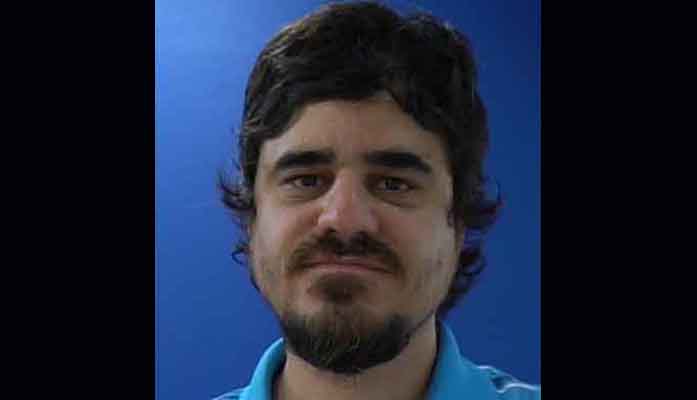
The killer facing charges, 46-year-old Murad Dervish, disclosed that his motive for killing concerned perceived disrespect from the Department of Hydrology & Atmospheric Sciences run by the slain professor, Thomas Meixner. The professor had denied Dervish a teaching assistant position for this spring semester.
Belief that Dervish’s motive for killing was antisemitism arose from testimony by another professor. Although Meixner wasn’t Jewish, Dervish reportedly believed he was based on his research using an online background checker.
This detail and speculation of antisemitism was disclosed by another of Dervish’s intended targets that fateful day: Meixner wasn’t Dervish’s first or only target.
Dervish first sought out Eyad Atallah, who Dervish knew wasn’t Jewish. Atallah was aware of Dervish’s animosity toward him, telling the Arizona Daily Star that he bought a bulletproof vest to teach classes. Atallah said that Dervish sent antisemitic messages about Meixner, though both UArizona President Robert Robbins and Pima County Attorney Laura Conover said that filed complaints didn’t meet the threshold for pressing charges.
Here is one of the Simon Weisenthal Center's "Top Ten Worst Global Anti-Semitic Incidents" for 2022. A gunman is said to have killed a professor because he mistakenly thought the professor was Jewish
If these lists are so necessary, you have to wonder why they just make stuff up pic.twitter.com/462QuoNeJI
Dervish’s escalation from menacing language to killing may have also arisen from an eviction notice served the week prior to the killing. His former neighbors told reporters that they felt threatened by Dervish for over a year. Dervish attempted to fight his female neighbors, and would watch them come in and out of their house.
“First thing ever he said to both me and my other roommate, different times, was, ‘You won’t last long here,’” said one of the women.
Neighbors of the man whose accused of killing the University of Arizona professor said they’ve felt threatened by Murad Dervish for more than a year. https://t.co/vDTTLViTpbpic.twitter.com/XkBfcA7an0
Dervish’s father, Dolgun, said that his son struggled due to having Asperger’s Syndrome and later, alcoholism. Dervish went to prison on three separate occasions.
Dervish had attempted to kill in the past, but not because of antisemitic beliefs. He pulled a knife on a pizza man while at Penn State University. He later served a prison sentence for attempting to kill his own mother by strangling her with a scarf.
In 2011, Dervish was arrested and sentenced to prison for some undisclosed crime in California.
Dervish also had a restraining order filed against him in 2020 while he was a teaching assistant at San Diego State University. The complainant was a woman who claimed he harassed and stalked her, and even ignored the order against him. Prior to that, Dervish assaulted his father at his restaurant. Dervish reportedly smashed restaurant equipment with a crowbar, threw a plate at his father, and hit his father’s back.
Prosecutors haven’t characterized Dervish’s killing as a hate crime. He faces seven charges including first-degree murder, aggravated assault with a deadly weapon, first-degree burglary, possession of a deadly weapon, and endangerment.
CAMPUS SHOOTING IN TUCSON
Yesterday, on the campus of the University of Arizona, professor Dr. Thomas Meixner was shot and killed.
The suspect, Murad Dervish, 46, one of Meixner’s former students, has been arrested and will be charged.