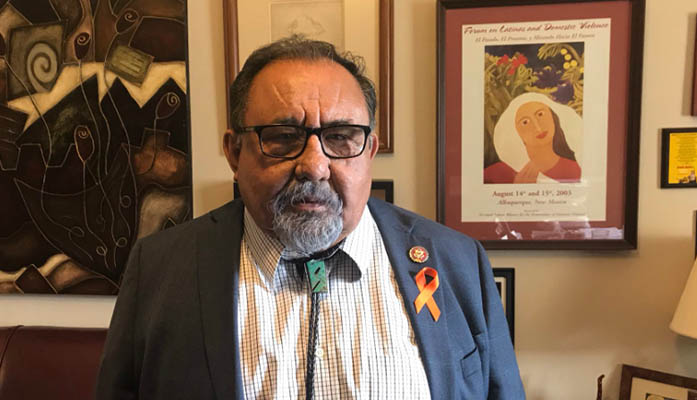
Rep. Raúl Grijalva (D-AZ-07) selected an anti-Christian art piece as the winner of this year’s Congressional Art Competition.
The piece, titled “Chokehold,” depicts a blonde, curly-haired woman being choked with a scarred cross on her forehead. According to the artist, recent Nogales High School graduate Grecia Solorio, the drawing signifies the “damaging effects of purity culture on women,” referencing Christian values specifically. The piece will be displayed in the U.S. Capitol for one year.
“I’d like to thank everyone who submitted their art for the competition this year and want to congratulate Grecia on this impressive accomplishment,” said Grijalva. “The depth of talent and range of artistic styles are inspiring and each participant should be proud of their work. I look forward to welcoming Grecia to Washington and viewing her art in the U.S. Capitol.”
Felicidades to Grecia Solario from Nogales High and the winner of #AZ07's Congressional Art Competition!
I look forward to welcoming Grecia to Washington and viewing her work hang in the U.S. Capitol.https://t.co/10D3qSBlKT
— Raul M. Grijalva (@RepRaulGrijalva) May 30, 2023
Solorio will also be brought to the Capitol and honored at a congressional reception for her work.
In the 22nd Annual Juried Exhibition, Solorio said in an artist statement that she was happy that artwork allowed her to disrespect the sacred aspects of Christian religion. Solorio added that her work represented a rejection of the patriarchal customs of Hispanic-American culture and society.
“Throughout my life, I was taught that freedom was the most important thing for a human being to possess. However, I learned that in order to feel free, I needed to confront my belief-based fears, and continuously fight back against the patriarchal customs that were introduced to me by my culture and by society,” stated Solorio. “I find my freedom through art, most specifically in creating artwork that allows me to be irreverent. The religion I defied as my first act of personal freedom, serves as inspiration for my feminist work. I strive to combine both topics, not to intertwine them, but rather to point out the hypocrisies of the prior and create an impactful view into issues of the latter.”
Solorio also received Best of Show for the piece during an art show last month displaying high school students’ work, “Hi-Art.” The piece was also displayed last November in ArtLink’s 22nd Annual Juried Exhibition, one of the largest group artist exhibitions in the state.
ArtLink partners include Valley Metro, Kimpton Hotel Palomar Phoenix, Arizona Commission on the Arts, Arizona Center, Phoenix Sky Harbor International Airport, the city of Phoenix, Arizona Strategies, Arizona Public Service, and FOUND:RE Phoenix Hotel.
Another of Solorio’s pieces depicted motherhood as slavery. The piece, titled “Modern Madonna,” displayed a breastfeeding, crying mother with a chain around her neck, with the saying underneath, “La maternidad será deseada o no será,” a saying that translates to, “Motherhood will be desired or will not be” — a statement in support of abortion.
Solorio plans on attending the School of Art Institute of Chicago.
Corinne Murdock is a reporter for AZ Free News. Follow her latest on Twitter, or email tips to corinne@azfreenews.com.
The former USA Today editor-in-chief took over the Arizona State University (ASU) initiative to “reimagine” local journalism efforts.
The editor-in-chief, Nicole Carroll, formerly served as editor of The Arizona Republic for nearly 20 years prior to joining USA Today. Both outlets are owned by the Gannett Company, where Carroll also served as president of news.
USA Today hired Carroll following her Pulitzer Prize award for coverage of former President Donald Trump’s border wall plans.
Under Carroll, TheArizona Republic broke precedent by endorsing a Democratic candidate, Hilary Clinton, in the 2016 presidential election. The editorial board at the time asserted that former President Donald Trump wasn’t conservative and therefore not qualified.
“Clinton has the temperament and experience to be president,” wrote the board. “Donald Trump does not.”
In early 2020, just weeks before the declaration of a national emergency over the COVID-19 outbreak, The Arizona Republic said it would no longer endorse candidates.
In a press release, Carroll said that reporters should embrace disruptive solutions when delivering the news.
“We must create and embrace disruptive solutions to engage and empower people with the news and information they need to strengthen our communities and democracy,” said Carroll.
ASU said that Carroll’s role would be to develop new strategies and business models for local reporting through ASU Media Enterprise.
Under Carroll, major articles included what was widely perceived as a hit piece portrayed as news rather than opinion against Supreme Court (SCOTUS) Justice Brett Kavanaugh ahead of his confirmation.
In one of Carroll’s last opinion pieces for USA Today before departing, Carroll featured former SCOTUS Justice Sandra Day O’Connor and discussed how the current SCOTUS erred in overturning Roe v. Wade.
Last summer, Carroll highlighted the USA Today goal of increasing gender and race-based diversity in newsrooms.
Carroll took over for her former longtime colleague: professor and managing program director, Mi-Ai Parrish, who’d most recently served as the publisher for TheArizona Republic. Both Carroll and Parrish served on TheArizona Republic editorial board together.
Parrish was friends with newly-appointed Ninth Circuit Court judge Roopali Desai, casting her as a diversity appointment.
“Interviewing fellow Athena and rockstar pal Judge Roopali Desai, first So. Asian on @US9thCircuit for an Asian Am Wonder Women evening. #truthmatters #justicematters #inclusionmatters,” tweeted Parrish.
ASU Media Enterprise housesArizona PBS, the public broadcasting channel and platform; Issues in Science in Technology, a public policy forum partnering with the National Academies of Sciences, Engineering, and Medicine; Zocalo Public Square, a humanities journal; Global Sports Matters, a sports publication; Transformations, an online magazine for narrative essays that serves as a publishing channel of the Los Angeles Review of Books; Narrative Storytelling Initiative, a writing projects cohort; Future Tense, a Washington, D.C. partnership with New America and Slate magazine to analyze and project technology’s impact on society; Leonardo, a problem-solving initiative combining the arts, sciences, and technology; KBAQ, a classical public radio station; Digital Audiences Lab, a student-led social media campaign strategy program; Innovation Happens, a student podcast to highlight the diversity of ASU.
Corinne Murdock is a reporter for AZ Free News. Follow her latest on Twitter, or email tips to corinne@azfreenews.com.
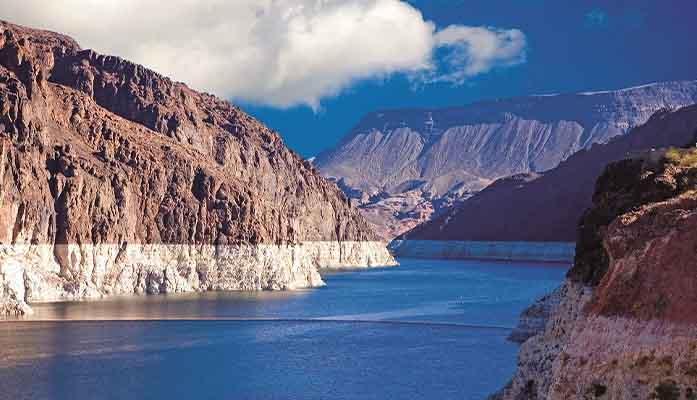
Arizona Republican legislators made sure that water investments received sizable contributions in the recently negotiated budget deal for the state.
In a press release issued last week, Representative Gail Griffin, the Chair of the House Committee on Natural Resources, Energy & Water highlighted a realized commitment to strengthen “Arizona’s water resources by directing over $360 million of state general fund dollars to be allocated to projects and programs that help to promote the conservation, development, and enhancement of water in Arizona.”
Griffin lauded Republicans’ efforts to include this funding for the state’s water security and future, saying, “Never before in our state’s history has water been as important to our state’s economic prosperity and individual liberty as it is today. As Republicans, we will continue to find solutions to Arizona’s most pressing issues, from water security to housing availability. We will continue to make investments in Arizona’s long-term water future.”
The release listed several areas where funds were invested: Water infrastructure projects, Reconstruction of a levee, Design and construction of a recharge basin, Installation of new irrigation systems and xeriscaping, Water project assistance for cities, towns, and irrigation districts in rural counties, Wastewater system improvements, Construction of groundwater delivery infrastructure, Brackish groundwater recovery pilot program, Statewide water resources planning, Water supply and demand assessments, Assured and adequate water supply administration, Stream adjudication support, Rural water studies, Water protection fund for projects that address conservation and watershed improvement, Conservation and drought program, Brackish groundwater study, Water conservation projects, On-farm irrigation efficiency projects, Water quality fee fund, PFAS mitigation, Safe drinking water program, Direct potable reuse of treated wastewater, Water infrastructure and commerce grants, Long-term water augmentation, Rehabilitation and drilling of new water wells.
Earlier this session, Representative Griffin was named as a co-chair of the Joint Legislative Study Committee on Water Security, which was formed by Arizona House Speaker Ben Toma and Senate President Warren Petersen to “convene and solicit information from water users, stakeholders, and the public regarding state solutions to address water security in Arizona.”
When announcing the formation of this committee, Speaker Toma said, “The availability of water for the success of all industries in our state is critical to our economy. Strengthening our existing water resources while we secure our future water supply is a top priority as we work to achieve common-sense solutions for our state. His counterpart in the Senate, Petersen, also stated, “From the 1980s Groundwater Management Act to last year’s historic investment in WIFA, the Legislature has led and will continue to lead the water policy solutions that require legislative action to implement.”
Water policy will most certainly be an issue of contention in a divided government in the years ahead. Republicans in the state legislature and Democrat Governor Katie Hobbs have already proven that they have varying opinions about how to lead the Grand Canyon State forward in this critical area. Democrat Attorney General Kris Mayes has also weighed in with her perspectives on Arizona’s water security, attempting to make sure that her office has a seat at the table for future actions.
Daniel Stefanski is a reporter for AZ Free News. You can send him news tips using this link.
Arizona’s Republican Superintendent of Public Instruction gave an update on the new Empower Hotline from the state’s Department of Education.
On Thursday, Superintendent Tom Horne provided an update on the Empower Hotline program and elaborated on some of the concerns that his staff had fielded since the March launch. According to the Department, “the Empower Hotline allows parents to report inappropriate content being taught that detract from teaching academic standards. These include those that focus on race or ethnicity, rather than individuals and merit, promoting gender ideology, social emotional learning, or inappropriate sexual content.”
In a release sent after the update, the Department made clear that complaints submitted through the Empower Hotline have revealed potential violations to state law and demonstrate that elements of Critical Race Theory are present in the public school system.
Horne issued a statement in conjunction with the press release, saying, “Despite those in ideological groups and some in the media that propagate the urban myth that CRT is not a part of the school system, we have evidence from the empower hotline, that there is enough CRT in our schools to constitute a problem, though it is obviously not universal. We also have evidence that schools have put systems in place to hide or attempt to hide critical personal information from parents about their child. This is in direct violation of Arizona law, A.R.S. §1-602.”
The Arizona Department of Education pointed to three examples of vetted concerns brought to staff through the Empower Hotline. The first came from Mesa, where the Department shared that “a teacher reported through the hotline that the Mesa school district has a training program for teachers that clearly states that certain Americans are ‘living under a system of white supremacy.’” Horne added, “That is a divisive and bigoted statement that has no place in education. We are individuals, entitled to be judged by what we know, what we can do, our character, and not the color of our skin. To its credit, Mesa is in discussion with the Department about this.”
The other two examples occurred in the Catalina Foothills School District and in the Chandler Unified School District. In the Catalina Foothills instance, the Department revealed that a concern was raised regarding “a spreadsheet distributed in this school district with a list of pronouns chosen by students. The email and attached file clearly show the school withholding information from parents contrary to A.R.S. §1-602.”
In Chandler, the Department reported that “a lunch time Gay-Straight Alliance Club was created to discuss gender issues but also included the distribution of emancipation paperwork, which a parent only knew about because parents found it in their students backpack. Both of the above are examples of activity contrary to Arizona law.”
Since assuming office in January, Horne has worked tirelessly to shed light on what children are being taught and exposed to in their schools, giving interested parents the transparency that many have demanded in increasing numbers over the past few years. Horne stated, “Since its inception earlier this year, ADE has been compiling information regarding inappropriate activity occurring in Arizona schools through the Empower Hotline. These complaints have come not just from concerned parents but also from teachers. When parents saw during COVID what students were being taught on their laptop, they were outraged by CRT content, and went to school board meetings, where some were treated rudely. The Employer Hotline directs them to a method to communicate their concerns.”
The Department also communicated that the Hotline had received 30,000 crank calls and emails since its inception in March, promising that “all legitimate complaints received through the Empower Hotline will continue to be accepted and investigated.”
Daniel Stefanski is a reporter for AZ Free News. You can send him news tips using this link.
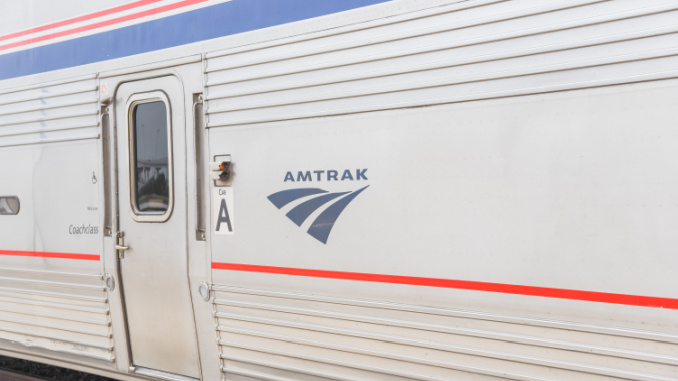
Phoenix Mayor Kate Gallego heeded the call of Amtrak CEO Stephen Gardner, urging for the addition of a public railroad to the city.
Gallego said that the railroad, or passenger railway, would make long-distance travel easier for both locals and visitors.
“An @Amtrak connection in Phoenix would make long-distance travel easier for Phoenicians and bring more visitors. Let’s get it done!” said Gallego.
An @Amtrak connection in Phoenix would make long-distance travel easier for Phoenicians and bring more visitors. Let’s get it done! https://t.co/2NYqU7AuTN
The renewed calls for a public railway came after Gardner singled out Phoenix in recent public comments on his company’s intent to expand nationally. Gardner said it was an “embarrassment” that Phoenix doesn’t have his passenger railway company.
“(It is) frankly an embarrassment that we don’t serve such a major, prominent city,” said Gardner.
Amtrak applied for $716 million in federal funding from the Bipartisan Infrastructure Law to launch 16 projects nationwide, including Phoenix. The Arizona Department of Transportation (ADOT) submitted a proposal to the federal Corridor Identification and Development Program (Corridor ID Program) to assist in the expansion. Additionally, ADOT provided $3.5 million.
Another proponent of the Amtrak expansion into Arizona, Rep. Greg Stanton (D-AZ-04), claimed that passenger railway would reduce the number of cars and therefore result in significant emissions reductions.
In a press release, Stanton also claimed that a public railway would provide an economic boost for the state.
“[It’s an] opportunity to connect our communities, make them more accessible and productive, and more internationally competitive,” said Stanton. “Opportunity to boost our regional economies with better access to jobs and more private investment along the route. Opportunity to ease congestion along Interstate 10 and help reduce air pollution.”
Likewise, Sen. Mark Kelly (D-AZ) said Phoenix needed to join the other major cities in the country served by Amtrak.
“Phoenix is the largest city in the country not served by Amtrak, but thanks to our Bipartisan Infrastructure Law, we’re working to fix that,” said Kelly. “This support for the Return to Phoenix Project will finally bring together Arizona communities, the railroads, and Amtrak to develop a comprehensive plan to connect Phoenix and Tucson with passenger rail and connect Phoenix to Amtrak’s nationwide network.”
Public railway, like other forms of public transit, suffers from high crime rates. According to Amtrak police, there were around 6,000 incidents and over 456,400 calls for police assistance in 2021. That’s based on the latest National Incident-Based Reporting System (NIBRS) data from the FBI.
That’s compared to about 5,000 incidents and 412,000 calls in 2020; around 6,700 incidents and 419,700 calls in 2019; around 6,100 incidents and 254,700 calls in 2018.
Amtrak has 30 routes consisting of 500 stops along 46 states. Based on their latest crime data report (2021), that’s about 12 incidents and 912 calls to Amtrak police at each stop annually.
In a press release on Monday, Amtrak explained that their applications were submitted through the Federal Railroad Administration (FRA) programs funded by the Infrastructure Investment and Jobs Act (IIJA): the Corridor ID Program and the Federal-State Partnership for Intercity Passenger Rail Program. The essential goal of the programs is to establish a comprehensive national passenger rail network.
Another Arizona Republican proposal to protect children has been rejected by the state’s Democrat governor.
On Thursday, Governor Katie Hobbs, vetoed SB 1040, which was sponsored by Senator John Kavanagh. The legislation, designated as the Arizona Accommodations for All Children Act, would have required “a public school to provide access to a single-occupancy or employee restroom or changing facility to a person who is unwilling or unable to use a multi-occupancy restroom or changing facility designated for the person’s sex or multi-occupancy sleeping quarters.”
In a letter to Senate President Petersen, explaining her reasoning for the veto, Hobbs wrote, “SB 1040 is yet another discriminatory act against LGBTQ+ youth passed by the majority at the state legislature. As I stated in my veto letter for SB 1001, I will veto every bill that aims to attack and harm children.”
Kavanagh was outraged by the governor’s action against his bill, saying: “Women and young girls deserve privacy and their own protected bathrooms, showers and locker rooms where they can have such privacy and are safe from the risk of sexual harassment or sexual violence. Unfortunately, Democrat Legislators and Governor Hobbs are catering to an extremist culture by pushing ‘gender neutrality’ as a means to win political points from their liberal base while stealing dignity away from women and girls in the process. SB 1040 is about protecting our children while respecting the natural privacy rights of students. A 14-year-old female high school coed should not be forced to stand next to a naked, transgender female, who is actually an 18-year-old biological male. In a rush to become ‘trans inclusive,’ Governor Hobbs and fellow Democrats have forgotten about the needs of innocent young girls. This veto shows exactly how little they care to protect our female citizens.”
Progress Arizona cheered on Governor Hobbs’ veto, tweeting, “SB 1040, sponsored by Sen. Kavanagh, has been VETOED! SB 1040 targeted transgender students and teachers by prohibiting them access to public school restrooms.”
🚨SB1040, sponsored by Sen. Kavanagh, has been VETOED! SB1040 targeted transgender students and teachers by prohibiting them access to public school restrooms.
Extremists like John Kavanagh have spent the entire #azleg session, pushing hateful rhetoric on LGBTQ+ youth and… pic.twitter.com/uyRKo2KFmC
A day before Hobbs’ veto, the Arizona Senate Democrats warned about Republican “attacks on LGBTQ+ protection,” stating, “Rather than invest in our public school students and their future success, Republicans are more interested in culture wars and clickbait bill titles.”
When it comes to attacks on LGBTQ+ protection, Arizona Republicans nearly take the cake.
📚 Rather than invest in our public school students and their future success, Republicans are more interested in culture wars and clickbait bill titles. (4/) pic.twitter.com/zUfK9MPFUX
— Arizona Senate Democrats (@AZSenateDems) June 7, 2023
Earlier this session, after his chamber gave the bill the green light, President Petersen had highlighted the lack of attention given to the legislation by the media, posting on Facebook, “We recently passed a bill out of the senate that said no boys in girls showers. All the democrats voted no. One of the democrats suggested we put up shower curtains as a solution. Zero coverage by the media. Lots of bills like that all the time. Zero coverage by the media.”
The first-year governor had already telegraphed her decision on SB 1040 and similar pieces of legislation three months ago, alerting the public that these bills were dead on arrival in the Governor’s Office under her administration: “On this International Women’s Day I want to make it clear that trans women are women, they are welcome here, and any bill that harasses or threatens their safety will swiftly meet my veto stamp.”
On this International Women's Day I want to make it clear that trans women are women, they are welcome here, and any bill that harasses or threatens their safety will swiftly meet my veto stamp.
— Governor Katie Hobbs (@GovernorHobbs) March 8, 2023
Daniel Stefanski is a reporter for AZ Free News. You can send him news tips using this link.