by Corinne Murdock | Feb 10, 2024 | News
By Corinne Murdock |
In Flagstaff, a citizen requesting one hour of police body camera footage could expect to pay about $80.
Flagstaff Police Department body camera footage will now cost $46 per hour reviewed, along with a $30 charge for digital media storage, after the city council voted to no longer offer the records for free.
The Flagstaff City Council voted on Tuesday to charge for the footage during their regular meeting. The council cited a law from the state legislature enacted last October, which enabled cities to begin charging for police body camera footage. The law set the maximum fee at $46, which the council adopted.
The council noted in its presentation on the proposed fee that the hourly salary costs for legal review of public records requests of footage, in addition to the redactions by records personnel, exceeded the state statute cap of $46.
The city estimated that the labor cost of FPD’s records lead was $37 an hour, while a records supervisor was $42 an hour, and a legal advisor’s labor cost was $118 an hour. Factoring those estimates and excluding use of equipment or digital media costs, the city calculated that the hourly cost to review, redact, and copy the footage was around $160 an hour.
The presentation further suggested that the public mitigate its costs by narrowing public records requests to specific videos within a case, rather than casting a wide net. City staff noted that FPD posts videos of certain critical incidents online at no charge.
“Costs for videos can be managed by making requests for specific videos, such as one where a person was arrested, or ones where a particular people were interviewed as opposed to all videos in each case,” stated the city.
The city’s financial impact description on its final agenda noted that staff spent over 200 hours redacting body camera footage over the course of one year, July 2022 to July 2023: about four hours a week. However, the city’s presentation on the policy said that the 200 hours were spent reviewing body camera footage, not the time it took to redact and download the footage.
The city estimated that redactions took as long as 45 minutes per every hour of video. For downloads, they estimated it takes about 20 minutes for a CD download per hour of video and three minutes for a thumb drive transfer per hour of video.
The 200 hours were responsive to about 136 public records requests. For all that time, the city estimated that it would have collected over $9,200 in revenue under the state statute’s $46 cap.
The legislature previously passed a law enabling the Department of Public Safety (DPS) to charge for body camera footage in 2021. DPS charges about $42 per hour of footage reviewed.
The council passed the policy without any comment.
Additionally, the city updated the language describing the police body camera records from “copies of tapes” to “digital media.”
Corinne Murdock is a reporter for AZ Free News. Follow her latest on Twitter, or email tips to corinne@azfreenews.com.
by Corinne Murdock | Feb 9, 2024 | News
By Corinne Murdock |
A vote by the Arizona Corporation Commission (ACC) earlier this week moved to limit energy companies’ push to meet Environmental, Social, Governance (ESG) goals.
The ACC voted 4-1 on Tuesday to draft rules to repeal existing rules and mandates for renewable energy as well as electric and gas energy efficiency: the Renewable Energy Standard and Tariff (REST) Rules and the Energy Efficiency Standards (EE), also known as the Demand Side Management (DSM). Per the commission, the rules and mandates for REST and EE/DSM resulted in incentives for renewable energy projects and services, since utilities were required to file proposals describing REST compliance.
Commissioner Ana Tovar was the sole “no” vote on the motions. The standards behind EE/DSM expired in 2020, but previous commissions didn’t repeal the rule.
The commission noted in Wednesday and Thursday press releases that the rules, tracing back to 2006 for REST and 2010 for EE/DSM, have cost customers nearly $3.4 billion through corresponding surcharges. REST surcharges have cost ratepayers nearly $2.3 billion, while EE/DSM surcharges cost nearly $1.1 billion.
Commissioner Nick Myers said in Wednesday’s press release that the rules and mandates were unnecessary and would result in a drastic cost increase to consumers.
“I believe it is time for the Commission to consider repealing these rules and mandates that appear to unnecessarily drive-up costs,” said Myers. “Utilities should select the most cost-effective energy mix to provide reliable and affordable service, without being constrained by government-imposed mandates that make it more expensive for their customers.”
In Thursday’s press release, Chairman Jim O’Connor — who filed the motion to repeal REST — said that the commissioners from nearly 20 years ago were “well-intentioned” in their vision for reducing the state’s carbon footprint through the REST rules, but that no cost controls were ever implemented, at the detriment of ratepayers.
“In 2006 when the REST rules supplanted the EPS rule, concerns by the dissenting Commissioner cited the lack of cost control measure that would negatively impact ratepayers, and the then-Chairman Hatch-Miller intended that the Commission review annually whether it was in the best interest of the ratepayers. Those reviews never occurred and costs were never considered,” said O’Connor.
O’Connor further remarked that contracts in pursuit of environmental mandates ultimately burdened the ratepayers.
“We began the steps needed to repeal a rule that has cost ratepayers billions of dollars in out of market priced contracts,” said O’Connor. “Mandates distort market signals and are not protective of ratepayers.”
Commissioner Kevin Thompson — who filed the motion to repeal EE/DSM — stated in the press release that the repeal marked a victory for ratepayers, and the end of “feel-good programs” that lack affordability and reliability.
“Arizona utilities have collected over a billion dollars in ratepayer surcharges for efficiency initiatives that have done little to avoid the need for new generation and have benefitted a select few,” said Thompson. “Energy efficiency programs are routinely pushed by vocal special interest groups where the economic benefits favor a small group of customers, and the large majority of ratepayers foot the bill.”
Prior to the ACC acting on the draft rules, the commission will open up multiple public comment opportunities. The draft rules and intake for public comment will be located on the following ACC dockets: gas utility energy efficiency, electric utility energy efficiency, and renewable energy.
The entire rulemaking process will take over a year, according to commission staff. The REST and EE/DSM repeal are part of a greater, five-year review of existing ACC rule packages.
Corinne Murdock is a reporter for AZ Free News. Follow her latest on Twitter, or email tips to corinne@azfreenews.com.
by Daniel Stefanski | Feb 9, 2024 | News
By Daniel Stefanski |
A bill to restrict foreign funding of Arizona elections is attracting some bipartisan support in this legislative session.
Earlier this week, the Senate Elections Committee passed SB 1374, which “requires a person to provide certification that the person is not the knowing recipient of foreign donations before entering into any agreement with a government entity to provide goods or services relating to elections administration.”
According to the fact sheet provided by the Arizona Senate, a ‘person’ is defined as “an individual, candidate, corporation or other entity or committee as prescribed by statute.”
The elections-related proposal, which was introduced by Senator Shawnna Bolick, passed the committee with a 6-2 vote. One Democrat, Senator Flavio Bravo, voted for the legislation in the committee.
In a statement to AZ Free News, Bolick said, “SB 1374 is a bill in support of free, fair, and transparent elections. Leading up to the 2020 elections, billionaires and big tech played an outsized influence in Arizona’s elections. In 2021, the Arizona legislature passed a law prohibiting election offices from receiving private monies for preparing, administering, or conducting an election. In October 2023, in Louisiana, the voters overwhelmingly voted to ban foreign funding of their elections by a vote of 72.57% in favor. When SB 1374 is signed into law, it will send a strong message that Arizona’s elections aren’t for sale by foreign billionaires.”
According to the legislature’s RTS system, representatives from the Arizona Free Enterprise Club and Heritage Action for America support the bill. A representative from the Arizona Secretary of State’s Office signed in as ‘neutral.’
Senators Borrelli, Farnsworth, Gowan, Hoffman, and Kavanagh; and Representatives Jones, McGarr, Montenegro, J. Parker, and Wilmeth have co-sponsored Bolick’s legislation.
SB 1374 awaits a vote in the full Senate chamber.
Daniel Stefanski is a reporter for AZ Free News. You can send him news tips using this link.
by Corinne Murdock | Feb 9, 2024 | News
By Corinne Murdock |
Congressional candidate Kirsten Engel has kept quiet on the ongoing conflict over the border crisis and accountability for Biden administration leadership.
Engel hasn’t addressed the recent actions on the $118 billion border bill, nor did she respond to an AZ Free News inquiry concerning the attempted impeachment of Department of Homeland Security (DHS) Secretary Alejandro Mayorkas.
Following the House rejection of a motion to impeach Mayorkas, Senate Republicans blocked the border bill from advancing on Wednesday. House GOP leadership say that they will make another attempt at impeaching Mayorkas.
As reported earlier this week, a majority of the funding in the bill goes to Ukraine: $60 billion, compared to $20 billion for the border. The remainder of the funds were apportioned for humanitarian aid, overseas projects, the Indo-Pacific, and the Red Sea conflict.
This week, Engel opted to issue public remarks only on her attendance at an annual Democratic dinner.
During her last run in 2022, Engel sided with a more lenient approach to border security that included the end of Title 42 and rejection of the characterization of the state of the border as a crisis.
It appears that Engel’s campaign has remained similar on the issues this time around. Her approach to the border crisis includes the Biden administration mantra of “secure, fair, orderly, and humane” with a focus on increasing pathways to citizenship, and ignores the illegal migration outside the legal ports of entry, rather focusing on increasing resources at those legal ports of entry.
In December, Engel told voters that border security efforts should be focused on legal ports of entry to mitigate drug and human trafficking.
Engel last addressed the border bill, indirectly, last month. She leveled criticism against her opponent for supporting House GOP leadership’s stance that the border bill wasn’t a valid solution to the ongoing crisis.
“This is further proof that Republicans want to play politics with this issue, rather than solve it,” said Engel.
Engel also blamed Republicans in December for the ever-worsening border crisis, and the then-shutdown of the Lukeville Port of Entry. The closure was roundly condemned by both Democratic and Republican leadership. The Biden administration shuttered the port to reassign agents elsewhere along the border to process illegal immigrants.
“The situation at the border is getting worse by the day. One port of entry has already been shut down, tens of thousands of asylum-seekers have nowhere to go, and our border communities have been left to deal with the situation on their own,” said Engel. “People are tired of dysfunction in Congress and they know who to blame: Juan Ciscomani and Congressional Republicans.”
In September, Engel expressed frustration that illegal immigrants were deposited into communities due to full processing facilities, calling the practice “callous” and “dangerous.” Engel blamed Washington lawmakers for the nonstop inundation of illegal immigrants.
“This type of callous treatment by CBE of our border communities and migrants is as alarming as it is dangerous,” said Engel. “We’re reminded nearly everyday of just how badly Washington has failed us at the border.”
Corinne Murdock is a reporter for AZ Free News. Follow her latest on Twitter, or email tips to corinne@azfreenews.com.
by Corinne Murdock | Feb 8, 2024 | Education, News
By Corinne Murdock |
A Paradise Valley Unified School District (PVUSD) governing board member is alleging the district violated open meeting law to determine school closures and redraw boundary lines.
In a letter to the Arizona Attorney General on Tuesday, PVUSD Governing Board Member Sandra Christensen accused district leadership of violating state open meeting law with several secretive committees that she says didn’t function to advise the superintendent as purported but had, in fact, functioned to deliver policy recommendations to the governing board. Christensen urged prompt action from the attorney general, citing a potential upcoming vote on Thursday to shut down and redraw boundaries for certain schools based on recommendations from at least one of these committees.
Specifically, Christensen brought up the School Closure and Boundary Review Committee, which conducted seven meetings from last April through November, all closed to the public and originally absent any agendas or meeting minutes. The committee consisted of some community members, including PVUSD teachers, support staff, administrators, central office administrators, and parents, and was led by assistant superintendents Jill Baragan and Steve Jerras.
Christensen expressed concern that the district used this committee to deliberately hide “controversial” discussions on school closures and boundary changes not only from the public, but the governing board itself.
“The Paradise Valley Unified School District must cease these unlawful practices,” said Christensen. “These practices are clearly intended to avoid public scrutiny by refusing to allow members of the public to attend said meetings and refusing to supply detailed meeting minutes to the PVUSD governing board or members of the public.”
Christensen said that the committee meetings yielded recommendations for the governing board regarding the potential closures of four schools and boundary changes to 12 schools, on which the board took action in December by scheduling a public hearing last month. Christensen was the only board member to oppose the recommendations, under concern that the committee had violated open meeting law.
“It is clear that the team is designed to advise the board regarding matters on only the governing board can make such as the recommendation of school closures,” said Christensen.
The School Closure and Boundary Review Committee wasn’t the only committee formed over the years in violation of open meeting law, according to Christensen.
“The Paradise Valley Unified School District has a history of these types of violations under the guise of superintendent committees that are not administrative in nature, they are advisory committees to the board that deliberately circumvent Open Meeting Law to shield controversial topics or information from the public,” said Christensen.
Christensen cited another superintendent advisory committee, a bond committee, which met from last January through April to craft recommendations on a bond, as well as a “secretive,” ongoing community legislative network, which Christensen said has met “for many years” to discuss legislative bills with a lobbyist.
According to Christensen, PVUSD Superintendent Troy Bales denies that the committees have ever been more than administrative in nature.
Corinne Murdock is a reporter for AZ Free News. Follow her latest on Twitter, or email tips to corinne@azfreenews.com.
by Daniel Stefanski | Feb 8, 2024 | News
By Daniel Stefanski |
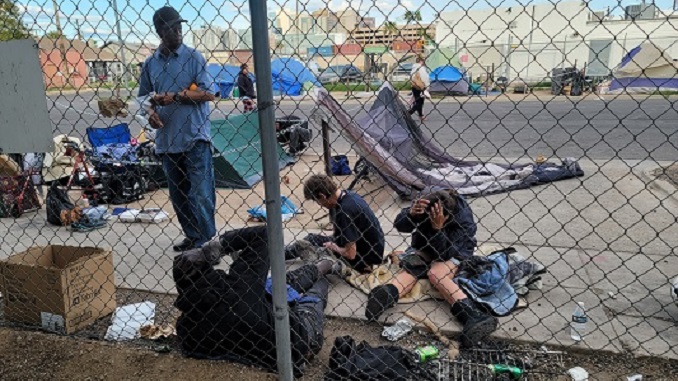
As Arizona’s homeless problems continue to grow, one Arizona legislator has introduced legislation to deal with some issues the state faces.
This week, State Representative Matt Gress unveiled HB 2782, the Arizona Homeless Protection and Drug Control Act. This bill would “bring significant amendments to existing laws to reduce homelessness and drug-related crime within designated homeless service zones.”
“This legislation is an important step towards reducing chronic homelessness and drug-related crime, ensuring that Arizona’s vulnerable populations are effectively supported while ensuring public safety,” said Representative Gress. “Establishing accountability within homeless service zones will help safeguard our communities from drug-related crime and offer a more structured and supportive environment for our homeless population to rebuild their lives.”
The freshman lawmaker added, “We are taking decisive action to improve the quality of life in these zones, ensuring that they are safe and conducive to rehabilitation and support services. Our goal is to help people and address the root causes of homelessness, which ultimately leads to safer, healthier communities across Arizona.”
According to the press release issued by the Arizona House of Representatives Republican Caucus, the legislation would “introduce new sections under Title 13, Chapter 34, to focus on the unlawful presence and activities related to dangerous drugs in homeless service zones.” Additionally, the bill would “revise existing sections under Title 41 to establish a permanent Homeless Shelter and Services Fund to allow money to be used for temporary emergency shelter while also providing clear guidelines for mixed hoteling in homeless service facilities.”
In the 2023 Annual Homelessness Assessment Report (AHAR) to Congress, which was published in December 2023, there was an estimate of 14,237 people in Arizona who were experiencing homelessness. Arizona had one of the highest rates in the nation of unsheltered people who were experiencing homelessness (7,615, 53.5%). The Grand Canyon State also observed one of the highest increases in individuals who were experiencing homelessness during the COVID-19 pandemic between the years of 2020 – 2022 (29.3%).
Daniel Stefanski is a reporter for AZ Free News. You can send him news tips using this link.