by Daniel Stefanski | Mar 5, 2024 | News
By Daniel Stefanksi |
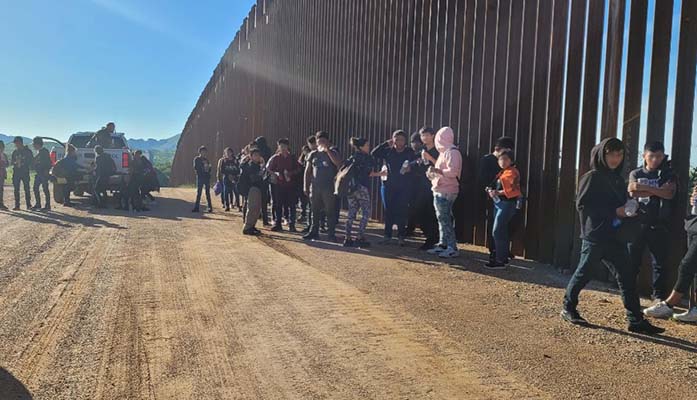
The Tucson Border Sector continues to be one of the nation’s most active crossing zones as the weather shifts to a more favorable climate for migrants journeying to the United States.
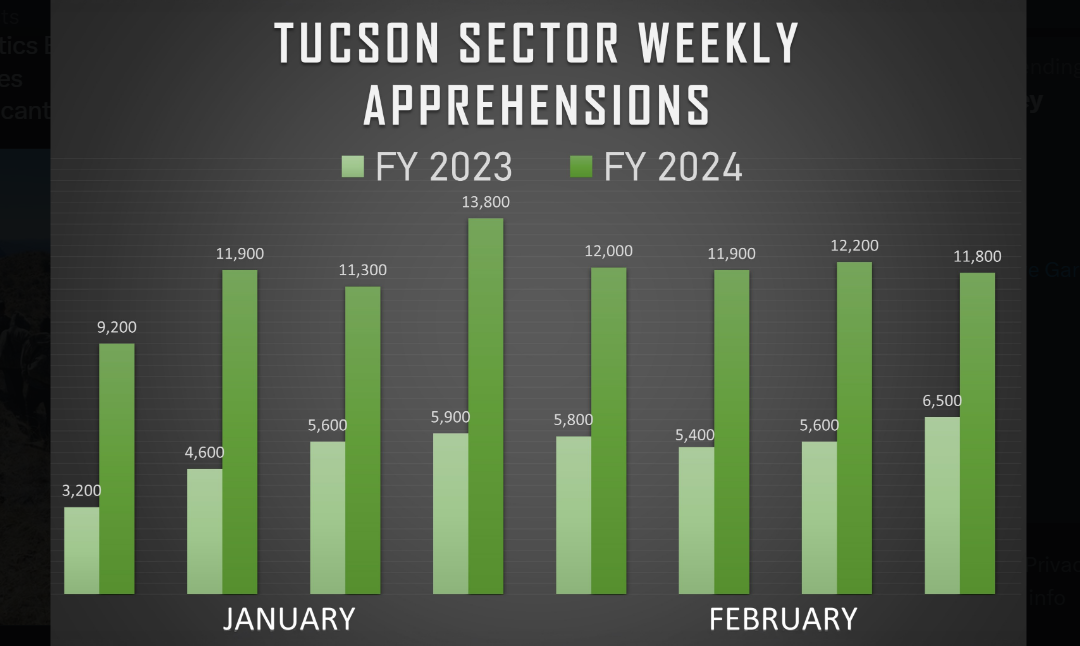
On March 1, John R. Modlin, the Chief Patrol Agent of the U.S. Border Patrol’s Tucson Sector, posted that there had been 11,800 apprehensions of illegal aliens in his region over the past week. He also noted that there were 195 federal criminal cases, 28 human smuggling cases, and 4 significant arrests during that time period.
This follows a similar report from Chief Modlin at the end of February, when he shared that there were 12,200 apprehensions over a week’s time.
Chief Modlin also revealed that Border Patrol agents had “detected, tracked, and apprehended 16 migrants dressed in camouflage in a remote area near Douglas, AZ.” This was a reminder to onlookers that, while many of the reported apprehensions are illegal aliens who essentially wait for Border Patrol to process them, there are many others who are attempting to make their way around law enforcement and into the heart of the country.
On Saturday, Fox News reporter Bill Melugin wrote that “numbers [are] slowly ticking back up at the southern border moving into March.” He added information from his sources at CBP that “there were just over 7,000 migrant encounters [Friday] led by Tucson sector with 1,800+ apprehensions.”
Although Chief Modlin provides regular updates on generic numbers at the border, including criminals and other dangerous individuals who are caught by law enforcement, much is still unknown to officials about the identities of many of the people who are apprehended. NewsNation National Correspondent Ali Bradley recently posted that the United States government does not “have access to most criminal databases – nearly 170 nationalities have been encountered at the border but if the host nation doesn’t alert the U.S. the reality is, we likely won’t know if they have any history.”
Bradley added a reminder from former Yuma Border Patrol Chief Chris Clem, who recently said, “If the fingerprints come back with no record matches, if the pictures come back with no record matches, then we’re having to do this based on what they tell us…Border Patrol agents are in the people business. So, we can kind of oftentimes smell a rat. But it’s one of those things where there is an opportunity for somebody to get through that shouldn’t.”
Arizona legislative Republicans have been hard at work this session – just as they were last year – to come up with solutions to help combat the crisis at the border and the security and humanitarian issues that are growing for communities across the state. However, most – if not all, of the Republicans’ proposals will be vetoed by Democrat Governor Katie Hobbs, who, although expressing interest in solving the issue and pointing blame at federal officials, has not been willing to sign legislation that would help the state and local law enforcement gain any more control over this very serious situation.
Daniel Stefanski is a reporter for AZ Free News. You can send him news tips using this link.
by Elizabeth Troutman | Mar 5, 2024 | Economy, News
By Elizabeth Troutman |
Four Arizona cities made it onto a list of America’s least financially distressed cities.
Last month, WalletHub released the results of their comparison of the 100 largest cities without data limitations across nine key metrics. The personal-finance website determined cities are the most and least financially distressed in light of inflation making it more difficult for Americans to keep up with payments on their loans and lines of credit.
Glendale was 92nd on the list, followed by Chandler at 97, Gilbert at 98, and Scottsdale at 99.
“Getting out of the downward spiral of financial distress is no easy feat,” WalletHub Analyst Cassandra Happe said in a news release. “You may get temporary relief from your lenders by not having to make payments, but all the while interest will keep building up, making the debt even harder to pay off.”
“People who find themselves in financial distress should budget carefully, cut non-essential expenses, and pursue strategies like debt consolidation or debt management to get their situation under control,” she continued.
Chicago, Illinois was the city with the most financial stress.
“It seems that in the Windy City, people’s financial security is also blowing away,” Happe said. “The share of Chicago residents who are allowed to skip debt payments due to financial difficulties went up by nearly 30% between Q4 2022 and Q4 2023.”
Additionally, Chicago residents had the third-most accounts in distress per person, according to Happe.
“Financial distress may increase further, too, as Chicago has some of the highest Google search interest in the country for terms like ‘debt’ and ‘loans,’ which indicates that people need to borrow even more,” she said.
After Chicago, Houston, Texas had the second most financial stress, followed by New York City, Los Angeles, Dallas, Las Vegas, San Antonio, Atlanta, Riverside, and Jacksonville.
Elizabeth Troutman is a reporter for AZ Free News. You can send her news tips using this link.
by Elizabeth Troutman | Mar 5, 2024 | Education, News
By Elizabeth Troutman |
Paradise Valley School Board candidate Eddy Jackson said he is running to represent stakeholders, not a teachers union.
“I refuse to seek the endorsement or campaign funds from district unions or contractors because I seek to represent all stakeholders, including all teachers, not just those in the union,” Jackson said in an email. “I will vote to give staff members that opted to not be in the union a seat at the table for contract negotiations and district committees.”
As a school board candidate, Jackson said he received an email from a district union Political Action Committee congratulating him for qualifying for the November 2024 ballot and inviting him to participate in their questionnaire to be considered for their endorsement. The PAC is called “Paradise Valley Fund for Children PAC.”
“Is their focus really children?” Jackson asked.
The PAC’s questionnaire focuses on questions about their power and influence in the district and district funding. Jackson noticed a lack of questions about declining enrollment, school closures or raising academic achievement, which he believes are the real issues parents care about.
Candidates funded by the PAC in 2022 elections recently voted to close Desert Springs Prep Elementary, Sunset Canyon Elementary, and Vista Verde Middle School.
The recommendation to close these schools arose out of the School Closure and Boundary Review Committee that violated Open Meeting Law and the public’s trust by holding secret, closed door meetings throughout 2023 and waited to reveal their recommendation until December, after the record $340 million dollar district bond was narrowly approved by voters, according to Jackosn.
Eddy Jackson is a father of four kids who attend school in the district. He is running on the platform of preparing students for success, protecting parental rights, supporting great teachers and staff, advocating for taxpayers, and protecting and putting students first.
Elizabeth Troutman is a reporter for AZ Free News. You can send her news tips using this link.
by Daniel Stefanski | Mar 4, 2024 | News
By Daniel Stefanski |
A bill to enhance punishment for human smuggling in Arizona is advancing through the state legislature.
Late last month, SB 1608 passed the Arizona Senate. The bill, which was sponsored by Senator Justine Wadsack, “classifies the unlawful use of an electronic device to smuggle human beings as a class 2 felony and prohibits a person from being released from confinement, if convicted” – according to the purpose provided by the chamber.
The bill passed with a 16-13 vote (with one member not voting). All Republicans voted in favor of the bill.
In a statement after the vote, Wadsack said, “Human smuggling is at an all-time high. Cartels are recruiting people, often our children, to participate in smuggling operations using various apps such as Snapchat and WhatsApp. The use of social media platforms to carry out these crimes has grown exponentially and contributes to the humanitarian crisis caused by Biden’s open border policies. Our children, our law enforcement, and our communities are being targeted, and it won’t be tolerated.”
According to the fact sheet from the Arizona Senate, a class 2 felony carries presumptive prison sentence of 5 years, and a sentence to pay a fine for a felony must be a sentence to pay an amount fixed by the court of up to $150,000. With some exceptions, a “general” human smuggling violation and conviction carries a class 4 felony, which comes with a presumptive prison sentence of 2.5 years.
On the Arizona Legislature’s Request to Speak system, a representative from the American Civil Liberties Union of Arizona signed in to oppose the bill, while former state legislator Nancy Barto indicated her approval of the measure.
Earlier in February, the proposal was approved by the Senate Committee on Transportation, Technology and Missing Children with a partisan 4-3 vote. The bill also passed narrowly out of the Senate Rules Committee.
SB 1608 now resides in the Arizona House of Representatives for consideration. If passed by that chamber, it will most certainly be vetoed by Democrat Governor Katie Hobbs, who has opposed most – if not all – of Republicans’ solutions to help the state combat the border crisis at hand.
Daniel Stefanski is a reporter for AZ Free News. You can send him news tips using this link.
by Daniel Stefanski | Mar 4, 2024 | News
By Daniel Stefanksi |
A bill to provide a new health treatment option for Arizonans has passed out of the Arizona Senate.
On Thursday, the Arizona Senate passed SB 1570, which “requires the Department of Health Services to begin the licensing of psychedelic-assisted therapy centers and prescribes licensure requirements and restrictions,” according to the purpose from the chamber. The bill was sponsored by Senate Pro Tempore T.J. Shope.
The proposal received an overwhelmingly bipartisan vote in the state senate with 24 members in favor compared to four members in opposition. Two senators did not vote.
In a statement, Shope said, “The controlled use of ‘magic mushrooms’ has proven to be a safe and effective treatment for people suffering from issues such as depression, anxiety, and PTSD. I’ve heard numerous testimonies regarding the success of this alternative therapy, especially within our Veteran and first responder communities, where this drug ultimately saved lives and allowed these individuals to properly function in society after enduring horrific PTSD. It’s our duty to support those who put their lives on the line to serve our communities and our country. If this treatment will help our heroes who are struggling with their mental health because of their service, then it should absolutely be offered as an option. I believe we are on the verge of something remarkable for Veterans, first responders, and other’s struggling with PTSD and other mental health issues.”
If the bill were to become law, the requirements would go into effect by January 1, 2026.
On the Arizona Legislature’s Request to Speak system, representatives from the Desert Rose Neutraceuticals, Professional Fire Fighters of Arizona, Citizens for Psilocybin, Arizona Public Health Association, and Psychedelic Association of Arizona signed in in support of the legislation.
Earlier last month, the Senate Committee on Health and Human Services unanimously approved the bill with a 7-0 vote.
SB 1570 will now be considered by the Arizona House of Representatives.
Daniel Stefanski is a reporter for AZ Free News. You can send him news tips using this link.
by Corinne Murdock | Mar 4, 2024 | Economy, News
By Corinne Murdock |
There were over 800 illegal immigrant children released to sponsors in Arizona in the last fiscal year, which would result in an estimated cost of over $10 million to educate them.
This estimate comes from Joint Legislative Budget Committee (JLBC) data, in which average per-pupil spending in 2022 derived from state, local, and federal funding, adjusted for inflation, was over $11,700. The Office of Refugee Resettlement (ORR) reported that there were 861 unaccompanied children released to sponsors in the 2023 fiscal year, which runs from October 2022 to September 2023. Altogether, that amounts to over $10 million.
Per the latest immigration data, another 368 unaccompanied children were released to sponsors from last October to December. JLBC estimated per-pupil spending last year, adjusted for inflation, to sit at about $12,000, and spending in 2024 to sit at about $11,700.
Since the 2021 fiscal year, there have been over 2,600 illegal immigrant children released to sponsors. That’s about 1,000 more in four years than the entire total for the six years spanning the 2015 fiscal year to the 2020 fiscal year (just over 1,700).
Under 2022 costs, that amounts to over $28.6 million. The estimated 2023 costs, adjusted for inflation, amounts to over $31.2 million, with a return to about $28.6 million under 2024 estimated costs.
Nationwide, there were about 113,500 illegal immigrant children released to sponsors in the last fiscal year. That’s a decline from the 2022 fiscal year, about 127,500, but remains a significant increase from all other years prior.
In the first four months of this fiscal year, there have been about 46,300 unaccompanied minors encountered along the southwest border. Border encounter data reveals that there have been over 468,180 unaccompanied minors since President Joe Biden took office.
Encounter totals for accompanied minors register far lower. There have been just over 500 encounters of accompanied minors in the first four months of this fiscal year, and over 7,800 in total since Biden took office.
These latest estimates are just a portion of total migrant children in the education system, and consist of only those reported. In 2022, there were over 90,000 students characterized as English Language Learners (ELLs) in Arizona. Using 2022 education costs, that amounts to over $1 billion.
Corinne Murdock is a reporter for AZ Free News. Follow her latest on Twitter, or email tips to corinne@azfreenews.com.