by Matthew Holloway | Jun 8, 2025 | News
By Matthew Holloway |
Arizona’s federal immigration court in Phoenix became off-limits to anti-immigration enforcement protestors and journalists covering them on May 21st when private security ordered them off the property. On May 28th, the Phoenix Police Department issued another warning to the protestors that they could be criminally cited for trespassing. The situation in Arizona is unique for the activists seeking to disrupt deportations because the Federal Immigration Court in Phoenix is located in a privately-owned office building.
Journalists covering the legal proceedings themselves are permitted inside the court as one would normally expect. However, the anti-ICE radicals who have sought to disrupt immigration proceedings in cities across the country, and the reporters following in their wake, are stymied by the newly installed “No Trespassing” signs and ropes to bar them from the private property.
The outlet reported Friday that activist groups and ASU’s First Amendment Clinic (FAC) expressed that the legal situation for protestors and reporters is unclear. Gregg Leslie, executive director of FAC explained, “Right now, it’s not all that clear because of the oddity of how this is all managed. Where the government’s rights take over versus the landlord’s rights, versus the other tenants’ rights.”
He added that the public “right of access,” exists largely as a function of whether a location is on publicly owned land or private land. This is complicated by the courtroom’s location on the third floor of a privately owned building. “If it’s private land owned for public access, there are certain allowances for there being greater public access to it,” he told the outlet.
The protests and subsequent restrictions came following a series of arrests on May 20th and 21st which found dozens of illegal aliens arrested after immigration charges against them were dismissed. Protestors gathered in front of the building chanted “No More ICE!” among other slogans including Spanish profanity. At least one protestor allegedly attempted to pull off an officer’s face covering.
Matthew Holloway is a senior reporter for AZ Free News. Follow him on X for his latest stories, or email tips to Matthew@azfreenews.com.
by Jonathan Eberle | Jun 8, 2025 | Education, News
By Jonathan Eberle |
Arizona lawmakers have approved legislation aimed at combating antisemitism in public schools and colleges, marking a bipartisan push to establish new standards for addressing hate-based conduct in the state’s education system.
The bill, House Bill 2867, also known as the Antisemitism in Education Act, received final approval from the Arizona House and now awaits the signature of Governor Katie Hobbs. Sponsored by Representative Michael Way (R-LD15), the measure bars the promotion of antisemitic views in classrooms and on public college campuses, while outlining a formal process for investigating and disciplining violations.
“Arizona’s students and teachers deserve to learn and work in an environment free from antisemitic hate,” said Rep. Way following the bill’s passage. “This bill ensures schools are places of learning, not battlegrounds for political indoctrination.”
The legislation applies to public K–12 schools, community colleges, and state universities. It prohibits educators and administrators from promoting antisemitic conduct or language, coercing students to support antisemitic viewpoints for grades or academic advancement, and using public funds for programs that include antisemitic instruction or training.
Violations are first to be reported to a school or college official, who must investigate and take corrective action within 30 days. Appeals can be escalated to a local school board or the Arizona Board of Regents. Legal action in court is permitted only after all administrative avenues have been exhausted.
HB 2867 is based on the International Holocaust Remembrance Alliance (IHRA) definition of antisemitism, a standard also recognized by the U.S. Department of State. The bill includes explicit protections for teaching about Jewish history, the Holocaust, and the State of Israel. Supporters say the measure does not interfere with First Amendment rights.
The legislation aligns with the House Republican Majority’s broader efforts to confront hate and promote public safety within state institutions.“The Legislature has done its job. The public supports this,” said Rep. Way. “Now it’s up to the governor to do hers and show that Arizona won’t tolerate antisemitism in public education.”
Representative Way, who represents Mesa, Queen Creek, and San Tan Valley, has made combating antisemitic threats in education a legislative priority. The bill’s bipartisan support suggests growing consensus among lawmakers that additional safeguards are needed in light of recent national and international events that have sparked increased concerns over antisemitism on college campuses and in school settings.
Jonathan Eberle is a reporter for AZ Free News. You can send him news tips using this link.
by Matthew Holloway | Jun 7, 2025 | News
By Matthew Holloway |
In the wake of what Turning Point PAC has declared “the largest launch event in Arizona gubernatorial primary history,” the political action committee has announced a massive initial media buy supporting Andy Biggs in his primary challenge against fellow-Republican Karrin Taylor Robson.
The upcoming media-buy is set to total over $500,000 without accounting for the Saturday “Biggs for Governor” Rally hosted by Turning Point Action and Turning Point PAC, which itself amounted to “an additional $780,000 in earned media value (EMV),” according to a press release.
Per the PAC, the $500k media buy will include “impactful ad placements that go live on strategic cable, over-the-top, radio and direct-to-voter placements most watched and listened to by local Arizonans.”
The $780k earned media value of the launch event includes clips, speeches, and promotional materials which were widely shared online during the weekend and reportedly generated 52.1 million impressions on social media according to Turning Point PAC.
“Taken as a whole with Turning Point PAC’s $500,000 media buy announcement, the organization’s independent expenditures and organizing to support Biggs’s primary launch already amounts to over $1,400,000,” the committee said in a statement.
“To see a room packed with thousands of Biggs supporters this far out from the primary was truly historic, and it’s proof of the grassroots energy that is already gathering behind his campaign. There isn’t a world in which voters will not be aware of Andy Biggs being on the ballot, and the more who find out, the more his double-digit lead over all other competitors will grow,” said Charlie Kirk, founder and president of Turning Point USA & Turning Point Action. “Andy Biggs is ready to bring a President Trump and Ron DeSantis level of leadership and competency to governing Arizona, and Turning Point is proud to get behind his campaign.”
Tyler Bowyer, COO of Turning Point Action and Turning Point PAC added, “Andy Biggs was the best Senate President Arizona has had in decades and he has been President Trump’s most reliable friend in Congress. He is Trump-endorsed, Charlie Kirk endorsed, and Turning Point Action endorsed. His campaign momentum is already building at an incredible clip and we’ve barely just begun. The media buy combined with Biggs’s impressive earned media exposure shows how enthusiastic the grassroots is to make Andy Biggs the next governor of Arizona.”
The media spending blitz comes alongside more good news for Biggs. A recent poll from American Commitment shows Biggs with a commanding lead over Taylor Robson in the 2026 Republican primary election for governor. Conducted by Kreate Strategies, the poll shows Biggs (57% support) leads Taylor Robson (25% support) by 32 points.
Matthew Holloway is a senior reporter for AZ Free News. Follow him on X for his latest stories, or email tips to Matthew@azfreenews.com.
by Jonathan Eberle | Jun 7, 2025 | News
By Jonathan Eberle |
Arizona Senate Public Safety Committee Chairman Kevin Payne (R-LD27) is intensifying his investigation into the state’s Department of Corrections, Rehabilitation, and Reentry (ADCRR), citing a string of violent incidents—including inmate murders, suicides, drug overdoses, and assaults on staff—as signs of a deepening crisis within the prison system.
Chairman Payne, who first launched a probe in April after the murder of three inmates at the Arizona State Prison Complex in Tucson, has now sent a second letter to ADCRR Director Ryan Thornell, requesting a broader set of records and data to evaluate the agency’s operational failures and safety protocols.
The investigation was originally prompted by a high-profile case involving Ricky Wassenaar, a convicted murderer serving 16 life sentences. Wassenaar, who previously orchestrated a two-week-long hostage crisis at the Lewis Prison Complex in 2004, is accused of killing three fellow inmates during what prison officials described as an “altercation.”
In response, Payne initially requested timelines, staffing rosters, incident reports, and documentation on policy changes related to the case. After reviewing the initial information provided by the department, Payne—joined by House Judiciary Committee Chairman Quang Nguyen—is now demanding additional public records be delivered by June 25.
“These details will be used in determining the next course of action to ensure the safety and security of both correctional employees and inmates,” Payne said. The senator did not mince words in describing the situation.
“I have grave concerns that a disaster is unfolding right before our eyes at Arizona’s correctional facilities,” Payne said in a statement. “I fear the lives of correctional officers and staff are in jeopardy each day they report for duty, and I’m concerned dangerous inmates within their custody are not secure. It appears we have a ticking time bomb on our hands.”
Payne added that the requested records will help determine why “current policies and procedures are failing both employees and inmates.” He pledged to keep the public informed as more information is gathered and reviewed.
The ADCRR has faced scrutiny in recent years over staffing shortages, aging infrastructure, and ongoing security issues. The outcome of this investigation could carry significant implications for prison policy and oversight in Arizona.
Jonathan Eberle is a reporter for AZ Free News. You can send him news tips using this link.
by Staff Reporter | Jun 6, 2025 | News
By Staff Reporter |
The Arizona Republican Party (Arizona GOP) joined President Donald Trump in the legal battle to require proof of citizenship to vote.
Chairwoman Gina Swoboda announced the Arizona GOP’s involvement on Wednesday. The state party filed an amicus brief with the Massachusetts District Court last week.
“The American people expect secure elections, not open invitations to fraud,” said Swoboda. “Arizona has led the nation with proof-of-citizenship laws for two decades, and we stand firmly behind President Trump’s efforts to protect the ballot. This is about safeguarding every legal vote — and stopping those who want to dilute it.”
Trump issued Executive Order 14248, “Preserving and Protecting the Integrity of American Elections,” in March. Trump’s order directed the Election Assistance Commission (EAC) to require within its national mail voter registration form documentary proof of citizenship as well as require state or local officials to record that applicants presented documentary proof of citizenship.
Per the president’s executive order, proper documentary proof of citizenship would only include U.S. passports, identification documents compliant with the requirements of the REAL ID Act of 2005, official military ID cards indicating an applicant is a U.S. citizen, or a valid federal or state government-issued photo ID indicating the applicant is a U.S. citizen or if the ID is otherwise accompanied by proof of citizenship.
The president also directed the Department of Homeland Security and Department of Government Efficiency to review the voter rolls and records of each state to verify citizenship and immigration status. Trump also directed each federal voter registration executive department or agency head to assess citizenship prior to providing federal voter registration forms to enrollees of public assistance programs.
Trump’s order also put an end to the acceptance of tardy ballots — the president restricted the reception of absentee and mail-in ballots to the Election Day deadline.
States who refuse to comply with the executive order would cease to receive federal funding.
Several left-wing organizations filed suit against the Trump administration in April to stop the order: the Brennan Center, American Civil Liberties Union (ACLU), ACLU of D.C., Asian Americans Advancing Justice, LatinoJustice, and Legal Defense Fund. These organizations filed on behalf of League of Women Voters of the United States, the League of Women Voters of Arizona, League of Women Voters Education Fund, Hispanic Federation, the National Association for the Advancement of Colored People, Asian and Pacific Islander American Vote, and OCA-Asian Pacific American Advocates.
That same month, a federal court issued a ruling temporarily blocking the executive order.
The Arizona GOP amicus brief argued the EAC maintains statutory authority to require documentary proof of citizenship in voter registration, and that the executive order merely enforced existing laws rather than creating new ones.
While the Arizona GOP has issued its support of the president’s election policy, Attorney General Kris Mayes and Secretary of State Adrian Fontes have been fighting against it. Mayes and Fontes joined a 19-state coalition to sue Trump over that executive order.
AZ Free News is your #1 source for Arizona news and politics. You can send us news tips using this link.
by Matthew Holloway | Jun 6, 2025 | News
By Matthew Holloway |
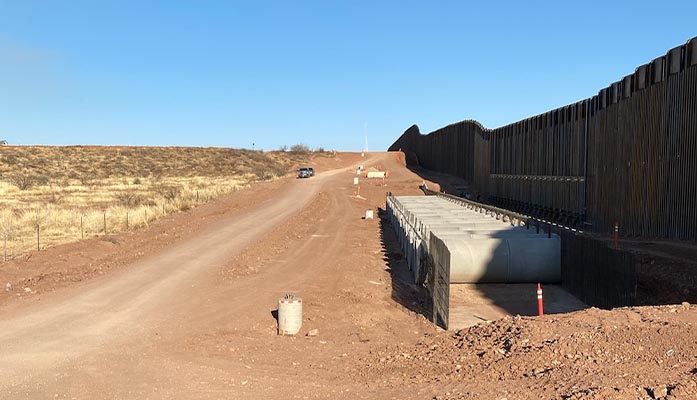
The Department of Homeland Security (DHS) under Secretary Kristi Noem has ordered the issuance of three new waivers to allow construction on 36 miles of new border wall in Arizona and New Mexico to begin. The largest stretch of border wall will be constructed at the Tucson Sonoita Project covering approximately 24.7 miles of the border.
Under the power of the waivers issued by Noem on Thursday, the Department of Homeland Security is able to bypass environmental laws such as the National Environmental Policy Act in order to expeditiously construct physical barriers and roads. Waivers of this kind are authorized by Section 102 of the Illegal Immigration Reform and Immigrant Responsibility Act of 1996.
According to a press release from U.S. Customs and Border Protection (CBP), the waivers will cover projects that were already funded under appropriations for Fiscal Year 2020 and 2021. In addition to the major stretch between Tucson and Sonoita, the waivers will cover approximately seven miles of the El Paso Sector’s Santa Teresa Secondary Wall Project, about 2.1 miles of the Tucson 10-6 Project, as well as allowing for the closure of several gaps in the El Paso and Yuma Sectors ranging in size from 40 feet up to a fifth of a mile, with seven prominent gaps in the Yuma Sector Barry M. Goldwater Range (BMGR) Wall Project South of Gila Bend.
The full breakdown by project is:
- El Paso Sector Santa Teresa Secondary Wall Project (~7 miles)
- El Paso Sector 16-4 Wall Project Anapra (~1.3 miles)
- El Paso Sector 2 Wall Project & Port of Entry (POE) Gate (~0.2 mile & ~40 feet)
- Yuma Sector Barry M. Goldwater Range (BMGR) Wall Project (7 gaps; ~40-240 feet)
- Tucson Sonoita Project (~24.7 miles)
- Tucson 10-4 Project (~0.2 miles)
- Tucson 10-6 Project (~2.1 miles)
DHS described the newly resumed projects by stating that they will “close critical gaps in the border wall and enhance border security operations in the U.S. Border Patrol’s El Paso, Tucson and Yuma Sectors.”
Matthew Holloway is a senior reporter for AZ Free News. Follow him on X for his latest stories, or email tips to Matthew@azfreenews.com.