by Staff Reporter | Jan 20, 2026 | Economy, News
By Staff Reporter |
The Republican faction of Congress’ Joint Economic Committee (JEC) reported inflation as “hold[ing] steady” in its monthly update released last week.
JEC Republicans reported in a press release accompanying the update that the Consumer Price Index (CPI) “remained relatively steady” at just under 2.7 percent year over year in December.
The coalition stated that November’s end CPI (2.74 percent) represented “the biggest [inflation] drop” since March 2025.
Food and energy prices went up by half a percent to almost three percent from 2024 to 2025, respectively; the latter by far outpacing the former.
Food price inflation hit 3.07 percent, up .56 percent year over year. Energy price inflation hit 2.30 percent, up by 2.82 percent year over year.
These price increases were felt differently based on region. Those in the Northeast were hit hardest by inflation (3.3 percent), then the West (2.9 percent), and then the Midwest (2.7 percent). The South felt it the least of all the regions, with inflation hitting 2.2 percent.
Income year over year overall saw increases: an increase in 1.07 percent for all employees and a .57 percent increase in weekly earnings. There was a “virtually unchanged” decline in hourly earnings of .01 percent.
President Donald Trump broke down this latest report as part of his address on the state of the economy in Detroit last Tuesday.
Trump said the U.S. has experienced “the greatest year in history” in terms of its finances.
“Under our administration, growth is exploding, productivity is soaring, investment is booming, incomes are rising, inflation is defeated. America is respected again like never before,” said Trump. “There’s never been numbers like this.”
Trump said the stagflation (low growth, high inflation) that took place under his predecessor, Joe Biden, was “a disaster” for the country. Trump claimed the current economy has “the highest growth” it’s ever had.
“The Trump economic boom has officially begun,” said Trump.
The president said he would work with Venezuela on oil, and aims to reduce gas prices beyond its current six-year low.
Trump called Federal Reserve Chairman Jerome Powell “a real stiff.” He expressed a desire to have a high-performing market matched with lower interest rates, not higher — he said the former arrangement was the norm years ago.
“Our growth potential is unlimited and could be much higher if we went back to sanity,” said Trump. “We announce good numbers and we see the stock market drop. And I say ‘What the hell is going on?’”
Trump said he secured commitments for over $18 trillion in new investments into the country, compared to Biden’s under $1 trillion secured in four years.
A White House press release following Trump’s remarks maintained that the latest inflation report came in below economists’ expectations. Their statement compared Trump’s core inflation (2.4 percent) as “much lower” than former President Joe Biden’s 3.3 percent annual rate.
Their summary also emphasized that wages are “rising” on track to four percent: an estimated $1,100 real wage gain among private sector workers, and $1,300 real annual earnings gain among goods-producing workers.
AZ Free News is your #1 source for Arizona news and politics. You can send us news tips using this link.
by Matthew Holloway | Jan 20, 2026 | News
By Matthew Holloway |
U.S. Representative Eli Crane (R-AZ-02) has introduced H.R. 6931, the Yavapai-Apache Nation Water Rights Settlement Act. The bill would ratify and authorize the Yavapai-Apache Nation Water Rights Settlement Agreement reached in 2024 between the Tribal Nation, the State of Arizona, the Salt River Project, the U.S. Department of the Interior, and local stakeholders.
The agreement, approved by the Yavapai-Apache Nation Tribal Council on June 26, 2024, resolves water rights claims that have been pending in Arizona courts for over four decades.
A central component of the settlement is the Cragin-Verde Pipeline, a roughly 60-mile-long pipeline that will deliver surface water from the C.C. Cragin Reservoir on the Mogollon Rim to the Verde Valley. The pipeline will provide reliable drinking water to the Nation, reduce groundwater pumping, support housing and economic development on the reservation, and contribute to the sustained health of the Verde River, as explained by the ASU Arizona Water Innovation Initiative.
H.R. 6931 would codify the Nation’s water rights, authorize federal funding for construction of the Cragin-Verde Pipeline and the Yavapai-Apache Drinking Water System, and establish dedicated trust funds for water, wastewater, watershed restoration, operations, and maintenance.
Under the legislation, the U.S. Department of the Interior would oversee planning, design, and construction of the Cragin-Verde Pipeline as part of the Salt River Federal Reclamation Project. The bill also authorizes the Nation’s use of Central Arizona Project (CAP) water, establishes a permanent CAP delivery contract, and allows the Nation to store, lease, or exchange CAP water within Arizona.
The settlement would provide water reliability for the Nation’s more than 2,500 enrolled members across five tribal communities and enhance long-term water security throughout the Verde Valley, according to a press release from Crane’s office.
Yavapai-Apache Nation Chairman Buddy Rocha Jr. stated, “The passage of the Yavapai-Apache Nation Water Rights Settlement Act will finally resolve our water rights claims that have been pending in Arizona’s courts for over four decades, providing water certainty for the Nation and our neighbors throughout the watershed. On behalf of the Yavapai-Apache Nation, I want to thank Congressman Crane for his commitment to the Settlement and to his constituents here in the Verde Valley. We are also truly grateful to Congressman Crane for his recent visit to the Nation, where he, and Assistant Secretary of Indian Affairs Kirkland, saw first-hand how the Settlement will help support critically needed housing and economic development on our Reservation for years to come.”
Rep. Crane said in the press release, “I’m honored to introduce this legislation to help secure long-term water security for the Yavapai-Apache Nation, develop critical infrastructure, and finally move toward a permanent solution. After visiting and meeting with tribal leaders and surrounding communities, it was clear how much certainty and stability this bill would provide. I’m proud to fight for rural Arizona.”
Matthew Holloway is a senior reporter for AZ Free News. Follow him on X for his latest stories, or email tips to Matthew@azfreenews.com.
by Staff Reporter | Jan 19, 2026 | News
By Staff Reporter |
A Phoenix-based progressive lobbyist organization is being accused of involvement in an “illegal” political campaign against two Democratic state lawmakers.
The campaign, “Hernandon’t,” is allegedly the handiwork of at least one lobbyist with Creosote Partners. Hernandon’t seeks to prevent the reelection of Democratic state representatives Alma Hernandez and Consuelo Hernandez this November.
The campaign accuses the Hernandez sisters of being “far-right Democrats” who align more with President Donald Trump than the Democratic Party. Specific grievances include the sisters’ votes or sponsorships of bills banning police budget cuts, enabling institutionalization of the homeless, prohibiting antisemitism in public schools, banning unauthorized encampments at public universities, and requiring age verification for online access to pornography.
The campaign is also seeking viable candidates to run against the Hernandez sisters.
The Hernandont’s website doesn’t disclose who is behind the campaign. Rather, a disclosure at the bottom of the website says, “Hernandon’t is sponsored by an individual and not by any political committee.”
Arizona law requires disclosures under certain circumstances on political advertisements:
“A person that makes an expenditure for an advertisement or fundraising solicitation, other than an individual, shall include […] disclosures in the advertisement[.]”
Statute defines advertisements as any “information or materials, other than nonpaid social media messages, that are mailed, emailed, posted, distributed, published, displayed, delivered, broadcasted, or placed in a communication medium and that are for the purposes of influencing an election.”
Earlier this week, Rep. Alma Hernandez posted on X that a sign from the Hernandon’t campaign was placed in her neighborhood, and that it lacked the “paid for by” disclosure. Hernandez accused those behind Hernandon’t of breaking the law.
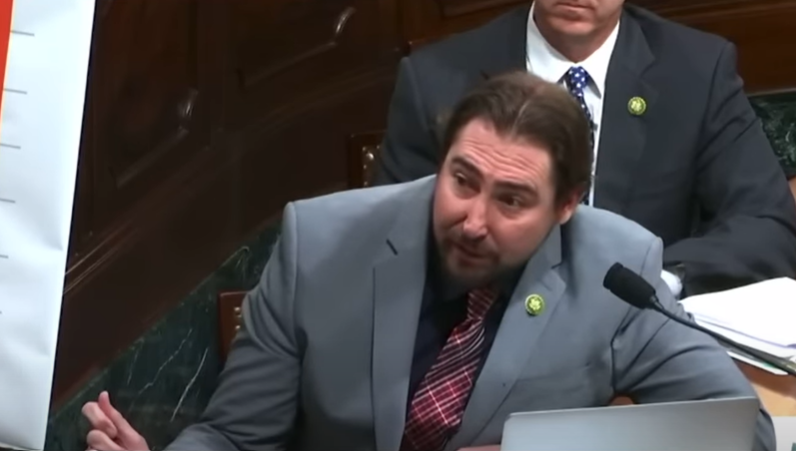
Hernandez specifically accused one of the Creosote Partners, Hugo Polanco, of being behind Hernandon’t after he appeared in the House Judiciary Committee on Wednesday with a Hernandon’t sticker on his laptop. Hernandez is a member of the House Judiciary Committee. She asked Hugo whether the sticker on his laptop was related to the campaign, and he confirmed it was.
“Clearly showing his direct involvement is a new level of stupid,” said Hernandez.
Later that day on the House floor, Hernandez made a public statement accusing Polanco of “deeply troubling, inappropriate, creepy, and unacceptable” behavior. Hernandez also put Creosote Partners on notice.
“To all lobbyists, I’m not here to be your friend. I’m here to work,” said Hernandez. “I don’t work for you. I work for my district who has elected me for the last eight years.”
Hugo was present at the House Judiciary Committee to deliver testimony on House Bill 2108 as a representative of Rural Arizona Action. Chairman Quang Nguyen interrupted Hugo twice for failing to speak to the bill.
Hugo strayed from the bill when he attempted to discuss the case of the Minnesota woman fatally shot after driving into an ICE agent, Renee Good. Nguyen advised Hugo that the Good incident was federal in nature.
Later, Rural Arizona Action cited Nguyen’s two corrections as part of their claim that Nguyen “cut off” Hugo mid-testimony. Hugo was allowed to finish his testimony, per the committee video.
Polanco’s coworkers at Creosote Partners are familiar with independent efforts to make and distribute campaign materials.
Jeanne Woodbury, transgender activist and fellow lobbyist at Creosote Partners, designed and posted campaign signs against Proposition 138 in 2024.
The campaign signs read “No on Prop 138, we can do the f*****g math.” Woodbury told the Arizona Agenda and the Arizona Republic in separate interviews that he put them next to campaign signs in favor of Proposition 138.
Woodbury claimed to the Arizona Republic that he wasn’t required to put a funding disclosure on his signs because he paid for them himself as an individual.
AZ Free News is your #1 source for Arizona news and politics. You can send us news tips using this link.
by Matthew Holloway | Jan 19, 2026 | Economy, News
By Matthew Holloway |
Arizona House Majority Whip Julie Willoughby (R-LD13) has introduced legislation to temporarily suspend the state gasoline tax in Maricopa and Pinal counties during the summer months, citing higher fuel costs tied to air-quality regulations.
According to a release from the Arizona House Republican Caucus, Willoughby’s House Bill 2400 would suspend the state’s 18-cent-per-gallon gas tax on the special Cleaner Burning Gasoline blend required in Maricopa and Pinal counties from May through September.
“Because of federal requirements, families in Maricopa and Pinal counties are forced to pay more at the pump than the rest of Arizona,” Willoughby said in a statement. “During the summer, these counties can only sell Cleaner Burning Gasoline—a boutique fuel blend refined in limited quantities, primarily in California. That limited supply drives up costs, and Arizona drivers pay the price.”
“In 2023, Phoenix drivers paid higher gas prices than Los Angeles,” she continued. “As California refineries shut down, supply constraints will increase—pushing prices higher at a time when families are struggling with rising costs. Arizona now ranks as the sixth most expensive state in the nation for gas.”
Because of the added production and transportation costs, drivers in Maricopa and Pinal counties often pay more for gasoline than motorists elsewhere in Arizona, according to the House GOP. The release cited comparisons showing Phoenix-area gas prices exceeding those in Los Angeles during parts of 2023.
Willoughby said lawmakers have previously worked with federal officials to explore lower-cost fuel alternatives, but federal environmental requirements have limited available options. Her proposal includes a provision to backfill lost revenue to the Highway User Revenue Fund, which supports transportation infrastructure and is shared by state and local governments.
“Republicans are focused on affordability,” Willoughby said. “Our Majority Plan is about upholding the American Dream and making sure the cost of living doesn’t keep climbing out of reach for working families.”
In addition to the state tax suspension, Willoughby is advancing House Concurrent Memorial 2008, which urges Congress to suspend the federal gas tax on Cleaner Burning Gasoline during the same May-to-September period.
Matthew Holloway is a senior reporter for AZ Free News. Follow him on X for his latest stories, or email tips to Matthew@azfreenews.com.
by Ethan Faverino | Jan 19, 2026 | Economy, News
By Ethan Faverino |
U.S. retail sales experienced healthy growth in December 2025, aligning holiday season results closely with its forecast for record consumer spending, according to the National Retail Federation (NRF).
“December Retail Monitor data saw a sharp surge in growth as consumers continued prioritizing holiday spending on family and friends,” said NRF President and CEO Matthew Shay. “Continued economic momentum helped land 2025 holiday sales near the top of NRF’s forecast, reaffirming that consumers remain on solid footing.”
The Retail Monitor, which draws from actual, anonymized credit and debit card transaction data, showed that holiday sales from November 1 through December 31, 2025, increased 4.1% year-over-year.
This performance fell within NRF’s pre-season forecast range of 3.7% – 4.2% growth over the same period in 2024, which projected total holiday spending surpassing $1 trillion for the first time. Official December figures from the U.S. Census Bureau have not yet been released.
Key December highlights include:
- Total retail sales (excluding car dealers and gas stations) rose 1.26% month over month on a seasonally adjusted basis and 3.54% year over year, unadjusted. This marked a significant increase from November’s 0.12% monthly gain and 4.53% annual gain.
- Core retail sales (excluding car dealers, gas stations, and restaurants) climbed 1.6% month over month and 3.58% year over year, compared to a slight 0.04% monthly decline and 4.66% annual increase in November.
A calendar shift contributed to December’s strong performance, as a late Thanksgiving pushed Cyber Monday to December 1, adding an extra high-volume shopping day to the month’s totals.
The full year’s impact was notable, with total 2025 retail sales up 4.93% over 2024 and core sales rising 5.08%.
December sales increased in six out of the nine tracked categories on a year-over-year basis, with strong performances in:
- Clothing and accessories stores: +6.11% year-over-year, +2.05% month-over-month
- Sporting goods, hobby, music, and book stores: +5.16% year-over-year, +3.52% month-over-month
- Digital products: +3.6% year-over-year, +0.98% month-over-month
- General merchandise stores: +3.42% year-over-year, +2.9% month-over-month
- Grocery and beverage stores: +2.85% year-over-year, +0.33% month-over-month
- Health and personal care stores: +2.5% year-over-year, +1.92% month-over-month
Categories showing year-over-year declines included electronics and appliance stores (-0.09%), furniture and home furnishings stores (-0.82%), and building and garden supply stores (-5.3%), though all posted positive monthly gains.
Ethan Faverino is a reporter for AZ Free News. You can send him news tips using this link.
by Matthew Holloway | Jan 18, 2026 | News
By Matthew Holloway |
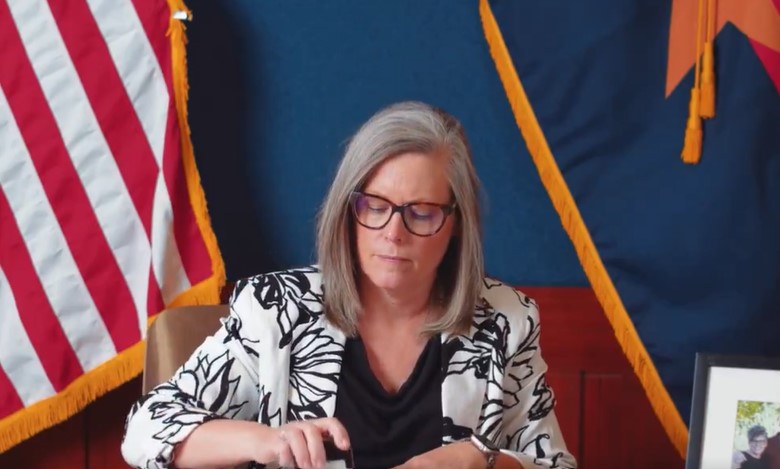
Gov. Katie Hobbs has vetoed Republican-backed tax conformity legislation approved Thursday by the Arizona Legislature.
The bill, SB 1106, would have provided $1.1 billion in tax relief over three years while maintaining a balanced state budget.
The legislation would have aligned Arizona’s tax code with recent federal changes and included provisions eliminating state income tax on tips and overtime pay, increasing the standard deduction, expanding the child tax credit, creating a deduction for childcare expenses, and providing additional tax relief for seniors.
Hobbs vetoed the bill without releasing a formal veto message as of the time of publication.
In response, House Speaker Steve Montenegro (R-LD29) issued a statement criticizing the governor’s decision and warning of potential impacts on taxpayers as the filing season approaches.
“Governor Hobbs’ veto of our tax relief act is a failure of leadership that will create unnecessary confusion and disruption for millions of Arizona taxpayers,” Montenegro said in a statement released Thursday.
Montenegro said House and Senate Republicans passed the legislation early to provide clarity and certainty for families, seniors, small businesses, employers, and tax preparers. He added that the bill conformed Arizona law to federal tax changes and removed provisions the governor had previously opposed.
“The Governor admitted swift action was needed. She asked for a bill to be sent quickly. We did exactly that,” Montenegro said. “What she did not do was offer a plan of her own. No bill. No alternative. No solution.”
Montenegro also listed several provisions included in the legislation that were rejected through the veto, including increases to the standard deduction, a childcare expense deduction, an expanded child tax credit, elimination of state taxes on tips and overtime, and additional tax relief for seniors.
Montenegro said the veto would lead to confusion for taxpayers, adding, “The chaos ahead is not accidental. It is the direct result of Governor Hobbs’ decision to veto a responsible tax conformity bill with no replacement plan.”
The veto also prompted reaction from other Republican lawmakers. State Rep. Nick Kupper (R-LD25) criticized the decision in a post on X. Kupper wrote, “Of course @GovernorHobbs vetoed the tax cuts we sent her because she doesn’t give a crap about working families. If she can’t give more handouts to non-working people then she won’t like whatever we send her.”
Arizona Congressman and 2026 gubernatorial candidate Andy Biggs, said, “Katie Hobbs vetoed a $1.1 BILLION tax cut for Arizona seniors, families, and workers. She is a weak and ineffective governor keeping Arizona from its full potential. She has no vision for the state. She has no ability to lead.”
Republicans do not hold the votes necessary to override the governor’s veto, leaving tax conformity unresolved unless lawmakers and the governor reach an agreement later in the legislative session.
Matthew Holloway is a senior reporter for AZ Free News. Follow him on X for his latest stories, or email tips to Matthew@azfreenews.com.