by Jonathan Eberle | Jun 14, 2025 | News
By Jonathan Eberle |
Governor Katie Hobbs has named Brigadier General John Conley as the new Adjutant General of Arizona and Director of the Department of Emergency and Military Affairs (DEMA).
In his new position, Brig. Gen. Conley will oversee the full scope of DEMA operations, including Arizona’s Army and Air National Guard units, Joint Task Force, Administrative Services, and the state’s Division of Emergency Management. The appointment comes as Arizona continues to contend with challenges related to border security, emergency preparedness, and the flow of illicit drugs into the state.
“Brigadier General Conley is a distinguished leader, accomplished lawyer, and dedicated public servant,” said Governor Hobbs in a statement. “As The Adjutant General and Director of DEMA, Conley will build on our efforts to secure the border and protect Arizona communities.”
Brig. Gen. Conley has more than 30 years of commissioned service in both the Army and Air National Guard. For the past 14 years, he has held key roles within the Arizona National Guard, including his most recent position as Director of Administrative Services for DEMA. There, he managed critical support functions such as personnel, finance, and mission planning for the Guard and Emergency Management Division.
Conley also previously served as the senior legal advisor for the Arizona National Guard, overseeing Judge Advocates and legal personnel across all service components. His work included the development of military cyber operations, where he played a pivotal role in establishing interagency cybersecurity partnerships with the FBI and the Arizona Department of Administration.
“I’m honored that Governor Hobbs has selected me to lead the Arizona National Guard and DEMA,” said Conley. “Throughout my career, I have been driven by a desire to defend our country and to keep people safe. I look forward to continuing to serve Arizonans alongside the exceptional men and women of DEMA.”
Conley’s appointment comes at a time when Arizona faces heightened scrutiny over border security and public safety.
Jonathan Eberle is a reporter for AZ Free News. You can send him news tips using this link.
by Jonathan Eberle | Jun 13, 2025 | News
By Jonathan Eberle |
With increasing public concern surrounding Arizona’s family court system, state lawmakers will continue their deep dive into the issue Monday, June 16, when the Joint Legislative Ad Hoc Committee on Family Court Orders reconvenes for its third hearing.
Committee Chairman Mark Finchem is inviting parents and community members who say they’ve been harmed or ignored by the family court system to testify before the panel at the Arizona State Senate. The hearing is scheduled from 9 a.m. to 5 p.m. in Senate Hearing Room 2.
“While we cannot resolve current individual cases, we must learn from them,” Finchem said in a statement. “Every story shared contributes to a clearer picture of where the system is falling short and how we can build something better for Arizona families.”
The committee is not empowered to provide legal advice, intervene in active litigation, or weigh in on ongoing cases. Instead, it is tasked with collecting public testimony to identify weaknesses and inform potential legislation for the 2026 session.
Finchem emphasized that all testimony will become part of the public record and may be subject to future public records requests. Despite these limitations, he says the hearings have already brought to light “horrific stories” that underscore the need for reform.
“Too many parents and children feel they have been silenced or dismissed by a system that’s supposed to protect them,” he said. “This is an opportunity for those voices to finally be heard and to drive real, lasting change.”
The committee will recess at noon on Monday and is tentatively scheduled to reconvene at 2 p.m., depending on the adjournment of the Senate and House floor sessions.
This session marks the third in a five-part series of public hearings focused on Arizona’s family court system. Lawmakers are expected to introduce reform proposals based on the testimony and findings from this ad hoc committee during the next legislative cycle.
Jonathan Eberle is a reporter for AZ Free News. You can send him news tips using this link.
by Jonathan Eberle | Jun 13, 2025 | News
By Jonathan Eberle |
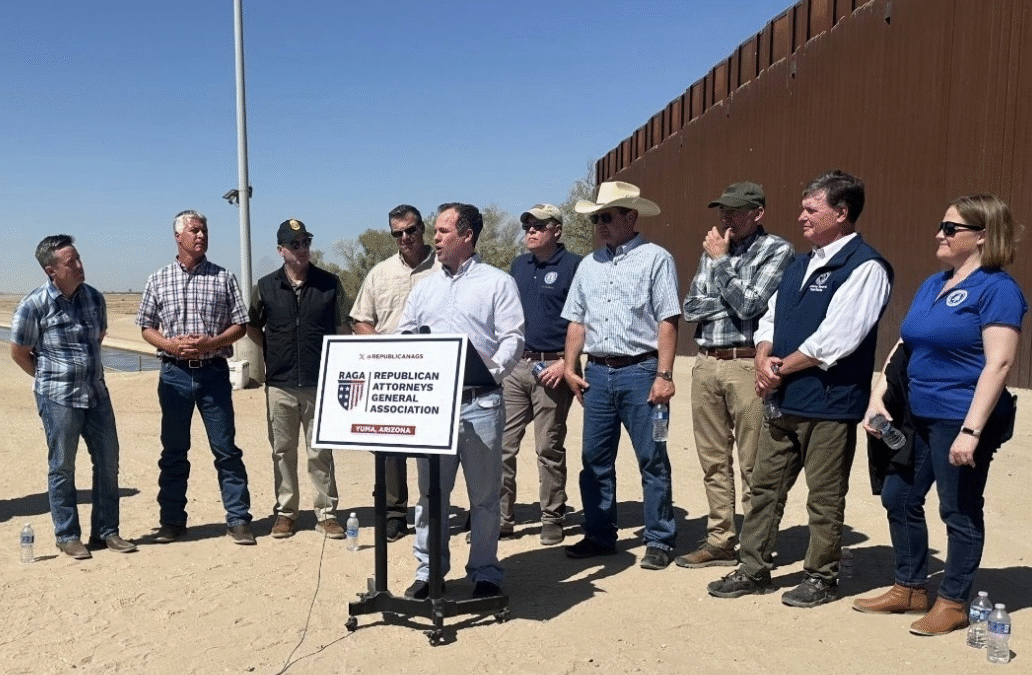
Arizona Senate President Warren Petersen recently led a delegation of nearly a dozen state attorneys general and local law enforcement officials to the U.S.-Mexico border, aiming to assess conditions on the ground and observe changes in federal immigration enforcement.
The bipartisan delegation, which included state attorneys general from as far away as Indiana, Mississippi, and South Dakota, met with local police, government leaders, medical professionals, and nonprofit organizations to get a clearer picture of the current border environment.
According to Petersen, the group found dramatically reduced migrant crossings, fewer than five per day in some areas, a stark contrast to the thousands reported daily in previous years. Officials attributed the drop to a return to stricter immigration enforcement policies, including the end of the “catch and release” practice and increased prosecutions under the U.S. Department of Justice.
“For the first time in recent history, most Americans say the country is on the right track,” Petersen said in a statement. “We didn’t need a new law. We just needed a new president to enforce the laws already on the books.”
Petersen framed the visit as a testament to the Arizona Legislature’s support for enhanced federal enforcement at the border. He emphasized the state’s continued commitment to addressing cross-border crime and public safety.
Other officials echoed Petersen’s message, citing improvements in morale among border agents and the impact of reduced immigration on state-level services.
Utah Attorney General Derek Brown linked the border situation to fentanyl trafficking, which he said has contributed to thousands of overdose deaths in his state. Mississippi Attorney General Lynn Fitch also referenced her office’s work with ICE through the 287(g) program, calling President Trump’s policies essential for restoring border integrity.
South Dakota Attorney General Marty Jackley and South Carolina Attorney General Alan Wilson both emphasized the criminal aspect of illegal immigration. Wilson, calling the previous administration’s approach “reckless,” said, “Every state is now a border state, and South Carolina is no exception.”
Local law enforcement also played a key role in the visit. Yavapai County Sheriff David Rhodes described the tour as a valuable educational tool for law enforcement across the country, citing the challenges posed by human and drug smugglers.
Yuma County Sheriff Leon Wilmot and County Supervisor Jonathan Lines, who hosted the delegation, expressed gratitude for national support. “We are grateful to again have officials in the White House who understand our plight,” said Lines. “Together, we are making a difference for residents of the border communities.”
Jonathan Eberle is a reporter for AZ Free News. You can send him news tips using this link.
by Matthew Holloway | Jun 13, 2025 | News
By Matthew Holloway |
Arizonans are bracing for what one online commentator called “Scottsdale Riots Round 2,” after the “No Kings Rally” was announced to take place at the intersection of Camelback and Scottsdale Roads on Saturday.
Arizona online commentator “₿ased male™,” a Scottsdale resident, called upon Arizonans to “avoid Fashion Square and look out for the self-professed organizer,” whom he identified in screen captures as Shea Najafi, founder of Scottsdale Women Rising and Civics 101 Happy Hour.
Sharing the post, Kari Lake, Senior Advisor for U.S. Agency for Global Media, commented, “They are pulling a page from their old playbook.”
The rally is being put on by “the 50501 national movement” (50 protests, 50 states, 1 movement). This is the very same group that attempted to force entry into the Arizona Capitol in February, and according to its website, has branded President Donald Trump a “traitor to the American people.”
“They’ve defied our courts, deported Americans, disappeared people off the streets, attacked our civil rights, and slashed our services,” the group claims. “They’ve done this all while continuing to serve and enrich their billionaire allies.”
The group accuses the President of “authoritarianism,” for enforcing federal immigration laws, and urged the American people to work for “removing the regime,” citing low approval in a single CNN poll, despite the aggregate polling from RealClear Polling showing Trump at a respectable 46.8%. A CBS poll released this week even found 54% of Americans approved of Trump’s approach to deportation, seemingly defying the ‘No Kings’ narrative.
“₿ased male™”, shared a screenshot of the rally’s purported demonstration route to X, indicating a gathering at the intersection of Tatum Blvd. and Bell Rd.
Research completed by DataRepublican indicated that funding for the No Kings Rally has flowed from a variety of radical leftist sources including George Soros’ Tides Center, Reproductive Freedom for All, Color of Change, Black Voters Matter Fund Inc, and the American Civil Liberties Union. DataRepublican further traced taxpayer funding through two layers of organizations back to the National Democratic Institute for International Affairs (NDI) and the National Endowment for Democracy.
In a statement to X in seeming anticipation of the rally, Scottsdale Mayor Lisa Borowsky wrote, “The right of citizens to peacefully assemble and protest is guaranteed by the U.S. Constitution and part of our nation’s political tradition. However, the City of Scottsdale will not tolerate mob violence, theft, destruction of property, attacks on law enforcement or other disorderly activities that endanger our community. Public safety is non-negotiable. I am in regular communication with Chief LeDuc and have full faith and confidence in @ScottsdalePD’s level of preparedness and their commitment to take whatever steps are necessary to protect our community.”
On Wednesday, a similar demonstration in Tucson turned violent, leading to the arrests of three rioters: 23-year-old Natalia Navarra, 46-year-old Sulutasen Amador, and 23-year-old Hannah Hartranett for Unlawful Assembly and Resisting Arrest, Obstructing a Public Thoroughfare and Disorderly Conduct, and Obstructing a Public Thoroughfare and Unlawful Assembly, respectively according to KOLD.
At least four ‘No Kings’ rallies are planned in the Tucson area on Saturday according to the organization’s website with at least fifteen sites listed in the Valley of the Sun including planned demonstrations in Scottsdale, Phoenix, Mesa, Tempe, Peoria, Glendale, Surprise, and Buckeye.
Matthew Holloway is a senior reporter for AZ Free News. Follow him on X for his latest stories, or email tips to Matthew@azfreenews.com.
by Matthew Holloway | Jun 12, 2025 | News
By Matthew Holloway |
Democrat Attorney General Kris Mayes announced on Tuesday the indictment of former Arizona State Representative Austin Smith (R-LD29) by an Arizona Grand Jury on 14 counts related to alleged fraudulent candidate signatures. According to the indictment, Smith faces both felony and misdemeanor counts.
The west valley Republican and former senior director of Turning Point Action served his first term in the Arizona House of Representatives from 2022-24 before withdrawing from the 2024 election when a legal challenge against his petition was filed. He also resigned from Turning Point Action at that time.
According to Votebeat’s Jen Fifield, Smith was still listed on Turning Point Action’s website as a director until Tuesday morning, listing the role on his X profile and now-deleted LinkedIn profile as well.
In a press release, Mayes said, “The defendant has been charged with multiple felonies and misdemeanors, including deceiving the Secretary of State’s office with petitions containing forged elector signatures and signing names other than his own to the nominating petition.”
He is charged with one count of Fraudulent Schemes and Practices, a Class 5 Felony, three counts of Presentment of False Instrument for Filing, Class 6 Felonies, and ten counts of Illegal Signing of Election Petitions, Class 1 Misdemeanors. Under ARS 13-702 and 13-802, Smith could face a maximum of 5.5 years in prison if found guilty on all four felony counts, and a fine of up to $2,500 per count for the ten misdemeanors totaling $25,000.
In a two-page statement posted to X, Smith described the allegations against him as being “alleged by two Democrat activists who were officers in the District 29 Democratic organization.” He added, “It seemed ludicrous because Republicans trying to get on the ballot don’t seek Democrat signatures and would have no reason to forge Democrat signatures, since they don’t count.”
He also characterized the allegations as a “coordinated attack,” that “included press releases and social media activity and other things that made it clear that this was a well-organized effort.”
He also made it clear at the time that he expected an indictment to come, writing, “This was a very intense effort to ‘get me’ and I needed to be prepared to spend tens of thousands of dollars to defend myself, not only against the civil elections matter, but most likely against some sort of criminal investigation that would be launched by those on the left who are unhappy with my politics.”
After Smith dropped out of the 2024 election, the lawsuit against him did not move forward according to Votebeat.
However, an investigation launched by Mayes against one of her most vocal critics in the Arizona legislature, resulted in the June 2nd indictment just over a year later.
Matthew Holloway is a senior reporter for AZ Free News. Follow him on X for his latest stories, or email tips to Matthew@azfreenews.com.
by Matthew Holloway | Jun 12, 2025 | News
By Matthew Holloway |
The tragic loss of Apache Junction Police Officer Gabriel Facio, who died from injuries sustained in the line of duty on Sunday, has spurred an upswelling of community support.
Facio, a 46-year-old with the AJPD for three years, was shot in the face by a driver he pulled over for brandishing a firearm in a road-rage incident on June 2nd according to ABC15. He passed away in the hospital six days later from his injuries and was the first Apache Junction Police officer to be killed in the line-of-duty. AJPD Chief Michael Pooley told reporters that Facio was a Mexican immigrant who was living his dream: “He came to the United States with the whole intention of being an officer, and he accomplished that goal.”
The suspect, 37-year-old Roger Nunez, left his vehicle and walked away from officers responding to the scene. He failed to respond to officers’ commands, until, per the AJPD, he told the officers to shoot him. The four responding officers then employed “less lethal ammo,” at which point Nunez turned and opened fire, striking Facio. Several officers fired back, subduing the suspect who remains in critical condition.
Arizona Representative Walt Blackman released a statement praising the life and sacrifice of Officer Facio. He wrote:
“Our community is grieving the loss of Officer Gabriel Facio, a three-year veteran of the Apache Junction Police Department, who died on Sunday from injuries sustained while bravely serving in the line of duty.
His passing marks the first line-of-duty death in the history of the Apache Junction Police Department—a painful milestone that underscores the risks our officers face each day and the selfless service they provide to keep us safe.
But Gabriel Facio was more than an officer. He was a devoted husband, a proud father, a beloved son and brother, and a trusted friend. His life was defined by his service and commitment to protecting others. Before joining the Apache Junction Police Department, Officer Facio served honorably in law enforcement across Phoenix and the Valley, earning a reputation for professionalism, compassion, and strength.
To the Facio family—please accept my deepest condolences. Words cannot ease your pain, but know that your grief is shared by all of us in Legislative District 7 and across Arizona. We mourn with you, we honor Gabriel’s service and sacrifice, and we stand beside you in sorrow and support.
To the officers of the Apache Junction Police Department—you have lost a brother. I share in your grief and thank you for your courage and resolve during this difficult time.
And to the community, thank you for the outpouring of love—through your prayers, your blue ribbons, and countless quiet acts of kindness. The 100 Club of Arizona, city leaders, and residents have come together to honor a true public servant and hero.
Let us never forget Officer Gabriel Facio. May we carry forward his legacy of service, courage, and compassion. Rest in peace, Officer Facio. You served with honor, and you will not be forgotten”
Apache Junction Police Chief Michael Pooley wrote in a statement to social media, “On behalf of the men and women of the Apache Junction Police Department, we appreciate the support and outpouring of love from the community. A little piece of us was lost as Officer Facio took his last breath surrounded by family and friends. He was a beloved father, husband, son, brother, friend and police officer who showed his passion for people through his service to others.”
Matthew Holloway is a senior reporter for AZ Free News. Follow him on X for his latest stories, or email tips to Matthew@azfreenews.com.