by Ethan Faverino | Aug 20, 2025 | Education, News
By Ethan Faverino |
In a unanimous decision, the Federal Trade Commission (FTC) has dismissed its lawsuit against Grand Canyon University (GCU) and its CEO, Brian Mueller, bringing an end to years of coordinated lawfare by former Biden administration officials targeting the university.
The lawsuit, previously dismissed by the United States District Court of Arizona on jurisdictional grounds, was fully resolved through a joint Stipulation of Dismissal with Prejudice.
FTC Chairman Andrew Ferguson, joined by Commissioners Melissa Holyoak and Mark Meador, issued a statement citing recent developments that influenced the decision.
The statement reads:
“This case, which we inherited from the previous administration, was filed nearly two years ago and has suffered losses in two motions to dismiss. These losses are compounded by recent events: Grand Canyon secured a victory over the Department of Education in a related matter before the Ninth Circuit; the Department of Education rescinded a massive fine levied on related grounds; and the Internal Revenue Service confirmed that Grand Canyon University is properly claiming 501(c)(3) non-profit corporation designation. In its reduced form, this case presents consumers very little upside relative to the cost of pursuing it to completion, especially given the developments chronicled above. We view it as imprudent to continue expending Commission resources on a lost cause. Because we have a duty to maximize consumers’ return on their tax-dollars investment, we have decided against pursuing this matter any further.”
GCU President Brian Mueller expressed gratitude for the FTC’s objective review, noting that multiple agencies and courts have consistently ruled in GCU’s favor.
“They threw everything they had at us for four years, and yet, despite every unjust accusation leveled against us, we have not only survived but have continued to thrive as a university,” President Mueller said. “That is a testament, first and foremost, to the strength and dedication of our faculty, staff, students, and their families. Above all, it speaks to our unwavering belief that the truth would ultimately prevail.”
The FTC lawsuit was part of a broader, coordinated campaign by former Biden administration officials, including the Department of Education (ED) and the Department of Veterans Affairs (VA), to target GCU with duplicative investigations and lawsuits.
Ethan Faverino is a reporter for AZ Free News. You can send him news tips using this link.
by Ethan Faverino | Aug 13, 2025 | Education, News
By Ethan Faverino |
A new report from the Common Sense Institute (CSI) revealed a crisis in Arizona’s district public school system, marked by declining enrollment, expanding infrastructure, and misallocated resources that fail to serve students effectively.
Despite a 5% drop in district school enrollment since 2019, Arizona’s public-school districts have continued to expand facilities, increase capital spending by 67% to $8.9 billion, and boost transportation costs by 11.3% to $561.2 million, even as eligible bus riders plummeted by 45%.
As Arizona’s population surged, districts expanded, constructing thousands of school buildings, hiring teachers, and extending bus routes to accommodate a growing student body.
Since peaking in 2008 with 931,000 students, district school enrollment has steadily declined, dropping to 859,519 students by 2024—a 5% decline since 2019 alone.
According to the report, this trend is accelerating, driven by demographic shifts and changing parental preferences.
Arizona’s school-aged population (ages 5–17) shrank for the first time in 2022, with a loss of 30,000 children by 2023.
Meanwhile, school choice has reshaped the educational landscape with 40% of incoming kindergarteners now opting for charter or private schools, which operate with leaner facilities and no formal transportation systems.
In the meantime, Arizona’s district schools have doubled down on expansion. Since 2019, districts added 499 new buildings, increasing gross square footage by 3% to 148.6 million square feet—78 million square feet more than needed, enough to accommodate 630,000 additional students.
The fastest-shrinking districts have increased capital spending the most, with 20% of districts (serving 73% of students) receiving 81% of capital funding.
Math proficiency in Arizona’s district schools fell 25% since 2019, and English proficiency dropped 5%, according to NAEP assessments.
Staffing has grown by 1.5% to 108,330 employees, with teacher salaries rising 24.1% to $65,113, yet class sizes remain stable at 17.7 students per teacher.
Administrative staffing has surged 6.7% since 2019, outpacing classroom staff growth, but these investments have not translated into academic gains.
Ethan Faverino is a reporter for AZ Free News. You can send him news tips using this link.
by Matthew Holloway | Aug 8, 2025 | Education, News
By Matthew Holloway |
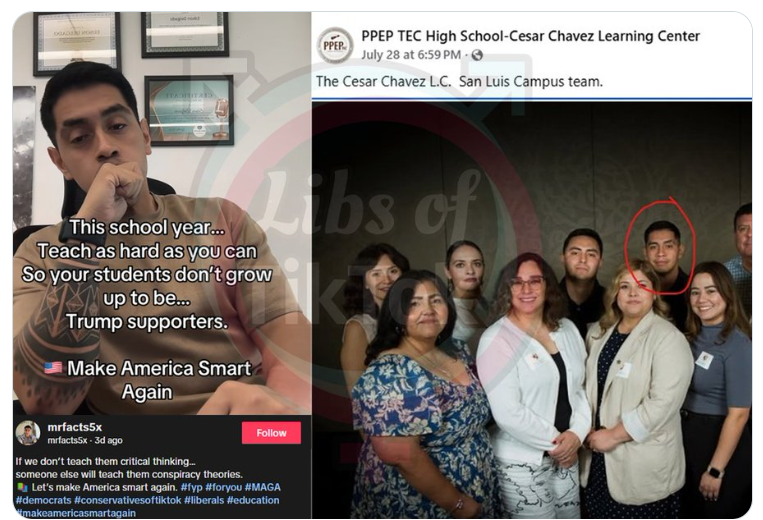
In a post to X earlier this week, Chaya Raichik’s ‘Libs of TikTok’ revealed a now-deleted video allegedly created by an educator at the PPEP TEC High School’s Cesar Chavez Learning Center in San Luis, Arizona. The video urged teachers to “teach as hard as you can[.] So your students don’t grow up to be… Trump supporters.”
In a screenshot of the post, a man believed to be PPEP TEC High School teacher Edson Delgado, posting under the now-deleted profile ‘mrfacts5x’ wrote, in full, “This school year… Teach as hard as you can[.] So your students don’t grow up to be… Trump supporters. Make America Smart Again.”
In the caption of the post, he added, “If we don’t teach them critical thinking… someone else will teach them conspiracy theories. Let’s make America smart again.”
Libs of TikTok commented on the post, “Teacher at PPEP Cesar Chavez Learning Center in AZ wants to ‘teach’ students so they don’t grow up to be Trump supporters. Any comment @ppeptechs?? Do you condone teachers indoctrinating kids???”
The individual depicted in the post as ‘mrfacts5x’ bears a notable resemblance to Delgado, an educator who was honored by the office of Yuma County Superintendent Tom Hurt as doing “Great things at PPEP Tech!” In a March 25th post to Facebook and is identifiable through the certifications shown hanging behind him in the post to TikTok.
Several commenters on social media expressed reactions, ranging from concern to outrage. Political commentator Paul Szypula wrote, “Our schools are compromised.”
Columnist Emilia Henderson replied on X, “That teacher is PROGRAMMING kids with hatred for their own country. If PPEP allows this, they’re no school at all.. they’re a political FACTORY pushing Democrat obedience.”
Some critics of the TikTok post called for federal funding for PPEP TEC High School to be terminated, while others called for the teacher’s termination. At least one Arizona commenter, ‘JustADudeAZ,’ stated that he reported the incident to Arizona Superintendent of Public Instruction Tom Horne. He wrote, “Credit to Tom Horne for listening and getting back to me. He provided where to go to keep people like this teacher honest. If you see teaching like this you can report them directly using this site,” and provided a link to the Empower Hotline.
The hotline is “the forum to report about inappropriate lessons that detract from teaching academic standards such as those that focus on race or ethnicity, rather than individuals and merit, promoting gender ideology, social emotional learning, or inappropriate sexual content,” according to the Arizona Department of Education.
AZ Free News has reached out to PPEP TEC High School for comment but received no response by the filing of this article.
Matthew Holloway is a senior reporter for AZ Free News. Follow him on X for his latest stories, or email tips to Matthew@azfreenews.com.
by Jonathan Eberle | Aug 8, 2025 | Education, News
By Jonathan Eberle |
As schools across Arizona reopen for the fall semester, State Superintendent of Public Instruction Tom Horne is encouraging parents to be alert to classroom content they believe may conflict with their family’s values. His call follows a recent U.S. Supreme Court ruling affirming parents’ rights to withdraw their children from classes that conflict with their religious beliefs.
“The U.S. Supreme Court recently ruled that parents have the Constitutionally protected right to opt their children out of classes when their religious beliefs conflict with course material,” Horne said in a public statement. “As the new school year begins, I am urging parents to be aware they have the power to ensure their child’s school is concentrating on academics, not social indoctrination.”
Horne cited a case from earlier this year involving a Tucson-area teacher whose lessons, he claimed, undermined students’ religious beliefs and promoted gender ideology. According to Horne, the teacher has since retired, and the matter was resolved. “This is exactly the type of situation that was addressed in this recent Supreme Court decision,” he said.
To address concerns like these, the Arizona Department of Education operates an “Empower Hotline,” which allows parents, educators, and citizens to report what they view as inappropriate content in the classroom. Horne said the hotline has received complaints about lessons that focus on race, gender identity, or content perceived as deviating from traditional academic instruction.
“Students need education in reading, writing, math, science, history, and the arts,” Horne added. “The inappropriate lessons about which parents are complaining are a distraction from these crucial academic subjects. My principal goal has been to bring back academic focus into the classrooms.”
The Supreme Court decision referenced by Horne affirms long-standing interpretations of parental rights in education but has gained renewed attention amid ongoing debates over curriculum content in public schools across the country.
Jonathan Eberle is a reporter for AZ Free News. You can send him news tips using this link.
by Ethan Faverino | Aug 4, 2025 | Education, News
By Ethan Faverino |
Arizona State Superintendent of Public Instruction Tom Horne criticized recent remarks made by Governor Katie Hobbs’ spokesman, Christian Slater, who labeled the Empowerment Scholarship Account (ESA) staff as “wasteful bureaucracy.”
Horne called the comments a reckless insult to dedicated state employees who are understaffed, under pressure, and focused on serving the parents seeking the best education for their children.
“The governor’s spokesman has demeaned state employees by calling ESA professionals a ‘wasteful bureaucracy.’ Defining people as waste is a terrible insult,” said Superintendent Horne. “No matter what her (Governor Hobbs) personal opposition, the ESA program exists to give parents’ choice when local schools don’t meet their children’s needs, and people are needed to serve those parents. That is not wasteful; it is essential.”
ESA Director John Ward, in a recent legislative testimony, highlighted the program’s significant growth and challenges.
In the 2025 fiscal year, the ESA program distributed $869 million, surpassing the $769 million allocated for all federal education programs in Arizona.
Despite managing a larger budget, the ESA program has only 40 employees, compared to the 300 staff members handling federal programs at the Arizona Department of Education.
Since its start in 2011, the ESA program has grown from $100 million and 11,000 accounts to now, nearly $1 billion and over 90,000 accounts today, with no additional staff to support the increased workload.
“We are always in survival mode,” Ward told lawmakers. “Our main responsibility is to get students who want to be in the program into the program, to review their purchases, and provide customer service. That is our core mission, and that is what we are focused on.”
Horne also noted that in 2025, the Department of Education requested 12 additional staff members to manage the growing program’s demands. The House supported this request in its budget, but Governor Hobbs refused to consider it.
“To deny these resources while allowing her spokesman to insult state employees serving parents is beyond the pale,” Horne said.
Ethan Faverino is a reporter for AZ Free News. You can send him news tips using this link.
by Matthew Holloway | Aug 2, 2025 | Education, News
By Matthew Holloway |
Arizona State Representative John Gillette (R-LD30) shared a post on Wednesday containing images and video footage taken at Dobson High School from Turning Point Action Field Representative Angel Guess. The images and video footage depicted Black Lives Matter (BLM) and pro-LGBTQ material in the classroom.
In her post, Guess wrote, “Attention Mesa Residents, mothers, fathers… this is what your taxpayer dollars pay for.. School starts tomorrow [at Dobson High] and YOUR kids are walking into this. Video from today!”
She continued, “Mesa Public School District is this what parents subscribe to when they sign your enrollment agreement? Not my child! Who agrees?”
Sharing the post, Representative Gillette declared it to be “Another advertisement for the Arizona ESA voucher program.”
“Govt schools can’t understand why their student count keeps falling. Woke indoctrination, DEI, and poor academic results are destroying government schools,” Gillette added.
The post to X has since garnered the attention of former Republican Congressional candidate Josh Barnett, who observed, “This is why school choice is so important and allowing Private/charter schools to prosper.”
Senior Advisor for the U.S. Agency for Global Media Kari Lake excoriated the district, writing, “Stop radicalizing our children! Cut all taxpayer funding to woke public schools. Our kids deserve better.”
As previously reported by AZ Free News, Dobson High School has a history of alignment with Diversity, Equity, and Inclusion (DEI) efforts such as the “No Place For Hate” (NPFH) program of the Anti-Defamation League (ADL) of Arizona, which named Dobson as an NPFH school in 2022.
As recently as July 18th, Arizona Women of Action posted a thread on X, making serious allegations that “There are explicit books in MPS libraries. High schools. Middle schools. Even ELEMENTARY schools.”
The texts reportedly include: “Push” by Sapphire, “The Bluest Eye” by Toni Morrison (which both detail sexual abuse), “Tricks” by Ellen Hopkins, which has been removed from schools in 13 states for references to drug use, sexual abuse, and suicide, and “Thirteen Reasons Why” by Jay Asher, which is available in elementary schools and has been challenged in dozens of school districts for its sexually explicit content and discussion of suicide.
Matthew Holloway is a senior reporter for AZ Free News. Follow him on X for his latest stories, or email tips to Matthew@azfreenews.com.