Arizona State Treasurer Kimberly Yee wants to ensure all State vendors understand their obligations in light of economic sanctions put on the Russian Federation by the U.S. and E.U. following Russia’s military invasion of Ukraine.
On Tuesday, Yee issued a Notice of Compliance about her expectation that State contractors, vendors, and other third-parties pay attention to the situation involving Russia and have all “necessary consents, approvals, and authorizations of all governmental authorities in connection with any transaction” dealing with the State.
“As you are aware, the State of Arizona and the Arizona State Treasurer’s Office (ASTO) are subject to U.S. laws, regulations, and orders applicable to its business activities and financial transactions, including those related to the international trade controls and economic sanctions,” Yee wrote. “As a vendor of the State of Arizona, you have separate and independent obligations under these same laws.”
Yee added that the State of Arizona has no investments in Russia, and while economic sanctions are subject to change, she expects all contractors and third parties “acting as intermediaries for the State of Arizona” to be knowledgeable about and remain in compliance with export and import laws, regulations, sanctions, embargoes, and policies.
That includes, but is not limited to, securing all clearances, export and import licenses, or exemptions therefrom, and making all required filings with appropriate governmental bodies, she noted.
“If you or your agents are unable to comply with the above foreign transaction requirements – including compliance with the United States trade sanctions related to Russia– in regard to your independent relationship with State of Arizona, you are required to notify the Arizona State Treasurer’s Office in writing immediately,” Yee wrote.
Yee also used the notice to suggest State contractors and vendors not be associated with financing any oil or other energy trades with Russia.
“Instead, we respectfully request you consider financing and investing in energy production in the United States, so we can be energy independent,” she wrote. “This is not only beneficial from a foreign policy perspective, but it is also a safer domestic investment.”
Yee’s suggestion, she noted, goes against the wishes of the Biden Administration but she pointed out there is no law against financing U.S. energy production.
“Doing so is a sound investment that does not carry the risk of foreign investment in that sector,” Yee wrote.
A municipality’s mayor or the chairperson of a county’s board of supervisors would not have the authority to order any business closed during a declared local emergency, if a bill introduced by House Majority Leader Leo Biasiucci is signed into law.
“Government should never have their hand in telling who can stay open, and picking winners and losers,” Biasiucci (R-LD5) recently said in support of House Bill 2107, which passed the House on Feb. 17 and was transmitted the next day to the Senate.
On Wednesday, HB2107 cleared the Senate Commerce Committee and now awaits further action in the Senate.
Under current state law, a mayor or county board chairperson has authority to declare proclamations in response to a local emergency, such as from fire, flood, earthquake, explosion, war, bombing, acts of the enemy or other natural or man-made disaster or by reason of riots, routs, affrays or other acts of civil disobedience that endanger life or property.
Once a local emergency is declared, the mayor or chairperson may then impose “all necessary regulations” to preserve the peace and local order through curfews; closing of streets, public places, and build facilities; and utilization of law enforcement agencies. The forced closure of businesses is also currently allowed under state law.
HB2107, however, would amend state law to repeal the authority of local government officials from ordering business closures. The bill is opposed by some cities and towns as well as the County Supervisors Association of Arizona, but many business groups and associations are calling for its passage due to the financial impacts of having to comply with local emergency declarations.
Among the issues is the fact many communities saw small businesses and locally owned businesses forced shut while national corporate businesses like Walmart and Home Depot were allowed to stay open.
State lawmakers continue to propose ways to rectify Arizona’s severe healthcare workforce shortage, including a bipartisan vote on House Bill 2691 to increase collaboration among the state’s education and healthcare communities.
Under HB2691, five new healthcare related programs would be established to promote various training efforts in an effort to address an ongoing shortage for nurses and other medical professionals. The programs are:
The Arizona Nurse Education Investment Program which would increase the capacity of nursing education programs in Arizona to increase the number of all levels of nurses graduating from the state’s nursing education programs. This is intended to address Arizona’s yearslong nursing shortage.
An Arizona Department of Health Services grant program to expand the capacity of preceptor training for nurse students and new nurse graduates. This would ensure an increase in instructors available to handle expanded nursing programs.
The Nurse Transition to Practice Program to better support and develop new nurses, provide evidence-based professional development, and more rapidly accelerate the novice nurse to a competent nurse.
A grant program to encourage and support more preceptorships in Arizona for the training and development of graduate students wishing to become physicians, advanced practice registered nurses, dentists, and physician assistants.
A pilot program to develop and expand capacity of behavioral health programs at community colleges. This would include coverage of tuition, fees, and related educational expenses for eligible students.
HB2691 also seeks to make it less difficult for military members who wish to receive credit in a healthcare education program for experience and skills developed during their service.
The bill passed its Third Reading in the House on Thursday with a 56 to 3 vote and has been transmitted to the Arizona Senate for consideration.
State Senators will have a chance Monday afternoon to hear a comprehensive update on the rapidly growing presence in Arizona of EV manufacturer Lucid Group.
Daniel Witt, head of State & Local Public Policy for the California-based automaker, is set to testify at 2 p.m. before the Arizona Senate Transportation Committee. The company produces its Lucid Air – the 2022 MotorTrend Car of the Year – at its Lucid Motors manufacturing facility in Casa Grande.
Among the topics Witt is expected to address is ongoing construction at its Casa Grande facility where deliveries of Lucid Air began last October. Other topics he will testify about the company’s hiring progress and workforce issues, including the need for support for technical skillset training in rural communities.
Lucid announced plans in late 2016 for a $700 million production facility to be built in Casa Grande on more than 500 acres owned by Pinal County. Construction began on phase one of the four phase project in late 2019, making it the first greenfield facility for EV manufacturing in the United States.
The first-phase of the Case Grande facility was completed in December 2020, with the initial delivery of Lucid Air vehicles coming less than a year later. There are now hundreds of Lucid Air vehicles on the road across America. The car is now the longest range, fastest charging luxury electric car in the world.
Phase two construction in Casa Grande is ongoing and will increase production capacity significantly, according to the company. By 2030, Lucid is expected to have created nearly 6,000 direct jobs with an economic impact in the state of more than $100 million.
With that expansion comes the growing need for trained technical workers. Last year Gov. Doug Ducey celebrated the opening of Drive48, a state of the art manufacturing training center in Coolidge.
Drive48, which is part of the Central Arizona College, provides specialized training in the fields of automotive, advanced manufacturing, heavy equipment, and general industry. However, Witt is expected to address the necessity for expanding technical training programs at other community colleges across the state.
Witt is also slated to discuss Lucid’s broader economic footprint in Arizona. In addition to the AMP-1 in Casa Grande, the company has its Powertrain Manufacturing facility on the same property and is looking to establish production of its newly designed Gravity SUV in Arizona next year.
Lucid Motors also has a sales studio at the Scottsdale Fashion Mall and a separate service center in Scottsdale.
Last November, MotorTrend announced its 2022 Car of the Year award, selecting the Lucid Air from a field of 24 competitors among several major manufacturers based on six key criteria: efficiency, value, advancement in design, engineering excellence, safety, and performance of the intended function.
The Lucid Air came out on top against finalists such as Mercedes‑Benz S-Class, Mercedes-Benz EQS, and Porsche Taycan. It is the first time the initial product of a new automotive company has been awarded MotorTrend’s flagship Car of the Year award.
“Our objective of achieving range through efficiency and technical innovation is crystallized in Lucid Air, and we’re elated that this effort has been recognized by MotorTrend against such formidable competition from well-established automakers,” CEO / CTO Peter Rawlinson said at the time.
Also last year, Lucid Group, Inc. joined the Nasdaq-100 Index, which is designed to measure the performance of 100 of the largest Nasdaq-listed non-financial companies, based on market capitalization.
Arizona is already home to Mesa-based EV passenger truck manufacturer Atlis Motor Vehicles as well as Phoenix-based Nikola which has a production facility in Coolidge for its EV commercial trucks. And last year, Vancouver-based ElectraMeccanica broke ground on a technical center and assembly facility in Mesa for its three-wheeled, single occupant EV.
According to the Governor’s office, several other companies have recently announced plans to operate automotive-related companies in Arizona, including EV manufacturer Zero Electric Vehicles, lithium ion battery manufacturer KORE Power, EV parts manufacturer UACJ Whitehall, and battery recycler Li-Cycle.
QR codes can be scanned to download a coupon, sign in at a medical appointment, even look at a restaurant’s menu while waiting to be seated. They can also used by cybercriminals to scam people, the FBI is warning.
A QR code is a square barcode that a smartphone camera can scan and read to provide quick access to a website. It can also be used to prompt the user to download an app or process a direct payment to an intended recipient. And businesses large and small utilize QR codes for customer rewards programs.
The popularity of QR codes grew during the COVID-19 pandemic in part due to the contactless nature of the technology. But more and more cybercriminals are now tampering with the codes to surreptitiously redirect victims to a malicious site in order to steal login and financial information, the FBI warns.
“Cybercriminals tamper with both digital and physical QR codes to replace legitimate codes with malicious codes,” the FBI stated. “A victim scans what they think to be a legitimate code but the tampered code directs victims to a malicious site, which prompts them to enter login and financial information. Access to this victim information gives the cybercriminal the ability to potentially steal funds through victim accounts.”
The scammers can also utilize a QR code to embed malware which allows a cybercriminal to gain remote access to a victim’s device, and even redirect money transfers to the criminal, according to the FBI. The cybercriminal can even leverage financial information stolen from the device to withdraw funds from the victim’s bank accounts or credit / debit cards stored on the device.
“Law enforcement cannot guarantee the recovery of lost funds after transfer,” the FBI stated.
Companies are advised to consider whether the immediate convenience of offering QR code options is worth the potential cost of dealing with security breaches and disgruntled customers.
And for those consumers who really want to utilize QR codes, the FBI has some suggestions to reduce -albeit not eliminate- the risk of falling victim to a scammer.
According to the FBI:
Do not download a QR code scanner app, as this increases your risk of introducing malware onto your device. Instead, use the built-in code scanner incorporated in your camera app.
Avoid making payments through a site you were sent to via a QR code. Instead, manually enter a known and trusted URL to complete the payment.
Also, use caution when asked to enter any login, personal, or financial information from a site you navigated to from a QR code.
If you receive a QR code that appears to be from someone you know—such as a local business or medical provider—contact them through a known number or address to verify they sent you the code.
Do not download an app to your device via a QR code. Use your device’s app store instead for any download.
If scanning a physical QR code, ensure the code has not been altered or tampered with, such as a sticker placed on top of the original code.
Once you scan a QR code, check the URL it opened to make sure it is the intended site and looks authentic. A malicious domain name may be similar to the intended URL but with typos or a misplaced letter.
Finally, if you receive a notice of a failed payment from a company you recently made a purchase with and the only option you are given for completing the payment is via a QE code, call the company to verify. But do not use the phone number included on the notice—ensure you obtain the number through a trusted site.
If you believe you have been the victim of a QR code scam, contact your local police department or sheriff’s office. They may conduct the investigation or refer the matter to the nearest FBI office.
Meanwhile, suspicious QR code activities can reported directly to the FBI Internet Crime Complaint Center at www.ic3.gov
Arizona businesses small and large are facing yet another challenge due to COVID-19.
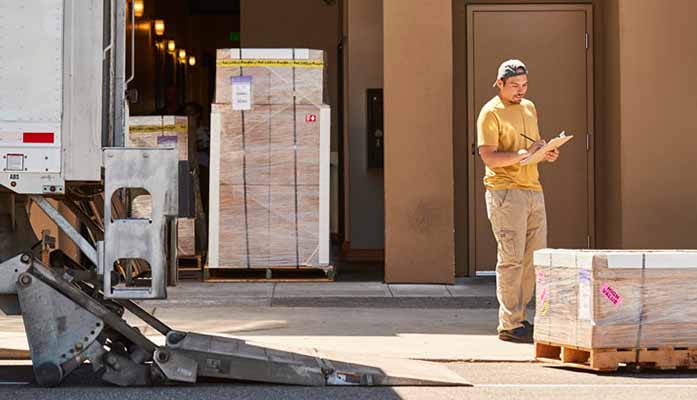
FedEx announced a pause this week of its economy express freight services within the U.S. The reason? Too many staff members are unavailable for work as a result of the continuing spread of the Omicron-variant.
The shortages impact FedEx’s popular two-day and three-day freight services relied on by thousands of businesses every day. The effect is a further disruption in America’s manufacturing and retail supply chains which have derailed U.S. automakers and the aerospace industry for months.
Economy freight services are also vital for the delivery of medical equipment, commercial construction, and high-volume printing.
News of the FedEx decision comes just as the company is restarting international economy freight services shut down last month in response to staff shortages across its network.
Similar delivery impediments have hit UPS and the U.S. Postal Service, due in part to employee absences related to COVID-19 as well several extreme weather events across the country. As a result, delivery guarantees are currently suspended on some UPS domestic and worldwide services. In addition, some UPS customer facilities are closed.
“Severe weather conditions and the COVID-19 Omicron variant may impact operations and staffing in parts of the country,” according to a current UPS service alert. “Although we implement contingency plans to minimize service disruptions, delays to service may occur.”
Even regular residential and business mail delivery is being effected in some parts of the U.S.
“Postal Service Priority Mail® products and First-Class® packages may temporarily require more time to be delivered due to limited transportation availability as a result of the Coronavirus (COVID-19) pandemic,” according to the USPS website. “Priority Mail’s two-day and three-day service commitments will be extended to three days and four days, respectively.”