by Matthew Holloway | Oct 14, 2025 | News
By Matthew Holloway |
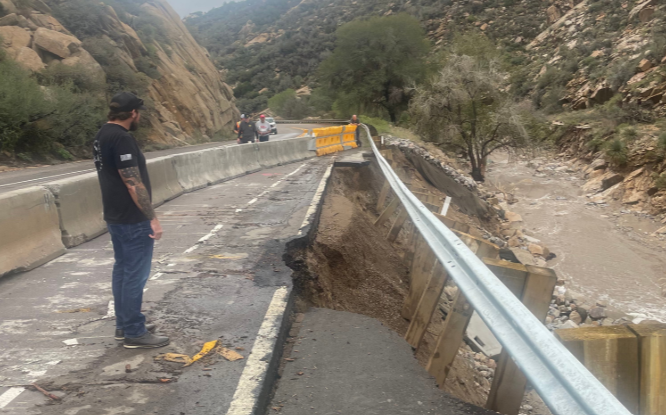
With tropical storm-fueled rains hammering various parts of Arizona and flood losses mounting, the U.S. Small Business Administration (SBA) announced that low-interest loans are now available for the victims of severe flooding in Coconino, Gila, Graham, Maricopa, Navajo, Pinal, and Yavapai Counties, as well as tribal nations.
The SBA is offering low-interest federal disaster loans to eligible businesses, nonprofits, residents, and tribal nations—similar to those provided for the Dragon Bravo Fire victims in September.
In a post to X announcing the relief for Gila County, Congressman Eli Crane (R-AZ02) called for continued prayers for those hit by the massive flooding. Remnants of Hurricane Priscilla hammered the area over the weekend, adding to late September’s monsoon deluge that devastated Globe-Miami.
Crane wrote: “@SBAgov has declared an economic disaster due to the severe flooding in Gila County. Through this declaration, SBA’s Economic Injury Disaster Loan (EIDL) program is available to eligible businesses, private nonprofits, and residents,” providing a link to resources.
He followed up: “Please continue to keep those impacted by the devastating floods in Gila County in your prayers. For those affected, @SBAgov is offering Business Physical Disaster Loans, Home and Personal Property Loans, and Economic Injury Disaster Loans.”
According to the SBA:
“Businesses and nonprofits are eligible to apply for business physical disaster loans and may borrow up to $2 million to repair or replace disaster-damaged or destroyed real estate, machinery and equipment, inventory, and other business assets.
“Homeowners and renters are eligible to apply for home and personal property loans and may borrow up to $100,000 to replace or repair personal property, such as clothing, furniture, cars, and appliances. Homeowners may apply for up to $500,000 to replace or repair their primary residence.
“Applicants may be eligible for a loan increase of up to 20% of their physical damage, as verified by the SBA, for mitigation purposes. Eligible mitigation improvements include insulating pipes, walls and attics, weather stripping doors and windows, and installing storm windows to help protect property and occupants from future disasters.”
The Economic Injury Disaster Loan (EIDL) program is also available to help small businesses, nurseries, and non-profit organizations with financial losses directly related to this disaster.
For more information, the SBA directs victims to visit this website. They can apply online, call SBA’s Customer Service Center at (800) 659-2955, or email disastercustomerservice@sba.gov.
“When disasters strike, SBA’s Disaster Loan Outreach Centers play a vital role in helping small businesses and their communities recover,” Chris Stallings, associate administrator of the Office of Disaster Recovery and Resilience at the SBA, said in a press release. “At these centers, SBA specialists assist business owners and residents with disaster loan applications and provide information on the full range of recovery programs available.”
Matthew Holloway is a senior reporter for AZ Free News. Follow him on X for his latest stories, or email tips to Matthew@azfreenews.com.
by Ethan Faverino | Aug 28, 2025 | News
By Ethan Faverino |
Through the One Big Beautiful Bill Act, the U.S. House of Representatives reauthorized the Radiation Exposure Compensation Act (RECA) through December 31, 2028, and enacted its largest-ever expansion.
This act broadens eligibility to include new populations, such as Northern Arizona counties and additional uranium workers, while continuing support for those affected by the U.S. nuclear weapons program.
The expanded RECA provides a one-time, lump-sum payment of up to $100,000 to qualifying individuals or their survivors, offering critical restitution for those who developed serious illnesses due to radiation exposure.
Representative Eli Crane (AZ-02) announced that the reauthorized act now covers individuals in Coconino, Yavapai, Navajo, Apache, Gila, and Mohave counties in Arizona affected between January 1951 and November 1962, as well as uranium workers employed in covered occupations from January 1, 1942, to December 31, 1990.
The program also extends to onsite participants of nuclear tests and those impacted by the Manhattan Project waste.
RECA provides a non-adversarial alternative to litigation, requiring no proof of causation. Claimants qualify by demonstrating a compensable disease and presence in a designated area or occupation during specified periods.
The program, administered by the Department of Justice, is designed to resolve claims efficiently, using existing records to minimize administrative costs for both claimants and the government.
The four qualifying categories are Downwinders, onsite participants, uranium workers, and Manhattan Project waste victims.
Downwinders are individuals who developed certain cancers after radiation exposure from U.S. nuclear tests between 1944 and 1962.
The program now includes several Arizona counties along with eligible areas in Idaho, New Mexico, Utah, and Nevada.
To qualify, individuals must have lived in one of the areas during a specific time period and have been diagnosed with a compensable disease such as leukemia, multiple myeloma, lymphoma, or certain primary cancers.
On-site participants were individuals present at U.S. atmospheric nuclear tests before January 1, 1963, and later developed a compensable disease.
Uranium workers also receive compensation for individuals employed in uranium mining, milling, core drilling, ore transport, or remediation efforts in mines or mills located in Colorado, New Mexico, Arizona, Wyoming, South Dakota, Washington, Utah, Idaho, North Dakota, Oregon, or Texas between January 1, 1942, and December 31, 1990.
To qualify, uranium workers must have been employed for at least one year during the time period and been diagnosed with a compensable disease such as lung cancer, pulmonary fibrosis, silicosis, pneumoconiosis, cor pulmonale related to lung fibrosis, or renal cancers.
Lastly, Manhattan Project waste victims get compensation for individuals exposed to Manhattan Project waste in designated areas of Missouri, Tennessee, Alaska, and Kentucky.
To qualify, individuals must have lived, worked, or attended school for at least two years after January 1, 1949, in designated zip codes and have a compensable disease.
The expanded Radiation Exposure Compensation Act delivers long-overdue justice, honoring those whose lives were forever changed by radiation exposure.
Ethan Faverino is a reporter for AZ Free News. You can send him news tips using this link.
by Matthew Holloway | Aug 23, 2025 | News
By Matthew Holloway |
Congressman Eli Crane announced that the U.S. Small Business Administration (SBA), under President Trump, is offering low-interest federal disaster loans to help businesses, nonprofits, and tribal nations recover from the devastating 2025 wildfires. The loans respond to the Dragon Bravo and White Sage fires, which scorched the Northern Rim of the Grand Canyon and the Kaibab Plateau in Northern Arizona.
The federal disaster declaration, issued by the SBA on August 13th, covers the Arizona counties of Coconino, Gila, Mohave, Navajo, and Yavapai, as well as the tribal nations of the Navajo Nation, Hopi Tribe, Havasupai Tribe, Hualapai Tribe, and San Juan Southern Paiute Tribe.
According to a press release from the SBA, “The loan amount can be up to $2 million with interest rates as low as 4% for businesses and 3.625% for PNPs with terms up to 30 years. Interest does not accrue, and payments are not due until 12 months from the date of the first loan disbursement. The SBA sets loan amounts and terms based on each applicant’s financial condition.”
The administration clarified that the Economic Injury Disaster Loan (EIDL) is available to eligible businesses, small agricultural cooperatives, nurseries, and PNPs with financial losses directly related to the disaster. However, the administration noted it is “unable to provide disaster loans to agricultural producers, farmers, or ranchers, except for aquaculture enterprises.”
The SBA explained that the purpose of the loans is “for working capital needs caused by the disaster, and are available even if the business did not suffer any physical damage. They may be used to pay fixed debts, payroll, accounts payable, and other bills that could have been paid had the disaster not occurred.”
As of this report, the Dragon Bravo fire has burned over 145,000 acres and is 62% contained. It has cut a swath of destruction from the north rim of the Grand Canyon northward along both sides of Arizona State Route 67 for about 12 miles and then along the east side of the State Route for nearly another twenty miles, leaving a scar almost 16 miles wide at its widest point.
The White Sage fire has burned nearly 59,000 acres and is 95% contained after spreading in a widening eastward arc from White Sage flat through the Kaibab National Forest toward Coyote Valley.
In July, Governor Katie Hobbs met with Trump administration officials, including Secretary of the Interior Doug Burgum, to coordinate with federal authorities on the Dragon Bravo wildfire, days after Congressman Paul Gosar (R-AZ09) joined a growing bipartisan coalition of Arizona leaders calling for an investigation into it. The fire claimed the historic Grand Canyon Lodge along with 50-80 other structures in the area in mid-July.
For more information about the SBA EID loans or to apply, please click here, call SBA’s Customer Service Center at (800) 659-2955, or email disastercustomerservice@sba.gov.
Matthew Holloway is a senior reporter for AZ Free News. Follow him on X for his latest stories, or email tips to Matthew@azfreenews.com.
by Ethan Faverino | Aug 18, 2025 | Economy, News
By Ethan Faverino |
The One Big Beautiful Bill Act (OBBBA) marks the most transformative overhaul of federal tax policy since the 2017 Tax Cuts and Jobs Act (TCJA).
The OBBBA locks in the TCJA’s individual tax provisions, avoiding a tax increase for approximately 62% of tax filers in 2026, according to the Tax Foundation.
The group’s recent analysis also shows that the law will reduce federal taxes for individual taxpayers in every state, with an average national tax cut of $3,752 per taxpayer in 2026.
The economic impact is equally as big, with 938,000 new full-time equivalent jobs created over the long term, including 132,000 in California, 81,000 in Texas, and down to 1,800 in Vermont.
In Arizona, the Tax Foundation says that the OBBBA will deliver an average tax cut of $3,521 per taxpayer in 2026, providing relief to families and individuals across the state.
Maricopa County will see an average tax cut of $4,049 per taxpayer in 2026, driven by key provisions like:
- Income Tax Rate Cuts and Bracket Changes: $1,613 in savings per taxpayer.
- Standard Deduction Expansion: $821 in savings
- Child Tax Credit Expansion: $630 in savings
- Tip and Overtime Deductions: $50 and $229 in savings
- Business Provisions: $1,321 in savings
Other counties in the state will see major tax cuts in 2026, including Coconino County, with $3,096, Yavapai County, with $3,066, Greenlee County, with $3,011, Pima County, with $2,781, and Pinal County, with $2,553.
The Tax Foundation also projects that Arizona will gain approximately 18,014 full-time equivalent jobs in the long run, boosting local economies and supporting communities across the state.
OBBBA’s long-term outlook remains strong, with average tax cuts projected to dip to $2,505 in 2030 due to the expiration of temporary provisions like the tip and overtime deductions, before rising to $3,301 by 2035 as inflation enhances the value of permanent cuts.
Arizona’s business-friendly provisions, such as permanent 100% bonus depreciation and research and development (R&D) expense, will continue to drive investment and job creation.
Ethan Faverino is a reporter for AZ Free News. You can send him news tips using this link.
by Jonathan Eberle | Jun 13, 2025 | News
By Jonathan Eberle |
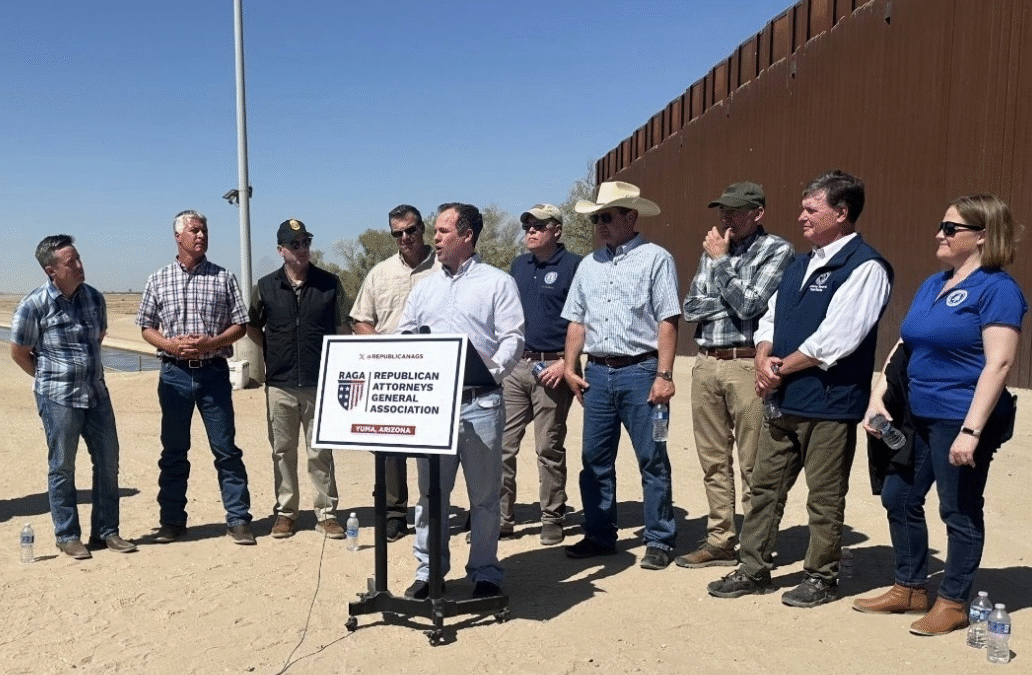
Arizona Senate President Warren Petersen recently led a delegation of nearly a dozen state attorneys general and local law enforcement officials to the U.S.-Mexico border, aiming to assess conditions on the ground and observe changes in federal immigration enforcement.
The bipartisan delegation, which included state attorneys general from as far away as Indiana, Mississippi, and South Dakota, met with local police, government leaders, medical professionals, and nonprofit organizations to get a clearer picture of the current border environment.
According to Petersen, the group found dramatically reduced migrant crossings, fewer than five per day in some areas, a stark contrast to the thousands reported daily in previous years. Officials attributed the drop to a return to stricter immigration enforcement policies, including the end of the “catch and release” practice and increased prosecutions under the U.S. Department of Justice.
“For the first time in recent history, most Americans say the country is on the right track,” Petersen said in a statement. “We didn’t need a new law. We just needed a new president to enforce the laws already on the books.”
Petersen framed the visit as a testament to the Arizona Legislature’s support for enhanced federal enforcement at the border. He emphasized the state’s continued commitment to addressing cross-border crime and public safety.
Other officials echoed Petersen’s message, citing improvements in morale among border agents and the impact of reduced immigration on state-level services.
Utah Attorney General Derek Brown linked the border situation to fentanyl trafficking, which he said has contributed to thousands of overdose deaths in his state. Mississippi Attorney General Lynn Fitch also referenced her office’s work with ICE through the 287(g) program, calling President Trump’s policies essential for restoring border integrity.
South Dakota Attorney General Marty Jackley and South Carolina Attorney General Alan Wilson both emphasized the criminal aspect of illegal immigration. Wilson, calling the previous administration’s approach “reckless,” said, “Every state is now a border state, and South Carolina is no exception.”
Local law enforcement also played a key role in the visit. Yavapai County Sheriff David Rhodes described the tour as a valuable educational tool for law enforcement across the country, citing the challenges posed by human and drug smugglers.
Yuma County Sheriff Leon Wilmot and County Supervisor Jonathan Lines, who hosted the delegation, expressed gratitude for national support. “We are grateful to again have officials in the White House who understand our plight,” said Lines. “Together, we are making a difference for residents of the border communities.”
Jonathan Eberle is a reporter for AZ Free News. You can send him news tips using this link.