by Ethan Faverino | Sep 11, 2025 | News
By Ethan Faverino |
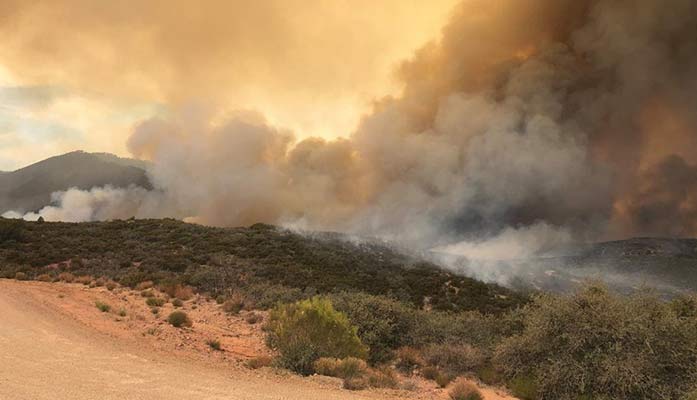
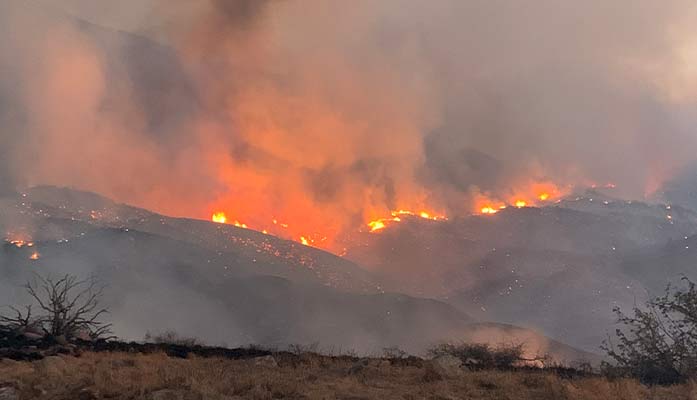
Arizona voters are deeply concerned about wildfires and are calling for a shift in state policy toward proactive forest and land management to prevent catastrophic fires, according to recent polling.
The survey, conducted by Noble Predictive Insights (NPI), found an overwhelming 78% of Arizona voters express concern about recent wildfires, with bipartisan alarm cutting across political divides.
Both Republicans and Democrats report identical levels of concern at 82%, while 70% of Independents share similar worries. This concern spans generations, with 80% of voters aged 65+ and 76% of those aged 18-29 voicing concerns.
In Maricopa County, 76% of voters express concern about recent wildfires, with 36% being very concerned, while Pima County reports a higher level of concern at 80%, with 48% being very concerned, reflecting its proximity to recent wildfire activity. Rural counties also show elevated concern at 80%, with 48% very concerned, likely due to their direct exposure to forested areas.
Notably, educational attainment correlates with heightened awareness, as 82% of college graduates and postgraduates express concern compared to 68% of those with a high school degree or less.
Despite recognizing wildfires as a pressing threat, only 18% of voters believe Arizona is well-prepared for future wildfire emergencies.
A majority (52%) acknowledge some level of preparation but see room for improvement, while 21% say the state is not prepared at all. Republicans (22%) and Democrats (21%) are slightly more optimistic about preparedness than Independents (12%), highlighting varied perceptions of state leadership’s efforts.
Maricopa County voters are slightly more optimistic on preparation, with 18% believing the state is well-prepared, compared to 17% in Pima and 20% in rural counties. However, all regions agree that significant gaps remain (54% in Maricopa, 51% in Pima, 50% in rural counties).
Arizona voters are clear in their preference for long-term prevention over short-term firefighting or recovery efforts. A striking 43% identify improved forest and land management as the top priority for state wildfire policy, far outpacing support for increased firefighting funding (23%) or post-fire recovery assistance (15%).
This prevention-first mandate holds across party lines, with 53% of Republicans, 41% of Democrats, and 35% of Independents prioritizing forest management.
“Wildfires touch every community in Arizona, and voters are telling us they do not think the state is ready enough for what lies ahead,” said Mike Noble, NPI Founder and CEO. “What is most striking is the consensus. Whether Republican, Democrat, or Independent, voters overwhelmingly want prevention to be the top priority.”
Ethan Faverino is a reporter for AZ Free News. You can send him news tips using this link.
by Daniel Stefanski | Feb 7, 2025 | News
By Daniel Stefanski |
A coalition of Arizona legislators are taking steps to improve the state’s wildfire mitigation efforts.
This week, State Representative Lupe Diaz, the Chairman of the House Committee on Land, Agriculture, and Rural Affairs, updated constituents on the progress of bills in the Arizona Legislature, which are meant “to protect lives, property, and communities from the growing threat of catastrophic wildfires.”
Those bills include:
- HB 2201, which was sponsored by Representative Griffin. The bill “requires utilities to develop and submit biennial Wildfire Mitigation Plans, which include clearing hazardous vegetation around power lines to prevent utility-caused wildfires.”
- HB 2219, which was sponsored by Representative Marshall; HB 2395, HB 2398, and HB 2400, which were sponsored by Representative Blackman; and HB 2694, which was sponsored by Representative Griffin. These bills “allocate funding for fire contingency planning and wildland firefighting efforts in Arizona’s high-risk areas.”
- HB 2456, which was sponsored by Representative Marshall. This bill would “establish fire incident management grants to assist districts across the state.”
- HB 2577, which was sponsored by Representative Griffin. The bill “cuts red tape to give the State Forester more flexibility to protect communities.”
- HB 2639, which was sponsored by Representative Griffin. This bill “extends the ‘healthy forest’ tax incentive to encourage responsible forest thinning and prevent catastrophic fires.”
In a statement, Representative Diaz said, “Public safety is more than law enforcement and border security – it means defending our communities from preventable disasters. Arizona has seen what happens when wildfires are mismanaged in places like California. We refuse to let that happen here. Our plan prioritizes proactive fire mitigation efforts, responsible forest management, and ensuring that Arizonans are protected when disaster strikes.”
Diaz added, “Preventing wildfires means enacting responsible management before disaster strikes. We are working with state agencies, local officials, and private utilities to get boots on the ground, clear hazardous areas, and stop wildfires before they start. This is what leadership looks like, and it’s exactly what Arizonans expect from us.”
Governor Katie Hobbs did not mention plans to address wildfire mitigation efforts in her State of the State address to the Arizona Legislature at the beginning of the 57th Regular Session last month. Chairman Diaz’s release highlights that the Democrat governor’s “proposed budget offers zero funding for hazardous vegetation removal or forest thinning despite recognizing that wildland fire costs have been ‘much higher in recent years’ due to neglected forest maintenance.”
Daniel Stefanski is a reporter for AZ Free News. You can send him news tips using this link.
by Matthew Holloway | Sep 30, 2024 | News
By Matthew Holloway |
The ‘Fix Our Forests Act’ introduced by Congressman Bruce Westerman (R-AR), co-sponsored by Congressman Paul Gosar (R-AZ), and supported by Congressman Eli Crane (R-AZ) passed the U.S. House of Representatives Tuesday in a 268-151 vote. The vote went largely along partisan lines with 55 Democrats joining the Republican Majority to advance it to the Senate. The act as explained by Crane’s office “would improve the health and resiliency of America’s forests.”
Citing the breadth of the designated forests in the United States at 117 million acres and with the stark warning that these forests are “overgrown, prone to fires, and in need of active management,” the Republican measure is designed to expedite the approvals process for forestry management and fire control. Both are imminent and ever-present concerns in the wildfire-prone high-desert grasslands and forests of Northern Arizona.
According to a press release from Crane’s office, the Fix Our Forests Act is designed to:
“Simplify and expedite environmental reviews to reduce costs and planning times for critical forest management projects while maintaining rigorous environmental standards;
End frivolous litigation that delays needed forest management projects;
Utilize state-of-the-art science to prioritize the treatment of forests at the highest risk of wildfire;
Incentivize forest management projects of up to 10,000 acres to increase the pace and scale of active management;
Promote federal, state, tribal, and local collaboration by creating a new Fireshed Center and codifying the Shared Stewardship initiative;
Make communities more resilient to wildfire by coordinating existing grant programs and incentivizing new research;
Give agencies new tools to restore watersheds, protect communities in the wildland-urban interface and prevent forest conversion;
Revitalize rural economies by strengthening tools such as Good Neighbor Authority and Stewardship Contracting;
Adopt new and innovative technologies to address forest health threats like wildfires, drought, insects and disease;
Harden utility rights-of-way against wildfire by encouraging more active management and removal of dangerous hazard trees.”
The Biden administration reportedly opposes the bill, and it could potentially meet with a veto if it passes the Senate. In a statement from the White House, the Biden-Harris administration wrote, “H.R. 8790, however, also contains a number of provisions that would undermine basic protections for communities, lands, waters, and wildlife; reduce opportunities for public input; and heighten the likelihood for conflict, litigation, and delay on needed forest restoration and resilience work,” the statement continued per the Washington Examiner. “The Administration therefore strongly opposes this bill.”
In a statement published by the Congressional Western Caucus, Rep. Westerman said, “America’s forests are on life support after decades of mismanagement. The clock on these ticking time bombs is down to the final few seconds, and Congress must move swiftly to save our forests from imminent destruction. Today, the House took decisive action on the bipartisan Fix Our Forests Act, which will empower local land managers and agencies with tools to enact the most vital forest management projects. The time to fix our forests is now.”
In a post to X, Crane wrote, “Yesterday, I voted proudly in support of the bipartisan Fix Our Forests Act, which would restore forest health and protect our communities in #AZ02. Thanks to @NatResources Chairman @RepWesterman for his leadership on this legislation.”
The bill was cosponsored by 17 Republicans including Rep. Paul Gosar (R-AZ) and six Democrats and must now be taken up by the Senate.
Matthew Holloway is a senior reporter for AZ Free News. Follow him on X for his latest stories, or email tips to Matthew@azfreenews.com.