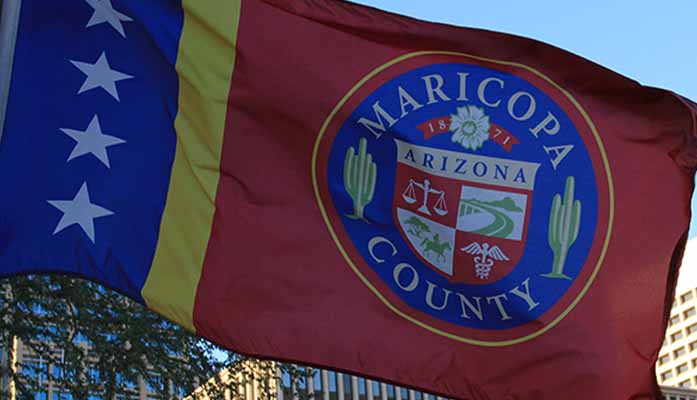
The legal fight between Maricopa County Recorder Justin Heap and the County Board of Supervisors escalated Monday. America First Legal filed two motions on Heap’s behalf, and Arizona’s legislative leaders submitted an amicus brief supporting him.
In a press release, the County Recorder’s Office stated that the motionsfiled by America First Legal “reveal how the County Board of Supervisors and County Attorney Rachel Mitchell have weaponized county government against duly-elected Recorder Justin Heap simply because he dared to fulfill his statutory duties and protect the sanctity of Arizona elections.”
Heap said in a statement, “It’s unfortunate that the Board’s unprofessional and bad faith actions have forced us to litigate this issue; however, it’s significantly more unfortunate that the Board continues to deny the voters of Maricopa County the positive, common sense election integrity reforms that they voted for last November when they elected me. As I’ve promised from day one, I am working to ensure honest, secure, and transparent elections for every voter in Maricopa County. I am not, and will not, waiver in my commitment to executing on this promise. I’m grateful to America First Legal for standing by my side in this battle.”
Recorder Justin Heap Refuses to Back Down in the Face of Unprecedented Attack on Election Integrity in Maricopa County ⤵️ pic.twitter.com/p9db5ODufm
— Maricopa County Recorder's Office (@RecordersOffice) August 25, 2025
America First Legal detailed Heap’s allegations in the first filing: “The Defendants — the members of the Maricopa County Board of Supervisors (‘BOS’) — have crossed from fiscal oversight into outright sabotage. Ignoring [state law] and decades of precedent, the BOS has refused to fund the Recorder’s ‘necessary expenses’ — from modern ballot-processing equipment to indispensable IT staff — while simultaneously seizing control of the very election functions its stonewalling endangers. The BOS’s obstruction is not mere bureaucratic foot-dragging; it is a calculated power grab that throttles the Recorder’s constitutional duty to administer secure, timely elections.”
🚨Arizona voters deserve elections run according to the law—not confusion or overreach.
Today Senate President @votewarren filed a brief in Heap v. Galvin making it clear: only the Legislature sets election duties, and they must be carried out by the officials elected for the… pic.twitter.com/CRGOFYIb34
In an amici filing in support of Heap, Arizona House Speaker Steven Montenegro and Senate President Warren Petersen’s legal representation call for a strict interpretation of state statutes which govern the responsibilities of the county recorder and board of supervisors. They argue that the “court should narrowly conclude that, based on the statutes’ plain language, when the statute authorizes ‘the county recorder or other officer in charge of elections’ to act, it is the recorder’s duty to ensure the statute is complied with unless the recorder expressly agrees to delegate that duty to another ‘officer in charge of elections.’”
As previously reported by AZ Free News, the months-long negotiations between Heap and the Board, led by Chairman Thomas Galvin, devolved steadily since Heap’s election and the replacement of Stephen Richer in January until finally collapsing into litigation in June.
The crux of the disagreement between the Board of Supervisors and County Recorder Heap rests upon a Shared Services Agreement (SSA) agreed to by Heap’s predecessor, Richer, who ardently opposed the election integrity efforts that Heap ran for office to enact. For nearly six months, the two county offices negotiated; however, Heap and the Supervisors were unable to reach an agreement, culminating in a lawsuit filed by Heap.
Since then, Heap has alleged that the Supervisors have “taken retaliatory actions” describing a series of measures that “make it impossible for him to do his job, including removing nearly all his election-related IT staff; seizing the servers, databases, and websites necessary to fulfill his duties; and restricting access to necessary facilities and equipment,” as reported by The Federalist.
In a second filing, Heap and America First Legal introduced allegations involving Maricopa County Attorney Rachel Mitchell, bringing a third County office into the fray in a dispute over who may represent the County Recorder, an attorney chosen by Heap or Maricopa County Attorney Rachel Mitchell. In the legal brief, they allege, “Attorney Mitchell originally appointed a criminal defense attorney to advise the Recorder; however, in April, America First Legal agreed to represent Heap pro bono, a move that Mitchell objected to.”
“When the Recorder complained that the original attorney appointed for him lacked sufficient subject matter expertise, County Attorney Mitchell appointed former Arizona Supreme Court Justice Andrew Gould to advise the Recorder only during negotiations with the Board. However, County Attorney Mitchell and the Board did not allow Justice Gould to litigate on the Recorder’s behalf,” the filing revealed.
But according to AFL, that wasn’t the end of it. “In May of 2025, Justice Gould specifically asked the Maricopa County Attorney’s Office for permission to litigate on Recorder Heap’s behalf but was not allowed to do so because the scope of his representation was limited to negotiation of the SSA and did not include litigation, and, accordingly, the County would not compensate him for litigation-related work.”
Mitchell responded by penning a letter to the AFL attorneys, writing in part, “This letter is to inform you that I am the Recorder’s attorney and that you do not represent the Maricopa County Recorder’s Office or Recorder Heap in his official capacity.”
Per The Federalist, AFL attorney James Rogers retorted that the “County Recorder is allowed to pick his own lawyer in litigation,” adding that Heap “is not subject to the whims of the county attorney.”
In the midst of the complex legal battle between the Recorder’s Office and the Board of Supervisors, which has drawn the attention of legislative leaders, the dispute with Mitchell adds yet another layer of infighting within the already divided county government, with the calendar counting down to the 2026 elections.
Arizona Senate President Warren Petersen announced on Monday several senior staff promotions and new hires within the Senate Majority office, moves he said will strengthen support for the chamber’s 17 Republican members as they pursue their legislative agenda.
Fletcher Montzingo has been elevated to Deputy Chief of Staff after more than a decade in state government, including six years staffing the Senate Finance and Appropriations Committees. In his new role, Montzingo will help oversee daily staff operations, advise on tax policy, and provide support for the newly formed Senate Committee on Appropriations & Transportation.
Brooke Huppenthal will join the staff on Sept. 15 as Deputy General Counsel. She will advise the Senate Committees on Judiciary & Elections and Military Affairs & Border Security, while also assisting the Senate Rules Committee. Huppenthal previously served as an Assistant Attorney General in Tennessee and clerked for Arizona Supreme Court Justice Clint Bolick.
Simone Westbrook Hall has been named Senior Policy Advisor for the Senate Committees on Natural Resources, Energy & Water and Public Safety. She most recently served as Arizona’s Deputy Land Commissioner and has experience in both public and private sector land use and natural resource policy.
Abigail McLain will begin on Sept. 8 as Policy Advisor for the Senate Committees on Finance and Health & Human Services. A graduate of Grand Canyon University, McLain previously worked on the government relations team at Alliance Defending Freedom, focusing on First Amendment policy.
“These new additions and promotions ensure that the Arizona Senate Majority Caucus has one of the most experienced and capable legislative staff teams in the country,” Petersen said in a statement. “They will play an important role in helping us deliver results for Arizona families.”
The updated Majority Staff roster includes:
Josh Kredit, Chief of Staff
Fletcher Montzingo, Deputy Chief of Staff; Policy Advisor for Appropriations & Transportation, Finance
Rusty Crandall, General Counsel; Policy Advisor for Director Nominations, Ethics, Judiciary & Elections, Rules
Brooke Huppenthal, Deputy General Counsel; Policy Advisor for Judiciary & Elections, Military Affairs & Border Security
Kim Quintero, Director of Communications
Alayna Kowaleski, Deputy Director of Communications; Policy Advisor for Federalism, Joint Legislative Audit
Blaze Baggs, Senior Policy Advisor for Health & Human Services, Government
Simone Westbrook Hall, Senior Policy Advisor for Natural Resources, Energy & Water, Public Safety
Emma Blair, Policy Advisor for Education, Appropriations & Transportation, Regulatory Affairs & Government Efficiency
Abigail McLain, Policy Advisor for Health & Human Services, Finance, Government
Gina Jenkins, Senior Executive Assistant
Jonathan Eberle is a reporter for AZ Free News. You can send him news tips using this link.
Last week, Arizona’s Democrat Attorney General Kris Mayes issued an opinion stating that roughly 200,000 voters mistakenly listed in state election records as having provided proof of U.S. citizenship should remain on the rolls, despite questions about their citizenship status and potential conflicts with Arizona law.
As reported by AZ Free News in November of last year, 218,000 voters were confirmed by Senate President Warren Petersen to have obtained their driver’s licenses prior to the 1996 requirement to apply with proof of citizenship, went on to get a duplicate license, and then registered to vote for the first time or re-registered to vote after 2004.
For over 20 years, they were caught up in a compatibility issue between the Arizona Department of Transportation (ADOT) and the state’s voter registration system.
JUST IN: Attorney General issues opinion on how AZ should treat 200K voters caught up in state error tracking voter citizenship. They should remain FULLY ELIGIBLE to vote, Mayes writes, because recorders don't have authority to remove them from rolls/make federal-only. STORY IN🧵 pic.twitter.com/ww8qtN4zFt
According to VoteBeat’s Jen Fifield, AG Mayes’ opinion marks a notable departure from how election officials have been working to remedy the problem with counties issuing notices to voters in an attempt to collect the information.
“If an Affected Voter responds by providing such evidence, that should dispel doubt,” Mayes wrote. “But if an Affected Voter does not respond, the mere lack of response does not, under current law, authorize the county recorder to cancel the voter’s registration, in whole or in part.”
Fifield, citing the Arizona Attorney General’s manual, noted that it is unclear whether or not the county election officials will conform to Mayes’ formal opinion, which is advisory in nature and does not carry the force of law.
“County recorders may take steps to inquire whether the affected voters are U.S. citizens, including by asking them to provide satisfactory evidence of citizenship,’’ Mayes wrote.
Mayes’ opinion came in response to a request made in May by fellow Democrat Arizona Secretary of State Adrian Fontes. In a statement, Fontes said he has appreciated Mayes’ guidance, writing, “The opinion stands for the notion that these folks have a right to vote,’’ he told the AZ Capitol Times.
“And it falls to the government to prove otherwise–which is the way every other accusation, every other denial of rights exists,” Fontes said. “So the burden has shifted back to where it belongs.’’
In a statement, Fontes wrote, “The consistent treatment of voters caught up in this situation between counties is most important to ensure everyone’s voting rights are protected. I am glad we now have a clear path forward.”
Arizona Republican Party Chairwoman Gina Swoboda agreed with Mayes’ opinion, in particular her assessment of the county recorder’s limited authority to cancel registrations.
“If the recorders have affirmative proof that one of the voters is a non-citizen, they may initiate a notice and cancellation process,” Swoboda told the AZ Capitol Times. “But they may not otherwise do so because of this error.”
Coconino County Recorder Aubrey Sonderegger told the Arizona Republic that the news was welcome. “It’s exactly what Coconino County has been doing all along,” she said. “We have more than cut our list in half.”
She added that “These people weren’t doing anything nefariously” but were merely caught up in the timing of the voter registration standard changing. “I’m very relieved to hear the AG opinion,” she said. “It just means we can keep doing what we’ve been doing.”
According to the Secretary of State’s office, the current number of affected voters stands at 202,760. Maricopa County Recorder Justin Heap issued a notification on June 26, 2025, to the 83,000 county voters on the list, informing them that they must submit proof of citizenship within 90 days. Failure to do so will result in reclassification as federal-only voters, and they will not be issued state and local ballots.
This week, Arizona Senate President Warren Petersen delivered a clear message: Arizona will not stand by while abortion providers try to dismantle the protections that defend women and children in our state. At the center of the lawsuit Isaacson v. Arizona is a basic truth: our laws were written to protect the vulnerable, not to support the bottom line of the abortion industry.
President Petersen made it plain that this case is about one fundamental question: will women keep their right to informed consent before an abortion? In every other area of medicine, informed consent is a non-negotiable standard of care. Women deserve the right to know their medical situation fully, to see an ultrasound, and to hear their baby’s heartbeat before making a life-altering decision. To deny them that right is not empowerment, it is exploitation.
But the stakes go even further. Arizona’s Prenatal Non-Discrimination Act makes it illegal to end a child’s life simply because of their race, sex, or disability. Just as America rejected slavery and other injustices that denied whole classes of people their humanity, we must not allow a new form of discrimination to take root in the womb. Every life has value, and no child should be targeted for elimination simply for who they are.
President Petersen is a champion for life, and he is willing to speak on hard truths and act to defend laws that reflect the dignity of every human being. His courage stands in sharp contrast to our current Attorney General Kris Mayes, who has made “reproductive rights” one of her central causes and even gone so far as to file consumer fraud reports against pregnancy resource centers that offer help and hope to women.
As Petersen runs to be Arizona’s next Attorney General, voters will have a choice between two very different paths. One leads toward a state where the powerful and profitable abortion industry writes the rules. The other leads toward a state that defends women’s health, protects children, and affirms that equality must extend to every human life, born and unborn.
Discrimination in the womb is still discrimination. Arizona must not go backwards. We must continue to stand on the side of life, justice, and truth. President Petersen has shown he is ready to fight that battle, and Arizona’s future depends on it.
Here’s where the case stands: on September 15th, there will be a motion to dismiss certain aspects of the lawsuit without even needing a hearing. And a trial is scheduled for November 5th through 7th.
Katarina White serves as Board Member for Arizona Right to Life. To get involved and stay informed, visit the Arizona Right to Life website.
Turning Point Action’s (TPA) recently updated scorecard grades the state of Arizona, as well as our members of Congress and State Legislators, on their alignment with or divergence from its policies and political positions. Federal-level scorecards were created for all fifty states, but state-level drilldowns were developed for six swing states: Arizona, Nevada, Wisconsin, Pennsylvania, Michigan, and Georgia.
The scorecard revealed a significant opportunity for improvement in the Arizona legislature, with many of the most prominent Republicans in leadership roles scoring below the 80th percentile. According to TPA, the conservative outreach organization, “has worked across the conservative movement to identify every scorecard and the legislation they encompass and provide an accumulation of scoring from across the Republican spectrum.”
Wondering if your rep is fighting for you or just warming a seat? Check https://t.co/IjWvCIVsZ7 to find out.
Bad politicians don’t come with warning labels… but we’ve got receipts. 👀🔥
Each state, policy category, and lawmaker (federal and state) is scored 0-100 and is classified from “Tyrant,” and “Becoming Tyrannical,” mainly for Democrats and some Republicans with a score of 49 or less, to “Turncoat” at 50, “Betraying America,” from 50-60, “Erratic,” from 60-70, “Becoming Erratic” from 70-80, “Losing Patriotism,” at 80-95, and for those scoring 95+: “Patriot.”
According to an explanation of lawmaker scoring from TPA, “Turning Point Action looks at each vote individually, identifies the category it belongs in and works amongst the grassroots to identify the conservative position. If the representative votes with Turning Point Action’s position for each bill or nomination, they receive full points. If the representative votes against TPA’s position, they receive nothing. Not voting, present, and abstaining from voting gives the representative only half credit, thereby diminishing their score for neglecting their responsibility.”
States are also scored in overall terms by “first finding the overall House score and overall Senate score by issue. Then the overall House score is added to the overall Senate score and divided by two to achieve the overall category state score.” States are accordingly ranked as being a “Tyrannical State” with a score between 0%-20%, “Becoming Tyrannical,” from 21%-40%, an “Erratic State” from 41%-60%, “Losing Freedom,” from 61%-80%, and a “Free State” scoring 81% or better.
As of this report, Arizona is ranked as “Losing Freedom” on federal matters with a score of 62.50 and as an “Erratic State” on state issues with a score of 41.69.
In the case of Arizona’s state legislature, the only “Patriots” recognized by TPA were Senator Jake Hoffman with a score of 99.40, and Representatives Joseph Chaplik with 98.05 and Alexander Kolodin with 96.10. The scores indicate a significant split between Arizona’s legislative GOP leadership and one of the largest, most impactful political organizations in the state and country.
These are the only members to score 90% and above in @AZHouseGOP!
It's no surprise the best members are Chaplik and Kolodin as these are the biggest grassroots fighters in… pic.twitter.com/0HK3BT080A
— Merissa Hamilton 🗳 ⛽ 🗽🔥 (@merissahamilton) July 6, 2025
Several of the most prominent leaders in the GOP were scored relatively low, such as House Speaker Steve Montenegro, who scored 77.27, labeled as “Becoming Erratic,” and Majority Leader Michael Carbone, who scored 71.43. Senate President Warren Petersen is listed as “Losing Patriotism,” with a score of 89.16 alongside Majority Leader John Kavanagh, who scored 83.13.