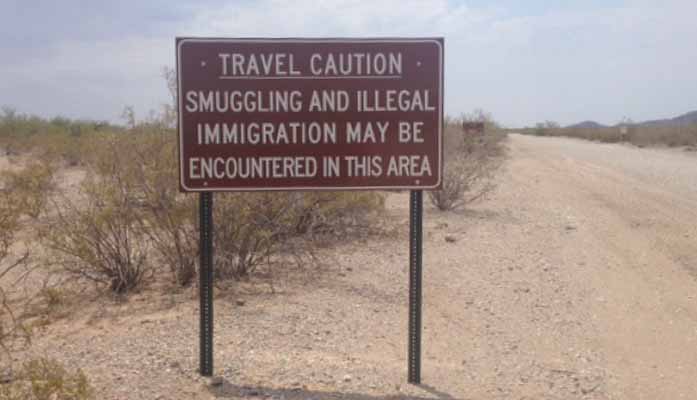
Three criminal illegal aliens accused of sex offenses against children were arrested in Virginia in late July, including one who entered the United States through Arizona before being released into the country by the Biden administration, according to the U.S. Department of Homeland Security (DHS).
The arrests come less than two months after another criminal illegal alien who entered the United States through Arizona was also arrested in Virginia on charges involving alleged attempted abduction and indecent exposure.
All three suspects arrested in July are currently being held at the Middle River Regional Jail in Staunton, Virginia, where U.S. Immigration and Customs Enforcement (ICE) has lodged immigration detainers.
The three men are:
Efren Ramirez Escobedo, a Mexican national who was arrested on July 24 and charged with sexual assault involving a victim age 13-14 and sexual assault involving forcible intercourse. DHS says he illegally entered the United States at an unknown date and location.
Santos Bautista-Molina, a Honduran national who was arrested on July 27 and charged with nine counts of child solicitation and attempted sex offenses with a child under 15. DHS says he illegally entered the United States through Texas in September 2005.
Bayron Jose De Paz-Lopez, a Guatemalan national who was arrested on July 28 and charged with nine counts of child solicitation and attempted sex offense with a child under 15. DHS says De Paz-Lopez illegally entered the United States through Arizona in 2021 and was released into the country by the Biden administration.
Under Sanctuary Spanberger, Virginia has become the Commonwealth of Criminals.
ICE has lodged detainers for THREE illegal aliens who have all been arrested for sex crimes against CHILDREN in Staunton. @GovernorVA must cooperate with us and commit to NOT RELEASING these… https://t.co/OvmjLzLdJkpic.twitter.com/bkxrYmZiRh
On June 21, police in Annandale, Virginia, responded to reports that a man had exposed himself to a woman walking on a trail in a park. Police also received a report that a man had attempted to abduct a woman in the same park by stepping in front of her bicycle, forcing her to dismount, and attempting to drag her into the woods. The woman was able to escape.
Two days later, Fairfax County Police announced the arrest of Moises Domingo Rico Rosales, a Nicaraguan national. He was charged with abduction of a person with intent to defile and indecent exposure.
According to DHS, Rico Rosales had previously been arrested in 2024 on felony drug trafficking charges. ICE lodged an immigration detainer at the time, but Fairfax County officials did not honor the detainer and released him back into the community.
DHS says Rico Rosales had illegally entered the United States through Arizona in 2022, where he was arrested by U.S. Border Patrol. The Biden administration subsequently released him back into the country.
This illegal alien who EXPOSED HIS GENITALS to one woman and then tried to ABDUCT another was previously RELEASED by Fairfax County sanctuary politicians.
In the latest cases, ICE has lodged detainers for all three men arrested in July and is asking Virginia authorities to maintain custody of the suspects rather than release them.
“ICE has lodged detainers for three illegal aliens accused of sex crimes against children, all being held at the same jail in Staunton, Virginia,” stated DHS Secretary Markwayne Mullin. “DHS is calling on Governor Abigail Spanberger and her fellow sanctuary politicians to commit to not releasing these criminals from jail and to instead hand them over to ICE. Under Spanberger, the Commonwealth of Virginia has become a magnet for illegal alien crime. These reckless sanctuary policies are putting American lives at risk.”
Ethan Faverino is a reporter for AZ Free News. You can send him news tips using this link.
When I was young, my parents always told us they met in college. Given that they went to different colleges for very different majors, that always seemed odd to me. When I was older, I learned the full story. They had actually met in an underground bunker during the Lebanese Civil War. They were both serving in the Lebanese Forces defending their Christian faith and families—my mother choosing to step up after losing her 19-year-old brother to the war.
This war was about their very right to live their Christian faith free from violent threats and governmental oppression. Unfortunately, the Christian forces did not prevail, and my parents ultimately immigrated legally to the United States to forge a new life for their family. They wanted to secure our freedom to live our faith and create a prosperous future.
They had put their lives on the line to secure that freedom in Lebanon. They knew all too well that you could not put your faith in the government to defend you. All too often, the government was the danger. So, from a young age, the importance of the Second Amendment was instilled in me, along with respect for all the freedoms enshrined in our Constitution. For a people to remain free, they must have the right and ability to defend themselves. That was true in 1776, and it’s perhaps even more true today.
When I speak to voters, I hear concerns about safety echoing frequently. Many of my friends and neighbors are gun owners for just that reason. They want to know they can defend themselves against dangerous people who could try to harm them or their family. In blue cities that have adopted soft-on-crime policies, it is the government that has created these conditions. But furthermore, many of us understand gun ownership in broader terms: that as Americans, the responsibility to defend our freedom has always and ultimately resided with us. Our faith is not in government to grant our rights, but rather to uphold rights that have already been granted by God. And if and when it fails on a grand scale to do so, we must be ready.
Many Americans are unaware how quickly their Second Amendment rights can vanish with just one election. And not just a Presidential election. In Virginia, a change in Governor and a number of legislative seats led to sweeping anti-gun legislation criminalizing the sale and transfer of the most common household firearm in the country. This bill (HB217/SB749) was sent to their new-Governor Abigail Spanberger along with 25 other anti-Second Amendment bills.
Arizona’s own Governor Hobbs is equally as radical as Governor Spanberger. The difference? Arizona’s Legislature, where pro-Second Amendment legislators hold a slight majority, would never send her such bills to sign. Were the balance of power in the Arizona House and Senate to shift by a few seats, a slew of similar bills would be promptly sent to her desk by Arizona Democrats and signed.
I’m proud that Arizona’s constitutional defense of gun ownership outpaces the Second Amendment, using the strong verbiage “the right to bear arms shall not be impaired,” and offering some of the strongest constitutional carry protections. We must defend our place as a leading Second Amendment state.
I urge voters concerned about defending this vital freedom to consider the consequences of elections. Vote all the way down your ballot and talk to every candidate about their position on the issue. It’s not just about party, but about commitment to the Constitution, regardless of political winds or the ways in which anti-Second Amendment activists leverage tragedy for political gain. That’s the kind of commitment I’ll always have to the Second Amendment. Freedom can be lost in a generation, but on my watch, I won’t allow it.
George Khalaf is a candidate for the Arizona House in Legislative District 3. You can follow him on X here.
Evidence of voter fraud has been discovered in Arizona and seven other states, allegedly.
The secretary of state of Ohio, Frank LaRose, announced Tuesday he had discovered and submitted evidence of voter fraud in Arizona as well as Colorado, Illinois, Kentucky, Maryland, Ohio, South Carolina, Virginia, and Washington, D.C.
The alleged voter fraud consisted of noncitizen voter registration and double votes. LaRose discovered the alleged voter fraud during reviews of the Ohio Voter Registration Database by their Public Integrity Division.
The reviews yielded evidence indicating 11 individuals voted in the seven states and Washington, D.C.
LaRose passed along the findings to Arizona Attorney General Kris Mayes, along with the attorneys general of the other affected states and Washington, D.C.
“We must send a clear message that election fraud won’t be tolerated,” said LaRose. “Through the investigations of our Public Integrity Division’s Election Integrity Unit, we are rooting out lawbreakers so we can bring accountability and justice.”
In a press release, LaRose reminded voters that every single vote counted.
“Critics of Ohio’s election integrity efforts may try to minimize the significance of these referrals, as though some small amount of election crime is acceptable,” stated LaRose in a letter to Ohio Attorney General Yost. “Even one illegal vote can spoil the outcome of an election for the citizenry at large, whether it be a school levy, majority control of a legislative chamber, or even a statewide election contest.”
We must send a clear message that election fraud won’t be tolerated.
Through the investigations of our Public Integrity Division’s Election Integrity Unit, we are rooting out lawbreakers so we can bring accountability and justice. https://t.co/d4iwB4UCR2
During her campaign for attorney general, Mayes dismissed claims of widespread voter fraud occurring in Arizona.
“Know what has been debunked repeatedly? Any indication of widespread, systemic voter fraud,” posted Mayes on X during her campaign run in 2022. “Many of us find the continuation of lies about that ‘truly appalling.’”
Know what has been debunked repeatedly? Any indication of widespread, systemic voter fraud. Many of us find the continuation of lies about that “truly appalling.” Have a lovely evening, “war room.” pic.twitter.com/BhE9Pa25fw
Mayes was declared the winner of the 2022 attorney general race, despite questions remaining of over 9,000 uncounted provisional ballots and their potential effect on her slim margin of victory over now-Congressman Abe Hamadeh. Mayes’ already-slim lead of over 500 votes dropped to under 300 after uncounted votes were discovered in Pinal County during a recount.
As of this report, Mayes hasn’t indicated whether she will act on the referral to her office for investigation or prosecution.
Mayes’ focus on election-related prosecution has largely concerned securing criminal convictions for President Donald Trump’s 2020 electors — a group she refers to as the “fake electors.” All of Mayes’ efforts to coordinate a plan of prosecution (with the help of a Washington, D.C. advocacy organization) and secure the indictments were for naught.
Late last month, the Maricopa County Superior Court ruled that Mayes must redo her entire case against the electors, citing her failure to instruct the grand jury on applicable provisions of the Electoral Count Act of 1887.
A state grand jury, made up of everyday, regular Arizonans, has handed down felony indictments in the ongoing investigation into the fake elector scheme in Arizona. pic.twitter.com/Nu8GcD4ZqJ
— AZ Attorney General Kris Mayes (@AZAGMayes) April 24, 2024
More recently, Mayes unsuccessfully attempted to prevent Cochise County from carrying out its plans for a new jail district election. The election was deemed necessary in court due to the 2023 election on the issue being invalid — nearly 11,000 eligible voters were left without ballots. Mayes pushed in court to have the county abide by the results of the flawed 2023 election.
AZ Free News is your #1 source for Arizona news and politics. You can send us news tips using this link.