by Matthew Holloway | Oct 14, 2025 | News
By Matthew Holloway |
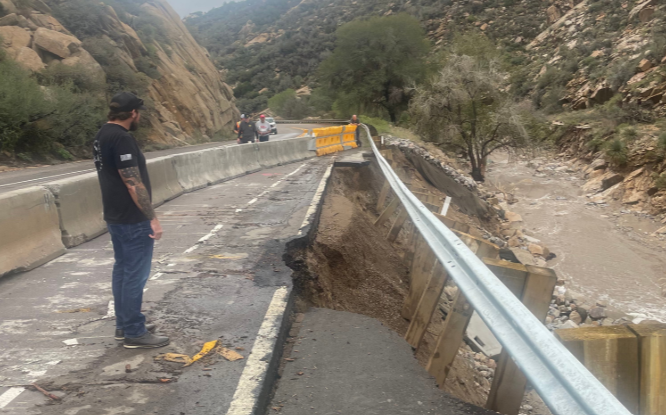
With tropical storm-fueled rains hammering various parts of Arizona and flood losses mounting, the U.S. Small Business Administration (SBA) announced that low-interest loans are now available for the victims of severe flooding in Coconino, Gila, Graham, Maricopa, Navajo, Pinal, and Yavapai Counties, as well as tribal nations.
The SBA is offering low-interest federal disaster loans to eligible businesses, nonprofits, residents, and tribal nations—similar to those provided for the Dragon Bravo Fire victims in September.
In a post to X announcing the relief for Gila County, Congressman Eli Crane (R-AZ02) called for continued prayers for those hit by the massive flooding. Remnants of Hurricane Priscilla hammered the area over the weekend, adding to late September’s monsoon deluge that devastated Globe-Miami.
Crane wrote: “@SBAgov has declared an economic disaster due to the severe flooding in Gila County. Through this declaration, SBA’s Economic Injury Disaster Loan (EIDL) program is available to eligible businesses, private nonprofits, and residents,” providing a link to resources.
He followed up: “Please continue to keep those impacted by the devastating floods in Gila County in your prayers. For those affected, @SBAgov is offering Business Physical Disaster Loans, Home and Personal Property Loans, and Economic Injury Disaster Loans.”
According to the SBA:
“Businesses and nonprofits are eligible to apply for business physical disaster loans and may borrow up to $2 million to repair or replace disaster-damaged or destroyed real estate, machinery and equipment, inventory, and other business assets.
“Homeowners and renters are eligible to apply for home and personal property loans and may borrow up to $100,000 to replace or repair personal property, such as clothing, furniture, cars, and appliances. Homeowners may apply for up to $500,000 to replace or repair their primary residence.
“Applicants may be eligible for a loan increase of up to 20% of their physical damage, as verified by the SBA, for mitigation purposes. Eligible mitigation improvements include insulating pipes, walls and attics, weather stripping doors and windows, and installing storm windows to help protect property and occupants from future disasters.”
The Economic Injury Disaster Loan (EIDL) program is also available to help small businesses, nurseries, and non-profit organizations with financial losses directly related to this disaster.
For more information, the SBA directs victims to visit this website. They can apply online, call SBA’s Customer Service Center at (800) 659-2955, or email disastercustomerservice@sba.gov.
“When disasters strike, SBA’s Disaster Loan Outreach Centers play a vital role in helping small businesses and their communities recover,” Chris Stallings, associate administrator of the Office of Disaster Recovery and Resilience at the SBA, said in a press release. “At these centers, SBA specialists assist business owners and residents with disaster loan applications and provide information on the full range of recovery programs available.”
Matthew Holloway is a senior reporter for AZ Free News. Follow him on X for his latest stories, or email tips to Matthew@azfreenews.com.
by Matthew Holloway | Sep 2, 2025 | Economy, News
By Matthew Holloway |
Rep. Eli Crane (R-AZ02) and the U.S. Small Business Administration announced last week that low-interest federal disaster loans are now available. The aid applies to businesses, nonprofits, and tribal nations that suffered losses from the Dragon Bravo and White Sage fires on the Grand Canyon’s North Rim and Kaibab Plateau.
The SBA has since announced that a series of meetings will be held across Coconino County, with in-person mobile services available to assist with the application process.
According to a press release from Rep. Crane, “These loans are intended to cover working capital needs and operating expenses that could have been paid had the disasters not occurred.”
The Economic Injury Disaster Loan (EIDL) is available to eligible businesses, small agricultural cooperatives, nurseries, and PNPs with financial losses directly related to the disaster. However, the administration noted it is “unable to provide disaster loans to agricultural producers, farmers, or ranchers, except for aquaculture enterprises.”
The purpose of the loans, as explained by the SBA, is “for working capital needs caused by the disaster, and are available even if the business did not suffer any physical damage. They may be used to pay fixed debts, payroll, accounts payable, and other bills that could have been paid had the disaster not occurred.”
As of this report, the Dragon Bravo fire has burned 145,504 acres and is 64% contained. It has cut a smoldering path of destruction from the north rim of the Grand Canyon along both sides of Arizona State Route 67 reaching as far as House Rock Valley and then along the east side of the State Route for nearly another twenty miles, leaving a scar almost 16 miles wide at its widest point.
The White Sage fire burned nearly 59,000 acres and was completely contained as of August 21st after spreading in a widening eastward arc from White Sage flat through the Kaibab National Forest toward Coyote Valley.
For more information about the SBA EID loans or to apply, please click here, call SBA’s Customer Service Center at (800) 659-2955, or email disastercustomerservice@sba.gov.
Matthew Holloway is a senior reporter for AZ Free News. Follow him on X for his latest stories, or email tips to Matthew@azfreenews.com.
by Matthew Holloway | Aug 23, 2025 | News
By Matthew Holloway |
Congressman Eli Crane announced that the U.S. Small Business Administration (SBA), under President Trump, is offering low-interest federal disaster loans to help businesses, nonprofits, and tribal nations recover from the devastating 2025 wildfires. The loans respond to the Dragon Bravo and White Sage fires, which scorched the Northern Rim of the Grand Canyon and the Kaibab Plateau in Northern Arizona.
The federal disaster declaration, issued by the SBA on August 13th, covers the Arizona counties of Coconino, Gila, Mohave, Navajo, and Yavapai, as well as the tribal nations of the Navajo Nation, Hopi Tribe, Havasupai Tribe, Hualapai Tribe, and San Juan Southern Paiute Tribe.
According to a press release from the SBA, “The loan amount can be up to $2 million with interest rates as low as 4% for businesses and 3.625% for PNPs with terms up to 30 years. Interest does not accrue, and payments are not due until 12 months from the date of the first loan disbursement. The SBA sets loan amounts and terms based on each applicant’s financial condition.”
The administration clarified that the Economic Injury Disaster Loan (EIDL) is available to eligible businesses, small agricultural cooperatives, nurseries, and PNPs with financial losses directly related to the disaster. However, the administration noted it is “unable to provide disaster loans to agricultural producers, farmers, or ranchers, except for aquaculture enterprises.”
The SBA explained that the purpose of the loans is “for working capital needs caused by the disaster, and are available even if the business did not suffer any physical damage. They may be used to pay fixed debts, payroll, accounts payable, and other bills that could have been paid had the disaster not occurred.”
As of this report, the Dragon Bravo fire has burned over 145,000 acres and is 62% contained. It has cut a swath of destruction from the north rim of the Grand Canyon northward along both sides of Arizona State Route 67 for about 12 miles and then along the east side of the State Route for nearly another twenty miles, leaving a scar almost 16 miles wide at its widest point.
The White Sage fire has burned nearly 59,000 acres and is 95% contained after spreading in a widening eastward arc from White Sage flat through the Kaibab National Forest toward Coyote Valley.
In July, Governor Katie Hobbs met with Trump administration officials, including Secretary of the Interior Doug Burgum, to coordinate with federal authorities on the Dragon Bravo wildfire, days after Congressman Paul Gosar (R-AZ09) joined a growing bipartisan coalition of Arizona leaders calling for an investigation into it. The fire claimed the historic Grand Canyon Lodge along with 50-80 other structures in the area in mid-July.
For more information about the SBA EID loans or to apply, please click here, call SBA’s Customer Service Center at (800) 659-2955, or email disastercustomerservice@sba.gov.
Matthew Holloway is a senior reporter for AZ Free News. Follow him on X for his latest stories, or email tips to Matthew@azfreenews.com.
by Jonathan Eberle | Aug 19, 2025 | Economy, News
By Jonathan Eberle |
Arizona businesses are taking on some of the nation’s largest loans, according to a new study that analyzed Small Business Administration (SBA) lending data from 2021 through 2024.
The report, compiled by Fleysher Law Bankruptcy & Debt Attorneys, found that companies in Arizona borrowed an average of $699,343 per loan, placing the state sixth highest nationwide. In total, 5,293 SBA loans worth more than $3.7 billion were approved in Arizona during the study period.
Georgia topped the list, with businesses borrowing an average of $795,216 per loan across 8,099 approvals, amounting to $6.4 billion. Texas and California followed, averaging $770,887 and $765,968 per loan respectively. California led all states in both total approvals (31,610) and overall loan value ($24.2 billion).
Other high-borrowing states included Alaska ($725,285), North Carolina ($722,981), Louisiana ($663,950), Nevada ($647,991), Alabama ($637,609), and Utah ($630,412). Maine ranked lowest, with businesses averaging just $272,290 per loan.
The study highlights wide regional differences in borrowing patterns, particularly with Southern states recording higher average loans. Analysts note that while large loans may suggest increased financial obligations, they are often a sign of investment rather than distress.
“This data shows clear differences in how businesses across the country access financing,” a spokesperson from Fleysher Law said. “Though large loans mean that the company needs money, it doesn’t automatically signal financial trouble. Many businesses borrow for working capital, equipment purchases, or product development.”
The report reviewed three types of SBA loans:
- 7(a) Loans, which provide flexible funding for a variety of business needs.
- 504 Loans, designed for fixed assets such as real estate, buildings, or large equipment.
- Microloans, offering up to $50,000 for smaller businesses or startups.
The findings underscore how companies across the U.S. are leveraging federal loan programs to finance operations and growth. With economic pressures continuing, access to capital remains a critical factor in business sustainability.
Jonathan Eberle is a reporter for AZ Free News. You can send him news tips using this link.
by Matthew Holloway | May 9, 2025 | Economy, News
By Matthew Holloway |
Kelly Loeffler, Administrator of the U.S. Small Business Administration (SBA), stopped in Arizona as part of her nationwide tour for National Small Business Week.
During an interview with Arizona’s James T. Harris on KFYI, Loeffler described the disastrous state of the SBA as she took office following her confirmation, and her efforts alongside President Donald Trump to get both the SBA and the small businesses it supports back to work.
Asked by Harris what happened when the SBA building went from a “ghost town,” to “workers actually show up and do the job,” she said, “It’s incredible. And it’s great to be part of President Trump’s restoration of main street across every corner of this great nation. He believes in the American worker. He believes in American industry. And he believes in getting the government back to work. And that’s what I did on my first day when 90% of the office was empty. We got people back to work real quick, and that’s thanks to President Trump’s leadership. And also, thanks to the fact that we have a lot of work to do getting back to working for the American people on main street not the globalists. Working for our job creators and not bureaucrats.”
Posting to X, Loeffler wrote, “Our job creators have endured endless challenges over the last four years. It’s great to see the optimism returning to Main Streets across America – including here in Arizona.”
Asked how American small businesses are driving the revival of the U.S. economy, Loeffler was fulsome in her praise:
“Well, it’s been incredible. I’ve been out across the country visiting our manufacturers of which there are thousands in this country, and they all tell me we have been fighting for two decades to make sure that people understand we can make it in America. And they’ve been hiring, they’ve been building. And now that President Trump is back in, they’re investing because reassuring and onshoring our supply chains is absolutely critical. It creates tremendous economic opportunity. If you think about the towns, the small towns, the urban areas that were just left behind. And I’ve seen it from Gary, Indiana, to you know out west everywhere. We had 70,000 factories closed in the last 30 years that cost us 5 million jobs that were exported out of Detroit to Beijing. And we have to make sure that we’re restoring American strength and job creators.”
“You know small businesses, let’s just level set here what are small businesses? Well, they represent 99% of all businesses in this great nation, and also of the manufacturers most of them, 99% of them, also are small businesses,” continued Loeffler. “And so, what they’re seeing is a president who wants to cut regulation. He wants to cut taxes, and he’s doing it. And he wants to make sure that we stand up to our allies and adversaries alike and say, ‘We’re not gonna be taken advantage of any longer. We’re gonna have fair trade.'”
Loeffler detailed the “Made in America” Manufacturing Initiative as well, telling Harris that the administration is working to make lending capital more available for American small businesses.
“What we are doing is focusing on, first of all, delivering access to capital is what I’m hearing from manufacturers across this country. That if they can just get a little bit larger loan size, then they can invest in that new CMC machine. They can hire more people. They can build out parts for their factory. What’s happening in these factories is incredible. It’s next generation smart manufacturing, and the investment in the equipment is, you know, you need computers you need people to run them. So we’re going to make sure the capital access is there, so our loans are doubling up from 5 million to 10 million.”
Loeffler also laid the blame firmly on the Biden administration for dropping stifling regulations on American businesses.
She said, “We’re working on deregulating because unfortunately under Joe Biden, he imposed about $1.7 trillion of excessive regulation. Most of that fell on the backs of our small businesses and our manufacturers. So, we’re working hard to deregulate. And then we’re also just advocating for developing a skilled workforce that doesn’t necessarily need a four-year degree. This is just helping have those on ramps into the modern economyfor these great blue collar or new-collar jobs and made in America.
Loeffler concluded, “That’s a tremendous opportunity. Only 9% of our country is involved in manufacturing of today. I used to be 35% in the 1950s. So somewhere in the middle is probably where we need to get back to. Because we don’t even make our fasteners anymore, nuts and bolts and screws. We’re dependent on China for that. We’ve… that can’t persist. We can’t become dependent on China for anything ever again. We saw that during COVID, so we’re helping turn that around, and President Trump understands that. It’s his job to fight for the American people. He’s the only one with the backbone to do it.”
Matthew Holloway is a senior reporter for AZ Free News. Follow him on X for his latest stories, or email tips to Matthew@azfreenews.com.
Page 1 of 11