by Jonathan Eberle | Oct 20, 2025 | Economy, News
By Jonathan Eberle |
A new national analysis reveals that Arizona’s job market is holding steady, ranking 12th in the nation for job openings with a rate that mirrors the U.S. average.
According to a new report from Podium AI, which analyzed the latest data from the U.S. Bureau of Labor Statistics, Arizona’s job opening rate sits at 4.4%, matching the national average. That equates to roughly 149,000 available positions across the state—placing Arizona in a balanced middle ground between neighboring New Mexico (5.1%) and Utah (4.2%).
West Virginia tops the national rankings with the highest job opening rate in the country—6%, which is 36% above the national average. Despite its smaller population, the state reports around 46,000 open positions, a sign of a particularly tight labor market. Meanwhile, Washington State ranks lowest with a 3.7% job opening rate, 16% below the national average, though it still reports 142,000 job openings in total.
Arizona’s mid-tier ranking suggests a stable labor environment, neither overheated nor stagnant. Economists often view such alignment with national averages as a sign of balance between worker demand and supply.
The data may also reflect Arizona’s ongoing economic diversification. With growth in industries like manufacturing, logistics, and healthcare, employers are competing to fill specialized roles while maintaining steady hiring across service sectors. Nationally, the report identifies roughly 7.4 million job openings, translating to a 4.4% rate. But that average conceals deep regional differences.
Eric Rea, CEO and founder of Podium AI, said the results underscore the complexity of comparing job markets across states. “What really stands out is the contrast between smaller states like West Virginia and Maine, which are posting the highest rates, and much larger economies like California and Texas, which sit near the bottom,” Rea said.
“It’s not that California and Texas don’t have jobs—they have hundreds of thousands—but because their workforces are so large, those openings represent a much smaller share overall.”
Rea added that high job opening rates can reflect both strong demand for workers and challenges for employers struggling to find qualified staff.
“States like West Virginia and Maine may be experiencing tight labor markets where businesses are competing harder to attract workers,” he said. “That can create opportunities for job seekers, but it also puts pressure on employers to raise pay and improve benefits.”
For Arizona job seekers, the state’s alignment with the national average means steady opportunities across sectors but not the intense competition—or leverage—seen in smaller, high-demand states. With roughly 149,000 openings on the books, Arizona’s workforce remains in a healthy equilibrium—a sign of resilience in a national economy still recalibrating after pandemic-era labor shifts.
Jonathan Eberle is a reporter for AZ Free News. You can send him news tips using this link.
by Jonathan Eberle | Oct 19, 2025 | Economy, News
By Jonathan Eberle |
A new study shows that Arizonans are among the hardest-working Americans, with the state ranking third in the nation for longest average working hours.
The research, conducted by global executive search firm Keller, analyzed Bureau of Labor Statistics data from 2022 through 2024 to determine where U.S. workers are putting in the most time on the job. Across that three-year period, Arizona’s workforce averaged 116.43 annual hours worked, placing it just behind two other top-ranking states.
Breaking it down year by year, Arizonans logged 113.39 hours in 2022, 116.87 hours in 2023, and 119.01 hours in 2024, showing a steady upward trend in the state’s overall workload. A spokesperson for Keller noted that Arizona’s rapid population growth and expanding industries are key drivers behind the long hours.
“Arizona’s booming construction and healthcare industries, along with rapid population growth, have created sustained demand for longer workweeks,” the spokesperson said. “The Grand Canyon State’s workforce is balancing expansion in both service and industrial sectors.”
The findings underscore Arizona’s continued economic momentum, as the state has seen significant growth in sectors such as healthcare, logistics, and advanced manufacturing. Keller’s study highlights how workforce trends vary widely across the U.S., with some states showing shorter workweeks even as national labor participation remains steady.
The firm, which specializes in global recruitment and executive placement, said the results reflect broader economic and demographic shifts shaping local job markets.
Jonathan Eberle is a reporter for AZ Free News. You can send him news tips using this link.
by Matthew Holloway | Jul 8, 2025 | Economy, News
By Matthew Holloway |
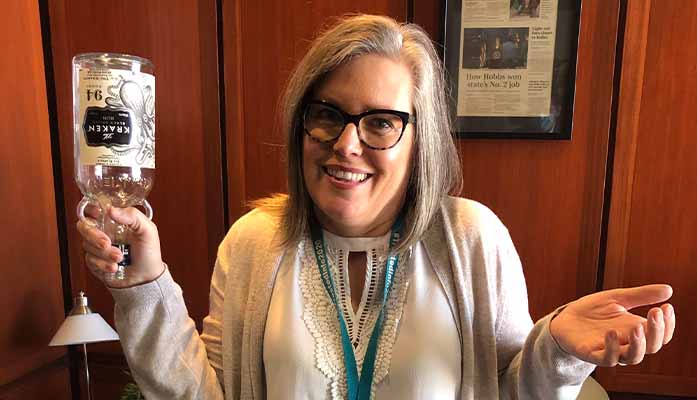
Although the causes are attributed to various factors by different sources, largely dependent on political leanings, one irrefutable fact emerged on Monday. During Governor Katie Hobbs’ tenure, Arizona has plunged from a ranking of 4th place in the nation in job growth, to 47th.
On Monday, Russ Wiles, writing for the Arizona Republic noted, “AZ no longer ranks near the top for job creation,” and asked rhetorically, “What went wrong?”
Citing figures from the U.S. Bureau of Labor Statistics, the Republic reported that Arizona now ranks in 47th place among the fifty states, just ahead of Massachusetts, West Virginia, and Iowa. The report cited a net loss of 1,900 jobs year-to-date in 2025.
In 2020, at the height of the first Trump Administration and under former Gov. Doug Ducey’s tenure, Arizona ranked third in the nation for economic momentum.
In 2019, the Phoenix Metro area even beat out the largest cities in California, Texas, and Florida to take the #1 slot for job growth.
More recently, in a March 2024 statement, Hobbs touted that Arizona ranked 4th in job growth, and tripled the national average in workforce growth. In the pronouncement, which has aged quite poorly, the governor even dubbed herself “Governor Katie Jobbs,” and credited the “81,800 jobs created,” to “investments in housing, healthcare, infrastructure, childcare, and education.”
Meanwhile, a Goldwater Institute op-ed in January, predicting an acrimonious budget battle that materialized over the next five months, pointed out Hobbs’ askew priorities. While the beleaguered Democrat focused on defeating Arizona’s popular Empowerment Scholarship Account program (ESA) and presided over a surge in crime, her failure to account for $800 million in statutorily required Medicaid spending and an affordable housing crisis represented “fiscal mismanagement at its worst.”
AZCentral’s Russ Wiles, in working to answer “What went wrong?” addressed one factor in the decline as “slowing migration, with fewer people moving here from other states,” which dovetails with the affordable housing issue and the Arizona Department of Water Resources (ADWR) rule cracking down on new developments.
Lee McPheters, director of the Economic Outlook Center for Arizona State University’s W. P. Carey School of Business, noted to the outlet, “With domestic migration trending down and international migration dropping off a cliff in 2025, the impetus for population growth has diminished and undoubtedly plays a role here.”
In May, Goldwater launched a legal battle against the Hobbs administration over the ADWR’s controversial new rule imposing the requirement of a 100-year “unmet demand” groundwater supply rule across wide swaths of the state, essentially choking out new housing development.
In addition, as Wiles notes, construction employment has been further weakened by rising material costs, with overall job growth stunted by tariff uncertainty and high interest rates.
Large scale layoffs, such as Nikola Corp.’s 855 jobs lost to its February bankruptcy and Joann Fabrics’ layoffs of 374 employees in January, also factored in heavily. While not directly attributable to Hobbs’ actions, the losses drew a spotlight to a lack of decisive action from Hobbs to attract new employers to Arizona in the short term.
Another factor, unmarked by AZCentral however, has been the $1.6 billion deficit under Hobbs which forced budget cuts, including Department of Economic Security layoffs that directly contributed to the 1,900 net job loss. As Common Sense Institute of Arizona (CSIAZ) explained in June, rather than being caused by Arizona’s flat tax, the shortfall was caused by a massive increase in spending under Hobbs.
“If spending had followed historical trends, Arizona would have had a $4.3 billion surplus rather than a $1.6 billion cash shortfall last year,” CSIAZ wrote.
Hobbs’ vetoes could present the most egregious contribution she’s made. By vetoing 178 total bills in 2025, 73 in 2024, and 143 in 2023, totaling 424 to date, or approximately a third of all bills sent to her desk, Hobbs has prevented the implementation of a comprehensive policy for economic growth from either her administration or Republican leaders in the state legislature from materializing.
Ultimately, Hobbs’ unwillingness to work productively with Republican lawmakers and her active obstruction of legislation to reduce tax burdens, ease regulation, and stimulate job growth may have proven to be as prominent in Arizona economics as it has been in politics. And as prominent Democratic President Harry Truman famously said, “The buck stops here.”
Matthew Holloway is a senior reporter for AZ Free News. Follow him on X for his latest stories, or email tips to Matthew@azfreenews.com.
by Matthew Holloway | Aug 17, 2024 | Economy, News
By Matthew Holloway |
Arizona Rep. David Schweikert shared the shocking July Consumer Price Index (CPI) report of the U.S. Bureau of Labor Statistics that utterly shatters any narrative suggesting that the economy has recovered and inflation is abating. Citing the Bureau, Schweikert’s office noted that consumer prices are up 0.2% month-over-month and 2.9% compared to 2023. This requires the average family to spend $13,138 more per year to maintain the same lifestyle they enjoyed in 2021, while real average weekly earnings dropped 3.9%.
Most damningly, per the report, Cumulative CPI inflation (not seasonally adjusted) is up a devastating 20.2% with the American people effectively losing one-fifth of their buying power since President Joe Biden and Vice President Kamala Harris took power in 2021.
In several states, the cumulative inflation is significantly higher still. In the states of Arizona, Utah, Colorado, and Nevada, all key states in the 2024 Presidential election, cumulative inflation stands at 21.8%, and cumulative additional costs are the highest in the nation with Colorado’s the worst at $36,703 per average household. Colorado is exceeded only by Washington, D.C. where the cost increase is a staggering $41,313 per household. Arizonans have spent $32,625 more due to cumulative inflation.
Schweikert said in the statement:
“Though hardworking Americans received positive news this morning that inflation continued to slow in July, overall prices are still up more than 20% and real average weekly earnings are down 3.9% since the beginning of the Biden-Harris administration.
From Day One, this administration’s radical agenda has been a rubber stamp for growth-slowing tax hikes and runaway inflationary spending that have dramatically reduced Americans’ purchasing power and standard of living. It’s no wonder that consumers have declining confidence in President Biden and Vice President Harris to improve their financial standing after three-and-a-half years of economic calamity.”
The congressman’s office summarized the lengthy report, finding that food prices have increased 22% since January and energy costs have skyrocketed over 40%.
According to the JEC State Inflation Tracker, the average U.S. household was forced to spend $1,095 more in July, or $13,138 more per year, to maintain the same consumption basket they had in January 2021.
Headline CPI-U inflation increased 0.2% m/m and 2.9% y/y.
Core CPI-U inflation increased 0.2% m/m and 3.2% y/y.
Since January 2021:
- Headline CPI-U inflation has increased 20.2%.
- Core CPI-U inflation has increased 18.3%.
- The food price index has increased 22%.
- The energy price index has increased 40.2%.
Real average weekly earnings for all employees have decreased by 3.9%.
On the national inflation tracker, measuring the additional monthly cost for the average U.S. household since January 2021, Arizona placed 11th, well above the national average. The five states that enjoyed the smallest cost increases due to inflation were Arkansas, Oklahoma, Maine, West Virginia, and Louisiana.
On August 2, the Joint Economic Committee Republicans also reported that per the July jobs report, only 114,000 new jobs were added to the economy, well short of the 175,000 projected, and unemployment has increased to 4.3%, further indicating a weakening economy. A week prior, in a fiery speech to a largely empty House, Schweikert sarcastically congratulated Congress for the gross national debt passing $35 trillion.
He admonished his colleagues arguing to protect Social Security, saying they should “know the math and know how it actually works.”
Matthew Holloway is a senior reporter for AZ Free News. Follow him on X for his latest stories, or email tips to Matthew@azfreenews.com.