by Corinne Murdock | Feb 25, 2024 | News
By Corinne Murdock |
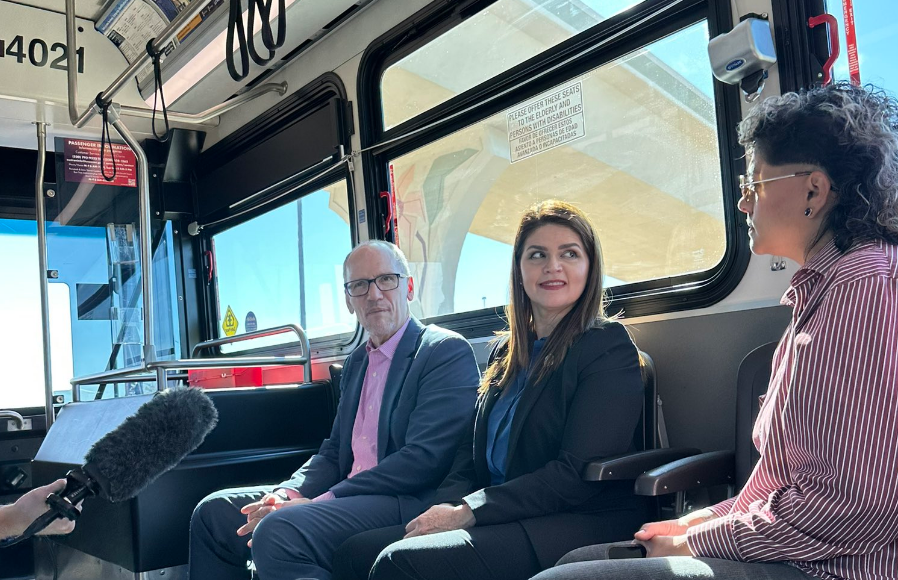
Tucson Mayor Regina Romero played host to President Joe Biden’s senior advisor last week to discuss public infrastructure.
Tom Perez, senior advisor and assistant to the President and director of the White House Office of Intergovernmental Affairs, visited the city of Tucson on Tuesday. Perez, the former chairman of the Democratic National Committee, visited as part of the Investing in America tour highlighting initiatives funded by the Bipartisan Infrastructure Law (BIL) and Inflation Reduction Act (IRA).
In a press conference, Perez said that the Biden administration prioritizes giving awards to those projects rooted in equity.
“There has never been in our lifetime a more robust investment in building America, building out our infrastructure, making sure in that process that we view everything through that equity lens, understanding that zip code will no longer determine destiny,” said Perez. “We have this opportunity folks, and we are not going to squander this opportunity to build an Arizona, and to build an America where everybody has access to good middle-class jobs, where high speed, affordable internet is a reality so that if you have a behavioral or mental health issue, you can do telemedicine.”
Among the initiatives for which Tucson received millions in federal funding under IRA and BIL was the 22nd Street Bridge revitalization, TARP Facility, Tucson Million Trees (TMT), and relinquishment of their water rights.
The Biden administration gave Tucson $25.9 million to build the 22nd Street Bridge. According to the Department of Transportation (DOT), it was the city’s focus on equity for the project that secured the funds.
Tucson also received a $5 million grant from the USDA last September for TMT. Despite the funding, TMT has fallen far short of its goal to plant one million trees by 2030. Only about 100,000 trees were planted as of last year.
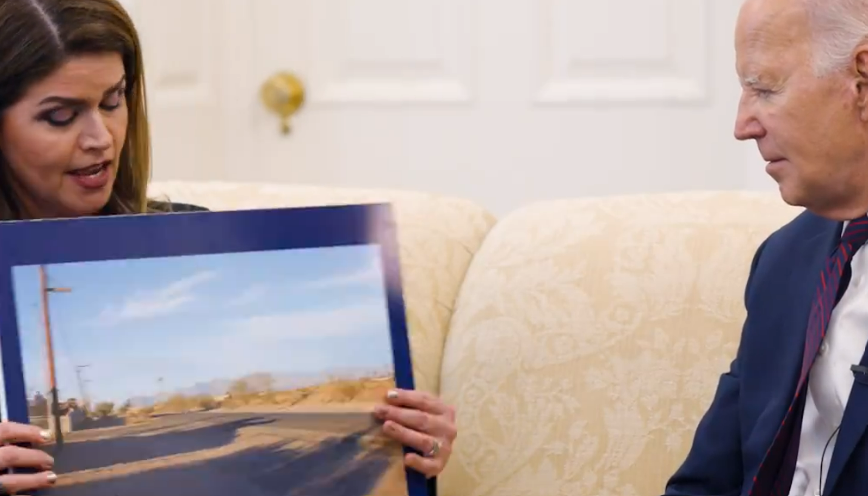
However, Romero claimed in a one-on-one meeting with President Joe Biden earlier this month that TMT was on track.
Tucson also traded its water rights for $44 million in federal infrastructure funds last summer: over 110,000 acre-feet through 2025.
Perez also made a stop with another major Arizona city that has received millions in BIL and IRA funds.
Last Monday, Perez visited with Phoenix Mayor Kate Gallego to discuss the availability of funds to both public and private entities for “clean” energy initiatives, such as electric buses for schools or solar panels for churches.
Earlier this month, Perez and National Economic Advisor Lael Brainard met with county elected officials through the National Association of Counties Legislative Conference to discuss Biden’s Investing in America agenda. Santa Cruz County Supervisor Manuel Ruiz was among those elected officials to attend.
Per White House data on federal awards, the Biden administration has issued over 1,800 BIL discretionary and formula grants in Arizona. USDA data reflects that Arizona has requested over $2.1 billion in clean energy funding.
Corinne Murdock is a reporter for AZ Free News. Follow her latest on Twitter, or email tips to corinne@azfreenews.com.
by Corinne Murdock | Feb 4, 2024 | News
By Corinne Murdock |
Tucson Mayor Regina Romero told President Joe Biden earlier this week that her plan to plant one million trees in the city by 2030 is on track, yet Tucson is falling far short: only about 100,000 have been planted as of last year.
The initiative, Tucson Million Trees (TMT), would require the city to plant over 128,000 trees annually to reach their goal. Averaging out the number of trees planted since TMT began in 2020, that means the city has only planted about 33,000 trees a year. Should that trend continue, the city will have around 330,000 trees planted by 2030.
“[M]y vision of planting a million trees by 2030 is becoming a reality,” claimed Romero.
The halted progress in tree-planting has persisted despite the extensive and varied funding sources committed to the initiative, including the $5 million grant issued last September from the USDA for which Romero thanked Biden. That USDA funding came from the Inflation Reduction Act.
The city’s inability to achieve its million-tree goal in a timely manner may have to do with who the city selected to lead the program.
When Romero launched the TMT initiative in April 2020, the city created the new position of “Urban Forestry Program Manager” to oversee it. That position originally paid up to $95,000 annually.
Tucson hired Nicole Gillett for that inaugural role, though it appears that her prior experience didn’t match the listed requirements and preferred qualifications of the program manager’s job description.
Prior to her hiring by the city, Gillett was a conservation advocate for the Tucson Audubon Society from 2017 to 2020. On LinkedIn, Gillett described her conservation advocacy as, mainly, activism for the protections of birds and their habitats.
Prior to that role, Gillett was a graduate student studying community flood resilience in New England — which consisted of small-town flood preparedness and response as well as community outreach — and before that, she earned a BA studying community integration in marine conservation efforts.
According to Tucson’s original job description, the city needed an Urban Forestry Program Manager that could demonstrate experience designing, implementing, monitoring, and evaluating urban forestry projects, as well as experience leading and managing a major urban forestry or related program. At a minimum, the city required the candidate to have at least three years of “managing complex projects and coordinating experts from different fields.”
As for preferred qualifications, the city asked for candidates with a minimum of five years of experience in “practical tree and plant appraisals,” a minimum of five years of “progressively responsible experience in forestry or a related area,” field experience related to the planting and maintenance of native trees, as well as a minimum of five years of community organizing and/or mobilizing.
The city further considered additional relevant experience to include certification from the International Society of Arboriculture; possession of a Tree Risk Assessment Qualification; experience developing, implementing, and evaluating comprehensive ecological restoration and monitoring plans; experience implementing adaptive management and developing socioecological success indicators for urban forestry projects; experience in the selection and management of trees as part of green stormwater infrastructure features; experience in Green Stormwater Infrastructure and data management related to urban forestry; experience in remote sensing and Green Vegetation Indices; knowledge and experience related to tree diseases and pests; experience with forestry-related public relations, communications, and marketing; and administrative experience related to budget management, procurement, and payments.
Additionally, current city partnerships have fallen short of the manpower needed to make progress on the initiative.
One of the city’s key partners to see TMT through is the nonprofit Tucson Clean & Beautiful. However, that nonprofit hardly makes a dent in the city’s goal.
Tucson Clean & Beautiful told the Arizona Daily Star that they aim to plant about 100 trees weekly, or over 5,000 trees a year. Their efforts, if consistently hitting 100 trees weekly every week for a decade, amount to just five percent of the million-tree goal.
‘The nonprofit also receives funding from other entities and corporations, including Target, Bank of America, the Arizona Department of Forestry and Fire Management, Republic Services, Southwest Gas, Circle K, Coca-Cola, Qwest, and REI.
Gillett’s former employer, Tucson Audubon Society, also received a portion of the $5 million federal grant to assist TMT, along with the Iskashitaa Refugee Network, Sonora Environmental Research Institute, and Watershed Management Group.
TMT is part of the city’s Climate Action program, which includes the expansion of electric vehicle infrastructure and usage, expansion of solar energy usage, establishment of Green Stormwater Infrastructure on public property, refurbishing buildings to be more energy efficient and climate resilient, and coordination of public cleanups.
TMT targets mainly poorer areas using a “Tree Equity Score” based on one by American Forests.
Corinne Murdock is a reporter for AZ Free News. Follow her latest on Twitter, or email tips to corinne@azfreenews.com.