by Daniel Stefanski | Jul 23, 2023 | Education, News
By Daniel Stefanski |
A federal judge has issued a ruling in a case involving Arizona’s recently passed Save Women’s Sports Act.
On Thursday, Judge Jennifer Zipps, in the United States District Court for the District of Arizona, granted a preliminary injunction against SB 1165, which was signed by former Governor Doug Ducey on March 30, 2022. The law would prohibit biological males from competing in women’s and girls’ athletic events at state public schools, colleges, and universities. Judge Zipps’ order blocks the law from going into effect.
Arizona’s Republican Superintendent of Public Instruction, Tom Horne, released a statement after the judge’s order, vowing to continue his fight to uphold the law. Horne said, “We will appeal this ruling. This will ultimately be decided by the United States Supreme Court, and they will rule in our favor. The Plaintiffs in this case claimed that this only involves pre-pubescent boys, but we presented peer-reviewed studies that show pre-pubescent boys have an advantage over girls in sports. The only expert presented by the Plaintiffs was a medical doctor who makes his money doing sex transition treatments on children and who has exactly zero peer-reviewed studies to support his opinion.”
One of the representatives of the plaintiffs, Justin R. Rassi from Debevoise & Plimpton LLP, lauded the judge’s ruling, writing, “The Court’s well-reasoned decision exposes the lack of any legitimate justification for this discriminatory law, which inflicts severe and irreparable harm on transgender girls like Megan and Jane. We are very happy that, as a result of this ruling, Jane and Megan will be immediately able to resume playing sports with their friends.”
Judge Zipps found that “the Arizona legislature intentionally created a classification, specifically ‘biological girls,’ that necessarily excludes transgender girls, and expressly allowed only that exclusive classification to play girls sports to the exclusion of transgender girls.” The judge wrote, “Enforcement of the Act in violation of the Equal Protection Clause in and of itself is sufficient to presume irreparable harm to justify a preliminary injunction.”
While Superintendent Horne has taken the primary lead in defending this law, he hasn’t been the only public official to take action in this case. Earlier this year, both Arizona Senate President Warren Petersen and House Speaker Ben Toma filed a Motion to Intervene in the matter. The Senate Republican’s press release highlighted that “on April 17, 2023, plaintiffs represented by a radical organization filed a motion for a preliminary injunction to stop the law from being enforced in Arizona,” and “Attorney General Kris Mayes is not defending the constitutionality of the law.”
At the time of their filing, Petersen said, “In the absence of the Attorney General defending Arizona’s law, we’re looking forward to fighting for the rights of female athletes across Arizona, as well as for the Court making it clear Arizona’s law protecting women and girls should be enforced.”
Daniel Stefanski is a reporter for AZ Free News. You can send him news tips using this link.
by Daniel Stefanski | Jul 21, 2023 | Education, News
By Daniel Stefanski |
Arizona’s Republican Superintendent of Public Instruction is pushing back after the state’s Democrat Attorney General issued a legal opinion on a Structured English Immersion law.
On Tuesday, Superintendent Tom Horne issued a press release to call a recent formal opinion from Attorney General Kris Mayes “ideologically driven.”
The Attorney General’s opinion answered the question of “which state entity has statutory authority to eliminate a model of structured English immersion approved by the State Board of Education.” Mayes sent her findings to Democrat Representatives Jennifer Pawlik, Laura Terech, Nancy Gutierrez, and Judy Schwiebert.
Mayes wrote, “Arizona law is clear that the Board has the sole authority to eliminate or modify an approved SEI model. The Board also has the sole authority to determine whether a school district or charter school has failed to comply with Arizona law governing English language learners. Only those school districts and charter schools found by the Board to be noncompliant are barred from receiving monies from the English language learner fund.”
The Attorney General declined to answer the Representatives’ question of “whether the Dual Language Immersion SEI Model approved by the Board is consistent with Arizona law.”
Horne disagreed with the opinion, stating, “The Attorney General, for ideological reasons, wanted to rule in favor of the Democrat legislators who favor dual language. So, she refused to comment on whether a dual language program without waivers violates the voter protected initiative (Proposition 203). She simply said that the State Board of Education has the power to adapt models under legislation. Neither the legislature nor the board has the power to overrule a voter approved initiative. Legislative Council found that dual language without a waiver does violate the initiative.”
The scuttle between Horne, Mayes, and Democrat legislators began on June 19, when the Superintendent announced that “public schools that are not teaching English Language Learners in English as required by state law risk losing funds for this legal violation.” Horne said at the time, “Proposition 203, the voter protected initiative passed in 2000, specified that classes for English Language Learners must be taught in English: ‘all children in Arizona public schools shall be taught English by being taught in English and all children shall be placed in English language classrooms.’”
Horne also included a memorandum from the Arizona Legislative Council to make his case, which read, “If the 50-50 dual language immersion model allows students to be taught subject matter in a language other than English as part of structured English immersion, the model likely violates Proposition 203.”
Later, he countered opposition to his action, saying, “In 2000, more than 925,000 Arizonans – 63 percent of voters – approved Proposition 203, making English immersion the law…. Before I took office the first time in 2003, when they had bilingual education, Lisa Graham Keegan reported to the legislature an English proficiency rate of 4%. The English proficiency rates for structured English immersion, by contrast for the last four years when I was last Superintendent (2007-2010), were an average of 31% each for those years.”
He then shared English proficiency rates for four Arizona schools, that the Superintendent asserted have had dual language for several years. According to the Superintendent’s release, those four schools had English Proficiency Rates of under 10%.
Earlier this month, Superintendent Horne posted a statistic on English Immersion success, writing: “English immersion gives students three quarters of a year more education, they’re 50% more likely to earn a bachelor’s degree, and earn significantly more in the labor market.”
In his response to Attorney General Mayes’ opinion, Horne charted the path forward for his battle with the state’s top prosecutor. Horne said, “This will obviously be resolved in the courts. Until that happens, the State Board will not withhold funds. However, there are other remedies in the initiative for violation of its requirements. Any parent can sue a school or district that adopts dual language without waivers, and if the parent is successful, the school board, and the superintendent, and maybe the principal must leave office and cannot apply for their offices for five years. That will be a considerable incentive for school districts not to adopt dual language without waivers.”
The battle over the Structured English Immersion law is the second significant conflict between the Attorney General and Superintendent this year. In May, Attorney General Mayes said on television that “there are no controls” on the ESA program, “no accountability,” that “they” (presumably parents) are “spending hundreds of millions of dollars of taxpayer money,” that this “needs to be looked at,” and that it’s (her) “responsibility to do that” as Arizona’s “top law enforcement officer.”
At that time, AZ Free News featured Horne’s reaction to Mayes’ comments: “Under my predecessor, who was unfriendly to universal Empowerment Scholarship Accounts (ESAs), the laws were not strictly enforced, and therefore funds were used for non-educational purposes, including restaurants and clothing stores. Because I am the defender of the ESA program, I want the laws to be strictly adhered to. I want to ensure that not one penny is used for a non-educational expense. Arizona is the first in the nation, and a model for the rest of the country. I am determined that all laws be strictly enforced, and all funds be used only for valid educational purposes. I’m disappointed that Attorney General Mayes has chosen, at every single opportunity, politics over the law.”
Daniel Stefanski is a reporter for AZ Free News. You can send him news tips using this link.
by Daniel Stefanski | Jul 3, 2023 | Education, News
By Daniel Stefanski |
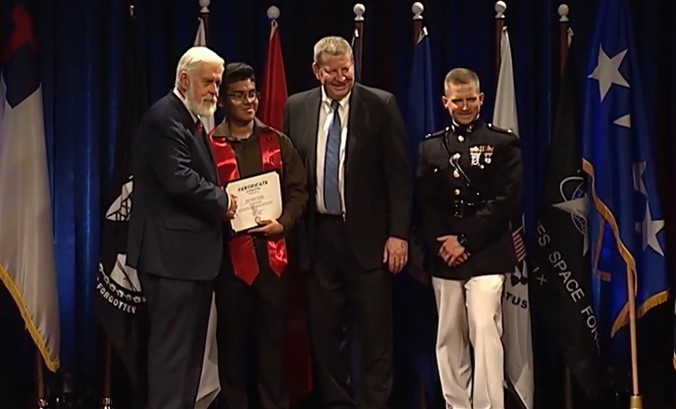
Arizona’s Superintendent of Public Instruction shared a helpful announcement about a new feature for high school students seeking information about careers in the U.S. military.
In a release sent last week, the Arizona Department of Education revealed that it had “unveiled a one-stop service to help students interested in a military career get information about the U.S. armed forces.” The website – azed.gov/military – was established so that “students can get essential information about the various branches of the service.”
Horne, a Republican, issued a statement in conjunction with the announcement, saying, “With a historic shortfall of U.S. military recruiting goals, Arizona high schools need to do as much as possible to help students get the information they need to learn if a career in the armed services is an appropriate choice for them. Serving our country is an honorable endeavor and our nation will depend on the next generation of those who enlist or become officer candidates so that our military can continue to defend our freedoms.”
The release highlighted that “the need for this effort was presented to state schools chief Tom Horne earlier this year by Raif Byers, a now-graduated Phoenix-area high school senior who was unable to find helpful and detailed information about a military career on the websites for his high school or the district he attends. He found that many other students his age have the same problem.”
Byers added, “I was trying to learn more about a career in the Navy when I was in high school, but it was nearly impossible for me to find any information on my school district website. It’s relatively easy to learn about other types of careers, so I believe it’s just as vital for schools to make armed services information readily available to students. Unfortunately, I learned that in many districts, that’s just not the case. I’m very grateful to Superintendent Horne for creating this webpage where anyone in the state can easily learn about a career serving our country.”
According to the Arizona Department of Education, “the webpage includes links to the Army, Navy, Marine Corps, Air Force, Space Force, Coast Guard, Army National Guard and Air National Guard. It also has details about the various military benefits and information for those interested in becoming officers or enlisted personnel.”
Horne’s efforts join several other similar endeavors from public officials around the state, who are very active in promoting opportunities in the U.S. Military or honoring those who serve. Recently, Glendale Mayor Jerry Weiers “partnered with local sponsors to host the Mayor’s Military Induction Ceremony” at a Phoenix-area church – with over 350 recruits!
In May, two in Arizona’s congressional delegation, Andy Biggs and Eli Crane, co-hosted a Military Service Academy Conference to give high school students more information about opportunities to learn more information about future military service and career opportunities.
Daniel Stefanski is a reporter for AZ Free News. You can send him news tips using this link.
by Corinne Murdock | Jul 2, 2023 | Education, News
By Corinne Murdock |
On Thursday, the Ninth District Circuit Court denied Superintendent Tom Horne’s emergency petition for the relocation of a lawsuit challenging Arizona’s ban on boys in girls’ K-12 sports.
Horne filed the emergency petition last month after District Court Judge Jennifer Zipps twice refused to approve his requested change of venue to a Phoenix court. The case sits currently in Tucson.
Horne’s team argued in their change of venue requests that his residency and primary duties as superintendent relegated him to Phoenix, making travel to a Tucson hearing difficult to arrange. They also argued that Zipps failed to follow Ninth Circuit precedent deferring to the state’s strong public policy interest in protecting residents and elected officials subject to frequent lawsuits from inconvenient venues.
“The District Court thus seriously erred and abused its discretion in overlooking or failing to properly weigh the effect of two Arizona statutes requiring suits against public officials to be filed in the county in which they hold office […] and requiring suits against the state to be filed in Maricopa County,” stated Horne. “Because public officials are subject to more lawsuits based on their public service, the State of Arizona has enacted special venue provisions requiring that public officials be sued in a venue that is convenient to the public official[.]”
However, the Ninth District Court determined that Horne hadn’t demonstrated a “clear and indisputable right” to such a change of venue.
In the case, Jane Doe v. Thomas Horne, the parents of an 11-year-old boy and a 15-year-old boy sued the state in April. The parents are seeking an injunction on SB1165, which requires children to play on sports teams aligning with their gender in K-12 sports.
The lawsuit claims that transgenderism — a mental dissonance between one’s perceived and actual biological gender — is a sex-based trait.
The lawsuit also claimed that all individuals have a gender identity — a perception of one’s gender in addition to their biological reality — and that the only proper treatment for those with gender dysphoria was to allow the full exercise of the dysphoric feelings.
The children in the case are an 11-year-old Maricopa County boy that desires to play girls’ basketball, cross country, and soccer, named “Jane Doe” for anonymity, and a 15-year-old Pima County boy who desires to play girls’ volleyball, “Megan Roe.”
“Under the medical standards of care for the treatment of gender dysphoria in adolescents, the only safe and effective treatment for gender dysphoria is to permit transgender adolescents to live consistent with their gender identity in all aspects of their lives,” stated the lawsuit.
Doe hasn’t begun puberty blockers yet, but plans to at the onset of puberty; Roe has been on puberty blockers since 11 years old, and hormone replacement therapy since 12 years old.
Horne told The Associated Press that the lawsuit was “backwards” and an attempt to steal protections instituted for girls and women originally.
“Title IX was aimed at giving girls equal opportunities for playing sports. When a biological boy plays in a girl’s sport, it disadvantages the girls,” said Horne. “There have been lots of news stories about girls who worked hard to excel at their sports, found they could not when they had to compete against biological boys and were devastated by that.”
One mother, who remains anonymous due to concerns over her family’s safety, told The Associated Press that she worries about her son’s mental health due to this lawsuit.
“Jane knows this would be because [he] is transgender, and I worry about how that will affect [his] self-esteem and [his] confidence,” said the mother.
AIA first began to allow transgender students to compete on the sports team of the opposite sex in 2014. The AIA thereafter considered these acceptances on a case-by-case basis. In 2018, the AIA revised the policy to allow students to compete on sports teams that aligned with their gender identity rather than biological sex.
The lawsuit claimed that since no reported harm had come of the several students who exercised this policy, the Arizona legislature had no basis for passing its ban last year.
Attorney General Kris Mayes refused to defend the law in court, prompting State Sen. President Warren Petersen (R-LD14) and State House Speaker Ben Toma (R-LD27) to intervene.
Corinne Murdock is a reporter for AZ Free News. Follow her latest on Twitter, or email tips to corinne@azfreenews.com.
by Daniel Stefanski | Jun 12, 2023 | Education, News
By Daniel Stefanski |
Arizona’s Republican Superintendent of Public Instruction gave an update on the new Empower Hotline from the state’s Department of Education.
On Thursday, Superintendent Tom Horne provided an update on the Empower Hotline program and elaborated on some of the concerns that his staff had fielded since the March launch. According to the Department, “the Empower Hotline allows parents to report inappropriate content being taught that detract from teaching academic standards. These include those that focus on race or ethnicity, rather than individuals and merit, promoting gender ideology, social emotional learning, or inappropriate sexual content.”
In a release sent after the update, the Department made clear that complaints submitted through the Empower Hotline have revealed potential violations to state law and demonstrate that elements of Critical Race Theory are present in the public school system.
Horne issued a statement in conjunction with the press release, saying, “Despite those in ideological groups and some in the media that propagate the urban myth that CRT is not a part of the school system, we have evidence from the empower hotline, that there is enough CRT in our schools to constitute a problem, though it is obviously not universal. We also have evidence that schools have put systems in place to hide or attempt to hide critical personal information from parents about their child. This is in direct violation of Arizona law, A.R.S. §1-602.”
The Arizona Department of Education pointed to three examples of vetted concerns brought to staff through the Empower Hotline. The first came from Mesa, where the Department shared that “a teacher reported through the hotline that the Mesa school district has a training program for teachers that clearly states that certain Americans are ‘living under a system of white supremacy.’” Horne added, “That is a divisive and bigoted statement that has no place in education. We are individuals, entitled to be judged by what we know, what we can do, our character, and not the color of our skin. To its credit, Mesa is in discussion with the Department about this.”
The other two examples occurred in the Catalina Foothills School District and in the Chandler Unified School District. In the Catalina Foothills instance, the Department revealed that a concern was raised regarding “a spreadsheet distributed in this school district with a list of pronouns chosen by students. The email and attached file clearly show the school withholding information from parents contrary to A.R.S. §1-602.”
In Chandler, the Department reported that “a lunch time Gay-Straight Alliance Club was created to discuss gender issues but also included the distribution of emancipation paperwork, which a parent only knew about because parents found it in their students backpack. Both of the above are examples of activity contrary to Arizona law.”
Since assuming office in January, Horne has worked tirelessly to shed light on what children are being taught and exposed to in their schools, giving interested parents the transparency that many have demanded in increasing numbers over the past few years. Horne stated, “Since its inception earlier this year, ADE has been compiling information regarding inappropriate activity occurring in Arizona schools through the Empower Hotline. These complaints have come not just from concerned parents but also from teachers. When parents saw during COVID what students were being taught on their laptop, they were outraged by CRT content, and went to school board meetings, where some were treated rudely. The Employer Hotline directs them to a method to communicate their concerns.”
The Department also communicated that the Hotline had received 30,000 crank calls and emails since its inception in March, promising that “all legitimate complaints received through the Empower Hotline will continue to be accepted and investigated.”
Daniel Stefanski is a reporter for AZ Free News. You can send him news tips using this link.