by Staff Reporter | Aug 2, 2026 | News
By Staff Reporter |
The federal government expects Arizona to do more to conserve its water in the ongoing Colorado River supply crisis while other basin states face far lower restrictions.
Arizona’s elected leaders responded that the state has done more than its fair share to conserve water throughout this historic multi-decade drought, and that they would not accept this federal directive. They indicated that they may challenge the directive in court.
The Final Environmental Impact Statement on Colorado River operations, released by the Bureau of Reclamation on Friday, would require Arizonans to cut water usage by up to 77% in 2027 and 2028.
Arizona, California, and Nevada had proposed water usage reductions that would have reduced Arizona’s supply by about 31%, but the federal government rejected that proposal.
The Arizona Department of Water Resources (ADWR) said the federal decision would “devastate” Arizonans and the state’s economy. ADWR criticized the federal framework for not including reductions to the Upper Basin or sufficient use of water in those upper reservoirs.
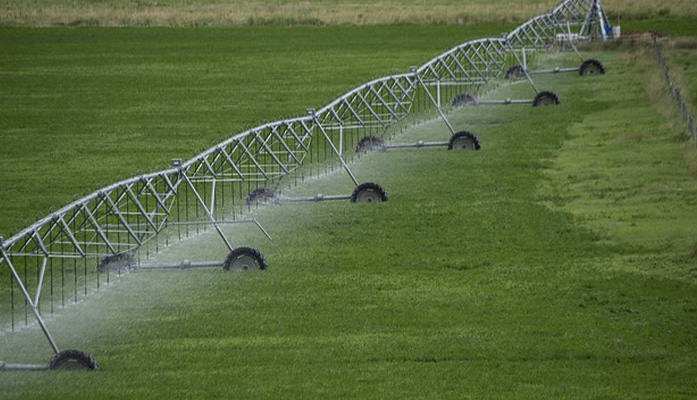
The Colorado River Basin provides drinking water and power for more than 40 million people, and irrigation water for more than five million acres of agricultural land. A 26-year drought has reduced the basin to historically low runoff and reservoir levels.
Arizona, California, and Nevada rely on water from the Lower Basin, while Colorado, Utah, Wyoming, and New Mexico rely on the Upper Basin.
Gov. Katie Hobbs expressed hope that the Department of the Interior (DOI) would still accept the Lower Basin alternative plan, but acknowledged the federal restrictions contained “unacceptable options” that included having Arizona take on the majority of water cutbacks, which Hobbs called “draconian.”
As Rep. Andy Biggs (AZ-05), Republican nominee for governor, mentioned in his appeal to Congress for Colorado River emergency funding, Hobbs cited Arizona’s unique position as a power player in the agricultural and defense industries.
“Arizona provides the agricultural produce, critical minerals, weapons defense systems and cutting-edge semiconductors that feed America, protect America and fuel America’s high-tech economy. No other state in the Colorado River basin can say the same,” said Hobbs.
The DOI has been unsuccessful in its attempts the past six years to reach consensus with Arizona and the six other basin states concerning long-term operational guidelines. The lack of consensus didn’t stop the federal release of the environmental impact statement, since current operational guidelines expire this year and the government must begin new operations on October 1 of this year.
Danny Seiden, President and CEO of the Arizona Chamber of Commerce & Industry, condemned the DOI decision as placing a “deeply disproportionate burden on Arizona” while failing to provide a cohesive conservation solution for all basin states. Seiden said they would stand alongside state leaders to demand a fairer decision.
“[A] plan that imposes severe, enforceable reductions on Arizona while shielding senior users and allowing other states to avoid comparable mandatory commitments is neither fair nor sustainable,” said Seiden. “Arizona will do its part, as it always has, but we will not accept being treated as the system’s default shock absorber. Any sustainable path forward must recognize Arizona’s conservation record, protect the investments our state has already made, and require measurable contributions from the entire Colorado River Basin.”
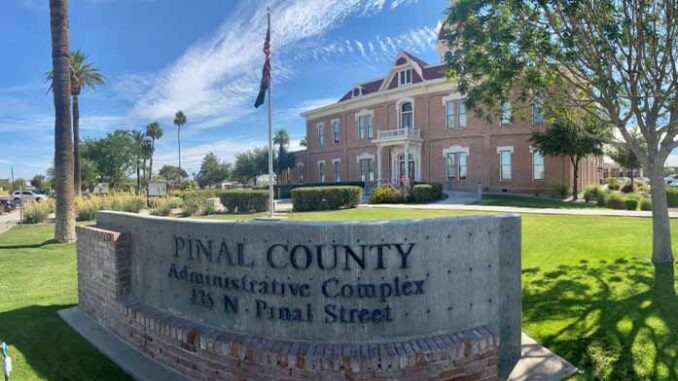
Rep. Teresa Martinez, an LD16 Republican whose constituents also hail from Pinal and Pima counties, questioned who in Arizona would be expected to cut water usage, and who would be given the better end of the deal.
Martinez said the federal government is forcing communities and farmers to bail out those beginning to feel the effects of the water crisis.
“Pinal County farmers already lost their Colorado River water. That happened years ago. They took the hit without a bailout, without fanfare, and without much sympathy from anybody,” said Martinez. “Rural Arizona cannot keep being treated like the first place to cut and the last place anyone thinks about.”
Martinez said she plans to speak with LD16 community leaders, especially those within the agriculture industry, to gauge the anticipated impact of this latest decision.
AZ Free News is your #1 source for Arizona news and politics. You can send us news tips using this link.
by Ethan Faverino | Feb 12, 2026 | News
By Ethan Faverino |
State Representative Teresa Martinez (R-LD16) recognized Pinal County Sheriff’s Office (PCSO) Deputies Gregory Sanders and Jacob Montoya on the floor of the Arizona House for their courageous actions in rescuing an 8-year-old boy from a suspected human trafficking and smuggling operation in January.
In a formal legislative proclamation read before members of the House, Rep. Martinez honored the deputies for their quick thinking, professionalism, and unwavering commitment during a multi-agency traffic stop that led to the child’s safe recovery and the arrest of a suspect.
“These deputies trusted their training, asked the right questions, and refused to ignore what didn’t add up,” stated Martinez. “Because of their professionalism and courage, a child was removed from danger and protected. This is the kind of work Pinal County deputies do every day to keep our communities safe.”
According to PCSO, the incident began on January 7, when a multi-agency task force, including officers from Cochise County and federal partners, conducted a traffic stop on a vehicle with Mexican license plates in Cochise County. The driver, a Mexican citizen, was transporting two young children: her biological daughter and an unrelated 8-year-old boy.
During a subsequent search of the vehicle for narcotics, federal partners flagged suspicions of child trafficking linked to cartel activity. The vehicle was temporarily seized, and the woman obtained a motel room in Eloy, Arizona. PCSO deputies were called to make contact.
Upon questioning, deputies observed inconsistencies in the woman’s story. The boy appeared coached in his responses and was unable to correctly identify the woman as his guardian. Deputies separated the child from the suspect, confirmed that he was unharmed, and learned the woman had provided a false name for the boy.
She ultimately admitted to being paid $500 to transport the 8-year-old across the border for unknown individuals, with no knowledge of his family or destination.
Body camera footage released by the Pinal County Sheriff’s Office captured the interaction, including the moment the suspect confessed to the payment and the boy’s visible relief and comfort once separated from her, allowing him to speak freely without coercion.
Cochise County deputies assisted in Eloy, and federal agents took custody of the boy to facilitate family reunification efforts. The suspect was placed in federal custody, facing potential charges, while the investigation continues to determine the full intentions of the traffickers.
Following the proclamation, Rep. Martinez praised the Pinal County Sheriff’s Office and all involved agencies for their collaborative efforts in combating human trafficking and protecting vulnerable children.
Ethan Faverino is a reporter for AZ Free News. You can send him news tips using this link.
by Ethan Faverino | Feb 4, 2026 | News
By Ethan Faverino |
The Arizona House of Representatives paid tribute to the life and legacy of Charlie Kirk, founder of Turning Point USA, during a special session at the State Capitol in Phoenix on Thursday, January 29, 2026.
Erika Kirk, widow of Charlie Kirk and current leader of Turning Point USA, was warmly welcomed to the House floor, where she delivered a heartfelt opening prayer. She drew from a Bible verse on Charlie’s desk as she prayed for courage in defending freedom, healing for the nation, integrity in governance, and blessings upon those present.
Following the prayer, a Legislative Proclamation sponsored by State Representatives Teresa Martinez (R-LD16) and Matt Gress (R-LD4) was read aloud in the chamber. Titled “In Recognition of Charlie Kirk on National Freedom Day,” the proclamation honors Kirk’s profound contributions to civic education, constitutional literacy, and public engagement among young Americans.
The proclamation stated, “Charlie believed deeply in this country and in what it stands for. His work expanded opportunities for young people to engage thoughtfully in public life and reinforced the principle that freedom must be renewed by each generation.”
It highlighted Kirk’s role in founding Turning Point USA, which has grown into a national force through campus initiatives, events, debates, and training programs that promote individual liberty and free expression.
Kirk’s efforts, the proclamation notes, align with the ideals of National Freedom Day, observed annually on February 1 to commemorate President Abraham Lincoln’s signing of the resolution leading to the Thirteenth Amendment and the nation’s commitment to liberty and equal justice.
“I’m going to speak from the heart,” expressed Rep. Martinez to Erika Kirk. “For those who knew Charlie, you know the vast void that is left. I ask that all the love we want to give to Charlie be shown to his beautiful wife and family, and that we continue to bless them.”
Rep. Gress added, “Citizenship is not a skill to be learned, but a muscle to be exercised, and Charlie Kirk was one of our best personal trainers in civic responsibility in our generation.”
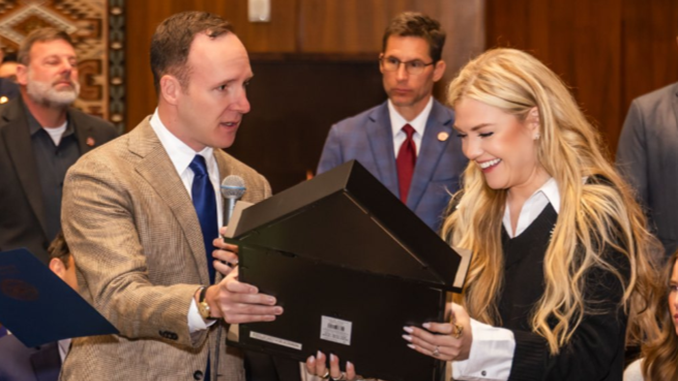
The lawmakers also presented Erika Kirk with a framed Arizona state flag that had been flown over the State Capitol on behalf of the House in Charlie Kirk’s honor, along with a signed copy of the proclamation.
Ethan Faverino is a reporter for AZ Free News. You can send him news tips using this link.
by Staff Reporter | Jan 22, 2026 | News
By Staff Reporter |
Voters may soon get to decide whether or not photo radar will continue to be used in the state.
A committee in the State Senate approved the bill on Tuesday.
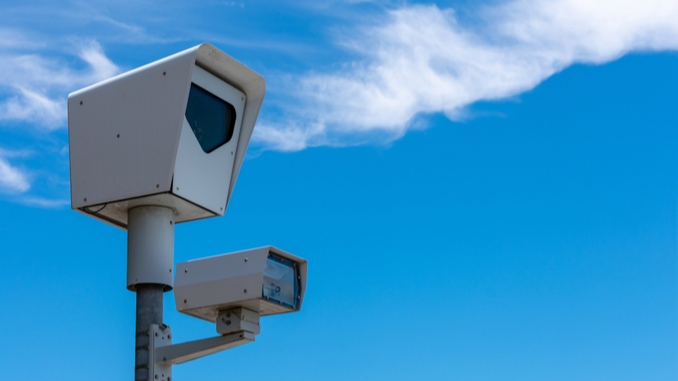
SCR 1004 would ban photo enforcement systems used to identify violators of speed restrictions or traffic control devices from the entire state.
If approved by the state legislature, the measure could appear on the ballot as early as this November. Lawmakers opted for a resolution as a more viable pathway to bypass the requirement for Governor Katie Hobbs’ approval.
The governor didn’t support attempts to ban photo radar in the past.
Last year, the governor vetoed the same legislative language (outlined in a bill rather than a resolution) after its party-line approval in the legislature. No Democrats in either the House or Senate voted for the bill. Hobbs’ veto letter argued that the removal of photo radar would make the roads more dangerous, not safer.
“This bill attempts to remove the ability of local law enforcement to keep our streets safe by eliminating a tool used to enhance roadway safety,” stated Hobbs.
This sentiment was shared by Democratic lawmakers. State Sen. Lauren Kuby argued that certain studies supported the effectiveness of photo enforcement systems to reduce and deter traffic violations.
During voting on the bill last year, some Republicans — Reps. Teresa Martinez, Justin Wilmeth, Alexander Kolodin — did express doubts about the strategy of advancing a bill with SB 1019 rather than a resolution. An identical measure existed in SCR 1002.
Wilmeth said they were “wasting” their time by voting on the bill version of the legislation rather than the resolution.
“I want my Republican caucus members to understand: this bill will pass, and it will get vetoed,” said Wilmeth. “This is what majorities are about, and in this issue we are wasting our opportunity.”
Kolodin said Democrats were defending photo radar under false pretenses of public safety concerns, and that their true intentions had to do with ticket revenues’ ties to clean election campaign funds.
“The photo radar scam is the way that our friends across the aisle fund their war machine. They run candidates in noncompetitive districts and funnel taxpayer money over to competitive districts, all on the backs of hardworking Arizona drivers who are denied due process when they receive their traffic tickets,” said Kolodin. “It’s almost as if we’re more interested in making a show of solving the problem than actually solving the problem.”
State Sen. Wendy Rogers authored both pieces of legislation last year and was the lawmaker to reintroduce it again this year.
Rogers disputed Hobbs’ veto claim in a press release published on Tuesday. The state senator stressed the unreliability of automated enforcement, which is what photo radars operate under. Rogers said it should be law enforcement, not technology, to make the judgment call on violations of traffic law.
“Automated enforcement removes discretion, undermines due process, and turns routine driving into a revenue stream,” said Senator Rogers. “That’s not how law enforcement should work in Arizona. The resolution does not excuse dangerous driving or eliminate traffic enforcement. It ensures that enforcement decisions are made by trained law enforcement officers, not algorithms and contractors.”
AZ Free News is your #1 source for Arizona news and politics. You can send us news tips using this link.
by Ethan Faverino | Jan 11, 2026 | News
By Ethan Faverino |
Arizona House Speaker Steve Montenegro announced last week, the establishment of two new House committees for the 57th Legislature’s Second Regular Session. The move reflects a proactive effort to address emerging technologies and the distinct needs of Arizona’s rural communities as lawmakers assemble on January 12.
In announcing the decision, Montenegro said, “Arizona lawmakers cannot afford to be passive while technology reshapes our economy and government. At the same time, rural communities deserve policies that recognize their role in feeding, powering, and supporting this state.”
Rep. Justin Wilmeth (R–LD 2) will chair the newly established House Committee on Artificial Intelligence and Innovation, with a focus on responsible policymaking in the rapidly evolving field of AI.
“Artificial intelligence has become a powerful engine for our nation’s economy, and it’s here to stay,” said newly appointed Chairman Wilmeth. “With the creation of the AI and Innovation Committee, the legislature is signaling that policymakers are evaluating their role in the future of Arizona: creating high-skill jobs, attracting new investment, and strengthening existing industries from semiconductors to healthcare. As Chairman, I hope to create a forum where experts, industry leaders, and members of the public can share their perspectives, knowledge, and concerns so we can create informed and effective legislation. Our state’s future competitiveness depends on embracing AI and supporting the innovators who choose to build and grow here.”
Rep. Teresa Martinez (R–LD 16) has been appointed chairwoman of the House Committee on Rural Economic Development, which will focus on all policies affecting rural jobs and local investment.
“Too often, policies are written without considering how they affect rural Arizona,” said Chairwoman Martinez. “I intend for the Rural Economic Development Committee to closely examine how state decisions impact jobs, infrastructure, water access, and local investment—and to advance policies that help rural communities grow, compete, and keep opportunity close to home.”
Both committees will meet on Thursdays at 9:00 a.m., The new legislative session opens on January 12.
Ethan Faverino is a reporter for AZ Free News. You can send him news tips using this link.