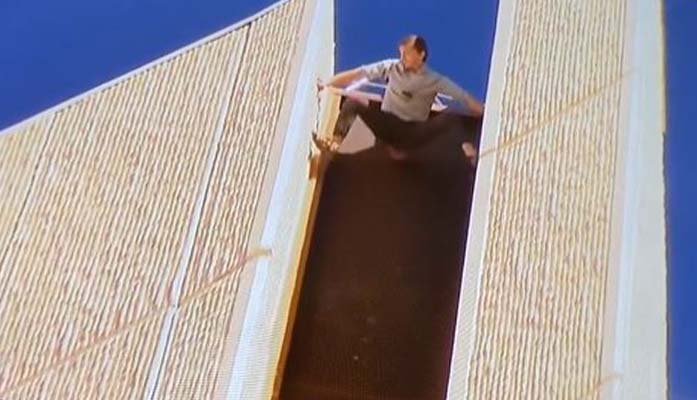
An activist who goes by the nickname “Pro-Life Spiderman” was arrested after climbing Phoenix’s tallest building.
The activist, Maison Des Champs, scales buildings to raise money and awareness for pro-life causes. Des Champs climbed the former Chase tower on Tuesday to raise awareness for Let Them Live, a charity that incentivizes women to cancel their abortions by providing financial support, as well as to fundraise for a pregnant mother named Hope, who reportedly has an abortion scheduled Friday, Feb. 10. Hope is 22 weeks along.
Des Champs has been a featured guest on a number of networks and media groups since he began this strain of activism last year.
Des Champs appeared on The Daily Wire host Michael Knowles’ show last month. He claimed that Knowles was the inspiration for his activism — specifically, the conservative pundit’s coverage of the “Justice for the Five” movement that arose after pro-life activists discovered the remains of five unborn children killed by potentially unlawful late-term abortion procedures last March.
Des Champs shared that he undertook these climbs because they attracted the media attention required to bring awareness of pro-life efforts and needs. He claimed that his first climb occurred the day after the Roe v. Wade decision was leaked last May, calling it a “divine timing.”
“I’m sitting at home and I’m thinking to myself, ‘If politics are downstream of culture, and I want to change the culture, then the best way to change culture is to somehow become part of it,” said Des Champs.
However, Des Champs stated on his website that he began scaling buildings in August 2021 to protest Nevada’s COVID-19 mandates.
Des Champs also posted about that climb on his Instagram. He said he was inspired to climb due to his passion for mental health, and the impact of pandemic lockdowns and mandates. Des Champs revealed that he’d struggled with suicidal ideation for about six years leading up to the pandemic, but used rock climbing as an outlet.
Des Champs encouraged others to join him in a protest he organized later that month at the Planet Hollywood Casino in Los Vegas, Nevada, attended by conservative radio pundit Joey Gilbert.
Then, for nine months, Des Champs didn’t post climbing or protest content on Instagram. He broke the dry spell in May after posting his climb of a California skyscraper, coming out as a pro-life climber that time around.
Des Champs has had a number of other media rounds and appeared on Fox News host Tucker Carlson’s show, “Tucker Carlson Tonight,” in November.
Des Champs also earned the ire and mockery of leftist networks, like Stephen Colbert’s “The Late Show.”
On his website, Des Champs calls for the arrest of the abortionist behind the five late-term babies’ deaths, Cesare Santangelo.
Des Champs has amassed tens of thousands of social media followers: over 18,500 on Instagram. His Twitter, which hasn’t been updated since last June, has just over 400 followers.
Corinne Murdock is a reporter for AZ Free News. Follow her latest on Twitter, or email tips to corinne@azfreenews.com.
On Wednesday, the city of Phoenix rescinded the NFL’s authority to regulate free speech via signage throughout the Super Bowl season. The city’s resolution, issued Wednesday, followed their court loss last week in Paulin v. Gallego, in which a resident challenged the city’s resolution granting the NFL authority to approve or deny residents’ signage.
The change comes with less than one month left to go before the Super Bowl.
The city has a significant financial incentive to cater to the NFL’s requests. When the city last hosted an NFL game in 2015, they experienced a $700 million boost. Gallego toldScripps News this month that they anticipate over one million visitors to the downtown area.
“These events and activities will bring significant revenue and media exposure to the City of Phoenix during the event period,” stated the city’s original resolution.
In anticipation of this lucrative opportunity for exposure, the city enacted a resolution in October granting the NFL and Arizona Super Bowl Host Committee the authority to reject signage within a “clean zone” constituting two square miles in downtown Phoenix.
Direction on whether existing signage had to remain was unclear: the city issued contradictory instructions on its website, in one post declaring that temporary signage had to be removed by last Halloween, while another post declared that the signage rule didn’t take effect until Jan. 15.
Additionally, the city’s signage rule applied to all types of signage: menus, political yard signs, and trespassing warnings. The ordinance only left alone any permitted permanent signs — not temporary ones.
Local business owner Bramley Paulin challenged the city’s initial resolution; the rule prevented him from advertising on his property. Paulin wanted to advertise to the upwards of 1.5 million people anticipated to attend a nearby music festival in the week leading up to the Super Bowl. Yet, any potential business partners told Paulin they could not advertise on his property since he was in the city’s “clean zone,” and they were considered non-NFL partners.
In an email exchange, Coca-Cola informed Paulin that they would receive a cease-and-desist letter if they attempted to advertise within the “clean zone.”
Any business seen as competition to the NFL couldn’t advertise — effectively giving the NFL a monopoly over their allotted downtown area.
In response, Paulin sued the city with the help of the Goldwater Institute. In the lawsuit, the Goldwater Institute asserted that the city’s ordinance gave power to unaccountable private actors and stripped Paulin of his right to limited, accountable, and transparent government.
“The [city’s] resolution further violates the separation of powers by giving the NFL and the Hosting Committee unchecked power to make decisions about Arizonans’ constitutional rights, without the panoply of safeguards by which citizens can hold their governments accountable, such as public hearings, record requests, and elections,” stated the lawsuit.
A trial court judge issued a temporary injunction on the city’s ordinance; a more permanent block of the rule was contingent on the city removing it completely in Wednesday’s meeting.
Victory in @GoldwaterInst free speech lawsuit against Phoenix: judge bars the city from enforcing its #SuperBowl censorship law that forbids people from displaying signs on their own property w/o getting permission from government bureaucrats AND the NFLhttps://t.co/uPhZ59PMFz
The Goldwater Institute noted on its online profile of the lawsuit that cities in recent years have begun enacting similar, restrictive “clean zone” ordinances to cater to mega-events like the Super Bowl.
Censored… by the NFL?
The city of Phoenix has given the #NFL the authority to censor signage on private property.
That's why we're suing the city of Phoenix for this unconstitutional attack on Phoenicians’ free speech rights:https://t.co/QeT7KtQ8pG
A judge has been asked to put an end to a City of Phoenix ordinance which grants the NFL and the Arizona Super Bowl Host Committee authority over how and where residents and property owners can exercise their free speech rights before and after the Feb. 12 Super Bowl.
Although Super Bowl LVII is being played at Glendale’s State Farm Stadium, many of the NFL’s pregame festivities will be held in Phoenix. As a result, the Phoenix City Council quietly approved an ordinance establishing a nearly two-square-mile Special Promotional and Civic Event Area which encompasses most of downtown.
Anyone in the event area, also known as the “Clean Zone” is barred for the three weeks before the big game and one week after from displaying any temporary signage without the approval of the city as well as the NFL and the Arizona Super Bowl Host Committee.
The Goldwater Institute warned city officials weeks ago to put an end to the prohibitive ordinance or face legal action. There was hope the matter would be resolved Tuesday when council members met in a non-public Executive Session on Tuesday.
But when the ordinance was not repealed, the Goldwater Institute followed through on its pledge to defend those whose constitutional rights are being infringed by the ordinance. Its lawsuit filed Wednesday seeks an injunction blocking enforcement of the ordinance.
Phoenix resident Bramley Paulin is the plaintiff represented by the Goldwater Institute, while Mayor Kate Gallego and City Manager Jeff Barton are defendants in their official capacity along with the city as a municipal corporation.
“The Phoenix signage restrictions are just the latest instance in a disturbing, years-long nationwide trend of local governments forcing their own citizens to beg the NFL’s permission to speak freely. But Goldwater intends to stop this trend,” according to John Thorpe, an attorney for the Goldwater Institute.
Thorpe says Paulin, who is also a local business owner, has suffered firsthand the effects of city’s special deal with the NFL.
“While Bramley would like to lease his property for temporary signage placements, businesses won’t even talk to him because they’re afraid to do anything – even on private property, in compliance with all the regular city ordinances – without the express approval of the NFL.”
Thorpe argues that the signage restrictions violate the Arizona Constitution’s free speech protections while also flouting the Constitution’s due process of law guarantee by infringing on residents’ rights without providing any of the minimum procedural safeguards the Constitution requires.
“Moreover, the restrictions violate the Arizona Constitution’s principles of separation of powers, giving two unaccountable private entities—the NFL and the Arizona Super Bowl Host Committee—a blank check to wield government power against private citizens,” Thorpe says.
It is estimated the ordinance encroaches on the rights of hundreds of businesses and thousands of residents.
Paulin issued a statement after the lawsuit was filed on his behalf. He said it is not right that Phoenix city officials are letting the NFL decide what he can and cannot say on his own property.
“The government shouldn’t censor business owners like me, or any residents of the downtown area, when we communicate with the public—and it certainly shouldn’t let private companies decide what we can say,” Paulin said.
Terri Jo Neff is a reporter for AZ Free News. Follow her latest on Twitter, or send her news tips here.
Although Super Bowl LVII will be played in Glendale, the residents, property owners, and business owners in downtown Phoenix must obtain permission from the NFL to place temporary signage on their own property before and after the big game.
Phoenix city officials passed Resolution 22073 earlier this year to designate nearly all of downtown as a Special Promotional and Civic Event Area in connection with the Super Bowl game being played at State Farm Stadium on Feb. 12.
The NFL has planned several pregame events at venues across the area, including downtown Phoenix. As a result, a little publicized provision of the city’s resolution restricts “all temporary signage” unless approved by city staff, the NFL, and the Arizona Super Bowl Host Committee.
“In other words, the city has banned hundreds of businesses, and thousands of residents, from speaking freely without permission from the government and two of the government’s handpicked entities,” explains John Thorpe, an attorney for the Goldwater Institute which is fighting back on the constitutional restriction.
Thorpe sent a letter on behalf of a Phoenix property owner to City Attorney Julie Kriegh last week demanding an end to the unconstitutional free speech restrictions.
“The ordinance also violates constitutional guarantees regarding due process and improper delegation of government power by broadly authorizing two private entities—the NFL and the Arizona Super Bowl Host Committee—to regulate private citizens’ speech with unfettered discretion and no procedural safeguards,” Thorpe wrote.
The signage restriction went into effect Nov. 1 with no fanfare from city officials. It remains in effect until Feb. 19, 2023, a full week after the Super Bowl. The Goldwater Institute became involved after Bramley Paulin sought to work with city officials so he could post temporary signage to advertise that his property is available to be leased.
Instead, Paulin was informed the property is within the “Clean Zone” covered by the Special Promotional and Civic Event Area. As a result, he cannot utilize the signage without authorization from the NFL and the host committee.
The city’s actions have already imposed substantial harm on Paulin, Thorpe told the city attorney. The letter seeks assurance that Paulin or his representatives may advertise on his property “without unreasonable restriction and without any input or review by the NFL or the Super Bowl Host Committee.”
It is unclear how city officials believe such an overreaching censorship deal is legal, let alone in the best interest of its residents. It does not appear that such restrictions were implemented in Inglewood, California during this year’s Super Bowl.
And there is no record of such restrictions back in 2015 when the Super Bowl was last played in Arizona, also in Glendale at what is now known as State Farm Stadium.
Thorpe acknowledges that hosting Super Bowl festivities is an exciting opportunity for many Arizonans, but he argues no benefits of any sporting event should come at the cost of forcing Arizonans to surrender their constitutional rights.
“And decisions about the free expression rights of downtown residents should not be delegated to unaccountable private parties,” he added.
AZ Free News has reached out for a comment about the free speech restrictions from Fox Sports and the Westwood One radio network, which are broadcasting Super Bowl LVII. A similar request was sent to Apple Music, the sponsor of the halftime show, as well as Roc Nation Management which represents Super Bowl halftime performer Rihanna.
No responses were received by press time.
Terri Jo Neff is a reporter for AZ Free News. Follow her latest on Twitter, or send her news tips here.
While some politicians have called in the past for boycotts or buycotts of specific companies, Rep. Reginald Bolding (LD27) has raised the subject of whether the National Football League should consider pulling the February 2023 Super Bowl out of Arizona in response to the state’s new election laws.
Bolding, the House Democratic Leader, broached the issue in a May 11 letter to NFL Commissioner Roger Goodell on the same day the Senate passed SB1485, a bill which could remove more than 100,000 names from the early voting list of voters who continually fail to utilize the early ballot option.
The NFL announced in May 2018 that the Super Bowl LVII would be returning to Arizona in 2023 with a week-long list of activities culminating with the championship game. But in his letter, Bolding reminded Goodell the NFL reneged on its plan to hold the Super Bowl in Arizona in 1993 after legislators opted to not recognize Martin Luther King Jr. Day as a state holiday.
“I am respectfully requesting that you add your powerful voice to a chorus of folks from a broad political spectrum to urge Governor Doug Ducey to veto this reprehensible legislation,” Bolding wrote to Goodell, adding “it is time for organizations like the NFL, the NCAA and the College Football National Championship to get off the sidelines and take a stand like Major League Baseball.”
The MLB reference relates to last month’s announcement that the All-Star Game was being moved from Atlanta to Denver after Georgia lawmakers made changes to the state’s election laws.
What Bolding didn’t know when sending his letter to Goodell was that Ducey signed SB1485 less than one hour after the legislation was transmitted to his desk.
Since then, Bolding’s suggestion that the NFL could consider pulling a premier sporting event has been heavily criticized for its negative impact on Arizona’s tourism and hospitality industries still reeling from the last 15 months of COVID-19 restrictions.
An economic study released after last year’s Super Bowl LIV in Miami showed that visitor spending -including spectators, media, teams, and NFL – brought in nearly $250 million to the Greater Miami area. There were also millions in short term labor income, and a $34 million bump in local and state tax revenues connected to the event.
Bolding’s letter to Goodell referred to a decision by Michael Bidwell, owner of the Arizona Cardinals, to join a few dozen Arizona business leaders to oppose some election-related legislation, including SB1485.
But Ducey made it clear when signing the bill that he found nothing nefarious about making changes to the state’s elections law.
“Arizona has for years continuously improved and refined our election laws —including intuitively renaming ‘absentee’ voting to ‘early’ voting— and constantly seeking to strengthen the security and integrity of our elections,” he said. “SB 1485 ensures Arizona remains a leader for inclusive, accessible, efficient and secure election administration.”
Bolding has continued to attack SB1485, although he has not repeated his panned comments about the NFL’s option to pull the Super Bowl from Arizona. The February 2023 game would be the fourth time the Super Bowl is held in the state.