by Dr. Thomas Patterson | Feb 14, 2025 | Opinion
By Dr. Thomas Patterson |
“Rust Belt city benefits from Bidenomics” headlined an article last month in the Wall Street Journal, detailing the economic rebound being experienced by Terre Haute, Indiana, a former manufacturing center in decline for many decades.
Suddenly, due to an infusion of stimulus funding from the 2021 American Rescue Plan Act and the 2022 Inflation Reduction Act, this community is experiencing such a windfall that the mayor is “running out of room on his whiteboard” tracking infrastructure projects. New factories are being built, new home starts have tripled, long vacant properties are rehabbed. The venerable Charlie’s Pub and Grub will get a new roof and awnings.
The new initiatives in Terre Haute are part of the hundreds of billions of dollars in federal subsidies supporting manufacturing, housing, and clean energy ventures doled out during the Biden administration.
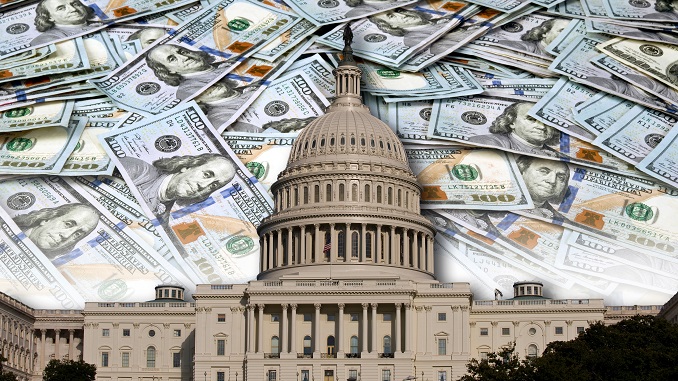
But one question was never asked. Where is all this money coming from? You might think “taxpayers,” but the truth is that we spend $2 trillion more every year than we take in. There are no available tax-derived funds available to distribute.
Instead, we spend fantasy money, loans charged off to future generations who don’t vote yet. We really do love them, just not as much as the luxury of getting to have things that we don’t have to pay for.
The Terre Haute story, just one of thousands like it, contains several insights into why spending cuts are so difficult and rare. The public habits of mind we have developed about the role of government and the responsibility of government to live within its means are the ultimate reason we have fallen into such fiscal danger.
Earlier generations of Americans would have been alarmed, not heartened, at the gigantic unfunded Biden spending surge. We instead assume that none of us should endure hardship or decline and that if we do, it is the duty of government to rescue us. Personal responsibility is outmoded.
Government has never been known for its efficiency, so all these “free” things are actually quite expensive. The good news is we still have a productive economy that has generated 1.4% revenue growth, net of inflation, since 2001, the last year the budget was balanced. Reasonably prudent governance would have achieved budget surpluses.
But that’s not what happened. Politicians spent so much feeding our welfare addiction that spending grew by an inflation-adjusted 3.0% annually, creating the true crisis we now face. Present projections by the Congressional Budget Office indicate spending will continue to outpace revenues, absent reform. Our national debt stands at an unimaginable $36 trillion, while borrowing costs are rising.
We’re in deep trouble. It may well be too late to avoid fiscal collapse. Interest on the national debt, the only truly non-negotiable item in the budget, tripled during the Biden years. It now exceeds total defense spending.
Interest payments amount to half of the total amount borrowed We are borrowing money to pay interest on the growing sums already borrowed, with no plan in place to reduce the debt amount, the dreaded Doom Loop.
Yet at this point, millions of families and seniors, businesses and governments manage their finances based on the expectation of federal subsidies, without which they presumably would be bereft. Over 75% of the federal budget goes to support these private expenditures.
Can Trump be the white knight who rescues us from fiscal doom? The logistics aren’t all that ominous (e.g., raising the retirement age of Social Security by two years would help), and Trump has generated more support for cost-cutting than any politician in memory. But it’s a matter of simple arithmetic. We can never balance the budget without addressing entitlements. That’s where the money is.
Entitlements are termed “mandatory” spending, but they are really just creations of Congress which can legally amend them at will, if they have any.
Unfortunately, Trump so far shows more interest in the low hanging fruit (Department of Education, USAID, obvious fraud) than in the hard work of convincing the American people that substantial entitlement reform is risky but necessary. Without him, Social Security and Medicare will remain No-Go zones even for budget hawks.
The task only gets harder as time passes. We’ll see soon.
Dr. Thomas Patterson, former Chairman of the Goldwater Institute, is a retired emergency physician. He served as an Arizona State senator for 10 years in the 1990s, and as Majority Leader from 93-96. He is the author of Arizona’s original charter schools bill.
by Dr. Thomas Patterson | Nov 9, 2024 | Opinion
By Dr. Thomas Patterson |
Here are the hard truths of our threatening situation with Social Security and Medicare. We have a looming major fiscal crisis which no one denies. There are solutions but no politically easy ones, and our options get worse with time.
Yet every time a working politician suggests considering even mild changes, the formidable senior lobby and AARP erupt in outrage and beat down the hapless reformer. Former allies of responsible reform flee, and the status quo is again preserved.
Facts, as they say, are stubborn things. Social Security is by design a mandatory government administered defined-benefit retirement trust, funded by payroll taxes. However, the inflows to the trust are insufficient to support the benefits promised and, unlike private pension plans, there is no corpus of funds earning compound interest to make up the difference. Thus, the fund will become insolvent in nine years. As matters stand, benefits across the board will need to be reduced by 23%.
Worse, deficits in Social Security and Medicare comprise the overwhelming majority of future anticipated federal debt accumulation. So, the courageous politicians who assured seniors in this and every election that they will “protect” their Social Security (i.e., do nothing) were not protecting anything except their own political skins.
The problem nobody wants to face is that either benefit levels are too high, payroll taxes are too low, or retirees are retired for too long. Politicians long ago raided the “surplus” and replaced the funds with non-income generating IOUs.
Reducing benefit levels, even for high earners, is politically toxic. The mere suggestion evokes hyperbolic charges of “pushing granny over the cliff” and “giving the middle finger to senior citizens.”
On the other hand, raising taxes would be nearly as unpopular. It would take a 25% hike in the payroll tax to fill the hole once insolvency occurs. Economic growth and consumer spending, the drivers in our economy, would be crowded out as would several federal programs.
Clawing back the Social Security trust funds so that income could be generated would be nice. But that train has left the station. The funds have long since been spent on other priorities
That leaves only shortening the length of retirements that Social Security supports. This option is also massively unpopular, as public demonstrations against it here and around the globe attest.
Yet when Social Security was established in 1935, the average life expectancy was just 63. Today it is nearly 80. We are now down to just three workers paying into the system for every retiree, compared to 16 at the beginning of Social Security.
These workers’ earnings are paid out as current benefits in what amounts to a giant Ponzi game. Like Ponzi schemes before it, this one is also doomed to failure.
The concept of retirement was basically unknown until recently in human history. Everyone worked as long as they could, and the rest were cared for primarily by families. So why is delayed retirement, even modest (two years) and gradually phased in, violently opposed?
Part of the reason is that government subsidies are never “enough.” Free money is always popular, and beneficiaries quickly develop an entitlement mentality.
Since retiree benefits are funded by payroll taxes, the notion of being “owed” is understandable. Unfortunately for proud seniors, the facts now are that the money flows in Social Security are essentially like other government welfare programs.
Fortunately, most jobs today are not as physically demanding as in the past. Medical care for job related injuries is much improved. Disability insurance and retirement accommodations for workers in occupations like law enforcement and the military are already in place. For the rest, many able seniors experience work as manageable and even enriching.
Regardless, the do-nothing option, so wildly popular in this last election, is no longer feasible. The “private account” reform offered by George Bush in 2005, which was demagogued into the ground by the same crowd proudly blocking all reforms this go-around, would have resulted in the average worker having three times more retirement income by now.
This can has been kicked down to near the end of the road. Our options now are to defer retirement or face serious program cuts. Sad.
Dr. Thomas Patterson, former Chairman of the Goldwater Institute, is a retired emergency physician. He served as an Arizona State senator for 10 years in the 1990s, and as Majority Leader from 93-96. He is the author of Arizona’s original charter schools bill.
by John Huppenthal | Oct 30, 2024 | Opinion
By John Huppenthal |
This analysis looks at President Trump’s first three years in office—2017, 2018 and 2019, the pre-COVID era—to get a more unbiased view of the policy impact of his approach.
In Trump’s first three years:
Trump extended economic growth to achieve the longest economic expansion in the history of the U.S.: 10.5 years.
Trump had the largest single year increase in 2019 median household income in history, increasing income by $5,420 to a level, $81,210, that Biden/Harris still haven’t reached.
To do this, Trump created 7.1 million full-time jobs in his first 3 years as president, the jobs that count: full-time jobs, in the pre-COVID era. This is more than an amazing feat because Trump only created 6.7 million total jobs. How did Trump increase full-time jobs by more than his total job increase? By making every job he created a full-time job, and, most importantly, converting 400,000 of Obama’s part-time jobs into full-time.
By comparison, Harris/Biden only created 1.0 million full-time jobs in the last two years, September 2022 to September 2024, the post-COVID era. Most of their job creation has been part-time jobs.
Trump created so many jobs that job openings exceeded the number of unemployed for the first time in history, not only exceeded but went on to double the number of unemployed.
The open job force was so strong under Trump’s first three years that he was stripping 160,000 people per month out of welfare for a total reduction of welfare recipients of 8.5 million, 19% of the total recipients.
The open job force was so strong that, for the first time ever, a million people left Social Security Disability and went from consuming Social Security tax dollars to paying into the system.
Trump pushed the bankruptcy date for the Social Security system back by years through welfare enrollment reduction and increased employment and wages.
Trump’s lowest unemployment rate of 3.5% was the lowest level since Eisenhower, just 0.1%, a tenth of a percent from its lowest level ever.
When Trump’s USMCA treaty was put in place, it created the world’s largest international trade confederation.
Trump set 12 all-time records for Black employment, pushing Black unemployment to its lowest level in recorded history, 5.3%, far below Obama’s lowest rate of 8.0%.
Trump reduced the personal income taxes for all families of four or more making $53,000 or less to zero. In the other 150+ countries of the world, such families are considered rich and pay tens of thousands in taxes. Economists have not begun to understand the full ramifications of this feat. In chess, it’s called checkmate. No other country can get the upper hand.
As a result, the wealth of the bottom 50% of the U.S. increased by $1.4 trillion under Trump. Under Obama’s last four years? 0.8 trillion
In a sane, rational world, Trump would have earned three economics Nobel prizes, setting records for trade, unemployment reduction, economic growth, and achieving economic equality. (That’s equality, not equity).
Trump’s strategy for his second term: the roaring 20s, where growth was 40% as compared to Obama’s 11%. The 1922 Fordney-McCumber tariffs of 40% were combined with a reduction of the personal income tax rate from 76% to 25% under Calvin Coolidge.
I am confident that Trump is eyeing a massive trade deal with China, just like Trump’s USMCA, which has shifted the trade balance of the world.
If Trump is successful at combining a modest and carefully designed broad tariff of 20% or less with equal or greater business tax rate reduction, we are likely to have the roaring 20s all over again. Hard to believe that the U.S. economy of $28 trillion could grow another 40% in the next four years but hold on to your hats.
John Huppenthal was the Arizona Superinterndent of Public Instruction from 2011-2015. Prior to this role, John served as a member of the Arizona State Senate and the Arizona House of Representatives. You can follow him on Twitter here.
by Elizabeth Troutman | May 16, 2024 | Economy, News
By Elizabeth Troutman |
Arizona Republican Rep. David Schweikert urged Americans to take “our fiscal responsibility” seriously in light of the Social Security Administration’s 2024 Trustees Report.
“I implore my brothers and sisters to take our fiscal responsibility seriously before it’s too late,” Schweikert said.
Schweikert, who serves as Joint Economic Committee vice chairman, issued a statement on the report, which projected that the Old-Age and Survivors Insurance (OASI) Trust Fund will become insolvent by 2033.
“The Social Security Trustees Report confirms that it’s no longer just future generations who should be concerned about receiving their full earned benefits but rather current retirees too,” Schweikert said
The congressman criticized Congress for failing to protect the entitlement programs millions of Americans depend on.
“As our nation’s fiscal health continues to deteriorate, Congress refuses to live up to its moral obligation to protect and modernize Social Security and Medicare,” he said. “It’s past time for the political class to put aside their talking points and start working on bipartisan solutions to save these programs for our seniors.”
According to the report, the Old-Age and Survivors Insurance Trust Fund is projected to become exhausted by 2033. Once the OASI Trust Fund goes insolvent, all beneficiaries will face an across-the-board 21% cut to retirement benefits.
The Disability Insurance (DI) Trust Fund will be able to keep paying full benefits through at least 2098. But the combined OASI and DI Trust Funds will become depleted by 2035.
Once the combined OASDI trust funds go insolvent, all beneficiaries will face an across-the-board 17% cut to retirement benefits.
The Hospital Insurance (HI) Trust Fund will become insolvent by 2036. At that point, the HI Trust Fund will only be able to cover 89% of total benefits.
The combined Social Security programs will run a cash-flow deficit of $169 billion this year and $2.7 trillion over the next decade.
Elizabeth Troutman is a reporter for AZ Free News. You can send her news tips using this link.
by Dr. Thomas Patterson | Nov 25, 2023 | Opinion
By Dr. Thomas Patterson |
Social Security and Medicare are so popular they are commonly known as the “third rail” of politics. Any politician who touches them gets a nasty shock. The politically smart thing for decades has been to periodically increase benefits and not worry too much about adequately funding these supposedly self-sufficient programs
Congress designates SS/Medicare as non-discretionary spending, which allows even fiscal conservatives to earnestly explain that Congress is unable to touch them, not even to reduce the benefit increases they themselves bestowed in the past. Of course, this is ridiculous since Congress could legally eliminate the programs if it chose to do so (not recommended).
As the population has aged and birth rates have fallen, SS/Medicare have descended into serious financial distress. This year, the programs will spend $69 billion more than they take in. The programs’ trustees recently moved the date for expected insolvency up to 2031 for Medicare, 2034 for Social Security.
Yet there is little acknowledgment from the political class that a problem exists. To acknowledge it creates a mandate for making highly unpopular choices. Even Donald Trump, the would be “conservative” leader, has decreed that no part of making America great again will involve touching our major entitlements. The endless quest for re-election continues to dominate decision making in Washington.
Even beyond entitlements, America has a spending problem. The federal government spends about 25% of GDP but only takes in revenues of 19%. The rest is charged off to future generations. With interest rates returning to normal levels, federal debt service will soon exceed $1 trillion a year, roughly what we spend to defend our country.
Why do we continue to spend so recklessly in times of peace and prosperity? It’s partly our perverse politics, where spenders dare opponents to suggest fiscal reforms and then rip them for bringing it up.
It’s also a mindset. Not long ago, families were considered the primary caregivers for each other. It was contemptible to neglect your own.
Americans today believe they are entitled to have government assume what were formerly family duties. Politicians gain millions of grateful dependents and family structure suffers, but there’s no going back.
Federal decision-makers have adopted an all-purpose solution to the problems that plague us: throw dollars at it. Schools failing? Send money. Semiconductor industry struggling? More money. People still living in poverty? Appropriate even more money. Money papers over our problems but affords no actual solutions.
Nobody even talks about the monetary implications of our ongoing border crisis. Over seven million mostly unskilled illegal immigrants breached our borders. Immediately upon successfully registering their fraudulent asylum claims, they expect food, shelter, medical care, transportation, eventually education, and social services all without a thought of paying for them.
The direct and indirect costs are incalculable, but California already reports annual direct expenses of $21.76 billion while Texas pays $8.8 billion and Arizona $3.2 billion.
Yet Democrats contend only more money can solve the problem. Biden and border czar Kamala Harris claim Republicans are responsible for the border mess because they once blocked further spending increases, even though the money goes to accommodate more illegal immigration. It’s time to end this massive farce and lawfully control the border. Democrats will have to find some less costly way to recruit future voters.
Our response to the COVID epidemic was another giant boondoggle. There wasn’t much to do about the virus. Protect the vulnerable, treat the ill, develop a vaccine, and allow it to run its course.
Instead, we embraced an orgy of spending. Trillions went to infrastructure improvements, solar energy, daycare, schools, businesses, and even individuals, all inexplicably in the name of COVID. It didn’t affect the course of the disease, but our descendants will pay for this spree far into the future.
It gets worse. In 2025, the spending caps on Obamacare and other discretionary items are set to expire as are the low interest bonds the government issued when money was cheap. There will be tremendous pressure to spend yet more just to maintain the spending status quo.
Thomas Jefferson, 250 years ago, extolled the benefits of a “wise and frugal” government. We didn’t listen. We will soon wish we had.
Dr. Thomas Patterson, former Chairman of the Goldwater Institute, is a retired emergency physician. He served as an Arizona State senator for 10 years in the 1990s, and as Majority Leader from 93-96. He is the author of Arizona’s original charter schools bill.