by Corinne Murdock | Mar 30, 2022 | News
By Corinne Murdock |
On Wednesday, Governor Doug Ducey signed HB2492, which requires individuals to provide proof of citizenship when registering to vote. The law most heavily impacts federal-only voters: federal law doesn’t require proof of citizenship when voting in federal elections. In the 2020 election, there were over 11,600 Arizonans who didn’t provide proof of citizenship, and state legislators reported that the current numbers were even higher: around 36,000, according to State Senator Warren Petersen (R-Gilbert). In 2018, there were 1,700 registered voters without proof of citizenship.
In a statement to AZ Free News, former Arizona Supreme Court Justice Andrew Gould commended Ducey for signing the legislation. He predicted that the law would improve voter turnout: the opposite of what the bill’s opponents claimed it would do.
“I want to thank Governor Ducey for signing HB2492. This new law, which requires proof of citizenship for state and federal elections, provides a critical protection for election integrity in Arizona,” said Gould. “This important piece of legislation, like all common-sense elections laws, will boost voter confidence and increase voter participation in Arizona.”
The Democratic Party’s Russiagate hoax lawyer, Marc Elias, pledged to sue Arizona over the law. Elias specializes in election litigation; he’s intervened in nearly 330 elections-related cases following the 2020 election, 150 of which he’s won. This week, the Washington Examiner reported that the Federal Election Commission (FEC) fined the DNC $105,000 and Hillary Clinton $8,000 for failing to accurately report how they funded the sole instigator of the Russiagate hoax, the Steele dossier. Clinton and the DNC together paid over $1 million to Elias’ law firm, Perkins Coie, for the opposition research firm that compiled the dossier, Fusion GPS. The DNC and Clinton claimed their combined funds were for legal services, not opposition research.
Based on Elias’ latest remarks, it looks like he will make good on the promise to sue.
In a letter to Secretary of State Katie Hobbs on Wednesday, Ducey offered a history of Arizonans’ support for proof of citizenship in order to vote. He recounted Proposition 200, a proof of citizenship requirement passed by voters in 2004 but later struck down by the Supreme Court (SCOTUS). Ducey also dispelled rumors that those who registered to vote without proof of citizenship prior to this bill’s enactment would have to re-register to vote.
“Election integrity means counting every lawful vote and prohibiting any attempt to illegally cast a vote,” wrote Ducey. “[This bill] is a balanced approach that honors Arizona’s history of making voting accessible without sacrificing security in our elections.”
In response, Hobbs claimed the legislation was “illegal.” She noted that the law would cause “costly litigation,” potentially alluding to Elias’ threats. Hobbs criticized Ducey’s latest efforts as a failure, a day after her signature-gathering system crashed while Maricopa County Attorney candidates attempted to submit signatures before their deadline in just a few days’ time. Those candidates need over 4,000 signatures to qualify for the ballot.
Corinne Murdock is a reporter for AZ Free News. Follow her latest on Twitter, or email tips to corinne@azfreenews.com.
by Corinne Murdock | Mar 23, 2022 | News
By Corinne Murdock |
State Representative Jake Hoffman’s (R-Queen Creek) controversial proof of citizenship for voting bill passed the Senate on Wednesday along party lines. HB2492 now heads to the governor for final approval. The legislation requires that individuals provide proof of citizenship when registering to vote in the state, and further requires election officials to confirm with all available government databases that the applicant is an American citizen.
The bill advanced steadily through both the House and the Senate, moving out of Senate committee less than two weeks ago, shortly after it was passed by the entire House a few weeks before that. The legislation didn’t advance without pushback, however. Community activists attempted to stall the bill during its consideration by the Senate Judiciary Committee, forcing a recess with their antics such as shouting down the legislators and shouting, “Shame!” repeatedly after the bill passed.
In a statement to AZ Free News, Arizona Free Enterprise Club President Scot Mussi was hopeful that Governor Doug Ducey would sign the bill. Mussi applauded the legislature for passing a bill that aligned with the state and federal constitution, forecasting that the bill would prevent bad actors from interfering with elections.
Senate Democrats had a different perspective of the bill: they claimed that the legislation would force numerous Arizonans to register to vote again. They also claimed that the bill violated federal election law.
In regard to the constitutionality claim, Arizona Free Enterprise Club Deputy Director Greg Blackie explained during the Senate Judiciary Committee hearing that the 2013 Supreme Court ruling determined that the National Voter Registration Act didn’t stop states from denying an applicant’s registration based on information that proved the applicant’s ineligibility. Under this bill, that would mean proof that an applicant isn’t a citizen.
Corinne Murdock is a reporter for AZ Free News. Follow her latest on Twitter, or email tips to corinne@azfreenews.com.
by Corinne Murdock | Aug 20, 2021 | Education, News
By Corinne Murdock |
On Thursday, the Arizona Supreme Court ruled that Proposition 208 (Prop 208), the voter-approved increase on income taxes to fund public education, was unconstitutional and remanded to lower court. If that trial court determines that Prop 208 exceeds the constitutional spending limit, then Prop 208 would be killed. Chief Justice Brutinel authored the opinion.
The case, Fann, et al. v. State of Arizona, et al., challenged one major provision of Prop 208 and the circumstances of its approval.
First, the case questioned how Prop 208 exempted itself from the Arizona Constitution’s provisions on tax revenue spending caps, or the Education Expenditure Clause.
Brutinel ruled this aspect of Prop 208 unconstitutional. The chief justice made sure to note that this ruling rendered the other aspects of Prop 208 unworkable and unseverable. Meaning, no part of Prop 208 is enforceable if the trial court concurs with the Arizona Supreme Court’s opinion.
“We hold that the direct funding provision does not fall within the constitutional definition of grants in article 9, section 21 of the Arizona Constitution, and Prop. 208 is therefore unconstitutional to the extent it mandates expending tax revenues in violation of the Education Expenditure Clause,” wrote Brutinel. “Likewise, the remaining non-revenue related provisions of Prop. 208 are not separately workable and thus not severable.”
Second, the case challenged tax impositions made by voter initiative. The plaintiffs cited the Arizona Constitution’s Tax Enactment Clause, which stipulates that tax changes must be approved through a two-thirds vote by the state legislature.
The court disagreed with this assessment.
“Additionally, we hold that Prop. 208 does not violate article 9, section 22 of the Arizona Constitution (‘Tax Enactment Clause’), because that clause does not apply to voter initiatives,” wrote Brutinel. “Therefore, the bicameralism, presentment, and supermajority requirements found therein are inapplicable to Prop. 208.”
The Goldwater Institute, Snell & Wilmer, and Greenberg Traurig filed the lawsuit on behalf of the 11 plaintiffs: State Senate President Karen Fann (R-Prescott); State Senators David Gowan (R-Sierra Vista) and Vince Leach (R-Tucson); Arizona House Speaker Russell Bowers (R-Mesa); State Representatives Regina Cobb (R-Kingman), John Kavanaugh (R-Fountain Hills), Steve Pierce (R-Prescott); Montie Lee of Lee Farms; Dr. Francis Surdakowski; NO on 208; and Arizona Free Enterprise Club.
In a statement, Goldwater Institute Vice President for Litigation Timothy Sandefur classified the ruling as a win.
“Today represents a major victory for the hardworking taxpayers of Arizona,” said Sandefur. “The justices made clear that the state constitution’s limits on spending—which were added to the Constitution by the voters themselves—cannot be simply ignored, as Prop. 208’s funders attempted.”
Governor Doug Ducey concurred that this ruling signaled that the end was near for Prop 208.
“There is a clear legal path to Prop 208 being knocked down entirely, it’s only a matter of time,” tweeted Ducey. “The out-of-state proponents of this measure drafted bad language, and now they are paying the price.”
Proposition 208 (Prop 208) tacked on 3.5 percent to the existing 4.5 percent income tax for individuals making over $250,000 or couples making over $500,000. Previously, Arizona’s income tax rate was capped at 4.5 percent for individual incomes above $159,000 or joint incomes above $318,000. The revenue from the income tax increase would fund a wide variety of educator salaries and programs.
About 52 percent of Arizonans voted in favor of Prop 208 last November, and about 48 percent voted against it.
Corinne Murdock is a reporter for AZ Free News. Follow her latest on Twitter, or email tips to corinne@azfreenews.com.
by Terri Jo Neff | Jun 26, 2021 | Economy, News
By Terri Jo Neff |
Positive reactions continue to come in from business groups in response to the Arizona Legislature’s passage this week of a Fiscal Year 2022 budget package which includes more than $1.3 billion in tax cuts, $1 billion in payments toward state debt, and a transition of the state’s multi-tied income tax system to a flat rate.
The nonprofit, nonpartisan Arizona Tax Research Association called passage of the FY2022 budget “a watershed moment” for Arizona, while Scot Mussi, president of the Arizona Free Enterprise Club, commended the Legislature for passing what he called “historic” tax cuts.
“Every single taxpayer in Arizona will now get a tax cut,” Mussi said. “This is great news for the future of our great state!”
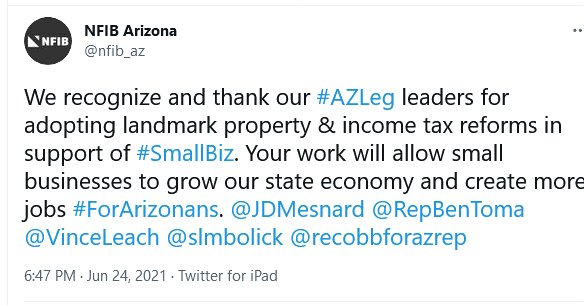
The National Federation of Independent Business, which advocates for small and independent businesses across the country, gave a shout out to the Legislature via Twitter for adopting “landmark property & income tax reforms” which support small businesses. “Your work will allow small businesses to grow our state economy and create more jobs #ForArizonans,” the message said.
On Friday, Gov. Doug Ducey issued a video statement celebrating passage of the 11 bills which make up what he calls the state’s “fiscally conservative, forward-looking budget” that starts July 1.
“Here in Arizona our economy is booming,” said Ducey, thanking House Speaker Rusty Bowers, Senate President Karen Fann, and all the legislators. “New people and businesses are moving here every day. And at the state level that’s resulted in record revenue. With this budget we’re investing those dollars in the things that matter: schools, universities, community colleges, and new roads and bridges, just to name a few.”
Ducey added that “most importantly we’re giving a bulk of the surplus dollars back to the people who earned them.”
A budget signing ceremony must wait until at least Monday when the Senate returns from recess to formally transmit the budget bills to the governor.
Meanwhile, supporters of the voter initiative known as Proposition 208 are promising a court fight over a bill Ducey is also expected to sign next week.
Prop 208 passed last November by a slim margin of 51.75 to 48.25 percent. The purpose of the initiative was to provide additional funding for public and charter school by way of a new 3.5 percent income tax surcharge for many Arizonans.
Among those subject to the new tax surcharge would be thousands of small business owners who currently report business profits on their state personal income tax return. SB1783, however, provides a small business alternate income tax as an option for those who operate as sole proprietors, LLCs, professional partnerships, and S Corporations.
Under the alternate tax, income derived from small business can be reported on a special small business income tax form. This will ensure the income is not added into personal income for purposes of calculating the amount of Prop 208 surcharge a taxpayer owes.
Critics contend SB1783 is a way to unlawfully circumvent the taxation provision of Prop 208. Proponents of the bill point to the many statements made prior to the 2020 General Election which assured business owners that “business income” would not be subject to the surcharge.
by Terri Jo Neff | May 27, 2021 | News
By Terri Jo Neff |
Senate President Karen Fann will try one more time this week to pull together the 16 votes needed to pass the budget bills, something she could not do Wednesday when one of the 30 senators did not come to work.
The Republican-majority Senate stands in recess until 11 a.m. Thursday at which time several bills are scheduled to be considered, most of which are budget-related. There was hope Wednesday that the 16 Republicans would pass the bills, but Sen. Michelle Ugenti-Rita’s daylong absence quashed that option.
Fann and Majority Leader Sen. Rick Gray need the entire Senate Republican caucus on board, so if it appears the 16 votes are not a sure thing Thursday then Fann can simply recess her chamber until June 10, a plan put into place Wednesday night after House Speaker Rusty Bowyers chose to recess his chamber for several days.
In the meantime, the fate of the months-long negotiated spending budget, tax cuts, and plan to transition Arizona to a flat rate income tax remains uncertain, according to budget-watchers. And that may not bode well for the flat tax plan which Republicans have sought for years.
“Right now, the flat tax proposal is still being negotiated among members to address a couple of concerns,” according to Scot Mussi, head of the Arizona Free Enterprise Club. “The first concern is the alleged impact on cities and towns due to revenue sharing. Cities are arguing that the tax cut will result in a massive cut in shared revenue from the state.”
But Mussi pointed out that flat tax supporters, including AFEC, believe cities are enjoying budget surpluses -in some cities quite sizable surpluses- and continue to receive a large infusion of new revenue from the taxation of online remote sales.
“The second concern was that the proposed tax package included a tranche of special interest tax breaks, which groups like ours oppose,” Mussi said. “It is our understanding that most of these tax breaks, including one for low income housing and another for wealthy investors, will be removed from the plan.”
But Mussi says groups like AFEC continue to support this year’s budget plan -minus the special interest tax breaks.
“Currently, Arizona has one of the highest income tax rates in the nation and we are uncompetitive compared to our low tax neighbors. The proposed tax plan goes a long way toward addressing this problem,” he explained.
With uncertainty over whether Fann has the 16 votes in the Senate and House Speaker Rusty Bowyers has his 31 votes, Mussi says the budget negotiations are likely not over.
“There is still a lot of horse trading occurring, much of which will continue,” he said. “Some of the demands still being made related to the budget is to rein in some of the pork barrel spending, make tweaks to the tax plan to address concerns with the cities, and to address other policy issues such as election integrity and school choice.”
And what about Fann and Bowyers trying to poach support from a few Democrats if not all Republicans are on board soon? Mussi believes the only budget bills Democrats may vote for would be the Education Budget which includes K-12 spending increases. But the legislative leaders are likely to have a hard time getting any further support across the aisle for the rest of the budget, Mussi said.