by Dr. Thomas Patterson | Jan 6, 2025 | Opinion
By Dr. Thomas Patterson |
What accounts for the differences in academic achievement between inner-city poverty area schools and high-income public schools? We‘ve all heard of the dreadful schools in cities like Chicago and Baltimore with no children in the entire school able to achieve even baseline levels of competence in math or verbal skills and many other schools with a third at most achieving at grade level.
Many would assume funding is the major determinant, but the facts don’t back that up. American public schools have traditionally been funded by local property taxes, which provide a clear advantage to the wealthy. But that was then. Today, education funding is complex, with federal funding for special programs, equalization formulas, and other inputs making it difficult for even experts to determine the bottom line.
A recent study from the Urban Institute confirmed other research showing that “when considering federal, state and local funding,” all states but three “allocate more per student funding to poor kids than to non-poor kids.” Moreover, researchers from Harvard and Stanford found that each extra $1,000 per pupil spending is associated with an annual gain in achievement of 1/10 of one percent of a standard deviation. In other words, more spending and more learning are essentially unrelated.
If more spending did produce more achievement, we would be morally obligated to provide it. As it is, we must look for other reasons to explain the achievement gap, examining how well the allocated funds are used. Education researcher Jay Greene observes that “wasteful schools tend to hire more non-instructional staff while raising the pay and benefits for all staff regardless of their contribution to student outcomes.”
Effective schools, whenever possible, prioritize the learning interests of students, eschewing the fads and misconceptions that plague the public school establishment. When a Stanford education professor helpfully developed an “equity-based” curriculum proposal, gullible California educators issued guidance against students taking algebra courses before high school.
After decades of the promotion of “context-based” reading instruction, it became obvious that the old-fashioned phonics instruction produced better readers. The Columbia University center that pushed context-based instruction was finally closed in 2023.
The devastating COVID closures demanded by the teachers’ unions disproportionately affected low-income public school students. The closures lasted longer and caused more learning loss for poor students than for those in private schools and more upscale districts.
The different, more “lenient” treatment afforded to low-income kids is evident also in the cellphone bans proliferating in the schools. Educators are suddenly realizing, after 20 years or so, that daily staring at a small screen bearing social media messages is not healthy for the developing brain.
According to advisories from the Surgeon General, UNESCO, and others, adolescent cell phone usage impairs academic achievement by distracting students’ attention from classroom instruction. Chronic cell phone overuse is also isolating and interferes with normal social development. Widespread cell phone use is associated with higher rates of teenage depression and suicide.
Eight states and many school districts have imposed cell phone bans, and others, including Arizona, are considering legislation. But there are objections. Parents feel the need to “keep in touch” with their children. Phones are also needed to locate friends in the lunchroom (yes, really). More seriously, parents worry about not having contact in a school shooting, even though the chances of any student encountering even one during their entire school life is vanishingly small.
The bigger problem is that legislative cell phone bans are typically so loose and riddled with exceptions that they are practically useless. California, with great fanfare from Governor Gavin Newsom, passed a bill that only required schools to “adopt a policy limiting or prohibiting smart phones by July 2026.” Any school with even an insignificant modification in cell phone usage would be legally in compliance, and enforcement would be a snap. Helicopter parents would still be in business. Florida’s ban is limited to classroom time only.
Private schools and high-end public schools pushed ahead with their own rules, which typically are more comprehensive and tightly written. Strict, uniform restrictions are easier for both teachers and students to understand. Meanwhile, poor students once again are saddled with misdirected compassion and low expectations.
Dr. Thomas Patterson, former Chairman of the Goldwater Institute, is a retired emergency physician. He served as an Arizona State senator for 10 years in the 1990s, and as Majority Leader from 93-96. He is the author of Arizona’s original charter schools bill.
by Terri Jo Neff | Aug 18, 2021 | Education, News
By Terri Jo Neff |
Starting this Friday, low-income families with K-12 students will be able to apply online for up to $7,000 in immediate relief to support educational opportunities which will close the achievement gap and better equip underserved students.
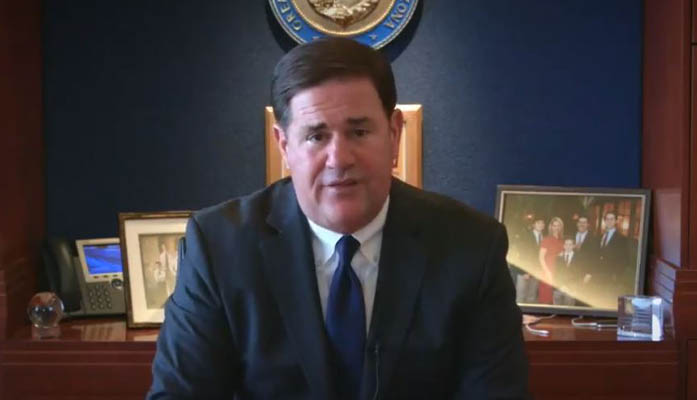
Gov. Doug Ducey announced Tuesday an initial $10 million investment for Arizona’s COVID-19 Educational Recovery Benefit program. The funding – on a first come, first serve basis – will provide choice for families facing financial and educational barriers due to unnecessary closures and school mandates which do not comply with state law.
“Our COVID-19 Educational Recovery Benefit will empower parents to exercise their choice when it comes to their child’s education and COVID-19 mitigation strategies,” Ducey said. “It will also give families in need the opportunity to access educational resources like tutoring, child care, transportation and other needs.”
According to the governor’s office, Ducey has been working for weeks to create an additional program to provide more education options for families.
Eligible families can have a total household income up to 350 percent of the Federal Poverty Level. In addition, applicants must demonstrate the student’s current school is isolating, quarantining, or subjecting children to physical in-school COVID-19 constraints such as mask mandates or preferential treatment of vaccinated students.
“We know that historically disadvantaged communities bear the brunt of excessive and overbearing measures, and we want to ensure these students are protected,” Ducey said.
The COVID-19 Educational Recovery Benefit program has the full support of Senate President Karen Fann and House Speaker Rusty Bowers.
“Educators, families and state leaders are working hard to get students back on track, and the Educational Recovery Benefit program will make sure kids have every opportunity to grow and thrive,” said Fann.
Bowers noted the desire to keep children “safe, healthy, and achieving” during the pandemic, adding that with the new program, “we can do it all at the same time.”
Grant applications can be submitted starting Friday. Additional information is available at https://arizonatogether.org/educationalrecoverybenefit/
by Terri Jo Neff | Jun 27, 2021 | News
By Terri Jo Neff |
When the State House voted Friday to pass HB2898, the K-12 Education budget bill, it marked the end of a grueling process that resulted in passage of a $12.8 billion budget package for Fiscal Year 2022.
A key provision of HB2898 is the establishment of new academic standards for K-12 students in the area of civics. There was also funding for a number of special programs for students and a variety of new rules for school board and school districts.
But much of the debate about the bill centered on whether more money should have been allocated.
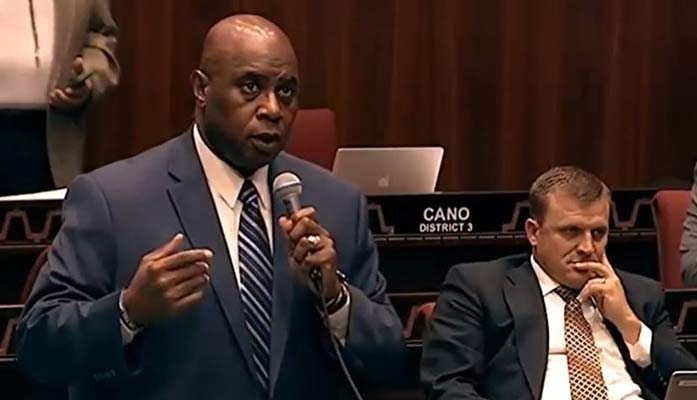
Rep. Aaron Lieberman (D-LD28) acknowledged HB2898 includes “a lot of money,” but he argued it was not enough. Lieberman noted 2,000 classrooms across the state do not have assigned, permanent teachers, something he said could be remedied by spending one-fourth of the state’s $2 billion surplus.
“It’s clear now more than ever we need every dollar,” Lieberman said in voting against the bill.
However, Rep. Bret Roberts (R-LD11) questioned why more focus is not on the decisions of school boards who spend the billions of dollars provided each year through federal funding and from the legislature.
“Why are we not asking the school boards why they’re not giving the money that the legislature sends to the school boards to the teachers?” he asked on the floor. “Why are we not holding the school boards responsible for the money that we send them to give to the teachers? When are the teachers going to hold the school boards responsible?”
Rep. Walt Blackman (R-LD6) expressed similar frustration, noting that many of the chamber’s 24 Democrats who were present Friday complained the funding in HB2898 was too low. So they simply voted against the bill.
Blackman acknowledged K-12 funding in the bill “may not be enough” but said those representatives who vote green -yes- are demonstrating they “support education by action.” Which is why he was disturbed to see so many red -no- votes.
Democrats may give myriad reasons for what is wrong in HB2898 or what could be done differently, he said, “but if we are really dedicated to teaching our children K-12, and that is a non-partisan issue, then why do we have red votes?”
“This can’t be an issue where we are upset and we take our marbles and we go home because we don’t have enough marbles to play,” Blackman said, adding that all of the votes should be green because “nothing is perfect.”
The House K-12 Education bill will now be transmitted to the Senate, which last week passed its own education bill. There is now one significant difference between the bills which will need to be reconciled.
That difference involves a major expansion of the state’s Empowerment Scholarship Accounts (ESAs) which is currently available to about 250,000 students. The Senate’s budget bill added two eligibility criteria which would make ESAs an option to 700,000 students, including children from Title 1 schools where at least 40 percent of the families are considered low-income.
However, three Republicans in the House voted against an amendment which would have included the ESA expansion in HB2898. The amendment died without those votes and the three Republicans also voted against a later attempt to insert the failed amendment into the main bill just prior to final voting.
Sen. Paul Boyer (R-LD20) is a teacher and a major supporter of ESA legislation. He took to Twitter after the House vote to express his disappointment with the ESA decision.
“Meanwhile, minority students are 6 to 12 months behind their white counterparts. This defeat of ESAs for Title I students makes sure those same students never leave the school that’s failing them,” Boyer tweeted.
by B. Hamilton | May 13, 2021 | Education, News
By B. Hamilton |
Two topics that arise year after year, teacher’s salaries and public-school budgets, are often misunderstood and misrepresented. In fact, many say the RedForEd movement was created and nurtured with those misunderstandings and misrepresentations.
The misunderstanding and misrepresentation has led to frustration for taxpayers and parents. Many of whom feel that no matter how much they pay in taxes, nothing seems to get better in kids’ classrooms.
A new study by the Goldwater Institute indicates those feelings and frustrations might be justified.
According to Goldwater, the “20×2020” plan, approved by Arizona lawmakers in 2018, was designed to provide enough funding to give Arizona teachers a 20% raise. However, Goldwater has discovered that schools are not allocating the funds the way lawmakers intended them to be.
In The Truth about Teacher Pay in Arizona: How Arizona School Districts Have Held Back Teacher Salaries, Blamed Lawmakers, and Continually Captured Public Sympathy, Matt Beienburg, Director of Education Policy at the Goldwater Institute found that “school districts used the majority of the new 20×2020 funds simply to replace, rather than add to, existing buckets of state money for teachers (and vice versa). The result: During the 2019-2020 school year alone, teachers received at least $170 million less from their school districts in salary increases than Arizona taxpayers provided for. And it’s part of a decades-long pattern in Arizona education.”

So what are schools doing with the extra funding that is being provided?
“District spending on administration, for instance, has risen by nearly $2,000 in inflation-adjusted terms per class of 20 students, even as teacher salaries were no higher through fiscal year 2020,” according to Beienburg.
Each year, teachers use their own money to buy supplies and decorations for their classrooms and to help offset the consistently growing list of “must buy” supplies sent to parents at the start of the school year. Yet, during the 1983-1984 school year almost 2,000 managers, supervisors, and directors were inexplicably added to Arizona school districts’ payrolls.
Many teachers have expressed frustration about not being a priority and tend to put pressure and blame on lawmakers as part of their demands for more money. It seems, though, that it is the school district administrators who need to feel the pressure and are to blame.
This last year has also placed additional stress on teachers and parents, with virtual and hybrid learning due to COVID-19.
Members of the state legislature requested that the COVID-19 stimulus revenue funds were given for school district use but the Arizona Department of Education (ADE) has declined to distribute much of the millions of dollars.
While it may be easy to blame political leaders and taxpayers for lack of support and failing to prioritize teachers, it seems to many observers that the attention should be on the ADE, school district administrators, and school boards who need to review and reconsider their budgets and priorities.