by Mike Bengert | Oct 20, 2026 | Opinion
By Mike Bengert |
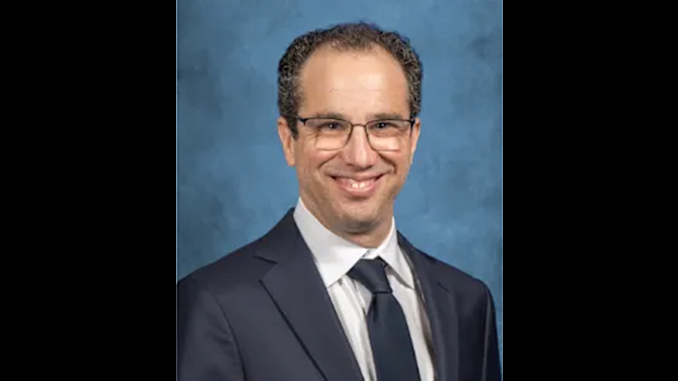
Anyone who has watched Scottsdale Unified School District (SUSD) Governing Board meetings over the past two years has likely noticed how often Member Pittinsky cites his business experience and expertise. He presents himself as a thoughtful decision-maker, especially when the board considers difficult choices such as closing schools.
Yet when the facts conflict or information is lacking to support what Menzel wants—or with what is right for SUSD students and parents—Pittinsky consistently abandons those concerns and votes in support of Menzel.
That is the pattern followed by the union-backed majority of education professionals on the Governing Board.
At the September 8th board meeting, Pittinsky asked how many students might leave SUSD if additional schools closed. Emphasizing his business background, he explained that businesses call this “churn.” Menzel and his staff agreed to provide the information.
At the October 6th meeting, when the board discussed and voted on the Phase II committee’s school closure recommendations, staff presented its “churn” analysis.
Notice that staff acknowledged receiving parental input, likely referring to surveys in which more than 160 families reportedly said they would leave the district if Laguna closed, but did not treat it as a “driving factor” in calculating churn. Instead, staff gave more weight to travel time, competition, and historical attrition.
Consider the contradiction: a district that says it values parents’ input discounted families who said they would leave and relied more heavily on other factors.
Menzel and his staff presented this as meaningful analysis for a critical decision about closing schools. That is difficult to accept.
The central problem is that closing four schools in two years, with more closures possible, is unprecedented in SUSD. Historical attrition is therefore an unreliable basis for estimating the effects.
Pittinsky’s response makes clear that he was dissatisfied with the analysis.
Pittinsky said:
“As I think it was noted, I’ve asked for this for a long time. I do need to say I am disappointed and frustrated that it came so late in the process. Not to be clear because I view it as like this point estimate. You know you could say 65,64,63. It’s all a function of the assumptions. But so, I think anyone who looks at these, my judgment at least, anyone who looks at this as a point estimate, I think that’s false precision.”
He continued:
“I think we can and need to do better in developing a much more multi-dimensional model for thinking about these kinds of enrollment dynamics.”
Although Pittinsky criticized the analysis and said the board needed a more sophisticated understanding of why families choose SUSD or a competitor, he nevertheless concluded that “it doesn’t block me from feeling like I can make a judgment tonight.”
In other words, Pittinsky acknowledged that the analysis was late, imprecise, and based on an incomplete understanding of declining enrollment, concerns many community members have raised for years, yet still felt prepared to vote on closing more schools.
Is that the way Pittinsky makes decisions in his business? Asking for data, not getting it, but proceeding anyway. The next time he says he needs data before making a decision, can we believe him?
The board and staff not only lack a clear understanding of declining enrollment, they have also declined to seriously examine alternatives to school closures, despite Member Carney’s repeated requests over the past two years.
Is the SUSD community comfortable with major decisions being made without adequate data and without considering all available alternatives?
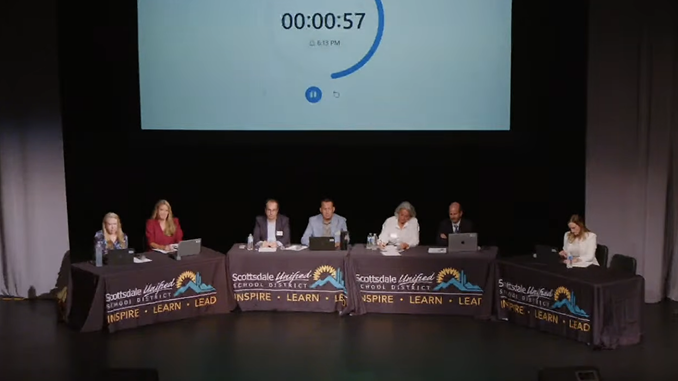
As the October 6thmeeting moved to the proposed alternatives and the vote, the board discussed how Mesa Public Schools was addressing declining enrollment. The exchange between Members Pittinsky and Carney became heated.
Carney noted that, a year earlier, she had asked the board to create a long-range planning committee modeled on Mesa’s. She questioned why SUSD was not considering Mesa’s other strategies instead of focusing solely on school closures.
Although alternatives like Mesa’s were not on the agenda, and district counsel repeatedly warned Pittinsky to stop so as to avoid another open meeting law violation, he continued the discussion and more than likely committed another violation. SUSD had been cited in the past for a violation by the Arizona Attorney General for discussing non-agendized topics.
Pittinsky insisted that he had researched the issue and argued that Mesa was starting from a very different position than SUSD. The issue is not whether districts statewide are losing enrollment, that is well documented, or what is the root cause of the decline, which SUSD has yet to determine. The key question is how each district responds.
Pittinsky then said, “Mesa actually did close schools. They closed or repurposed three junior high schools and they did it very early in a way that our board has been less willing to do.”
Notice how Pittinsky shifted from the definitive claim that Mesa “did close schools” to saying it “closed or repurposed” them. He also distanced himself from prior decisions by referring to “our board,” even though he has served on it for the past two years.
The point Pittinsky, Sharkey, Lewis, and Menzel appear to miss, perhaps deliberately, is that Mesa developed a plan for declining enrollment rather than closing schools first and asking what to do afterward.
Pittinsky’s research also appears to have overlooked publicly available information showing that Mesa’s schools and governing board are pursuing strategic ways to create “vibrant and thriving” schools rather than “disrupting and dismantling” the district, the way SUSD is doing.
Here are some excerpts:
“Mesa Public Schools will offer more educational choices to families by transitioning an elementary school into an accelerated learning campus and launching two new high schools for the 2026-27 academic year.”
“Because of dropping enrollment, the district has to think strategically and creatively, Superintendent Dr. Matt Strom said, “Or we’re probably going to be moving to school closure within the next three to five years.”
“We were fortunate to receive a lot of feedback from parents and community members that were excited and eager for this change to happen,” said Jacob Martinez, vice chairman of the district’s Planning and Boundary Design Advisory Committee.”
I believe that last year Member Carney asked for this same committee to be formed in SUSD. But “our board” rejected the idea.
Here are some excerpts from an article by Rachel Walden, Mesa Public Schools Governing Board Member, on how their board has been addressing the issue of declining enrollment.
“We adopted a small school model that allows a school to stay financially viable and continue to operate. These schools have shared resources, shared staff, focused specials, and aides may be leveraged differently than at a comprehensive campus. The model provides the opportunity to specialize and meet student interests.”
“Financial uncertainty also means we must explore ways to bring in revenue, which is underway at MPS. Mesa fully welcomes ESA families. The Eagleridge campus offers three full days of educational programming for K-12 students from across the Valley. Ninety-five percent of Eagleridge is funded through ESA dollars. The MPS board approved a fee schedule allowing families to use ESA dollars to participate in classes at other campuses, which increases revenue to the district.”
“Responsible budgeting requires continual evaluation. Positions not related to the classroom and not required by regulation or law can be eliminated in many cases. Courses with low student interest should be removed, which will change staffing needs.”
“If enrollment continues to decline, the Board may eventually have to consider school consolidation or closure. Those decisions should come only after other strategies have been exhausted and after careful consideration of student outcomes, finances, facilities, transportation and community impact.”
Notice how rather than just blaming ESA for declining enrollment, like Menzel does, Mesa schools turns it into a revenue stream for the district.
Although there are several more stories like these, here is just one more.
“Faced with ongoing student loss, Mesa Public Schools is looking to reconfigure six of its campuses for the 2026-27 year instead of closing sites.”
The bottom line is that SUSD’s Governing Board, dominated by Menzel’s supporters, has failed its students, parents, and broader community. SUSD cannot continue electing board members who place Menzel’s agenda above students’ interests.
It is time for a change.
Mike Bengert is a husband, father, grandfather, and Scottsdale resident advocating for quality education in SUSD for over 30 years.
by Matthew Holloway | Oct 6, 2026 | Education, News
By Matthew Holloway |
The Maricopa County Attorney’s Office (MCAO) found that Scottsdale Unified School District (SUSD) violated Arizona’s Open Meeting Law, according to a Sept. 22 letter that directly contradicts the district’s subsequent claim that no violation had been found.
“MCAO concluded that an Open Meeting Law violation has occurred,” Deputy County Attorney Caitlyn Mitchell wrote to complainant Michael Bengert in the letter.
The investigation concerned SUSD’s Phase II Design Advisory Team, whose work involved proposals for repurposing, consolidating, or closing district schools. Mitchell said investigators reviewed Governing Board meeting recordings, accompanying agendas, and supplemental information provided by Bengert.
SUSD General Counsel Renee Osipov subsequently disputed statements that MCAO had found a violation.
“Scottsdale Unified School District has received communication and a public comment indicating that the Maricopa County Attorney’s office found the District in violation of the Open Meeting Law (OML) with respect to the operation of the Phase II Design Team. This is inaccurate,” Osipov wrote in a correspondence with Bengert shared with AZ Free News.
“The County Attorney did not issue adverse findings, did not cite the District for an OML violation, and did not initiate any corrective action,” she added.
The district also published that position on its website Oct. 1.
MCAO’s Sept. 22 letter expressly states that the office informed SUSD of its conclusions.
“MCAO has informed SUSD of its findings and conclusions, recommended that SUSD revise its future use of superintendent appointed committees, and requested that the SUSD Governing Board acknowledge the results of this investigation publicly at the open meeting to discuss the Phase II Team’s recommendations,” Mitchell wrote.
The office said the team had completed its work, making it too late to require corrective action concerning future team meetings. The letter stated that the investigation was closed and did not announce a penalty.
An earlier letter to district counsel on Sept. 16 detailed the office’s reasoning.
“Although the creation of SUSD’s Phase II Design Advisory Team (‘Phase II Team’) does not—as a purely technical matter—fall under the statutory definition of an ‘advisory committee or subcommittee,’ the purpose and subsequent operation of the Phase II Team does,” prosecutors wrote.
The disagreement centers on the Governing Board’s involvement in the team’s creation and whether its work served the board or district administrators.
Osipov said the superintendent formed the team to conduct an analysis for the administration. She said it was not charged with making recommendations to the Governing Board regarding repurposing, consolidating, or closing schools.
“The team’s work was intended to inform the administration’s development of options for Governing Board consideration,” she wrote.
MCAO’s Sept. 16 letter said the board discussed creating an advisory body during 2025 and considered the issue Jan. 6, 2026. Although the board declined to amend its policy to establish a standing advisory board, prosecutors said the superintendent subsequently created the Phase II team and tasked it with making recommendations to the board.
“The timing of these events suggests the Governing Board’s implicit direction to the superintendent to create an advisory board for the purpose of advising the Governing Board,” the letter states.
Prosecutors described the team as the board’s “brainchild” and said its recommendations concerned matters the board would vote on.
Osipov challenged MCAO’s interpretation, saying portions of the Sept. 16 letter conflicted with opinions issued by the Arizona Attorney General’s Office. She also said SUSD posted materials after each meeting to support transparency.
The amended Attorney General Opinion, issued June 23, 2025, explains that a superintendent-created committee does not automatically become subject to Open Meeting Law because its work leads to recommendations reaching the board.
The opinion says the law typically does not apply when the superintendent develops a proposal without board direction or other close involvement. It also cautions that a governing board cannot evade public meeting requirements by informally establishing a committee or directing a superintendent to establish one. A committee’s subsequent work can become subject to the law when the board tasks it with developing policy recommendations.
MCAO’s Sept. 16 letter relied on its assessment of the board’s involvement and the team’s function. It recommended that SUSD avoid an overly narrow interpretation of the law when determining whether future advisory bodies must hold public meetings.
Prosecutors also cited A.R.S. § 38-431.09, which directs those interpreting Arizona’s Open Meeting Law to favor open and public meetings.
The complaint was initially submitted to Attorney General Kris Mayes’ office, which referred it to MCAO July 17 after citing a conflict of interest. The complaint concerned public access to the advisory team’s meetings.
Bengert has also raised broader concerns about district leadership and public participation, criticizing SUSD’s academic outcomes, enrollment losses, and financial management while questioning whether its governing board provided sufficient scrutiny of Superintendent Scott Menzel’s administration. He argued that parents and residents needed opportunities to hear opposing views on district policies and decisions.
Bengert has asked MCAO to respond publicly to SUSD’s characterization of the investigation. In correspondence shared with AZ Free News, he disputed Osipov’s statements and asked the county attorney’s office to clarify its findings directly to the district.
An MCAO spokesperson said the office was reviewing additional questions and checking whether other correspondence existed.
AZ Free News requested additional comment from Scottsdale Unified School District and General Counsel Renee Osipov regarding the county attorney’s findings and the district’s characterization of the investigation. Neither had responded to those inquiries by the time of publication.
Matthew Holloway is a senior reporter for AZ Free News. Follow him on X for his latest stories, or email tips to Matthew@azfreenews.com.
by Mike Bengert | Sep 28, 2026 | Opinion
By Mike Bengert |
After investigating an Open Meeting Law (OML) complaint against the Scottsdale Unified School District (SUSD), the Maricopa County Attorney’s Office (MCAO) determined that Dr. Menzel and the SUSD Governing Board once again violated the rights of SUSD parents and the public. They were denied the opportunity to attend Phase II Design Team meetings and hear deliberations as the team developed recommendations on school closures and boundary changes for the Governing Board.
SUSD parents should be outraged that the Governing Board and Dr. Menzel denied them rights guaranteed by law while considering such impactful decision as closing schools.
And by “Governing Board,” I mean Members Pittinsky, Sharkey, and Lewis. All three are union-backed Menzel supporters who consistently vote for his proposals, excuse the failures and consequences of his policies, and reward him with contract extensions and pay raises.
A.R.S. § 38-431.01(A), commonly known as the Open Meeting Law, states:
“A. All meetings of any public body shall be public meetings and all persons so desiring shall be allowed to attend and listen to the deliberations and proceedings.”
In its September 16 letter to the District, the MCAO stated:
“SUSD has already been warned by the Arizona Attorney General’s Office that the Open Meeting Law does not permit a governing board to evade the public meeting requirements by ‘informally’ forming or establishing, or by directing a superintendent to establish, a committee to perform work that would otherwise need to be conducted in public.”
Despite the Attorney General’s warning two years earlier, Dr. Menzel and the Governing Board disregarded it and again violated the public’s rights.
Any legal violation by SUSD is serious, but this one is especially egregious because it concerns perhaps the most consequential decision of Menzel’s tenure: school closures.
At the September 22 public hearing, parents described the profound effects the closures would have on their children and families.
Yet SUSD denied them the legal right to attend the meetings, hear the deliberations, and participate in the process. Had parents been allowed to attend, they could have raised questions and concerns for the board to address as the work proceeded.
The MCAO also stated in its letter:
“It is also advisable that the Governing Board acknowledge this investigation at the next public meeting and take steps to assure the constituents of SUSD that the intent of forming the Phase II Team was not to bar the public from the policy creating process.”
At what was the next meeting, held September 22, I was the only person to mention the OML violation. When I used that phrase, Dr. Lewis immediately interrupted and asked SUSD’s general counsel to stop the discussion, which she did. You can hear the exchange right here.
I understand why the Governing Board might hesitate to admit what it had done or try to assure parents that it never intended to exclude them and deny their rights.
At a December 2025 board meeting, the Board openly discussed how complying with the law, (i.e. posting an agenda in advance, keeping minutes, allowing public attendance, and enabling people to hear deliberations) would slow down the process, even if it was an acceptable alternative. Listen to the discussion here.
SUSD deserves a Governing Board that respects parents’ rights and will not sacrifice them for “flexibility and expediency” merely to allow the superintendent to be more “nimble.”
SUSD deserves a Governing Board that does not view a committee meeting behind closed doors as “much more interactive” than an open meeting where anyone who wishes to attend and listen to the deliberations can do so.
SUSD deserves a Governing Board that sees legal compliance not as a problem to solve, but as an opportunity to demonstrate they truly believe in the values of integrity, honesty, transparency, accountability, openness, and authenticity that SUSD espouses.
This is the kind of Governing Board SUSD parents should demand.
Unless the Governing Board fully understands and addresses the causes of SUSD’s declining enrollment and evaluates every viable option, it is unlikely to solve the problem. Closing schools under an ill-conceived plan, railroaded through behind closed doors, that fails to assess the full financial impact of the plan is irresponsible and will merely carry the district’s financial problems into the next budget cycle.
Parents, even if your child does not attend a school affected by this pending decision, do not assume you have nothing to fear. Menzel and his supporters on current and previous Governing Boards have repeatedly shown little regard for your rights. Without meaningful consequences, they will continue to ignore adverse legal findings and warnings and violate parents’ rights with impunity.
This Governing Board has failed the SUSD parents, and they must be held accountable.
Parents, will your school be next and your rights denied?
Attend the October 6 board meeting, voice your outrage, and urge the Governing Board to halt the school-closure process. Demand that it start over with a comprehensive plan that considers every option to deal with the declining enrollment.
Mike Bengert is a husband, father, grandfather, and Scottsdale resident advocating for quality education in SUSD for over 30 years.
by Staff Reporter | Sep 25, 2026 | Education, News
By Staff Reporter |
Scottsdale Unified School District (SUSD) violated the law with its school closure and consolidation committee, but the county attorney says it’s too late to stop them.
The complaint was filed originally with Attorney General Kris Mayes back in April, claiming that SUSD’s Phase II Design Advisory Team, an advisory committee responsible for coming up with school closure and consolidation options, violated Open Meeting Law because it prohibited the public from attending meetings.
Mayes waited nearly three months to refer the complaint to the Maricopa County Attorney’s Office (MCAO); she cited a conflict of interest as the basis for not taking on the investigation herself.
MCAO told AZ Free News that Mayes didn’t refer the complaint to their office until July 17.
By then, SUSD’s Phase II Design Advisory Team had held all five of its Phase A meetings and three out of five of its Phase B meetings. The final meeting for this illicit advisory committee occurred on August 17.
Since all of the meetings have already occurred, MCAO Deputy County Attorney Caitlyn Mitchell said in a disposition letter on Tuesday that nothing could be done beyond recommending to SUSD that they not recommit a similar Open Meeting Law violation in the future and acknowledge their wrongdoing at the special meeting scheduled to occur that day.
“[I]t is too late to require SUSD to take corrective action concerning future Phase II Team meetings,” stated Mitchell. “MCAO has informed SUSD of its findings and conclusions, recommended that SUSD revise its future use of superintendent appointed committees, and requested that the SUSD Governing Board acknowledge the results of this investigation publicly at the open meeting to discuss the Phase II Team’s recommendations.”
Arizona law requires any legal action taken in a meeting that violates Open Meeting Law to be rendered null and void, unless ratification occurs under certain parameters during a public meeting within 30 days of discovery of the violation.
Non-public advisory committees have been a recurring problem for SUSD. Mayes has previously found SUSD in violation of Open Meeting Law for its use of non-public advisory committees.
During the SUSD special meeting on Tuesday, the governing board didn’t advise the public of the MCAO letter or the fact that the advisory committee responsible for creating the school closure and consolidation options had been conducted in violation of the law. It also stopped the community from making any mention of the letter.
Mike Bengert, the community member who filed the complaint, attempted to speak about the disposition letter during public comment, but Governing Board President Donna Lewis interrupted him.
SUSD counsel Renee Osipov told Bengert that he could only talk about the proposed options for school closures and consolidations.
“We’re not talking about Open Meeting Law. That’s not what we’re agendized to do,” said Osipov.
Lewis had advised at the beginning of the special meeting that public comments not addressing school closure and consolidation options were only permitted for the next meeting scheduled for October 6 — the day that SUSD is anticipated to vote on school closures.
During Tuesday’s meeting, public comment on the school closure and consolidation options lasted more than three hours.
The Phase II Design Advisory Team operated as part of three phases to close, consolidate, and repurpose schools within the district. Phase III has another non-public advisory committee: the Coronado Learning Community committee.
Bengert told AZ Free News that he filed a new Open Meeting Law complaint over Tuesday’s special meeting.
AZ Free News is your #1 source for Arizona news and politics. You can send us news tips using this link.
by Staff Reporter | Sep 16, 2026 | Education, News
By Staff Reporter |
Scottsdale Unified School District (SUSD) is contemplating more school closures as enrollment continues to decline.
The SUSD governing board discussed their options going forward during Tuesday’s meeting. Superintendent Scott Menzel said “some very, very difficult decisions need to be made.”
Since 2010, SUSD enrollment has declined by 6,000 students and the district has only closed one school. SUSD also reported rising costs, competition against school choice programs for students, and underutilized facilities as key pressures on district conditions.
“We have far more physical space than we have students to fill that space,” said Menzel.
As part of Phase I of restructuring for “full and thriving schools,” SUSD decided to close Pima Elementary School and Echo Canyon School. The district is now in Phase II, where it will decide the fate of the Desert Mountain Learning Community and Copper Ridge School.
Capacity is below 50% at Laguna Elementary (43%), Desert Canyon Elementary (37%), and Cheyenne Traditional (11%).
SUSD is facing an open meetings violation complaint pertaining to these closed-door Phase II proceedings to determine closures and consolidations.
SUSD’s Phase II Design Advisory Team doesn’t permit the public to attend its meetings under its classification as a Superintendent Advisory Committee, but the complaint against the district contends that the team was formed at the direction of the governing board.
The Maricopa County Attorney’s Office (MCAO) is now handling the complaint after the Arizona Attorney General’s Office cited a potential conflict of interest.
The MCAO told AZ Free News that they just recently received the complaint from the attorney general on July 17, though it was filed back in April. Their office also told us that it couldn’t provide any additional details at this time since it is an open investigation.
The Phase II Design Advisory Team presented three options for further restructuring, in the following order of greatest to least preferences:
First-most preference: close Copper Ridge K-8 and Laguna Prep, redistribute boundaries, and a possible Desert Canyon K-8 merger. This option would impact 773 to 872 students and provide more than $2.7 million in savings.
Second-most preference: move Cheyenne Traditional K-8 to Copper Ridge, move Laguna Prep and Redfield to Cheyenne campus, and a potential Desert Canyon K-8 merger. This option would impact 2,126 to 2,232 students and provide nearly $2.6 million in savings.
Third-most preference: merge Desert Canyon schools into K-8 at Copper Ridge, close Laguna Prep, repurpose Desert Canyon campuses and Laguna Prep. This option would impact 2,132 to 2,153 students and provide nearly $2.7 million in savings.
Impact was measured beyond students moving into schools to include certain students at receiving schools.
All three options were presented with multiple potential models for restructuring boundaries.
Member Amy Carney attempted to explain that she believed closing schools was the “easy option,” to which she objected, but was interrupted multiple times by Governing Board Vice President Mike Sharkey and counsel with cautions that she shouldn’t express opinions about what the board should and shouldn’t do prior to community debate on the options.
Member Carine Werner urged agendizing a board discussion about the options before them prior to the board meeting in October in which they are scheduled to make a vote.
Member Matthew Pittinsky expressed caution against exploring other options beyond what the Phase II Design Advisory Team had presented to them; he characterized Carney’s position as “a very slippery slope.”
The district said it has not yet determined how it would repurpose any closed schools.
SUSD scheduled a special session to receive additional community input on September 22.
AZ Free News is your #1 source for Arizona news and politics. You can send us news tips using this link.