The field of Republican presidential hopefuls grows larger by the week. But do any of them stand a chance of beating Joe Biden next year?
The president’s approval ratings remain anemic. He can take comfort, though, by thinking back to what happened last year.
Every indication pointed to a Republican landslide in the 2022 midterms. Yet the polls and pundits were wrong. The GOP barely scraped together a House majority and actually lost a Senate seat.
Unless Republicans figure out what went wrong in November, they risk a similar humiliation in 2024 when their nominee takes on Biden. In this political mystery, there are all too many suspects. Many seem obvious: The GOP nominated bad candidates. Voters wanted to punish Donald Trump. Women alarmed by the overturning of Roe v. Wade flocked to the Democrats. Or maybe the polls were just wrong.
In a meticulous study for RealClearPolitics, the political scientist James E. Campbell considers and rejects each of those explanations.
If the nominees were so bad, why did they poll so well?
If voters wanted to rebuke Trump, why didn’t that hurt Republican numbers long before Election Day?
Most attempts to account for the “red wave’s” failure to swell fall short for the same reason. If voters soured on the GOP for whatever reason, polls should have picked up on their feelings. The trend should have been visible in advance.
Yet the polls weren’t exactly wrong, according to Campbell. They were inadequate.
A poll isn’t a prediction; it’s a survey of a limited number of respondents. Reputable polls try to survey the most likely voters. Last year, that led them astray.
Campbell proposes a “Breakwater Theory” of the 2022 election. In eight key states, which made the difference between the predicted red wave and the eventual red puddle, Democrats beat the polls by mobilizing unlikely voters.
Those eight states — Michigan, Wisconsin, Pennsylvania, Arizona, Colorado, Nevada, Washington and New Hampshire — all had “Democrat-friendly easy and early mail-in voting rules,” Campbell notes. And Democrats maximized their opportunity by concentrating midterm spending in those states.
Seven of those eight states had Senate races, and as Campbell reports, “The Democratic Party and its supporting outside groups and individuals spent in excess of $700 million on these seven races, over $200 million more than Republicans spent.”
There is more in Campbell’s analysis. But the bottom line is that Democrats picked their battles more wisely than Republicans did.
Extra campaign spending and accommodating election rules brought out marginal Democratic votes that pollsters mostly missed. Those eight states were the breakwater that stemmed the red tide.
Two Republican countermeasures for 2024 require no imagination. The party has to target its spending better.
And as much as the GOP would like to see stricter election laws, it must play the game by the rules now in place. That means pouring resources into getting out the early vote and mail-in vote for Republican candidates, rather than conceding those categories to the Democrats.
But another smart tactic goes against one of the most cherished cliches of campaign consulting. With good reason, campaign professionals tell their clients to “hunt where the ducks are.” Look for voters where you already know you have support. Don’t waste limited resources hunting in unlikely places.
In 2016, however, Donald Trump defied the experts’ advice. He ran an old-fashioned in-person campaign, showing up in places that hadn’t seen a candidate from either party in years, if not decades. His roving rallies were in contrast to the familiar circuit Hillary Clinton followed. And they won him states like Wisconsin and Pennsylvania that hadn’t gone Republican since the 1980s.
COVID-19 worked to Joe Biden’s advantage in 2020. His presence on the campaign trail wasn’t much missed at a time when most Americans were avoiding public gatherings. And while Trump held some rallies, especially toward the end of the campaign, he couldn’t do what he had done in 2016.
The Republican nominee will have to do it in 2024.
Just as the GOP has to compete with Democratic mail-in and early-vote efforts, Biden will be competing in a sport he would rather not play if the Republican forces him to take to the trail in state after state.
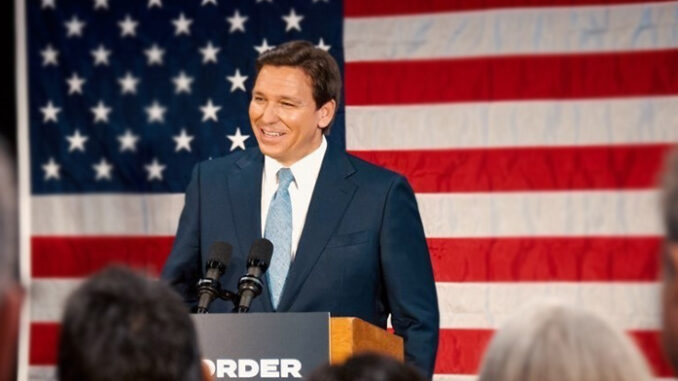
Donald Trump enjoys that game. Ron DeSantis is young enough that he should play it well. The contrast between his youth and Biden’s senescence will only be more striking when voters witness it firsthand.
Yet the most important thing is that Republicans be as smart and enterprising about mobilizing less likely voters as Democrats were last year.
Even as they aim to beat him in next year’s primaries, Trump’s rivals must learn from his example. They have to find unlikely voters in unlikely places.
The road to the White House runs through factory towns and flyover country.
Daniel McCarthy is a contributor to The Daily Caller News Foundation and the editor of Modern Age: A Conservative Review. To read more by Daniel McCarthy, visit www.creators.com.
The 2024 Presidential Primary is already testing the unity of the Arizona Republican Party as former and current officials take sides months ahead of the state’s preference election.
Late last week, a group of Arizona Republicans wrote a letter to Florida Governor Ron DeSantis, asking him “to seek the presidential nomination of our Grand Old Party.” The letter came as DeSantis was embarking on a high-profile to the important primary state of Iowa and as rumors have indicated he may be close to jumping into the presidential race on the Republican side.
The letter, entitled “Arizona Republicans Ready to Win in 2024,” was headlined by Speaker of the House Ben Toma, and former East Valley Congressman Matt Salmon. House Majority Whip Teresa Martinez, Senator Ken Bennett, Senator Frank Carroll, Senator Steve Kaiser, Senator J.D. Mesnard, Senator TJ Shope, Representative David Cook, Representative Lupe Diaz, Representative Kevin Payne, Representative Beverly Pingerelli, Representative Justin Wilmeth, City Councilwoman Vicki Gillis; and former officials Frank Riggs, Shawnna Bolick, Regina Cobb, Jeff Dial, Sandra Dowling, Nora Ellen, Eddie Farnsworth, Robert Garcia, Rick Gray, Vince Leach, Jeff Weninger, and Steve Yarbrough.
The plea for DeSantis to join the presidential field was driven by the “damage being done to (Arizona) by the reckless policies of the Biden Administration.” The officials highlighted “the strains that open borders are placing on (Arizona’s) health, education, and public welfare systems;” “reckless overspending” and “rampant inflation;” “liberal attacks on our first responders and public safety programs;” America’s deteriorating “standing in the world;” and “political correctness and its many cousins, like censorship, Critical Race Theory, SEL, ESG scores.”
After listing the primary areas where President Joe Biden’s policies are bringing harm to their state, the Arizona signatories wrote, “These are just a few of the many reasons why Republicans must retake the White House in 2024 and why we must be led in that effort by someone who knows right from wrong, is not afraid to speak truth to power, will not be bullied by the left or their accomplices in the media, who has a track record of successful governance, and who can assemble the required national coalition of voters needed to win the Presidency and bring along strong majorities in the House and Senate.”
They added, “We believe you are the right candidate at the right time, with the required combination of personal attributes we will require to unite our passionate party.”
If DeSantis joins the growing list of Republican contenders for the White House, these Republican endorsements of his candidacy will be vital in a state that has featured some of the top national supporters of former President Donald J. Trump from 2015 to present. When Arizona Republicans voted in the March 2016 Presidential Preference Election, the top two candidates at that stage in the national endeavor for the most delegates were Trump and U.S. Senator Ted Cruz. Trump beat out Cruz by almost 7,000 votes. The eventual nominee for the Democrats, Hillary Clinton, handily defeated U.S. Senator Bernie Sanders in the Grand Canyon State.
Daniel Stefanski is a reporter for AZ Free News. You can send him news tips using this link.
Republicans are leading a historic effort to raise teachers’ salaries, while most Democrats are resisting the current approach in the Arizona State Legislature.
On Monday, the Arizona House moved HB 2800, sponsored by freshman Representative Matt Gress, closer to a final vote in the chamber, amending it in the Committee of the Whole session. This bill “mandates each school district and charter school increase the base salary of all eligible teachers as prescribed.” It also “creates the Pay Teachers First Fund and appropriates a total of $1,100,000,000 in FYs 2024 and 2025 to the Fund for required teacher salary increases.”
According to figures provided by House Republicans, HB 2800 would give Arizona teachers the fourth highest ($50,554) starting salaries in the nation, compared to a current ranking of 27th ($40,554).
It’s simple: Provide every Arizona public school classroom teacher a permanent $10,000 raise – with 100% of the new state dollars going directly to teachers, rather than bureaucracy.
Arizona Superintendent of Public Instruction Tom Horne previously announced his strong support of this bill and appeared at a press conference at the state capitol last week with Gress and other lawmakers to tout the legislation’s movement through the House.
— Arizona Department of Education (@azedschools) March 25, 2023
When asked by AZ Free News about why he supported HB 2800, Superintendent Horne replied: “I support HB 2800 because no school is better than the quality of the teachers in the classroom. Our surrounding states pay more so we lose good teachers to them, and we can no longer afford to do that.”
Representative Gress thanked Superintendent Horne for his support of the bill, writing, “Thanks @RealTomHorne for your advocacy on #HB2800. Raising teacher pay is key to recruiting and retaining excellent talent. We will not be deterred by the unions who are actively pressuring House Democrats to kill a $10,000 pay raise for teachers.”
Thanks @RealTomHorne for your advocacy on #HB2800. Raising teacher pay is key to recruiting and retaining excellent talent.
We will not be deterred by the unions who are actively pressuring House Democrats to kill a $10,000 pay raise for teachers.
Gress submitted a floor amendment to his bill Monday, which passed. The changes, in part, “removes the stipulation that an eligible school may receive the prescribed per teacher base salary increases from the Pay Teachers First Fund only for the lesser of the number of eligible teachers that a) are employed by the school; or b) would be employed by the school if the school had 15 students per eligible teacher.” It also tweaked elements of the proposed school online transparency portal, school districts facilities master plans, and appropriations.
Though both Republicans and Democrats campaign on adequately funding public education in Arizona, Representative Gress’s proposal has met with fierce resistance from many Democrats and school & teacher organizations around the state. Five Democrats voted against the bill in the House Appropriations Committee, and representatives from the AZ School Administrators Association, AZ Education Association, Save Our Schools Arizona, and AZ School Boards Association have registered their opposition.
In the lead-up to Monday’s deliberations, the House Democrat Caucus ardently campaigned against HB 2800, calling it a “wolf in sheep’s clothing” and “deeply flawed.”
On the floor today, HB2800, Rep. Matt Gress's deeply flawed proposal to raise teacher pay. Our "teacher caucus" will try to make the bill workable with an amendment. Without it, it's a headline without a story, all hat no cattle, a soundbite, not a solution. https://t.co/0FwfRzmgiP
Should the bill pass the House, it will soon head to the Arizona Senate for consideration and a potential vote in that chamber in the near future. If it clears the Senate, Democrat Governor Katie Hobbs will be forced to decide between giving teachers a $10,000 raise or denying them this much-needed increase.
Daniel Stefanski is a reporter for AZ Free News. You can send him news tips using this link.
After vetoing a collection of budget bills last week, Democrat Katie Hobbs was ready to jettison another Republican-led policy as a divided state government remains far apart on solutions to help Arizonans weather the storms of a harsh economy.
Earlier this month, Republicans in the Arizona House and Senate passed legislation that would prohibit “municipalities from levying municipal tax on the business of renting or leasing real property for residential purposes,” sending SB 1184 to Governor Hobbs’ office on the Ninth Floor of the Executive Tower for consideration.
Governor Hobbs vetoed SB 1184, but her veto explanation struck a different tone than the one delivered to legislators after her rejection of their budget. The governor gave the following explanation for her veto: “I appreciate the legislature’s interest in addressing rising housing costs, particularly for renters. Lowering costs for Arizona families is a priority of my administration. Unfortunately, this bill suffers from two important defects at this time. First, this bill lacks any enforceable mechanism to ensure relief will be provided to renters. As noted by the legislature’s own attorney, provisions in the bill that purport to require that tax savings be passed on to renters face challenges under both the state and federal constitutions. If we are going to promise relief to renters, it’s important that we are able to ensure they actually receive it.
Hobbs then addressed the opposition to the legislative proposal from multiple cities and towns, including quotes from John Lewis (the President and CEO of PHX East Valley Partnership Board) and Yuma Mayor Douglas Nicholls (the League of Cities and Towns President), who had both urged the governor to veto SB 1184.
Republicans in the Legislature were not happy with Hobbs’ action to stop their bill from becoming law. Senate bill sponsor, Steve Kaiser, responded to the governor’s veto, saying, “Rent is the costliest expense for hundreds of Arizonans, but Governor Hobbs is clearly not among their ranks. If she was, she would know that in 70 cities across our state, renters see and pay for a rental tax line item on each monthly bill. Senate Republicans offered a substantive plan to fight spiking inflation that Hobbs vetoed. Governor Hobbs inflation plan? A limited tax exemption for diapers and feminine hygiene products. By her own logic used to veto SB 1184, her proposal would be a tax break for grocery stores, not consumers. Grocery stores, just like landlords, collect and remit tax paid for by consumers. Unlike Hobbs, our citizens don’t have the luxury of falling back on the semantics of tax collection, they feel the hurt of onerous taxation in their wallets.”
House Majority Leader Leo Biasiucci tweeted, “Removing the Home/Apartment rental tax would save Arizona renters $100-$200 per year. Yet, Governor Hobbs vetoed the rental tax repeal bill today. This idea that she’s a Governor for the people is now officially a lie! Watch, she’ll veto the grocery food tax repeal bill next!”
Daniel Stefanski is a reporter for AZ Free News. You can send him news tips using this link.
Republicans led a bipartisan effort in the Arizona Legislature to raise the aggregate expenditure limit (AEL) for school districts in Fiscal Year 2023, easily avoiding a March 1 deadline to authorize the excess funds.
The action in the legislature took place this week, with the House passing its authorization on Tuesday and the Senate on Wednesday. Representative David Cook sponsored the legislation in the House and Senate Education Committee Chairman Ken Bennett led the charge in the Senate. Both the House and Senate cleared the legislation by the required two-thirds majority vote.
According to the release sent out by Arizona Senate Republicans, the legislation “authorizes school districts to spend the approximately $1.4 billion that exceeds the AEL due to last year’s historic investment made in public education. The AEL is a constitutional amendment passed by Arizona voters in 1980 as a way to limit rapid increases in government spending that are out of proportion to population growth and inflation.” The Arizona Senate’s fact sheet stated that “there is no anticipated fiscal impact to the state General Fund associated with this legislation.”
Many Arizona Republicans cheered this bipartisan achievement this week. Senate Education Committee Chairman Ken Bennett said, “Senate Republicans have an uninterrupted history of always allowing our K-12 public schools to spend the money appropriated to them by the Legislature, and this year is no different.”
Senate President Pro Tempore T.J. Shope wrote, “A big reason school districts hit the AEL cap is because Republicans have infused so much money into K-12 education.” Senate Majority Leader Sonny Borrelli stated, “We’ve also increased per pupil spending by more than 40% since 2015.”
House Sponsor David Cook was also appreciative after the Tuesday action by his chamber, tweeting, “The Arizona House of Representatives today approved my legislation to raise the AEL this year, so our schools can fully access the funds that the Legislature already appropriated for them.”
Republican Representative Matt Gress tweeted, “I’m proud to vote with my colleagues on a bipartisan basis to keep our schools open. This vote allows for the largest investment in K-12 education history.”
Arizona Democrats were very happy about the AEL’s authorization this week. Senate Democrats tweeted a picture of a group of members smiling in the Senate chamber because “we passed the AEL!” Senate Education Committee Ranking Member Christine Marsh said, “This is a strong show of bipartisanship and one I hope can continue as we identify a more permanent solution for our public schools.”
The path to arrive at passage of the AEL wasn’t without its challenges. Last year, some Democrats claimed that then-Governor Doug Ducey had promised to call a special session of the Arizona Legislature to authorize the AEL once the budget was signed into law. Governor Ducey’s office denied that this stipulation had been part of the bipartisan negotiations. There were also weeks of speculation that perhaps a special session would be called at the end of Ducey’s term, but nothing materialized.
Members of the Arizona Freedom Caucus also made their voices known about their preferences for systematic reforms being instituted “to benefit students, families, and teachers.” According to a press release from Senator Jake Hoffman, and shared by the @AZFreedomCaucus Twitter account, the reforms include “classroom 1st funding,” “back to the basics instruction,” “empowering parents through academic transparency,” “parent trust & empowerment,” “transparency in district finances,” and “protecting children from political ideologies.”
The AZ Freedom Caucus opposes overriding the voter-approved AEL unless systemic reforms are made to benefit students families & teachers.
Critically needed reforms:
▪️Classroom 1st Funding ▪️Back to the Basics Instruction ▪️Empowering Parents Through Academic Transparency
Senate President Warren Petersen seemed to echo some of these concerns in his statement for the State Senate Republican Caucus release touting the legislative victory: “In the coming weeks, we will be working with the Joint Legislative Audit Committee Chairman to investigate how these (education spending) dollars are being spent. With extra funding comes a greater responsibility from our K-12 public school districts to provide a better education for all students.” Senate Majority Whip Sine Kerr also added a statement of caution and future investigation, saying, “We have some of the best schools in the country found in Arizona, but at the same time, we have some of the worst underperforming schools, and we need to figure out why.”
Daniel Stefanski is a reporter for AZ Free News. You can send him news tips using this link.